


Week Ending Friday, October 16, 2026
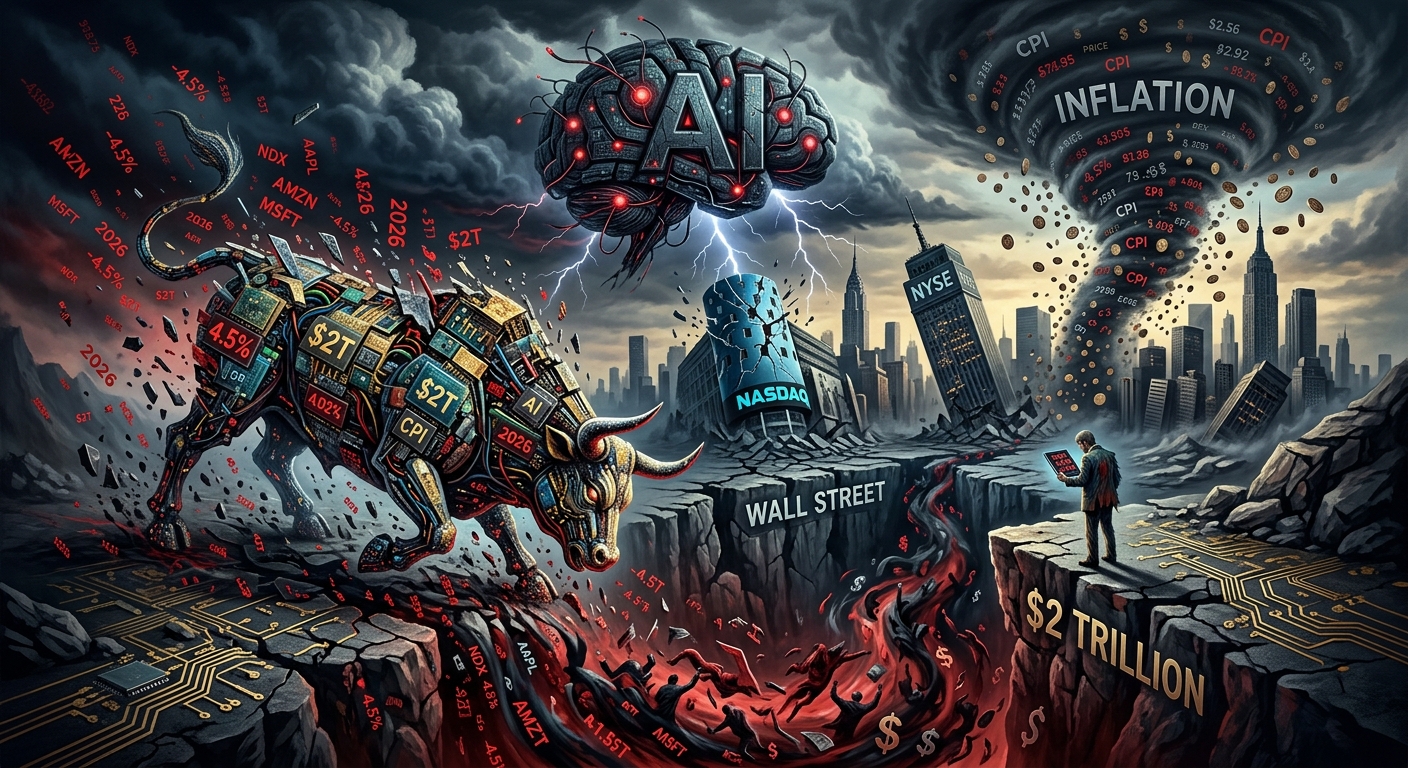
Wall Street finished the week with a pronounced split: the Dow Jones Industrial Average advanced, while technology stocks and smaller companies retreated. The Nasdaq Composite lost 4.5%, the S&P 500 declined 1.9%, and the Russell 2000 fell 3.0%. The Dow gained 0.7%, illustrating a rotation away from some of the market’s most aggressive growth bets rather than a uniform retreat from stocks. The S&P 500 and Nasdaq recorded their worst weekly performances since June. The defining word was rotation. Investors reassessed the cost of financing the artificial intelligence buildout, absorbed another round of unwelcome inflation readings and sought opportunities in healthcare and consumer-oriented businesses. Meanwhile, Washington reported a $1.992 trillion fiscal-year deficit, adding another substantial number to the debate over government borrowing and interest rates. There was still room for corporate spectacle. Tesla (TSLA) unveiled a thruster-equipped Roadster, NVIDIA (NVDA) defended a closely watched AI infrastructure partner, and Eli Lilly (LLY) moved closer to European approval for an oral obesity and diabetes treatment. Wall Street had plenty to discuss, even when it had less appetite to pay premium prices for it.
Stock Market Performance: Friday’s Close and the Full Week
U.S. stocks closed lower Friday, with the heaviest losses concentrated in the Nasdaq and small-cap shares. The closing figures below match the supplied market screenshots and the final closing reports from CNBC and The Associated Press. Weekly percentage changes are rounded as reported by AP..
| Index | Friday close | Friday point change | Friday change | Weekly change |
|---|---|---|---|---|
| S&P 500 | 7,659.44 | −84.62 | −1.09% | −1.9% |
| Dow Jones Industrial Average | 52,002.41 | −175.28 | −0.34% | +0.7% |
| Nasdaq Composite | 26,140.03 | −572.99 | −2.14% | −4.5% |
| Russell 2000 | 2,721.37 | −45.90 | −1.66% | −3.0% |
Despite the difficult week, all four benchmarks remained positive for 2026. Through Friday, the S&P 500 was up 11.9%, the Nasdaq had gained 12.5%, the Dow was ahead 8.2%, and the Russell 2000 had risen 9.6%. That context matters: this was a meaningful setback within a still-positive year, not the erasure of the year’s gains.
Why Stocks Fell: The AI Trade Meets the Financing Question
The AI investment story faced a more demanding examination this week. Investors looked beyond demand for computing power and focused on how infrastructure companies will finance their expansion, service their debt and eventually generate sufficient cash returns. CoreWeave (CRWV) became a focal point. Concerns about its debt-heavy balance sheet unsettled investors, while NVIDIA (NVDA) CEO Jensen Huang’s expression of confidence helped support a Thursday rebound. That reassurance did not remove the broader question hanging over the sector: strong demand for AI computing and attractive financing economics are related, but they are not interchangeable. The pressure extended to semiconductor shares. Micron Technology (MU) fell approximately 5.6% Friday, while Intel (INTC) lost about 5.8%, according to AP’s closing report. Those declines reinforced the week’s message that investors were becoming more selective about exposure to the AI spending cycle. The Dow’s weekly gain offered a useful counterpoint. Investors were not simply abandoning equities; they were reconsidering which earnings streams deserved the greatest confidence in an environment of elevated borrowing costs. Thursday’s gains in healthcare and consumer shares illustrated that shift.
Macroeconomic Report: Inflation Reasserts Itself
Consumer Prices Accelerated in September
The September Consumer Price Index, released Wednesday, rose 0.6% from August on a seasonally adjusted basis. Annual inflation accelerated to 3.7%, up from 3.4% in August and above economists’ expectation of 3.6%. The market significance went beyond a single disappointing headline. Faster inflation complicates the case for easier monetary policy and increases the pressure on companies to demonstrate that earnings growth can withstand elevated financing and operating costs. For richly valued growth stocks, that is an uncomfortable combination. Investors must weigh ambitious future earnings against a less accommodating interest-rate backdrop, precisely the tension that surfaced across AI-related shares this week.
Wholesale Inflation Added Another Warning
Thursday’s Producer Price Index reinforced those concerns:
- Final-demand producer prices rose 1.3% in September, the largest monthly increase since March 2022.
- Producer prices increased 6.3% over the preceding 12 months.
- Final-demand goods prices rose 2.6%, while services prices advanced 0.8%.
- Excluding foods, energy and trade services, prices rose 0.5% for the month and 5.0% over the year.
Energy accounted for much of the goods-price increase, but the services and underlying readings showed that the pressure was not confined to fuel. For businesses, the practical question is whether higher input costs can be passed through to customers without weakening demand or squeezing margins.
Consumers Continued Spending, but the Figures Need Context
The economic picture was not uniformly weak. September retail sales increased 0.8% from August, exceeding expectations, according to reporting on Thursday’s Census Bureau release. That followed a 1.3% increase in August. The distinction is important: retail sales measure dollars spent, so stronger sales do not automatically imply an equivalent increase in the volume of goods purchased when prices are rising. Even so, the report indicated that household spending had not abruptly stalled. The market’s challenge was a resilient consumer alongside renewed inflation pressure, not a straightforward collapse in demand.
The Federal Reserve Remains the Central Variable
Federal Reserve Chair Kevin Warsh declined this week to provide explicit guidance on the next interest-rate decision. The next scheduled policy meeting is October 27–28, leaving investors to assess incoming data rather than rely on a clear advance signal. For markets, that uncertainty makes earnings guidance particularly consequential. Companies must now explain not only whether demand is holding up, but also how higher costs, financing conditions and capital spending will affect profitability.
The $1.992 Trillion Budget Deficit: Why Investors Care
Friday’s fiscal report added a longer-term concern to an already crowded macroeconomic agenda. The federal government recorded a $1.992 trillion deficit for fiscal 2026, approximately 12% larger than the $1.775 trillion shortfall in fiscal 2025.
The fiscal-year totals showed:
- Revenue of $5.403 trillion, up approximately 3%.
- Spending of $7.396 trillion, up approximately 6%.
- A deficit equivalent to roughly 6% of the economy, according to Yahoo Finance’s reporting.
The central issue was the gap between the growth rates: government receipts increased, but spending rose faster. The Congressional Budget Office’s preliminary assessment earlier this month had already pointed to an approximately $2 trillion annual shortfall. For investors, persistent deficits matter because they require continued government borrowing and keep Treasury supply, interest costs and fiscal sustainability in focus. They do not determine bond yields by themselves. Inflation expectations, Federal Reserve policy and demand for safe assets also influence borrowing costs. Nevertheless, the fiscal backdrop offers little reason to assume that long-term financing will become inexpensive simply because equity markets would prefer it. Yahoo Finance also reported that gross federal debt exceeded $40.3 trillion and annual interest costs reached approximately $1.1 trillion. Those figures underscore how borrowing costs increasingly affect the government’s own budget flexibility.
Oil, Gold, Bitcoin and Volatility
A defensive cross-asset pattern materrialized this week: stocks and bitcoin declined, while oil, gold and volatility rose.
| Market measure | Supplied late-day reading | Displayed change |
|---|---|---|
| 10-year Treasury yield | 5.10% | — |
| Cboe Volatility Index | 19.99 | +21.45% |
| Gold | $4,186.70 | +0.40% |
| Bitcoin | $81,665.54 | −0.85% |
| November 2026 crude oil contract | $99.04 per barrel | +2.63% |
Oil remained a particularly important link between geopolitics and the inflation outlook. CNBC reported Friday that attacks affecting the Strait of Hormuz and continued threats to Russian refining infrastructure were supporting crude prices. Higher energy costs can benefit producers while increasing expenses for transportation, manufacturing and households.
Major Corporate Headlines This Week
NVIDIA (NVDA): Confidence in AI Demand Meets Financing Scrutiny
NVIDIA (NVDA) remained central to the debate over AI infrastructure spending. CEO Jensen Huang voiced optimism about CoreWeave (CRWV), helping the cloud provider recover Thursday after investors questioned its leverage and funding costs. The broader investment issue is whether AI infrastructure spending can translate into durable customer revenue and cash generation across the supply chain. This week’s selling showed that enthusiasm for the technology does not eliminate the need to examine the finances behind its deployment.
Tesla (TSLA): Roadster Returns With Thrusters and a 2028 Production Target
Tesla (TSLA) unveiled its redesigned Roadster Thursday, demonstrating rocket-style thrusters developed with SpaceX (SPCX). The company said production is expected to begin in 2028, more than a decade after it first presented a next-generation version of the sports car. The event generated an early premarket rally Friday, but that initial reaction should not be confused with a verified closing return. For investors, the Roadster’s near-term importance is its potential to refresh the brand’s engineering image, rather than an immediate contribution from high-volume production.
Eli Lilly (LLY): European Panel Backs Oral Obesity and Diabetes Treatment
Eli Lilly (LLY) received a significant regulatory milestone for Foundayo, its oral GLP-1 medicine containing orforglipron. The European Medicines Agency’s human medicines committee adopted a positive opinion on October 15, with the announcement published October 16, recommending authorization for weight management and type 2 diabetes. The distinction matters: a positive committee opinion is not final European Commission approval. It does, however, move the medicine forward in the regulatory process and keeps oral treatments at the center of the obesity and diabetes market’s next phase of competition.
Walmart (WMT): A Beneficiary of the Defensive Rotation
Walmart (WMT) gained approximately 1.4% Thursday following an upgrade from Deutsche Bank (DB), according to Reuters’ reporting. Eli Lilly (LLY) and UnitedHealth Group (UNH) also advanced, and the three companies helped lift the S&P 500 that session. The move illustrated the week’s preference shift. Investors showed renewed interest in established consumer and healthcare businesses as they reduced exposure to some of the market’s more financing-sensitive growth stories.
SpaceX (SPCX): Roadster Collaboration and a Higher Analyst Target
SpaceX (SPCX) drew attention through its engineering collaboration with Tesla (TSLA) and a bullish analyst update. CNBC reported Friday that Evercore ISI (EVR) raised its price target to $275 from $230 while maintaining an outperform rating, citing AI and Starship catalysts. A price target represents an analyst’s forecast, not a guaranteed outcome. The Roadster demonstration also revived analyst speculation about a potential combination with Tesla (TSLA). That discussion remains speculation, not an announced merger agreement.
Other Headlines Worth Watching
- Travelers (TRV) reported third-quarter core earnings of $9.18 per share on revenue of $12.48 billion, exceeding analyst expectations. Its shares nevertheless traded lower early Friday, illustrating that an earnings beat does not automatically produce a positive stock reaction.
- Rocket Lab (RKLB) fell 6.6% Thursday after announcing that the inaugural launch of its larger Neutron rocket had been delayed until next year, according to Reuters.
- Interactive Brokers (IBKR) reported adjusted quarterly earnings of $0.67 per share, slightly below the $0.68 consensus estimate, while revenue of $1.91 billion exceeded expectations.
What Many Will Watch Next
The next phase of earnings season will help determine whether this week’s rotation broadens or whether technology leadership can regain its footing. Tesla (TSLA), Netflix (NFLX) and Meta Platforms (META) are among the companies scheduled to report next week, according to Yahoo Finance.
Three questions stand out:
- Can corporate earnings justify valuations under elevated interest rates? Investors will look for evidence that revenue growth is translating into margins and cash flow, particularly among AI-related businesses.
- Will energy costs keep inflation pressure elevated? This week’s consumer and producer price reports made that risk harder to dismiss.
- Can market leadership broaden? The Dow’s weekly advance and Thursday’s healthcare and consumer-stock gains suggest that investors are willing to own equities, but increasingly on more selective terms.
The constructive case is that a broader set of businesses can support the market as earnings season progresses. The risk is that persistent inflation and expensive financing weaken both valuations and profit expectations. This week made that distinction clearer: investors still value growth, but they are asking more pointed questions about its price.
Here’s The VP Watchlist Updates
Amwell® (NYSE: AMWL)
Amwell® (NYSE: AMWL), a leading provider of a comprehensive SaaS-based software platform for technology-enabled healthcare, closed at $11.68.
AMWL announced (Sept 8) announced the Department of Veterans Affairs (VA) has declared its intent for the Company to deploy its virtual health platform within the VA enterprise and help power the modernization of the VA’s digital health infrastructure. The VA anticipates the Amwell platform will support a broad range of clinical services, enhance care coordination, and improve access for our Veterans across the VA enterprise. The Letter of Intent follows a comprehensive evaluation process by the VA, in which it determined that Amwell’s virtual health platform aligns with the Department’s strategic objectives to expand access to high-quality, secure, and reliable virtual care services for Veterans nationwide through the VA’s current electronic health record modernization efforts. Specifically, the capabilities Amwell demonstrated in scalable video consultations, interoperability, cybersecurity compliance, and support for integrated care delivery were significant factors in this determination.
Amwell® has received Frost & Sullivan’s 2026 United States Technology Innovation Leadership Recognition in the Technology-Enabled Care Platforms Industry. The recognition validates Amwell’s ability to address healthcare fragmentation through a unified platform that orchestrates consumer experiences, clinician workflows, care programs, and partner solutions.
The Company also reiterated recently its objective to achieve positive cash flow from operations in the fourth quarter of 2026.
Serina Therapeutics (NYSE: SER)
Serina Theraeuptics (NYSE: SER, $1.72) is a clinical-stage biotechnology company developing a pipeline of wholly owned drug product candidates to treat neurological diseases and other indications. Serina’s POZ PlatformTM provides the potential to improve the integrated efficacy and safety profile of multiple modalities including small molecules, RNA-based therapeutics and antibody-based drug conjugates (ADCs). Serina is headquartered in Huntsville, Alabama on the campus of the HudsonAlpha Institute of Biotechnology.
On Thursday, September 24, 2026, Serina CEO Steve Ledger discussed discuss Serina’s programs’ progress during Tribe Public’s “A New Approach to Advanced Parkinson’s Disease: Serina Discusses SER-252’s Clinical Progress”webinar, followed by a live Q&A. You may view it below.
SER announced (Sept. 9) that the independent Safety Monitoring Committee (SMC) has completed its blinded review of Cohort 1 of the ongoing Phase 1b registrational study of SER-252 in patients with advanced Parkinson’s disease and recommended that the study advance to Cohort 2. Cohort 1 evaluated the lowest dose level in the single-ascending-dose portion of the study. In addition to supporting continued dose escalation, blinded Cohort 1 observations showed a pharmacokinetic profile consistent with the sustained apomorphine exposure SER-252 is designed to provide and included sustained periods of improvement in motor function in individual patients on exploratory clinical measures.
Eupraxia Pharmaceuticals Inc. (EPRX)
Eupraxia Pharmaceuticals Inc. (EPRX, $6.62), a clinical-stage biotechnology company leveraging its proprietary Diffusphere™ technology designed to optimize local, controlled drug delivery for applications with significant unmet need, announced (Oct. 15) that the ongoing RESOLVE study evaluating the safety and efficacy of EP-104GI for the treatment of Eosinophilic Esophagitis (“EoE”) has reached its enrollment target. “This is a significant milestone for the RESOLVE trial and the development of EP-104GI as a potential treatment option in EoE” said Dr. James Helliwell, Chief Executive Officer of Eupraxia. “We look forward to our interim analysis in December where we will be reporting on symptoms, histologic findings and safety in the first 60 patients in Phase 2b to reach 6 months. Data will also be available on the patients at 3, 9- and 12-month timepoints giving a fulsome interim look at the RESOLVE Trial”.
Modular Medical, Inc. (NASDAQ: MODD)
Modular Medical, Inc. (NASDAQ: MODD, $2.31), a commercial-stage medical device company preparing for the full commercial launch of its next-generation Pivot™ tubeless patch pump, announced (October 15) the launch of two innovative digital education resources designed to assist people living with diabetes build familiarity and confidence with insulin therapy ahead of formal training on the Pivot insulin delivery system. Developed in partnership with Relevate Health Games, the new tools use game-based technology to walk patients through the skills needed for insulin pump therapy. The resources are designed to help reduce barriers to adoption by allowing prospective users to become familiar with pump therapy before beginning formal onboarding. The first educational module gives users a virtual, hands-on walkthrough of the Pivot insulin delivery system. In approximately 15 minutes, users can visualize how to unpack the system, prepare and apply the pump, and understand the basic operational functions. The Pivot module was first previewed at the ADCES 2025 Annual Conference in August 2025. Healthcare providers may also use the platform to gauge a patient’s interest in pump therapy and ability to navigate basic operational tasks associated with insulin delivery devices. The experience offers clinicians valuable insight into patient engagement, learning readiness, and willingness to transition from multiple daily injections to a more advanced insulin delivery approach.
MODD announced (September 4) that it has secured a contract with a national U.S. pharmacy benefit manager (PBM) in the United States. Pursuant to the contract, the Company’s Pivot insulin delivery system is now available through the national PBM. The Company believes the engagement with this national PBM represents a significant step forward in broadening patient access to the Company’s Pivot tubeless patch pump and will further validate the Pivot pump as an accessible therapeutic option for people living with diabetes.
MODD announced (September 3) that the U.S. Food & Drug Administration (FDA) has cleared a set of software enhancements to its Pivot insulin delivery system, further expanding the system’s functionality and providing users with greater flexibility and customization options in bolus dosing, an enhanced user-interface (UI), and other software upgrades.
MODD CEO, Jeb Besser, co-hosted a Tribe Public’s CEO Presentation and Q&A Webinar Event titled “The Road To Revenue: Modular Medical’s Strategy For Launching Pivot,” that was held Friday, September 4, 2026.. You may watch the event video below now if you missed it below now.
LG Display Co., Ltd. (LPL)
LG Display Co., Ltd. (NYSE: LPL, $2.63) has spent the last few years doing something many hardware companies talk about but few execute well: turning a technology pivot into a full‑blown business transformation that everyday investors can actually follow. Instead of chasing commoditized LCD TV panels in a race to the bottom, LPL is leaning into Gaming OLED, CES‑worthy innovation, and premium automotive displays – and the press trail tells a surprisingly investor‑friendly story.
Yatsen Group (NYSE: YSG)
Yatsen Group (NYSE: YSG, $2.58), a leading China-based beauty group, delivered the sort of quarter that can make a turnaround investor sit up straighter: reported revenue grew, its strategically important skincare operation accelerated sharply, and the company is increasingly built around clinical and premium brands rather than a pure color-cosmetics play. The results are not yet a victory lap, losses widened and third-quarter guidance is cautious, but YSG’s transformation is beginning to look less like a cosmetic touch-up and more like a genuine renovation.
YSG announced (July 8) a landmark collaboration to bring its flagship brand, Perfect Diary, to Sephora in China. This partnership integrates Yatsen’s rigorous scientific infrastructure with the world’s leading prestige beauty retailer, marking a significant milestone in Yatsen’s continuing evolution into a global beauty technology powerhouse.
Doximity, Inc. (NYSE:DOCS)
Doximity (NYSE: DOCS, $30.97) is the leading digital platform for U.S. medical professionals. The company’s network members include more than 85% of U.S. physicians across all specialties and practice areas. Doximity provides its verified clinical membership with digital tools built for medicine, enabling them to collaborate with colleagues, stay current on medical news and research, manage their careers and on-call schedules, streamline documentation and administrative paperwork, and conduct virtual patient visits.
DOCS announced (Oct. 13) it has extended its 13-year partnership with U.S. News & World Report, the nation’s most trusted source of independent healthcare information, rankings and guidance to help patients identify the best care for their needs.
Sable Offshore Corp. (SOC)
Sable Offshore Corp. (NYSE: SOC, $3.32). JPMorgan Chase (NYSE: JPM) initiated coverage of Sable Offshore (NYSE: SOC) with an Overweight rating and a $10 price target October 2. That target implies an approximately 178% gain from today’s prices that are in the $3.59 range. It is an attention-getting valuation gap, even by the standards of an industry accustomed to looking beneath the surface. The more substantive opportunity, however, lies offshore California. Sable is already generating revenue from its Santa Ynez Unit, while preparing to restart Platform Hondo and expand the infrastructure needed to move more oil to market. The bullish thesis is therefore more advanced than a bet on dormant assets: it is a wager for many that an operating business can overcome its remaining bottlenecks and convert additional barrels into stronger cash generation.
Nvidia (NVDA, $214.13)
NVIDIA Corp. (NASDAQ: NVDA). AM Intelligence (“AMI”), the AI infrastructure platform set up by Promoters of Greenko, announced (Oct. 5) two further firm and binding orders for 20,000 NVIDIA Rubin GPUs, to be deployed as NVIDIA Vera Rubin NVL72 rack-scale systems. Building on its first AI factory in Hyderabad, the expansion is designed to give cloud providers, enterprises and AI developers access to large-scale computing capacity closer to where they build and deploy AI.
NVDA recently has seemingly has given many a two-part bullish signal: a record-sized $150 billion increase to its share-repurchase authorization and a new AI-agent safety platform aimed at making autonomous software more secure for enterprise deployment. The combination suggests a company using extraordinary financial strength not merely to reward shareholders, but to expand its influence from AI computing into the governance, security and operating layer of the AI economy. The timing is notable. Markets are beginning the week with a cautiously constructive tone, even as investors brace for jobs, inflation and manufacturing data that could reset the outlook for interest rates. In that environment, NVIDIA is making a familiar but potent argument: its AI franchise is generating enough cash to finance innovation, deepen its ecosystem and return meaningful capital to shareholders, all at once. That is not an everyday corporate trick. It is closer to juggling bowling balls while also building the bowling alley.
The Sources
- CNBC Nasdaq slides Friday as AI stocks and oil prices pressure markets: October 16, 2026 live updates. Friday’s closing index performance, market developments and corporate updates.
- Yahoo Finance Stock market today: Dow, S&P 500, Nasdaq futures mixed amid volatile week. AI-sector sentiment, NVIDIA and CoreWeave developments, and the upcoming earnings calendar.
- The Associated Press, via Yahoo Finance How major US stock indexes fared Friday, October 16, 2026. Final daily, weekly and year-to-date performance for the major U.S. stock indexes.
- U.S. Bureau of Labor Statistics Consumer Price Index: September 2026. Official consumer inflation report. Note: this is a rolling release URL and may display a newer report after subsequent releases.
- U.S. Bureau of Labor Statistics Producer Price Index: September 2026. Official producer inflation figures and component details. Note: this is a rolling release URL and may update.
- Yahoo Finance The US federal budget deficit for 2026 just came in. It’s $1.992 trillion. Fiscal-year deficit, federal revenue, spending and debt-service context.
- Congressional Budget Office Monthly Budget Review: September 2026. Preliminary fiscal-year budget estimates published before the final Treasury figures.
- CME Group / Econoday US: Treasury Statement, October 16, 2026. September budget results and fiscal-year comparisons.
- Reuters Tesla’s new Roadster turns in air with SpaceX thrusters, won’t land until 2028. Roadster unveiling, SpaceX collaboration and production timing.
- European Medicines Agency Foundayo. Regulatory details concerning the positive committee opinion for Eli Lilly’s oral treatment.
- Reuters, via The Galveston County Daily News S&P 500 ends higher as traders shift from AI to healthcare. Thursday’s sector rotation and developments involving Walmart, Eli Lilly, UnitedHealth Group and Rocket Lab.
- Investopedia Stock Market Today: Nasdaq, S&P 500 sink as AI stocks remain under pressure. AI-stock weakness, retail sales commentary, the Federal Reserve calendar and corporate developments.
- Bloomberg Stock Movers: CoreWeave, Eli Lilly, Tesla. Additional reporting on corporate catalysts and CoreWeave credit-market concerns.
- Investing.com, via Yahoo Finance Warsh avoids rate guidance; Tesla’s Roadster turns in air: What’s moving markets. Federal Reserve commentary and Friday’s market backdrop.
Stay Updated with Vista Partners
Subscribe to receive market insights, investing ideas, and the latest updates directly in your inbox.
Weekly Market Summary – October 2, 2026: Stocks Finish Higher as Soft Jobs Data Reframes Fed Outlook -( $AMD $AVGO $F $GOOGL $HPP $LPL $NVDA $SER $SOC $TSLA )