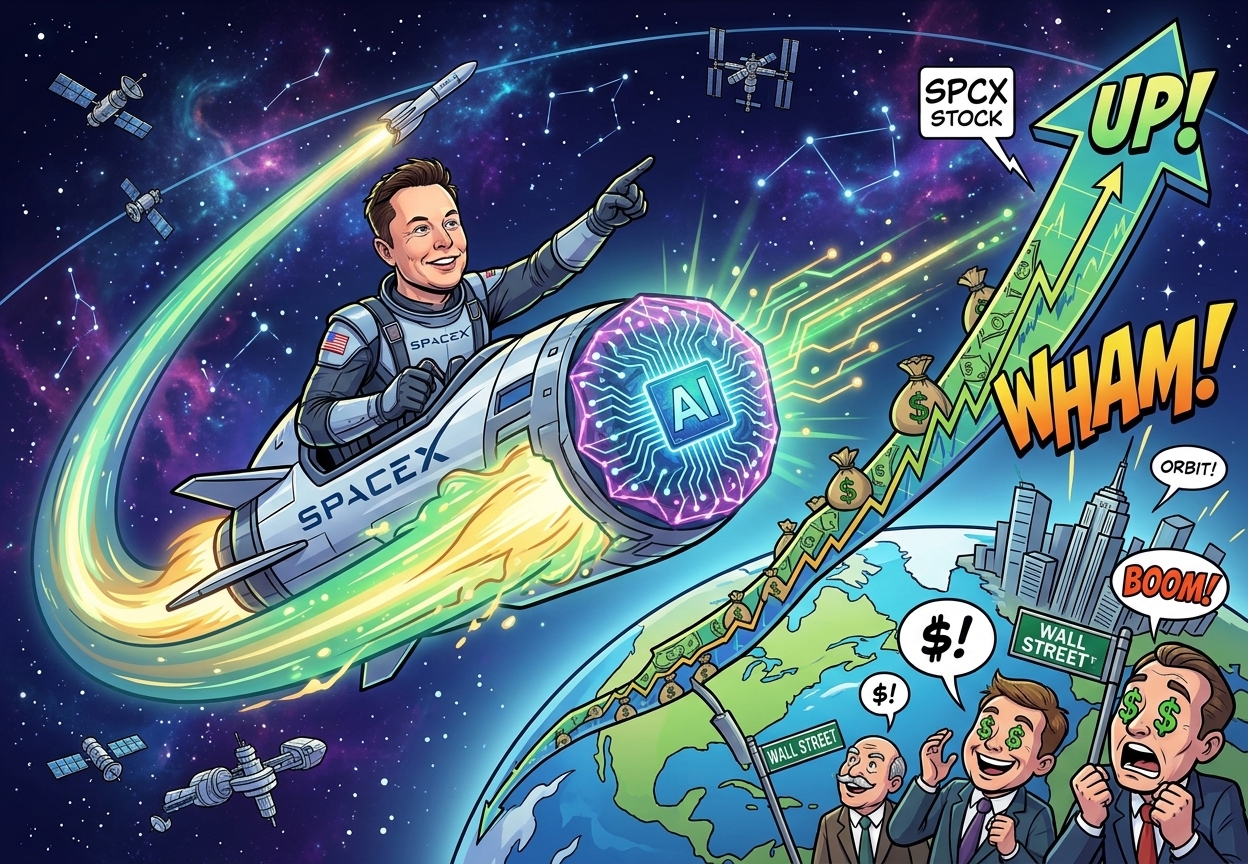
Starlink’s recurring revenue, multibillion-dollar computing agreements and a sharp earnings acceleration strengthen the bullish case for Elon Musk’s expanding infrastructure company.
Space Exploration Technologies Corp. (NASDAQ: SPCX) is giving many a reason to look beyond the launchpad. Shares traded at $133.84, up 8.27%, as of 2:39 p.m. ET on November 6, 2026, according to the market snapshot supplied for this article. That represents a $10.22 advance from the previous close of $123.62, with the stock moving between $128.58 and $134.38 during the session. The more consequential development, however, is happening beneath the share price. SpaceX has become a business in which rockets, satellite subscriptions and artificial intelligence computing increasingly contribute to the same financial story. Its third-quarter results show that transformation moving from strategic ambition into substantial revenue and operating profit. The bullish thesis rests on one word: infrastructure. SpaceX does not have to win every contest in artificial intelligence to benefit from the industry’s expansion. Owning computing capacity that competing AI developers need can be an attractive business in its own right. Its disclosed agreements with Anthropic and Google demonstrate that opportunity with unusually large monthly price tags. Selling shovels during a gold rush remains a respectable occupation. SpaceX has merely added graphics processors and a launch schedule.
SpaceX’s Latest Earnings Are Stronger Than the Opening Numbers Suggest
The March-quarter figures supplied with the original story are not the latest available results. SpaceX’s subsequent SEC-filed third-quarter earnings release presents a substantially larger business.
For the three months ended September 30, 2026, SpaceX reported:
- Revenue of $14.575 billion, up 161% from a year earlier.
- Operating income of $2.791 billion, compared with an operating loss of $273 million.
- Net income of $4.404 billion, compared with a net loss of $1.054 billion.
- Adjusted EBITDA of $8.809 billion, up 306%.
Those figures establish a stronger foundation for the bullish argument than a single afternoon’s rally. Sales expanded rapidly while the company moved into quarterly operating profitability. There is an important distinction inside the earnings improvement. Net income benefited from nonoperating items and an income-tax benefit, while adjusted EBITDA excludes substantial expenses, including depreciation and share-based compensation. The operating-income result therefore provides a useful, more grounded measure of the quarter’s progress. The company’s earlier registration statement and June-quarter filing also document the broader corporate and financial transition preceding these September results. SpaceX’s public-market story is no longer adequately described by launch activity alone.
The AI Rival Paying for SpaceX’s Computing Power
One of the most intriguing elements of SpaceX’s expansion is that an AI competitor can also become a major customer. A prospectus filed with the SEC describes cloud-services agreements signed with Anthropic in May 2026. The arrangements provided access to computing capacity across Colossus and Colossus II, including approximately 325,000 NVIDIA (NASDAQ: NVDA) graphics processing units, supported by processors, storage and high-speed networking. Under those original agreements, Anthropic agreed to pay SpaceX $1.25 billion per month through May 2029, with reduced fees during the initial capacity ramp. After the initial three-month period, either party could terminate the agreements on 90 days’ notice. That distinction matters. The widely discussed potential value approaching $45 billion is not equivalent to cash already received or an unconditional multiyear backlog. The strategic significance is nevertheless considerable: SpaceX can monetize computing resources through outside customers while retaining the ability to redirect capacity toward its own AI initiatives. The filing explicitly describes that flexibility. Anthropic’s own expansion helps explain the appetite for capacity. Bloomberg reported that the privately held Claude developer generated nearly $17 billion in third-quarter revenue, roughly twelve times its year-earlier figure. It also reported a $23.3 billion quarterly net loss, a reminder that exceptional demand and exceptional spending can occupy the same income statement. For SpaceX, the attractive proposition is not that every AI developer will emerge victorious. It is that ambitious developers need somewhere to run their models while the contest continues.
Google Adds Another Route to AI Revenue
Anthropic is not the only prominent name in SpaceX’s disclosed computing business. A separate SEC filing describes a June 2026 agreement with Google, a subsidiary of Alphabet (NASDAQ: GOOGL, GOOG), for capacity incorporating approximately 110,000 NVIDIA (NASDAQ: NVDA) GPUs and associated components. The agreement specified payments of $920 million per month from October 2026 through June 2029, following a reduced-fee ramp period. The contractual conditions are material. Google received rights to terminate or accept proportionately reduced capacity if SpaceX missed specified delivery requirements. After December 31, 2026, either party could terminate on 90 days’ notice. Those provisions make delivery, utilization and customer retention essential to the revenue opportunity. Even with those qualifications, the commercial pattern is noteworthy. SpaceX is building a business that can serve AI developers rather than relying exclusively on the success of its own models. In a sector fond of declaring winners before the electricity bill arrives, collecting revenue from multiple contestants has a certain elegance.
Starlink Gives the Growth Story a Recurring-Revenue Foundation
AI may command the liveliest conversation, but Starlink supplies an important operating foundation. SpaceX’s Connectivity segment generated third-quarter revenue of $5.248 billion, up 69% year over year, and operating income of $2.367 billion, up 99%. Starlink ended September with 13.6 million consumer subscribers, compared with 7.2 million a year earlier. That is more than a supporting role. Connectivity generated most of the company’s consolidated operating income during the quarter. The business also showed breadth:
- Consumer revenue reached $3.121 billion.
- Enterprise and government revenue totaled $2.127 billion.
- More than 3,800 aircraft were equipped with Starlink at quarter-end.
- Consumer monthly average revenue per user rose sequentially to $69, although it remained below the year-earlier $83.
The relationship between subscriber growth and pricing deserves attention. SpaceX is adding customers rapidly, but subscriber totals alone do not capture the economics. Revenue per customer, service costs and the capital required to expand the constellation remain important. For many evaluating SPCX, Starlink offers something especially useful alongside the AI buildout: an established subscription business with demonstrated operating profitability.
Starship Is Beginning to Connect Engineering With Commercial Capacity
The rocket business remains strategically important even as its share of consolidated revenue becomes smaller. SpaceX reported that its first revenue-generating Starship mission delivered 26 Starlink V3 satellites to orbit during the third quarter. According to the company, that deployment added approximately ten times the downlink capacity of a Falcon 9 Starlink launch. The economic connection is straightforward. More capable launches can help deploy a more capable satellite network, which can support additional customers and services. That does not automatically establish lower total costs or guaranteed returns, but it explains why the launch and connectivity businesses belong in the same strategic conversation. Space segment revenue reached $1.767 billion during the quarter. The segment recorded a $7 million operating loss as SpaceX continued substantial research and development spending, including investment in Starship. The bullish case does not require pretending rockets have become inexpensive. It requires their capabilities to create enough commercial value to justify the expense.
Tesla’s Cybercab Pivot Highlights Musk’s Broader AI Direction
A parallel development at Tesla (NASDAQ: TSLA) provides context for Musk’s increasingly pronounced emphasis on AI and autonomy. Bloomberg reported on November 6 that Tesla planned to wind down Cybertruck production at its Texas factory around the middle of 2027 to create room for increased Cybercab output. The report noted that it was not immediately clear whether Cybertruck production would end entirely or move elsewhere. That qualification is important. A factory-allocation decision is not necessarily a definitive obituary for a vehicle. Tesla had already begun Cybercab production earlier in 2026, according to Bloomberg’s April reporting. The latest move reinforces the company’s shift toward autonomous transportation rather than simply expanding its existing vehicle lineup. For SpaceX shareholders, the connection is strategic rather than an automatic financial entitlement. Tesla and SpaceX remain separate public companies. SpaceX’s September-quarter filing discusses the evaluation of a potential combination with Tesla, but explicitly identifies whether an agreement or transaction will occur as uncertain. A bullish SpaceX thesis should therefore stand on SpaceX’s own operations, not on treating a possible transaction as a completed event.
A Broader Customer Base Could Reduce One Familiar Concern
SpaceX’s commercial expansion may also change how many assess its dependence on Washington. Bloomberg reported on November 6 that Musk expected U.S. government payments to account for less than 10% of SpaceX revenue in the current quarter, compared with 16.6% in the most recent quarter. That is a management expectation, not a completed quarterly resul. If achieved, the shift would illustrate how rapidly computing and commercial connectivity are expanding relative to government-funded work. It would not eliminate regulatory exposure. Launch approvals, spectrum rights, data-center permits and power availability remain relevant to the company’s plans. SpaceX’s SEC filing identifies regulatory, infrastructure and financing constraints among the risks to its expansion. Still, a broader revenue base can make the business less dependent on any single customer category. That is a constructive development for a company once viewed primarily through its launch contracts.
The Bull Case Has a Large Addressable Market and a Large Capital Bill
The strongest positive argument for SPCX is supported by operating evidence: accelerating revenue, profitable connectivity services, meaningful third-party computing agreements and a growing AI segment. The capital requirements are equally real. SpaceX reported third-quarter capital expenditures of $19.593 billion, including $16.444 billion in its Super Intelligence segment. For the first nine months of 2026, operating cash flow totaled $13.097 billion, while purchases of property, plant and equipment reached $48.069 billion. The balance sheet provides substantial resources, with approximately $89.9 billion in cash, cash equivalents and marketable securities at September 30. But that liquidity should be viewed alongside the scale of spending and the financing that helped build it, including the IPO. Nor does the absence of a trailing revenue or price-to-earnings figure in the supplied valuation snapshot establish that the stock is inexpensive. Missing valuation fields are a data limitation, not a discount coupon. The constructive case is more specific: SpaceX is developing several connected revenue engines, and the latest quarter shows those engines producing meaningful operating results. The next test is whether that growth can support the capital intensity without surrendering the financial gains already achieved. For many watching SPCX, that is the compelling story behind the rebound. SpaceX is no longer selling only access to orbit. It is selling connectivity, computing capacity and software within an increasingly integrated business. The ambition remains expansive. The revenue has become harder to dismiss.
The Sources
- SEC.gov, SpaceX Form 10-Q for the quarter ended September 30, 2026.sec
- SEC.gov, “SpaceX Reports Third Quarter 2026 Results,” earnings release and financial statements.sec
- SEC.gov, SpaceX Form S-1 registration statement.sec
- SEC.gov, SpaceX free-writing prospectus describing Colossus, Colossus II and Anthropic computing agreements.sec
- SEC.gov, SpaceX free-writing prospectus describing the Google cloud-services agreement.sec
- SEC.gov, SpaceX Form 10-Q for the quarter ended June 30, 2026.sec
- Bloomberg, “Anthropic Revenue Hits Nearly $17 Billion Before Blockbuster IPO,” November 2, 2026.bloomberg
- Bloomberg, “Tesla to Wind Down Cybertruck Production in Texas Next Year,” November 6, 2026.bloomberg
- Bloomberg, “Tesla Starts Production of Cybercab Robotaxi, Musk Says,” April 24, 2026.bloomberg
- Bloomberg, “SpaceX to Get Under 10% of Revenue From US Government, Musk Says,” November 6, 2026.bloomberg
Stay Updated with Vista Partners
Subscribe to receive market insights, investing ideas, and the latest updates directly in your inbox.