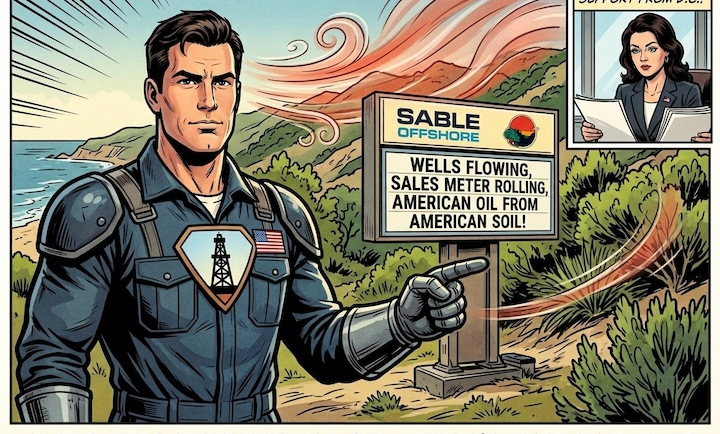
Sable Offshore (NYSE: SOC) has more than a fresh bullish rating: it has operating revenue, a developing production catalyst and a chance to turn California’s complicated energy landscape into a compelling turnaround story.
JPMorgan Chase (NYSE: JPM) initiated coverage of Sable Offshore (NYSE: SOC) with an Overweight rating and a $10 price target October 2. That target implies an approximately 178% gain from today’s prices that are in the $3.59 range. It is an attention-getting valuation gap, even by the standards of an industry accustomed to looking beneath the surface. The more substantive opportunity, however, lies offshore California. Sable is already generating revenue from its Santa Ynez Unit, while preparing to restart Platform Hondo and expand the infrastructure needed to move more oil to market. The bullish thesis is therefore more advanced than a bet on dormant assets: it is a wager for many that an operating business can overcome its remaining bottlenecks and convert additional barrels into stronger cash generation.
JPMorgan Adds a Bullish Voice
JPMorgan’s $10 target puts a prominent financial institution behind Sable’s potential recovery. Many services also reported five Buy ratings, one Hold and two Sell ratings, with an overall consensus classification of Hold and an average price target of $11.40. That combination captures the investment debate neatly: substantial modeled upside, but decidedly uneven conviction. For bullish investors, the distinction matters. A stock does not need unanimous applause to recover; it needs operating results that improve faster than expectations. Sable’s opportunity is to demonstrate that its production ramp, processing upgrades and sales arrangements can support a more durable business than its depressed share-price baseline suggests. There is also context investors should not overlook. JPMorgan participated in Sable’s July financing transactions, serving through its affiliates as underwriter, administrative agent and lead arranger. That relationship is relevant background, not proof that the research recommendation guarantees a successful outcome. The rating creates visibility. Execution must create value.
The Restart Already Produces Revenue
Descriptions of Sable as merely trying to revive an inactive oil field now miss an important development: the company has already crossed into meaningful revenue generation. In its August 10 earnings release, Sable reported approximately $137.1 million in second-quarter revenue and $9.4 million in positive operating cash flow. Management described the period as its first full quarter of revenue generation and positive operating cash flow since inception. Platform Heritage resumed production in early April 2026, joining the company’s broader Santa Ynez operating ramp. Those figures do not establish a finished turnaround. The Company reported a quarterly loss of $0.42 per share and revenue below analyst expectations. Sable also disclosed $39.4 million in quarterly capital expenditures, considerably more than its operating cash inflow. Positive operating cash flow is progress; it is not the same as positive free cash flow. Nevertheless, the investment narrative has seemingly changed. Many can now evaluate actual sales, operating cash generation and infrastructure performance, not simply a restart presentation. The next challenge is getting more of the assets’ productive capacity through the system. In its September 28 update, Sable said the Las Flores Canyon processing facility had been able to handle approximately 80% of the productive capacity of Platforms Harmony and Heritage. Planned upgrades are intended to accommodate all three Santa Ynez platforms at their full productive capacities, including Hondo. That seemingly gives the bullish case a practical foundation: improve the processing system, reduce downtime and turn more available production into saleable oil. In this business, a bottleneck is an expensive way to store potential.
Hondo Could Expand the Opportunity
Platform Hondo is the most visible near-term operating catalyst. Sable’s September 28 update said Hondo reconstruction and internal operational commissioning were complete. The company anticipated regulatory review and approval, along with further instrumentation, control and safety testing, in October, ahead of an expected fourth-quarter 2026 restart. This superseded the September restart expectation in its August earnings release; the newer timeline remains a forecast, not a completed milestone. The additional preparation could also bring more productive capacity online at restart. Sable plans to complete four additional well-enhancement operations before Hondo returns, bringing the number of completed perforation additions to nine of its 15 production wells, versus the five previously expected before restart. Management estimates each operation could add approximately 600 barrels of oil per day to base well production, at a cost of roughly $800,000 per operation. These are company estimates, not demonstrated production results. The sales outlook provides another measure of potential progress:
- Sable preliminarily estimated July and August oil sales at approximately 32,000 gross barrels per day, averaged across the two months.
- September oil sales were expected to average approximately 34,000 gross barrels per day.
- October nominations to its crude purchaser were expected to average 38,000 gross barrels per day, with an estimated month-end exit rate of approximately 45,000 gross barrels per day before adding Hondo volumes.
These figures are gross volumes and should not be confused with the net sales volumes reported elsewhere in Sable’s financial disclosures. October nominations and exit-rate estimates also should not be presented as realized sales. Even with those qualifications, the direction is encouraging. If Sable delivers the processing upgrades, eases third-party sales constraints and restarts Hondo, investors could gain a clearer view of the assets’ earning capacity. The next quarterly reports should help distinguish productive potential from profitable throughput.
Financing Buys Time, Not Comfort
Sable’s July refinancing addressed an important financial hurdle, but the terms make operational execution especially consequential. The company reported completing a $675 million senior secured Term Loan B, $345 million of 6.5% convertible senior notes due 2031 and a $115 million common-stock issuance. Proceeds were used to repay its former senior secured loan with Exxon Mobil (NYSE: XOM), while the new term loan extended the maturity runway to December 15, 2028. Simpson Thacher’s transaction announcement independently corroborated the principal financing amounts. The refinancing gives Sable more time to develop its operating business. It does not give the company inexpensive time. The Term Loan B carries a 15% annual coupon, mandatory quarterly amortization that increases in 2027 and a 100% quarterly excess-cash-flow sweep. Sable also established a $500 million revolving facility designed for commodity hedging, but disclosed a borrowing base of zero. The headline facility size therefore should not be mistaken for $500 million of immediately available borrowing capacity. Equity investors must also account for dilution. The common-stock financing added shares, while the convertible notes have an initial conversion price of $4 per share. A successful operating recovery could benefit the business substantially without delivering an identical increase in value per existing share. There are constructive offsets. Sable reduced the midpoint of its second-half 2026 capital-spending forecast by 41% to $85 million, with the stated aim of optimizing cash flow and accelerating debt amortization. It also disclosed Brent-linked hedges with $65-per-barrel floors on specified volumes, although those collars cap upside on the hedged barrels. The bullish interpretation is straightforward: higher sales, better throughput and controlled spending could improve Sable’s ability to service and reduce debt. The demanding financing structure makes those improvements a necessity, not merely a desirable finishing touch.
The Bull Case Has Conditions
Sable remains a high-risk turnaround, with legal and regulatory uncertainty central to its valuation. Bloomberg Law reported on October 2 that a federal appeals panel was scheduled to consider whether Sable’s pipeline falls under federal jurisdiction, with a hearing set for October 5. That report establishes a significant legal issue; it does not establish the hearing’s subsequent outcome. Sable’s own September update also identifies litigation, regulatory oversight and financing availability among the risks that could materially change its outlook. For many, the most meaningful checkpoints are concrete:
- Hondo’s approvals, remaining testing and actual restart date.
- Completion of processing upgrades and evidence that sales constraints are easing.
- Realized sales volumes and cash generation, rather than nominations alone.
- Debt reduction, financing costs and the effect of potential dilution.
- Legal developments affecting continued operations and pipeline oversight.
The appeal of Sable Offshore stock for many is not that these risks have disappeared. It is that an operating recovery could narrow the distance between a troubled valuation and a more productive asset base. JPMorgan’s $10 target supplies a striking headline. Sable’s revenue generation, Hondo preparations and processing upgrades supply the substance behind a bullish case, provided management delivers. California has supplied plenty of plot twists; many will now be watching for barrels, cash and fewer surprises.
The Sources
- MarketBeat “JPMorgan Chase & Co. Initiates Coverage on Sable Offshore (NYSE:SOC)” October 2, 2026. Coverage initiation, Overweight rating, $10 price target and analyst consensus.
- Sable Offshore “Second Quarter 2026 Financial and Operational Results” August 10, 2026. Financial results, production developments, financing terms and capital-spending outlook.
- Sable Offshore “Provides Operational Update” September 28, 2026. Hondo restart expectations, processing upgrades, well enhancements and projected oil sales.
- Simpson Thacher “Sable Offshore Completes Refinancing Transactions” July 2, 2026. Refinancing transactions and JPMorgan’s participation.
- Bloomberg Law “Trump Administration Pushes Pipeline Jurisdiction in Sable Case” October 2, 2026. Pipeline-jurisdiction litigation and the scheduled federal appeals hearing.
- Sidley Austin “Sidley Represents Certain Financial Institutions in Sable Offshore…” July 20, 2026. Additional transaction-level reporting on Sable’s $675 million senior secured Term Loan B.
- Stock Titan Sable Offshore Form 8-K Filing August 10, 2026. Filing-based financial and operational disclosures, including the term loan’s 15% coupon and December 2028 maturity.
- MarketScreener “Sable Offshore Corp. Reports Earnings Results for the Second Quarter and Six Months Ended June 30, 2026” August 10, 2026. Supplemental reporting on quarterly and first-half financial results.
- TradingView “Sable Offshore Completes $345M Converts, $107M Equity; Adds $675M Term Loan and $500M Revolver” Additional coverage of the convertible-note, equity and credit-facility transactions.
- Investing.com “Earnings Call Transcript: Sable Offshore Posts Q2 2026 Miss as Shares Fall” August 11, 2026. Management commentary on second-quarter performance, financing and operating plans. Its earlier Hondo timeline should be read alongside the newer September 28 company update.
Stay Updated with Vista Partners
Subscribe to receive market insights, investing ideas, and the latest updates directly in your inbox.