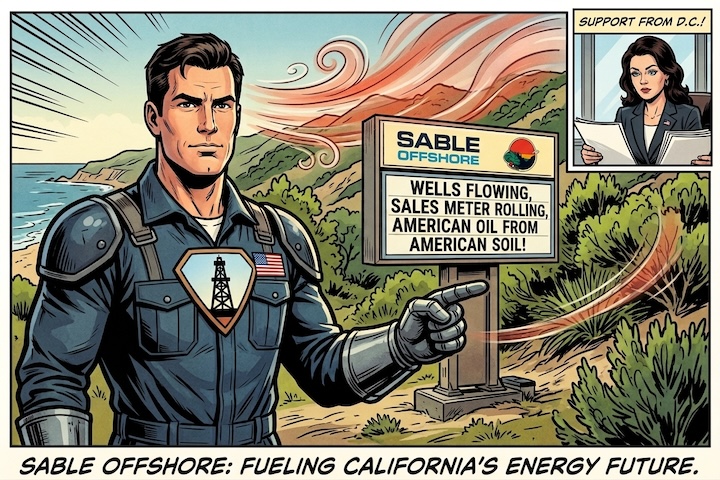
Sable Offshore Corp. (NYSE: SOC) is shaping up as one of the more unusual—and potentially compelling—U.S. energy turnaround stories: a concentrated, infrastructure-backed restart of offshore California oil production just as domestic supply security has returned to the policy conversation. The latest catalyst is personnel, but the investment case is operational: production is ramping, bottlenecks appear addressable, and the company is moving toward a steadier, more cash-generative 2027 profile. In energy, it is often said that barrels matter. In Sable’s case, pipes, permits, refinery logistics and Washington relationships may matter nearly as much.
A Washington Hire With Commercial Meaning
Brittany Kelm, a senior oil-and-gas policy adviser at the White House’s National Energy Dominance Council, is joining Sable Offshore as vice president of policy and commercial and will lead its Washington office. Her move follows an administration-supported restart of Sable’s California pipeline system, aided earlier this year through the Defense Production Act. Investors should resist treating any single executive hire as a substitute for a barrel of oil or a signed refinery contract. Still, this appointment is strategically sensible. Sable operates a highly regulated asset base in federal waters offshore California, where permitting, pipeline oversight, downstream coordination and public-policy navigation are not background noise—they are part of the operating model. Put differently: SOC is not hiring a policy executive to decorate the lobby. It is adding expertise precisely where its commercial opportunity and regulatory complexity intersect.
The Santa Ynez Restart Is Becoming Visible
Sable controls 100% of the working interest and operates the Santa Ynez Unit offshore California. The company estimates approximately 62,000 barrels of oil per day of fully ramped production, with oil representing about 90% of the production mix. That concentration creates a distinctly different equity proposition from a diversified shale producer. SOC is a restart-and-ramp story, with substantial potential operating leverage if the Santa Ynez Unit reaches stable production and marketing capacity catches up with field output.
The early operational evidence has been encouraging:
- Second-quarter 2026 revenue reached $137.1 million, while operating cash flow turned positive at $9.4 million—Sable’s first full quarter with both revenue generation and positive operating cash flow since inception.
- Net oil sales averaged roughly 21,000 barrels per day during the quarter, but exited the period at approximately 40,000 net barrels per day, a 149% increase from the first day of the quarter.
- July preliminary oil sales were approximately 38,000 gross barrels per day, while August sales averaged about 42,000 gross barrels per day through August 9.
- Management expects all 77 producing wells at Platforms Harmony and Heritage to be online during the third quarter, with Platform Hondo expected to restart in September.
This is what a ramp looks like in the real world: not a straight line, not a PowerPoint arrow, but an industrial system gradually shedding its constraints.
The Bottleneck May Be the Opportunity
The second-quarter results also explain why SOC remains a high-volatility, high-upside investment rather than a settled income stock. California’s refining system was not positioned to seamlessly absorb Sable’s rapid return of Pacific Outer Continental Shelf crude. That created temporary throughput restrictions, quality-related price deductions and $18.5 million in non-recurring demurrage costs during the quarter. The bullish interpretation is not that these issues do not matter. They do. It is that the market may be valuing a transitional logistics problem as though it were a permanent production problem. Sable expects downstream throughput constraints to begin easing in the back half of August, with California refiners expected to adjust supply slates in September to accept more Santa Ynez barrels and displace imports. The planned Platform Hondo restart could also lower field-wide sulfur content, while waterborne marketing options through existing Los Angeles-area marine terminals are under active negotiation. Notably, the company’s published guidance does not assume benefits from waterborne marketing, chemical treatments to improve crude quality, or broader California infrastructure improvements. That leaves room for upside if any of those initiatives materialize.
A Leaner Path Toward 2027 Cash Flow
Management reduced its midpoint second-half 2026 capital-expenditure budget by 41% to $85 million, redirecting the program toward asset integrity, throughput maximization, well optimization and high-return perforation additions.
The operational menu is unusually focused:
- Five completed perforation additions at Platform Hondo are forecast to add an estimated 600 gross barrels per day each when they come online with the platform restart.
- Four additional Hondo perforation additions are planned for early fourth-quarter 2026.
- Sable has increased its expected 2027 oil mix to roughly 100%, reflecting stronger-than-anticipated oil cuts from producing wells and deferred gas-related capital items.
Guidance calls for 2027 gross average daily sales of 50,000 to 55,000 barrels of oil equivalent per day, or 42,500 to 47,500 net barrels of oil equivalent per day, at lease operating expense of $9 to $12 per net BOE. For investors, the core question is not whether the second quarter was elegant—it plainly contained startup friction. The core question is whether Sable can convert a large installed asset base into normalized volumes, lower unit costs and more reliable realized pricing. If it can, the earnings profile could look markedly different once the restart is no longer competing with its own logistics.
Oil-Price Protection, With Trade-Offs
Sable has also installed a hedging framework centered on $65-per-barrel Brent floors. For the second half of 2026, the company has costless collars covering an average 28,000 barrels per day, with a $65 floor and an $89.39 ceiling. It has additional collars for 2027 and 2028, both with $65 floors and lower call ceilings. That structure offers investors useful downside protection during the ramp, though it also limits participation above the relevant call ceilings. Such is the ancient energy-industry bargain: a little less champagne in a surge, a little more shelter in a storm. Sable’s July refinancing extended its debt maturity runway to year-end 2028 and included a $675 million senior secured term loan due in December 2028, $345 million of convertible senior notes due in 2031, and $115 million of common equity issued at $3.08 per share. The balance sheet remains an important risk factor, particularly given the term loan’s 15% coupon, mandatory amortization and cash-flow sweep provisions. But refinancing reduced near-term maturity pressure while the operating ramp remains unfinished.
Why SOC Could Attract Investors
The bull case for Sable Offshore (NYSE: SOC) rests on a relatively simple proposition: the equity could be rerated if the company demonstrates that its current production and marketing constraints are temporary, rather than structural.
Key potential catalysts include:
- Platform Hondo’s expected September restart.
- Full well restoration at Harmony and Heritage.
- Better refinery intake and diminished demurrage costs.
- Improved marketing optionality through waterborne sales.
- Higher-margin, nearly all-oil production in 2027.
- Continued federal support for domestic energy infrastructure and policy execution.
Sable is not a conventional “sleep well at night” oil stock. It carries meaningful regulatory, environmental, financing, commodity-price, execution and geographic-concentration risks. Its assets are concentrated in one region, its pipeline history remains politically sensitive, and California’s regulatory environment can turn straightforward logistics into a graduate seminar in persistence. But for investors comfortable with event-driven energy equities, SOC offers something scarce: a visible production ramp, substantial installed infrastructure, potential operating leverage, and a policy-aware management expansion at a moment when U.S. energy security is again a Washington priority.
Takeaway
Sable Offshore’s story is evolving from “Can it restart?” to “How quickly can it normalize and monetize?” The distinction is consequential. With oil sales reaching roughly 42,000 gross barrels per day in early August, Platform Hondo poised to return, and downstream constraints expected to ease, NYSE: SOC may be approaching the portion of the turnaround where execution begins to show up less as a promise and more as a cash-flow profile. For bullish investors, the attraction is clear: Sable is attempting to turn an underused California offshore system into a strategically valuable source of domestic crude. If the pipes cooperate, the refineries adjust and the wells keep performing, SOC may prove that the most interesting comeback story in California oil is taking place offshore—where, appropriately, the drama already comes with a horizon.
The Sources
- E&E News — “Top White House oil liaison departs for Sable Offshore”
- Sable Offshore Corp. — Corporate Overview
- Sable Offshore Corp. — August 2026 Investor Presentation (PDF)
- Sable Offshore Corp. — Second Quarter 2026 Financial and Operational Results
Stay Updated with Vista Partners
Subscribe to receive market insights, investing ideas, and the latest updates directly in your inbox.