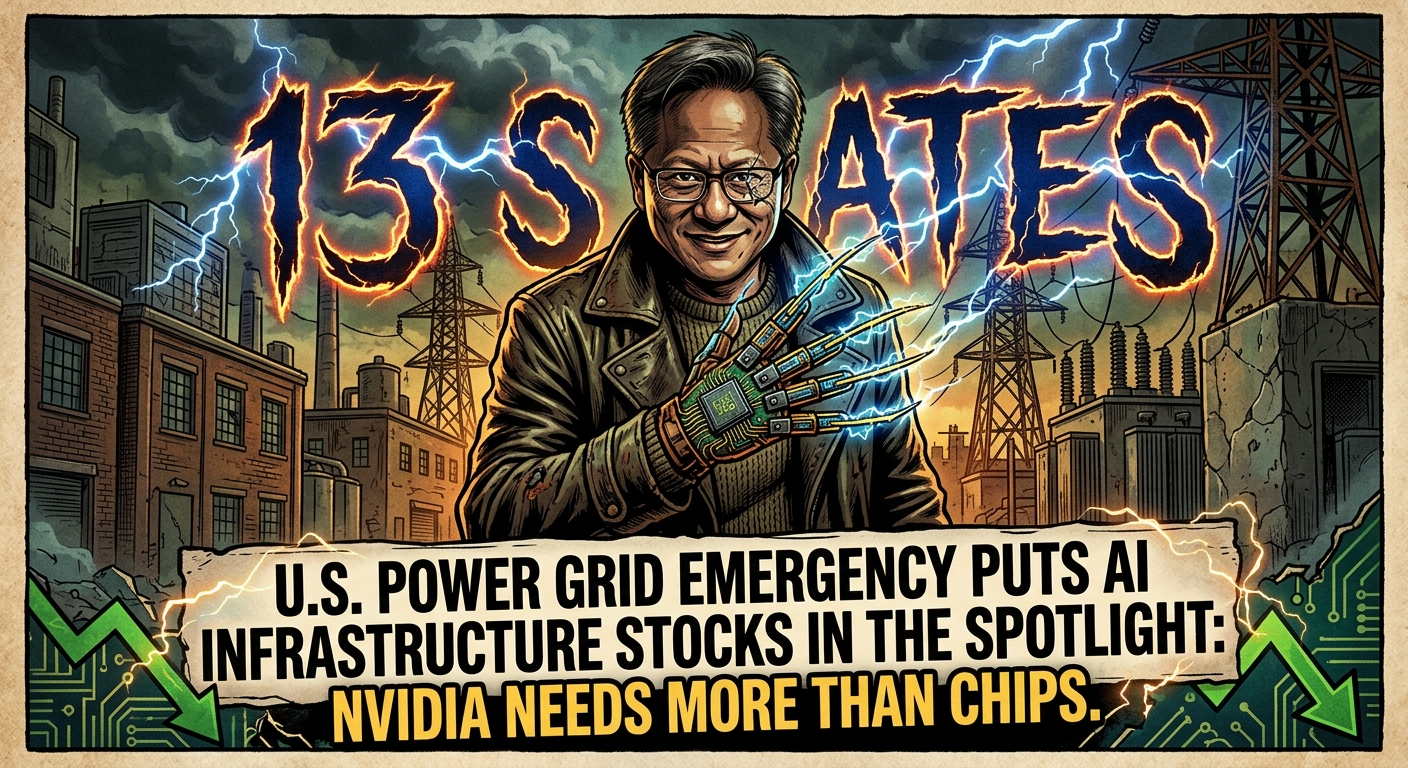
A federal reliability order across 13 states highlights the investment case for electrical equipment, grid construction and data-center power systems.
America’s artificial intelligence ambitions have encountered an old-fashioned requirement: the electricity has to show up. A U.S. Department of Energy emergency order covering the PJM Interconnection region, which spans all or parts of 13 states and Washington, D.C., has brought that requirement into sharper focus. Effective October 13 through October 16, 2026, the order gives grid operators additional tools to maintain reliability amid elevated demand, scheduled power-plant maintenance and transmission outages. It is a preventive measure, not an announcement of scheduled blackouts. For many, the development reinforces a bullish thesis that extends beyond semiconductors. NVIDIA (NASDAQ: NVDA) supplies the computing technology behind much of the AI buildout, but that buildout also requires electrical equipment, transmission connections, backup power and cooling. GE Vernova (NYSE: GEV), Quanta Services (NYSE: PWR), Eaton (NYSE: ETN) and Vertiv (NYSE: VRT) offer different exposures to those infrastructure requirements. The emerging investment theme is reliability. In an economy increasingly organized around digital services, dependable electricity is becoming as strategically important as computing horsepower.
What the 13-State Power Grid Emergency Actually Means
Energy Secretary Chris Wright issued the emergency order following an October 11 application from PJM. The directive permits PJM to dispatch specified generating units as needed and authorizes the use of backup generation as a last resort before, or during, an Energy Emergency Alert 3. That is the stage at which an electricity system faces particularly severe supply constraints. PJM’s territory includes all or parts of Delaware, Illinois, Indiana, Kentucky, Maryland, Michigan, New Jersey, North Carolina, Ohio, Pennsylvania, Tennessee, Virginia and West Virginia, along with the District of Columbia. The operator forecast electricity demand of approximately 111,500 megawatts or more for October 13, while unusually warm autumn weather coincided with scheduled infrastructure outages. The distinction matters. This is not evidence that 13 entire states are losing electricity, nor does it establish that AI caused the immediate emergency. The documented near-term pressures are elevated demand, generator maintenance and transmission work. A PJM spokesperson told Newsweek that the operator did not expect customer impacts and was not asking customers to take action. For many however, the episode supplies a timely illustration of a broader economic point: a grid needs sufficient capacity and operating flexibility precisely when several ordinary pressures arrive together. Electricity, inconveniently for the digital economy, cannot be downloaded.
AI Electricity Demand Gives the Infrastructure Thesis Staying Power
A four-day emergency order is not, by itself, a multiyear investment thesis. The more substantial argument comes from the expected growth in electricity consumption. The International Energy Agency projects that global data-center electricity consumption will roughly double to about 945 terawatt-hours by 2030 in its base case, representing just under 3% of global electricity demand. It expects electricity consumption by accelerated servers, driven largely by AI adoption, to grow approximately 30% annually over the forecast period. Those forecasts connect the AI spending cycle to physical infrastructure. More computing capacity requires more than additional processors. It also requires power delivery, heat removal and systems that can keep facilities operating when grid conditions deteriorate. The bullish interpretation is not that every electricity-related business will prosper equally. It is that rising demand can create multiple investment opportunities along the same supply chain, from generating and transmitting power to managing it inside a data center. GE Vernova, Quanta, Eaton and Vertiv operate at different points in that chain. That distinction gives investors a useful alternative to treating the entire AI trade as a referendum on chip sales.
NVIDIA: The AI Opportunity Has an Electrical Address
NVIDIA (NASDAQ: NVDA) belongs at the center of this discussion because increasingly capable AI systems also place greater demands on their surrounding infrastructure. Its collaboration with Vertiv illustrates the connection. In March 2026, Vertiv announced its role in the NVIDIA Vera Rubin DSX AI factory reference design and NVIDIA Omniverse DSX Blueprint. The work includes simulation-ready power and cooling assets, validated interfaces and repeatable infrastructure designs intended to accelerate deployment and reduce execution risk. Vertiv has also worked with NVIDIA on 800-volt direct-current power architectures designed for future high-density AI facilities. The collaboration addresses the electrical foundation required to support increasingly demanding computing systems. The investment implication is straightforward: NVIDIA’s ecosystem reaches beyond the server rack. As AI facilities become larger and more complex, their electrical and thermal systems become integral to deployment, rather than accessories purchased after the exciting equipment arrives. Even the most sophisticated processor remains notably unproductive without power.
GE Vernova and Quanta: Equipment Meets Execution
GE Vernova (NYSE: GEV): Supplying the Electrical Backbone
GE Vernova offers exposure to the equipment required to generate and move electricity. Its businesses include gas turbines and grid technologies such as transformers, switchgear and high-voltage direct-current systems. Its Electrification segment supports power transmission, grid stability and large-scale electrification programs. That positioning makes the company relevant to both expanding electricity demand and the modernization of existing infrastructure. The opportunity is broader than a single emergency or a single category of customer: new computing facilities still need to operate within a functioning electrical system. The bullish case rests on customers converting those requirements into equipment orders and GE Vernova converting those orders into profitable deliveries. An emergency headline can draw attention to the need, but execution determines the shareholder outcome.
Quanta Services (NYSE: PWR): Turning Capacity Plans Into Connections
Quanta provides engineering, procurement and construction services for electrical infrastructure, including high-voltage transmission lines, substations and interconnections serving data centers. Its role complements that of equipment manufacturers. A transformer can be ordered, a generating facility can be proposed and a data center can be financed, but the physical connections still have to be built. That creates a differentiated investment thesis: Quanta’s opportunity lies in executing the infrastructure work that allows additional electricity supply and demand to connect. GE Vernova supplies much of the hardware; Quanta helps put electrical infrastructure into service. The cloud, it turns out, requires a considerable amount of work on the ground.
Eaton and Vertiv: Bringing Power Into the AI Facility
Eaton (NYSE: ETN): Managing Electricity Where It Matters
Eaton offers broader exposure to electrical power-management systems, including the equipment needed as customers invest in power infrastructure. Its data-center capabilities also extend to liquid-cooling components such as cold plates, heat exchangers and coolant distribution units designed for high-power-density systems. Eaton describes working with NVIDIA accelerated-system integrators and data-center operators on customized cooling systems. That provides a tangible connection between advanced computing hardware and the infrastructure required to operate it efficiently. For many, Eaton represents a way to participate in electrical investment without relying solely on one AI computing platform or one type of facility.
Vertiv (NYSE: VRT): A More Concentrated AI Infrastructure Exposure
Vertiv specializes in the physical infrastructure surrounding digital computing, including power management, backup systems, thermal management and liquid cooling. Its NVIDIA collaboration integrates power, cooling, controls and services into coordinated AI-factory designs. That focus gives Vertiv a more concentrated connection to the demands of high-density AI facilities. Its work on modular infrastructure and digital simulation also addresses an important deployment challenge: making complicated facilities more repeatable and reducing the risk of costly integration problems. The bullish argument is not simply that AI servers get hot. It is that power and cooling increasingly need to be engineered together, creating a larger role for suppliers capable of delivering integrated systems.
What Investors Should Watch Beyond the Emergency Headline
The PJM order is a reminder of infrastructure’s importance, not proof that any particular stock is inexpensive. A disciplined bullish approach should distinguish among three questions:
- Demand: Are projected electricity and data-center needs becoming funded projects and firm orders?
- Execution: Can suppliers deliver equipment and complete installations without sacrificing profitability?
- Valuation: Does the share price already assume years of strong growth?
Those questions also keep the immediate event in perspective. PJM’s October emergency stems from a specific combination of operating conditions. The longer-term infrastructure thesis rests on sustained investment requirements, including the IEA’s projected increase in data-center electricity consumption. The two are related through the importance of grid capacity, but they are not interchangeable evidence. Many should also separate business exposure from stock-price opportunity. NVIDIA, GE Vernova, Quanta, Eaton and Vertiv occupy different competitive positions, serve different customer needs and will not necessarily respond alike to the same infrastructure spending cycle.
The Bullish Takeaway: AI’s Next Bottleneck May Be an Investment Opportunity
The 13-state power grid emergency offers a timely lens on an increasingly tangible investment theme: digital growth depends on physical capacity. NVIDIA (NASDAQ: NVDA) remains central to advanced AI computing. GE Vernova (NYSE: GEV), Quanta Services (NYSE: PWR), Eaton (NYSE: ETN) and Vertiv (NYSE: VRT) provide distinct ways to examine the generation, grid, electrical-management and cooling requirements surrounding that computing expansion. Their opportunity comes from helping customers make ambitious digital plans operational. For bullish investors, the compelling proposition is not to profit from the fear of blackouts. It is to identify businesses that can help prevent power constraints from becoming constraints on economic growth. The AI economy may be built on intelligence. Its expansion still needs an electrician.
The Sources
- The Economic Times: “US declares power grid emergency across 13 states: What it means for residents.”
https://economictimes.com/news/international/global-trends/us-declares-power-grid-emergency-across-13-states-what-it-means-for-residents/articleshow/134918446.cms - U.S. Department of Energy: “Energy Secretary Secures Mid-Atlantic Grid Ahead of Anticipated Stressed System Conditions.”
https://www.energy.gov/articles/energy-secretary-secures-mid-atlantic-grid-ahead-anticipated-stressed-system-conditions - U.S. Department of Energy: “Federal Power Act Section 202(c): PJM Interconnection, L.L.C. (PJM), Order No. 202-26-50.”
https://www.energy.gov/ceser/federal-power-act-section-202c-pjm-interconnection-llc-pjm-order-no-202-26-50 - Newsweek: “Map shows the 13 states under emergency order to prevent blackouts.”
https://www.newsweek.com/map-shows-the-13-states-under-emergency-order-to-prevent-blackouts-12560664[newsweek] - International Energy Agency: “Energy demand from AI,” from the Energy and AI report.
https://www.iea.org/reports/energy-and-ai/energy-demand-from-ai - Vertiv: “Vertiv brings converged physical infrastructure to NVIDIA Vera Rubin DSX AI factories.”
https://www.vertiv.com/en-us/about/news-and-events/corporate-news/2026/vertiv-brings-converged-physical-infrastructure-to-nvidia-vera-rubin-dsx-ai-factories/ - Vertiv: “From vision to readiness: Vertiv collaborates with NVIDIA to advance 800 VDC platform designs to power the next generation of AI factories.”
https://www.vertiv.com/en-us/about/news-and-events/corporate-news/from-vision-to-readiness-vertiv-collaborates-with-nvidia-to-advance-800-vdc-platform-designs-to-power-the-next-generation-of-ai-factories/ - Eaton: “Maximizing AI data center cooling efficiency with Eaton and NVIDIA solutions.”
https://www.eaton.com/us/en-us/markets/data-centers/data-center-cooling/efficiency/maximizing-ai-data-center-cooling-efficiency-with-eaton-and-nvidia-solutions.html[ - GE Vernova: Electrification news and company information.
https://www.gevernova.com/news/taxonomy/term/9481?page=1 - Yahoo Finance: “GE Vernova (GEV) vs. Quanta Services (PWR).”
https://finance.yahoo.com/energy/articles/ge-vernova-gev-vs-quanta-021313409.html - Yahoo Finance: “3 Stocks to Buy if You Believe the AI Power Crunch Is Just Getting Started.”
https://finance.yahoo.com/energy/articles/3-stocks-buy-believe-ai-192500744.html - Yahoo Finance: “GE Vernova vs. Eaton: Which AI Power Stock Can Earn Its Premium?”
https://finance.yahoo.com/markets/stocks/articles/ge-vernova-vs-eaton-ai-025639725.html
Stay Updated with Vista Partners
Subscribe to receive market insights, investing ideas, and the latest updates directly in your inbox.