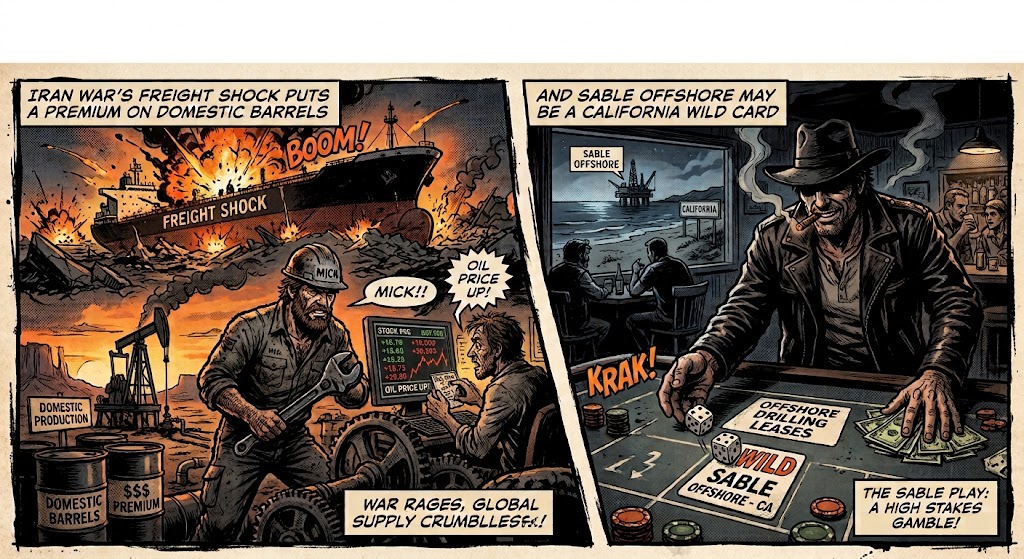
The most extraordinary winner from the Iran-war oil shock has not been crude itself, but the cost of moving it. That distinction matters for investors: as tanker freight rates surge, trade routes lengthen, and the Strait of Hormuz becomes a costly global bottleneck, domestically produced California oil could acquire a fresh strategic and commercial appeal. Sable Offshore Corp. (NYSE: SOC), which is ramping production from the Santa Ynez Unit offshore California, sits squarely at that intersection. The market’s message is unusually direct. A barrel is no longer merely priced by what it contains; increasingly, it is priced by how nervously it must travel.
The Real Oil Trade Is Freight
The Iran conflict has turned tanker logistics into one of Wall Street’s most extreme thematic trades. The Breakwave Tanker Shipping ETF (NYSEARCA: BWET), which tracks futures tied to crude-oil tanker freight rates rather than the price of crude itself, was up roughly 3,600% year to date through September 11, according to Morningstar data. Rates on the Middle East tanker routes tracked by BWET were up nearly 500% year over year as shipping through and around the Strait of Hormuz became more expensive, riskier, and less predictable. The point is not that BWET is an uncomplicated long-term investment, far from it. The fund is narrowly concentrated in tanker-freight futures, carries a 3.50% expense ratio, and may reverse sharply if conflict conditions abate. But the spectacular performance underscores a larger development: the market is assigning a much greater value to dependable physical access to energy. That is the backdrop that potentially elevates the Sable Offshore investment story. Oil price headlines often focus on Brent or West Texas Intermediate. Yet refiners and end users operate in the less poetic world of delivery dates, crude grades, loading schedules, insurance premiums, port access, and available ships. A cargo delayed, rerouted, or priced with a substantial risk premium is not equivalent to a nearby barrel that can reach a local refinery with fewer ocean-going adventures. In today’s energy market, the tanker has become an accidental macroeconomist.
Chokepoints Are Multiplying
The Strait of Hormuz remains one of the world’s most sensitive oil-transit corridors, but the disruption has not been limited to one body of water. Many have reported that Iran-backed Houthi forces captured Yemen’s key port of Mocka, adding risk to Red Sea shipping routes that had become an alternative to the Persian Gulf. Saudi Arabia also reportedly shut down its East-West crude oil pipeline as a precaution following drone attacks launched from Iraq. That means the global oil system is confronting not one constraint but a chain of constraints:
- Passage through the Strait of Hormuz has become more perilous and costly.
- Red Sea routes carry their own security risks.
- Alternative routes are longer, tying up scarce tanker capacity.
- Higher insurance and freight costs raise the delivered cost of crude.
- Drought-related shipping constraints, tariff-driven rerouting, and port congestion have compounded vessel shortages.
Project44 data cited by CNBC showed that vessel diversions and other disruptions rose above 9,000 at the height of the Iran crisis, compared with roughly 1,000 per week before the war. The supply-chain intelligence company counted 140,276 disruptions this year, even as conditions had begun to improve from their worst levels. This is not merely a temporary inconvenience for logistics managers. It is a reminder that seaborne energy supply, however globalized and technologically refined, still depends on geography, security, and a surprisingly finite number of ships. There is always a reserve of rhetoric in the oil market. There is not, apparently, a reserve fleet of tankers waiting in a drawer.
California Barrels Look Different When Imports Get Complicated
Sable Offshore’s relevance rests on its ability to supply production into California, a large energy-consuming market that has historically relied in part on imported crude. The company is developing the Santa Ynez Unit in federal waters offshore California and is focused on returning and expanding production from Platforms Harmony, Heritage, and Hondo. In a tranquil market, California crude must compete on the familiar commercial terms of grade, cost, refinery compatibility, timing, and regional price differentials. During a freight shock, those terms may shift. If imported Middle Eastern or other seaborne crude becomes more expensive to transport, harder to insure, delayed by rerouting, or exposed to greater delivery uncertainty, local supply can gain value. Sable’s barrels do not need to traverse the Strait of Hormuz, dodge Red Sea threats, or compete for a supertanker whose schedule now resembles a doctor’s office in flu season. That does not mean every California-produced barrel automatically commands a premium, nor does it cancel the regulatory, operational, and infrastructure hurdles that accompany producing oil in the state. But it does strengthen the strategic logic behind incremental domestic supply close to a major refining and demand center. The bullish argument for Sable is therefore more sophisticated than a simple call on higher oil prices. It is a call on the possibility that regional supply security, transportation optionality, and reduced import dependence become more valuable when global energy routes are under stress.
SOC Is Moving From Restart Story to Producing Asset
Sable Offshore reported $137.1 million in second-quarter 2026 revenue and $9.4 million in positive operating cash flow, marking its first full quarter of revenue generation and positive operating cash flow since inception. The company averaged approximately 21,000 net barrels of oil sales per day during the quarter and exited the period at roughly 40,000 net barrels per day, representing 149% entry-to-exit oil-sales growth. The volume ramp has continued:
- Preliminary July oil sales were approximately 38,000 gross barrels per day.
- Average oil sales through August 9 were approximately 42,000 gross barrels per day.
- Harmony and Heritage averaged about 47 producing wells online in July.
- Sable expects all 77 production wells on Harmony and Heritage to be online during the third quarter.
- Platform Hondo was expected to return in September, adding another potential production catalyst.
The company reported average production of 723 barrels of oil per day per well in the second quarter across an average of 35 producing wells per day. In July, the average output at Harmony and Heritage was approximately 721 gross barrels of oil per day per well from the producing-well base. For a small-cap oil company, the transition from dormant or constrained assets to material daily sales volumes is what changes the conversation. Many can begin assessing realized pricing, operating costs, capital intensity, throughput, debt reduction, and cash flow, not simply the promise of a future restart. That shift matters especially in a market suddenly more attentive to where oil is produced and how it reaches its destination.
The Throughput Constraint Could Become the Opportunity
Sable has not had a frictionless ramp. In fact, its near-term commercial issues illustrate precisely why the freight-and-location narrative is important. Because California refiners could not fully prepare for initial Santa Ynez Unit volumes amid the state’s regulatory environment, Sable said refiners had to displace imported cargoes during the second quarter. That created $18.5 million in non-recurring demurrage charges. A sudden influx of Pacific Outer Continental Shelf crude also led refineries to limit throughput temporarily and apply quality-related deductions, including for sulfur content. These facts should not be airbrushed from the investment case. They are risks, and they have near-term financial consequences. But there is another side to them. Sable expects California refiners to adjust their crude supply slate beginning in September to accept more Pacific Outer Continental Shelf barrels and fewer imported barrels, potentially alleviating its throughput constraint. The company also said Platform Hondo’s expected restart should reduce field-wide sulfur content because the platform is expected to produce lower-sulfur oil. Sable is additionally pursuing waterborne marketing options through existing Los Angeles-area marine terminals. A possible future restart of the San Pablo Bay Pipeline network could offer California producers more access to the San Francisco refining market, though that remains a prospective source of optionality rather than an assured result. This is where the macro story meets the company-specific one. The global freight crunch makes imported barrels less elegant and potentially more costly. Sable’s challenge is to turn its local production advantage into regular refinery acceptance, lower deductions, better market access, and improved realized pricing. If it succeeds, a bottleneck could begin to look like a bridge.
The 2027 Setup Includes Operating Leverage
Sable reduced the midpoint of its second-half 2026 capital-expenditure guidance by 41% to $85 million. Management said the lower capital plan was intended to optimize cash flow and accelerate debt amortization while focusing spending on asset integrity, throughput, well optimization, and high-return perforation additions.
The company’s 2027 guidance calls for:
| Metric | Sable Offshore 2027 Guidance |
|---|---|
| Gross average daily sales | 50,000 Boe/d |
| Net average daily sales | 42,500 Boe/d |
| Expected oil mix | Approximately 100% |
| Estimated marketing and GP&T deductions | $21 per barrel |
| Lease operating expense | $9 per net Boe |
| Cash G&A | $3.50 per net Boe |
| Total capital expenditures | $80 million |
Sable noted that its 2027 guidance does not assume benefits from waterborne marketing solutions, chemical treatments designed to lower sulfur content, or broader California infrastructure improvements. For bullish investors, that creates an identifiable upside framework: if volumes ramp toward guidance, refinery acceptance improves, marketing constraints ease, and the company captures even a portion of these currently excluded opportunities, the economics could improve beyond the base-case assumptions. The company has also implemented Brent costless collars with $65-per-barrel floors on specified volumes through 2028. The floors offer protection if crude prices weaken, though the sold calls limit a portion of upside in a sustained oil-price spike. That trade-off is particularly relevant in a geopolitical oil market. SOC shareholders retain exposure to operational execution and regional crude-market dynamics, but they should not assume the company has unlimited participation in every surge in Brent prices.
Freight Funds Show the Signal, Not Necessarily the Destination
The Iran conflict has produced several investable expressions of disrupted logistics:
- Breakwave Tanker Shipping ETF (NYSEARCA: BWET) offers concentrated exposure to oil-tanker freight futures.
- U.S. Global Sea to Sky Cargo ETF (NYSEARCA: SEA), with approximately 70% ocean shipping and 30% air-freight exposure, was up 42% year to date through September 11, according to Morningstar data cited by CNBC.
- SonicShares Global Shipping ETF (NYSEARCA: BOAT), which owns global maritime-shipping equities, was up 70% year to date over the same period.
Yet the freight trade and the Sable trade are fundamentally different. BWET is a tactical wager on freight rates remaining elevated. It can be highly sensitive to geopolitical de-escalation, shifting tanker availability, and futures-market conditions. CNBC noted that new vessel orders are rising, which could create longer-term industry oversupply and pressure freight rates once the immediate shortage eases. Sable Offshore is a more company-specific proposition: an operationally leveraged effort to restore, optimize, transport, and sell California oil into a market whose imported supply alternatives may be growing more complicated. The freight funds show the cost of global disruption. SOC may offer investors a way to examine the value of avoiding some of it.
The Bull Case and the Fine Print
The constructive case for Sable Offshore is clear:
- Global shipping disruptions have increased the strategic value of accessible, regional crude supply.
- SOC is ramping real production and generating revenue and operating cash flow.
- California refiners are expected to take more Santa Ynez Unit crude and fewer imported barrels beginning in September.
- Platform Hondo’s restart, well optimization, perforation additions, and potential quality improvements could support additional production and marketing gains.
- Management’s 2027 plan does not include benefits from several potential marketing and infrastructure improvements.
But the stock remains an execution-intensive investment. Sable’s debt load, including a $675 million senior secured term loan with a 15% annual coupon and mandatory amortization requirements, means sustained production and cash-generation progress matter enormously. The company also has $345 million of 6.5% convertible senior notes due in 2031, initially convertible at $4 per share. Other risks include regulatory delays, operational disruptions, refinery demand, crude-quality deductions, infrastructure constraints, commodity-price volatility, potential dilution, and the possibility that geopolitical conditions improve quickly—reducing freight and security premiums across the global oil system. Still, the current energy market is providing a useful reminder: oil is not just a commodity. It is an industrial supply chain that can suddenly become geopolitical, expensive, and very particular about where it comes from. For Sable Offshore (NYSE: SOC), the opportunity is to prove that California barrels can be not only productive, but increasingly prized.
The Sources
- CNBC: “Up 3,600%, this freight fund has posted the biggest gains of all on Iran war oil shock”
- CNBC: “Oil prices, Iran war and the Strait of Hormuz: Saudi pipeline becomes a key focus”
- Yahoo Finance: “Sable Offshore Corp. Reports Second Quarter 2026 Financial and Operational Results”
- Vista Partners: “Sable Offshore Gains 11.2% in a Month as California Barrels Meet a New Washington Defense Production Act Priority”
- Reuters: “Oil tanker rates hit record highs following Iran, U.S. shipping attacks”
- Reuters: “Iran and U.S. hit tankers in biggest wave of attacks on shipping since war began”
- Reuters: “Hormuz traffic dips to lowest since May after U.S., Iranian strikes on ships”
- Reuters: “Iran warns U.S. energy assets in Gulf are vulnerable after latest clashes”
- NPR: “U.S. military says it destroyed 5 Iranian oil tankers after attacks on Navy warship”
- Al Jazeera: “Why U.S.-Iran war over Hormuz is threatening the Gulf’s waters”
Disclosure: This editorial is provided for informational purposes only and does not constitute investment advice, a solicitation, or a recommendation to purchase or sell securities. Investing in Sable Offshore Corp. (NYSE: SOC), Breakwave Tanker Shipping ETF (NYSEARCA: BWET), U.S. Global Sea to Sky Cargo ETF (NYSEARCA: SEA), SonicShares Global Shipping ETF (NYSEARCA: BOAT), or any security involves risk, including possible loss of principal. Investors should conduct independent research and consider their own objectives and risk tolerance.
Stay Updated with Vista Partners
Subscribe to receive market insights, investing ideas, and the latest updates directly in your inbox.