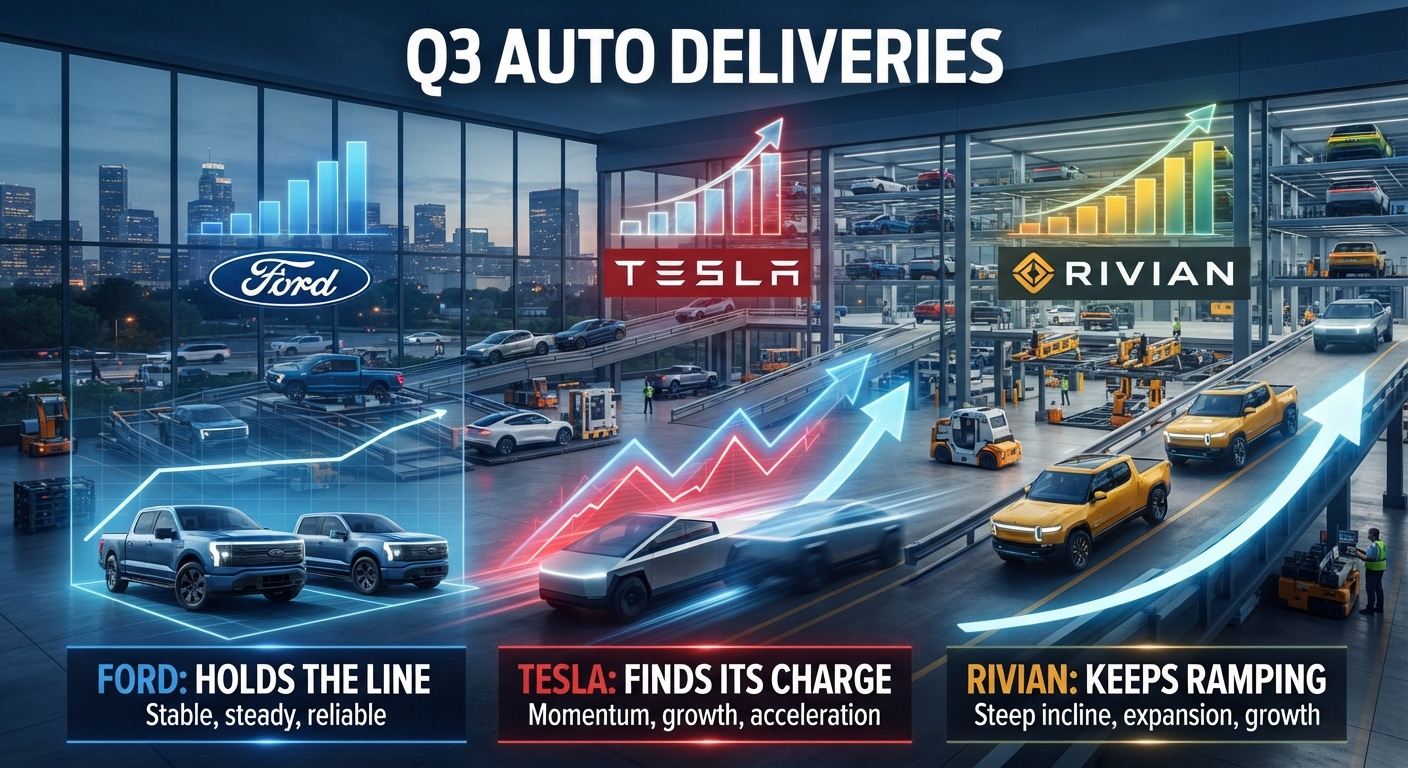
The third-quarter vehicle data delivered a more encouraging message for auto investors than the headlines might suggest: demand remains selective, execution still matters, and companies with product momentum are finding buyers. Ford Motor Co. (NYSE: F), Tesla Inc. (NASDAQ: TSLA) and Rivian Automotive Inc. (NASDAQ: RIVN) each supplied a different version of that story, and collectively, they suggest the U.S. auto market has not misplaced its appetite for capable trucks, desirable EVs or credible growth narratives.
Ford Defends Its Podium
Ford retained its position as America’s No. 3-selling automaker in the third quarter, reporting 507,395 light-vehicle sales despite a 6.6% year-over-year decline. Hyundai Motor Group, including Hyundai, Kia and Genesis, came remarkably close with 506,200 vehicles, but Ford kept the podium spot—by the sort of margin that probably makes an Olympic photo finish look leisurely. More important for investors, Ford remains ahead by roughly 89,700 units through the first nine months of 2026. The company’s third-quarter results were affected by production disruption involving crucial F-Series pickups and by difficult comparisons following discontinued models such as the Ford Escape. Yet F-Series sales fell only 1.9% during the quarter, a meaningful sign that the franchise underpinning Ford’s earnings engine is stabilizing. Ford’s management said inventory and sales trends for F-Series trucks improved during the quarter, positioning the company for a stronger fourth quarter. That matters because the F-Series is not merely another nameplate; it is one of the industry’s most commercially important profit centers. When Ford’s truck production normalizes, the operating leverage can become considerably more attractive than a simple quarterly sales percentage suggests.
What Many should watch for Ford (F)
- Recovery in F-Series availability after supplier-related disruptions.
- Mix improvement in high-margin pickups, commercial vehicles and Ford Pro services.
- Whether fourth-quarter unit momentum validates management’s stronger outlook.
- The pace of EV strategy adjustments after Ford’s EV sales fell 67.5% through September amid difficult comparisons and the end of prior federal purchase incentives.
Ford’s near-term investment proposition is less about chasing every battery-powered fashion show and more about monetizing its core strengths: trucks, fleets, brand recognition and industrial scale. Wall Street has seen this movie before. The sequels tend to improve when the factory lines stay open.
Tesla Beats Expectations and Energy Adds Another Gear
Tesla reported 486,532 third-quarter vehicle deliveries, exceeding the roughly 461,100-unit Wall Street consensus. Deliveries were down about 2% from the prior-year period but rose from 480,126 in the second quarter, offering a welcome indication that Tesla’s delivery trajectory may be improving rather than continuing to slide. Tesla’s total production reached 464,391 vehicles. The company said the Model 3 and Model Y accounted for approximately 98% of third-quarter deliveries, reinforcing both the strength and the concentration of Tesla’s core-volume platform. The market’s immediate response was emphatic: Tesla shares rose 5% following the release. Investors have had a demanding year with Tesla stock, which had declined 21% year to date through the prior day’s close, but the delivery beat gave the market something it prizes almost as much as growth itself: evidence that expectations may have become manageable. Tesla also deployed 13.7 GWh of energy-storage products during the quarter, above 13.5 GWh in the previous quarter and 12.5 GWh a year earlier. That figure highlights the increasingly consequential role of Megapack and Megablock systems in Tesla’s broader investment case. As utilities and data-center operators confront rising power demand, particularly from AI infrastructure, large-scale energy storage has become far more than an accessory business. It is beginning to look like a second engine.
Why Tesla’s Q3 report matters
| Metric | Q3 2026 result | Investor takeaway |
|---|---|---|
| Vehicle deliveries | 486,532 | Above analyst estimates of about 461,100 |
| Vehicle production | 464,391 | Production remained below deliveries, helping inventory discipline |
| Delivery change vs. Q3 2025 | Down about 2% | Still below last year, but materially better than a deeper miss |
| Delivery change vs. Q2 2026 | Higher than 480,126 | Suggests sequential momentum improved |
| Energy storage deployment | 13.7 GWh | Reinforces Tesla’s growing exposure to grid-scale storage and power demand |
Tesla will report third-quarter earnings after the market closes on October 21. The central question is no longer just whether Tesla can deliver vehicles. It is whether vehicle momentum, energy-storage expansion, software ambitions and manufacturing efficiency can restore confidence in a valuation story that has always asked investors to look several exits down the highway.
Rivian’s Growth Story Gains Traction
Rivian delivered 19,248 vehicles in the third quarter, a 46% increase from 13,201 vehicles a year earlier and ahead of the FactSet consensus expectation of 18,000. The company also reaffirmed its full-year 2026 delivery guidance of 65,000 to 70,000 vehicles. That is a constructive development for Rivian investors. Young EV companies are often judged as much by their ability to execute against their own targets as by the size of the targets themselves. Rivian’s decision to reaffirm guidance following a delivery beat signals management remains confident in its production ramp and demand outlook. The critical fourth-quarter hurdle is clear. To reach the low end of its full-year range, Rivian needs at least 23,193 deliveries in the fourth quarter—an increase of at least 20.5% from third-quarter volume. That is ambitious, but not implausible given the company’s continued ramp of the lower-priced R2 SUV, which broadens Rivian’s addressable market beyond its premium R1 lineup.
The R2 Could Reshape Rivian’s Narrative
The R2 represents more than a new vehicle launch. It is Rivian’s attempt to move from premium EV manufacturer to broader-volume contender without surrendering the outdoors-oriented brand identity that has helped distinguish it in a crowded market. For Rivian, success with R2 production could bring several advantages:
- A lower entry point for prospective customers.
- Higher unit volumes and better factory utilization.
- Greater visibility into fixed-cost absorption.
- A more persuasive long-term case for recurring software, services and charging-related revenue.
Investors should remain attentive to cash use, gross-margin progress, supply-chain execution and the company’s ability to achieve its fourth-quarter delivery requirement. Still, a 46% delivery increase and reaffirmed guidance give Rivian a substantially firmer footing than the market often grants a developing EV manufacturer.
The Bigger Auto Investment Picture
The quarter’s results show an industry splitting into distinct lanes rather than traveling in one neat convoy. Ford (F) remains a scale-and-cash-flow story built around trucks, commercial customers and a recovery in production consistency. Tesla (TSLA) remains the industry’s most closely watched blend of EV maker, energy-storage supplier and AI-adjacent technology platform. Rivian (RIVN) offers higher-risk, higher-upside exposure to an emerging EV brand attempting to convert product enthusiasm into scalable economics. The bullish takeaway is not that every automaker is suddenly accelerating in unison. It is that the companies investors care about are identifying viable routes through a choppier demand environment:
- Ford is protecting its domestic scale while its pivotal truck franchise improves.
- Tesla is beating delivery expectations while expanding its strategically valuable energy-storage business.
- Rivian is delivering growth above expectations and standing by its full-year outlook.
In a market that has spent much of the past year debating EV demand, pricing pressure and policy changes, third-quarter data provided an overdue reminder: product execution, manufacturing discipline and brand strength still matter. The automobile may be more electrified, software-defined and battery-backed than it used to be, but investors are still rewarding the old-fashioned virtues, making products people want and delivering them on time.
The Sources
- CNBC Ford fends off Hyundai to retain No. 3 U.S. sales position in third quarter
- CNBC Tesla stock jumps 5% on better-than-expected vehicle deliveries report
- CNBC Rivian tops Q3 delivery expectations, reconfirms 2026 guidance
- Reuters Ford’s quarterly U.S. sales dip after phasing out some models
- Reuters Rivian deliveries hit record high as R2 rollout gains momentum
- Ford Motor Co. (NYSE: F) Q3 2026 U.S. Sales Report / Form 8-K filing
- Investing.com Ford Q3 sales fall 6.6%; F-150 disruption contained within guidance
- Yahoo Finance Tesla Q3 2026 vehicle deliveries beat Wall Street estimates
- Yahoo Finance Rivian Q3 2026 vehicle deliveries beat Wall Street estimates
- Yahoo Finance Tesla’s Q3 deliveries loom large as the Roadster slips again
Stay Updated with Vista Partners
Subscribe to receive market insights, investing ideas, and the latest updates directly in your inbox.