The Market’s Growth Engines Are Getting Physical
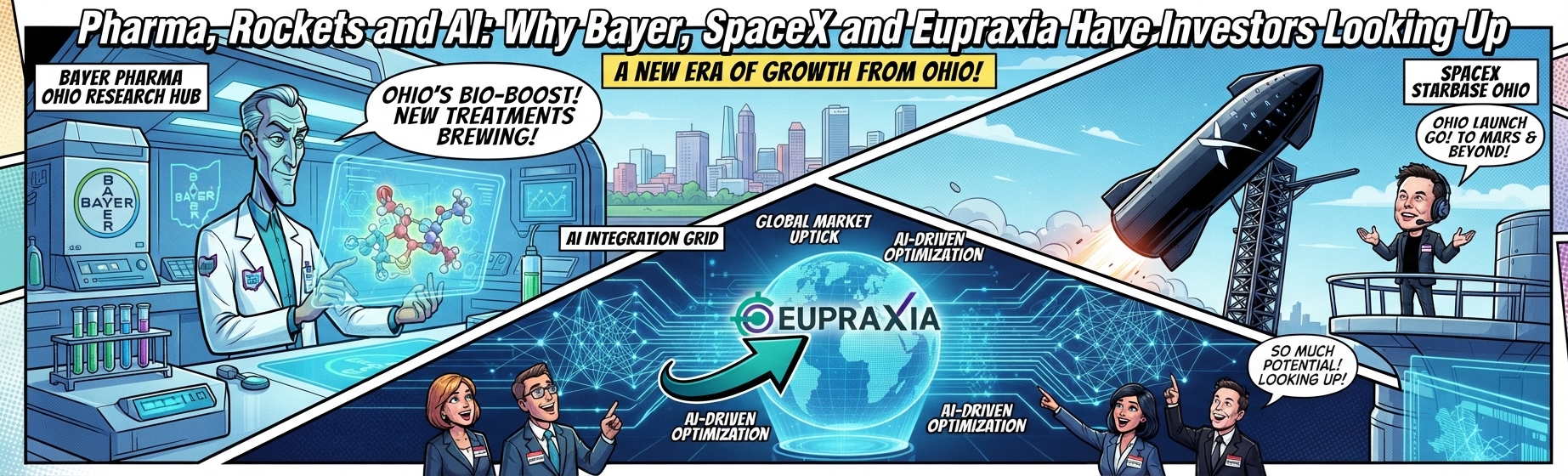
Wall Street has spent years rewarding promises around artificial intelligence, advanced medicine and space infrastructure. This week, the narrative acquired something investors usually appreciate even more: concrete evidence of execution. Bayer AG (OTC: BAYRY) is committing $2.2 billion to a new pharmaceutical manufacturing campus in New Albany, Ohio. SpaceX (private) has paired a successful crew mission to the International Space Station with the launch of Google’s (NASDAQ: GOOGL) Project Suncatcher satellite prototype. And Eupraxia Pharmaceuticals Inc. (NASDAQ: EPRX) has reported encouraging 52-week clinical data for EP-104GI in eosinophilic esophagitis, or EoE. These are very different businesses, but the investment conclusion rhymes: capital is being put behind platforms that can expand capacity, improve outcomes and create long-duration optionality. In a market often accused of paying for the future before breakfast, these developments offer a more tangible meal.
Bayer’s $2.2 Billion Ohio Bet
Bayer AG’s (OTC: BAYRY) pharmaceutical division plans to invest $2.2 billion in a new manufacturing site in New Albany, Ohio, reinforcing the United States as a central pillar of the company’s growth strategy. The site is expected to support Bayer’s oncology, cardiovascular and renal-care franchises while integrating drug-substance and finished-drug-product manufacturing in a modular, digitally enabled campus. The numbers deserve attention:
- Approximately 600 high-value permanent jobs are expected at the site, with another 1,500 construction jobs associated with the buildout.
- The first drug-substance manufacturing module is targeted to begin operating in 2031, with drug-product manufacturing planned to follow in 2034.
- Bayer has increased the United States’ share of its global pharmaceutical revenue to 35%, from 20% in 2018, and has stated an ambition to double U.S. pharmaceutical sales by the end of the decade.
The project is strategically notable because it goes beyond adding factory floor space. Bayer is constructing manufacturing flexibility around a portfolio that includes kidney-disease medicine Kerendia, prostate-cancer therapy Nubeqa and investigational stroke-prevention candidate asundexian. In plain English, the company is building infrastructure for medicines that address large, chronic and commercially meaningful disease categories. For many in Bayer AG (OTC: BAYRY), the announcement offers a useful reminder: a company reorganizing and rebuilding confidence is also investing heavily in its highest-priority growth market. Capital expenditures do not guarantee returns, of course, but a $2.2 billion commitment is a louder statement than a slide deck with an upward-pointing arrow.
SpaceX and Alphabet Put AI Into Orbit
SpaceX (SPCX) delivered a striking reminder of why it is one of the most closely watched echnology companies in the world. The company successfully launched four astronauts on NASA’s Crew-13 mission to the International Space Station and launched Alphabet Inc.’s (NASDAQ: GOOGL) Project Suncatcher satellite prototype through its Transporter-18 rideshare mission. Google’s Project Suncatcher is designed to test how the company’s tensor processing units, or TPUs, operate under the radiation, thermal stresses and physical demands of spaceflight. That turns the experiment into more than a satellite launch: it is an early test of whether elements of AI computing can eventually operate beyond terrestrial data-center constraints. The broader SpaceX story is equally important:
- SpaceX also put Starship into Earth orbit and deployed 26 Starlink V3 satellites, despite an engine outage during ascent.
- Starlink is described as SpaceX’s largest business, while Starship is central to lowering launch costs and expanding network capacity.
- Alphabet Inc. (NASDAQ: GOOGL) gains a real-world orbital laboratory for its AI hardware research, adding an intriguing long-term dimension to its deep investments in cloud computing and artificial intelligence.
SpaceX (SPCX), Alphabet (NASDAQ: GOOGL), Tesla Inc. (NASDAQ: TSLA), NASA contractors and publicly traded aerospace suppliers all sit within a rapidly expanding ecosystem shaped by SpaceX’s launch cadence and falling access-to-orbit costs. The sophistication here is not that every data center is moving to the heavens next Tuesday. It is that AI’s infrastructure race is testing every frontier, on Earth, in power markets, across semiconductor supply chains and now, quite literally, above the atmosphere. Apparently, even the cloud needed a higher floor.
Elon Musk’s Wealth Surge Reflects Execution Premium
Elon Musk’s net worth reportedly climbed by $61 billion in a single day to approximately $979.7 billion as shares connected to SpaceX and Tesla Inc. (NASDAQ: TSLA) advanced, moving his fortune closer to the $1 trillion threshold. The headline is extraordinary, but the more investable point is what it signals about market psychology.. Many are continuing to assign a premium to businesses that appear capable of executing at scale across difficult engineering domains: reusable rocketry, global satellite connectivity, electric vehicles, autonomous systems, AI computing and energy storage. For Tesla (NASDAQ: TSLA) shareholders, SpaceX’s momentum does not change Tesla’s financial statements. Yet the market’s continuing willingness to reward Musk-linked technological execution reinforces a wider valuation backdrop in which scale, software, autonomy and infrastructure remain powerful sources of investor interest. That said, many should separate personality from portfolio construction. A spectacular founder headline may be entertaining, but durable equity returns still depend on revenue growth, margins, capital intensity, competition, regulatory conditions and execution. A rocket may reach orbit on optimism; a stock generally needs cash flow to stay there.
Eupraxia’s Data Add a Biotech Catalyst
Eupraxia Pharmaceuticals Inc. (NASDAQ: EPRX) delivered the week’s more specialized, but potentially meaningful, bullish signal with updated 52-week data from the highest-dose cohorts of its Phase 1b/2a RESOLVE trial of EP-104GI for eosinophilic esophagitis. Across cohorts 5 through 9, nine of 14 patients, or 64%, remained in clinical remission 52 weeks after a single administration of EP-104GI. In the highest-dose cohort, two of three patients, or 66%, maintained clinical remission at 52 weeks. The clinical details matter because EP-104GI is designed as a locally delivered, extended-release treatment. Eupraxia’s investment thesis centers on the possibility that a single, targeted administration could produce durable benefit for a chronic inflammatory disease where patients may face recurring symptoms and treatment burdens. Additional elements many will be watching include:
- Cohort 8b reported mean reductions in EoE Histology Scoring System stage and grade of 0.26 and 0.27, respectively, at 36 weeks.
- The company reported no treatment-related serious adverse events to date and no observed cases of oropharyngeal candidiasis, adrenal insufficiency or glucose derangement in the reported study population.
- Eupraxia expects interim data from the randomized, placebo-controlled Phase 2b portion of RESOLVE in December 2026.
For Eupraxia Pharmaceuticals (NASDAQ: EPRX), the most attractive bull case is not simply a promising percentage from a small early-stage cohort. It is the potential validation of the company’s Diffusphere drug-delivery platform: precise local delivery, extended duration and a possible path toward once-yearly treatment. That would be a product profile worth watching if later, controlled data confirm the early signals. The caveat is equally clear. These are early clinical results from an open-label, dose-escalation study with small patient cohorts. The December 2026 Phase 2b interim readout is likely to be a substantially more important value-inflection event.
Why the Bullish Narrative Matters
The connective tissue among Bayer (OTC: BAYRY), Alphabet (NASDAQ: GOOGL), Tesla (NASDAQ: TSLA) and Eupraxia (NASDAQ: EPRX) is not a shared industry. It is a shared pursuit of scalable advantage.
| Company | Ticker | Current bullish development | Investor takeaway |
|---|---|---|---|
| Bayer AG | OTC: BAYRY | $2.2 billion Ohio pharmaceutical manufacturing investment | Expands U.S. capacity around high-priority therapeutic categories |
| Alphabet Inc. | NASDAQ: GOOGL | Project Suncatcher TPU prototype launched via SpaceX | Adds long-term AI-in-space research optionality |
| Tesla Inc. | NASDAQ: TSLA | Broader Musk-linked execution narrative continues to attract market attention | Remains exposed to the premium investors assign to ambitious technology platforms |
| Eupraxia Pharmaceuticals Inc. | NASDAQ: EPRX | 64% of evaluable patients remained in remission at 52 weeks after one EP-104GI administration | Provides an early clinical durability signal ahead of Phase 2b interim data |
| SpaceX | NASDAQ: SPCX | ISS crew mission, Google satellite launch and Starship progress | Demonstrates growing launch, connectivity and orbital-infrastructure capabilities |
The strongest market stories increasingly combine a near-term proof point with a longer-term platform. Bayer is investing in industrial capacity; Alphabet is testing AI hardware in orbit; SpaceX is broadening the economic map of launch services; Eupraxia is trying to turn drug-delivery precision into durable clinical value. For many, the practical implication is selective optimism. The market may be expensive in places, and each company carries distinct risks, but the underlying innovation cycle remains unusually broad. Pharmaceuticals are being re-shored and digitized, AI is stretching the limits of available computing infrastructure, and biotechnology continues to seek therapies that work longer with less systemic burden. That is a constructive backdrop for investors who prefer catalysts with substance, whether that substance is a drug molecule, a semiconductor, a reusable rocket, or 2.2 billion dollars of very deliberate Ohio concrete.
The Sources
- Bayer to Invest $2.2 Billion in a New Manufacturing Site in Ohio GlobeNewswire
- Bayer to Invest $2.2 Billion in New U.S. Pharma Site Reuters
- Bayer to Invest 2.2 Billion U.S. Dollars in a New Manufacturing Site in the United States Business Wire
- Bayer to Invest $2.2 Billion in a New Manufacturing Site in Ohio JobsOhio
- SpaceX Stock Surges After Successful ISS and Google Launches Yahoo Finance
- Elon Musk Gains $61 Billion in a Day as SpaceX and Tesla Shares Rise Yahoo Finance
- Eupraxia Pharmaceuticals Reports 52-Week Data from EP-104GI RESOLVE Trial GlobeNewswire
- Eupraxia Reports 52-Week EoE Treatment Data for EP-104GI Investing.com
- Eupraxia’s EP-104GI Holds 64% Clinical Remission at 52 Weeks MedPath
Stay Updated with Vista Partners
Subscribe to receive market insights, investing ideas, and the latest updates directly in your inbox.