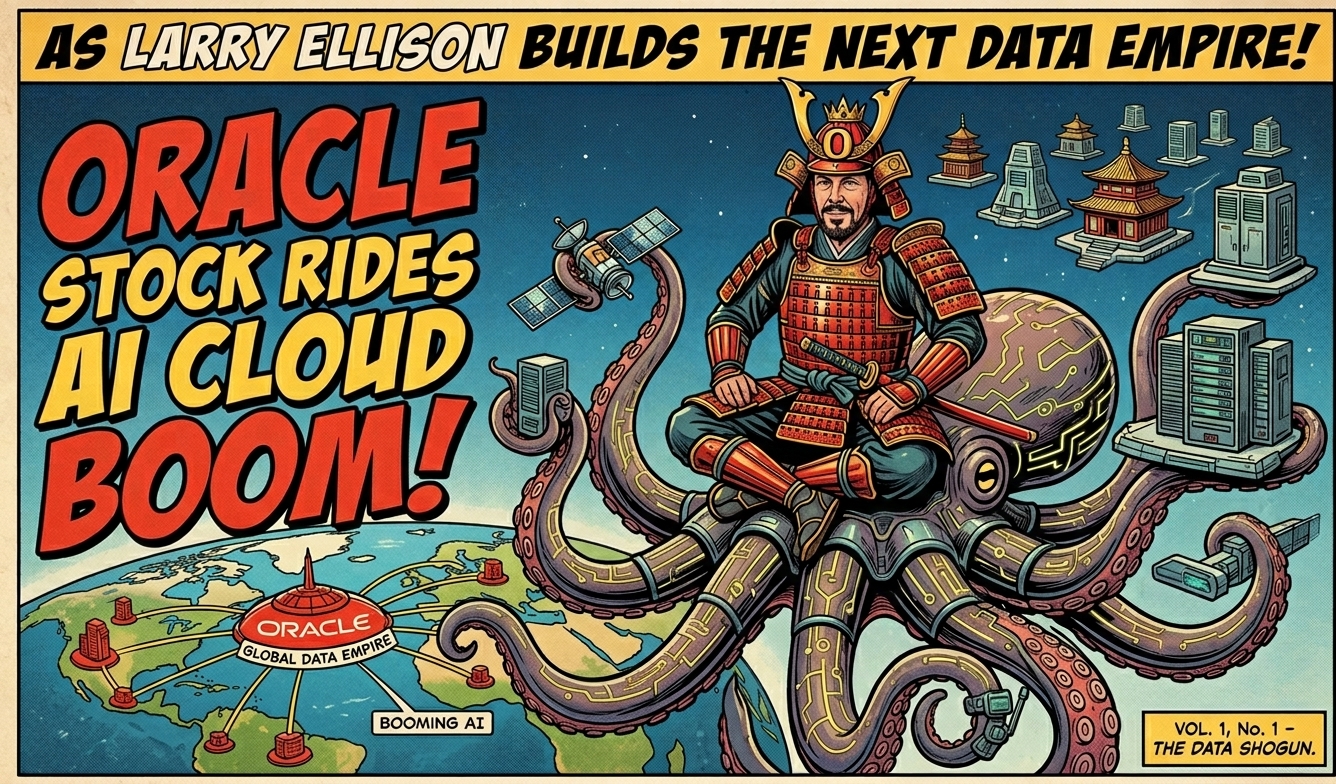
Oracle Corporation (NYSE: ORCL) has spent decades selling the corporate plumbing that keeps global business running. Now, it is turning that unglamorous-but-essential heritage into a far more fashionable enterprise: a major supplier of artificial-intelligence computing capacity. The latest quarter suggests Oracle’s AI transformation is no longer a presentation-slide ambition, it is increasingly visible in revenue, contracts and data-center delivery. Bloomberg Originals’ profile, How Larry Ellison Built His Empire, frames the company’s shift as the latest chapter in a career defined by aggressive reinvention: from relational databases and enterprise software to cloud infrastructure, AI capacity and a growing role in strategically important digital systems. The central takeaway is less theatrical than the Ellison legend, but perhaps more valuable: Oracle has found a way to make legacy enterprise relationships matter in the AI era.
Oracle’s AI Moment Has Actual Numbers Behind It
Oracle reported fiscal first-quarter 2027 revenue of $19.3 billion, up 30% from a year earlier. More important, total cloud revenue rose 62% to $11.6 billion, while Oracle Cloud Infrastructure, or OCI, revenue surged 121% to $7.4 billion. That pace puts OCI at the center of Oracle’s current growth equation rather than merely an interesting side business tucked behind the database curtain. The company also reported $6.7 billion in GAAP operating income, up 57% year over year, and $8.2 billion in non-GAAP operating income, up 31%. For many, the distinction matters: Oracle is not simply purchasing a larger cloud identity at great expense; it is still producing substantial operating profit while it builds. There is a certain elegance to the arrangement. Silicon Valley has spent years explaining that software will eat the world. Oracle’s recent results suggest that someone must also serve the world a rather expensive helping of compute, storage, networking and electricity.
The Backlog Gives ORCL a Longer Runway
Oracle’s remaining performance obligations, a measure of contracted future revenue, reached $664 billion in the fiscal first quarter. That figure increased by $209 billion from the prior year and by $26 billion sequentially. Oracle said it booked more than $30 billion in additional AI cloud contracts during the quarter. The backlog is significant because it changes the nature of the Oracle investment debate. Rather than asking only whether OCI can compete for today’s cloud workloads, investors can assess a growing body of contracted demand that could support years of capacity expansion and revenue recognition. Oracle’s management said demand for AI cloud-training and inference services continues to exceed available supply. The company added 850 megawatts of data-center capacity in the quarter, a reminder that in the AI economy, “scaling” is no longer only a software verb. It increasingly involves construction schedules, power agreements, chip availability and the occasional quantity of concrete large enough to make an infrastructure fund feel underdressed.
OpenAI and Stargate Put Oracle Near AI’s Center
The OpenAI–Oracle relationship is a major pillar of the bullish case. OpenAI and Oracle announced an agreement to develop up to 4.5 gigawatts of additional Stargate data-center capacity in the United States. The companies positioned the buildout as part of a larger push to expand AI infrastructure, support U.S. industrial capacity and advance American AI leadership. Bloomberg’s documentary describes Oracle’s reported OpenAI-related opportunity as an unusually consequential bet for both the company and Ellison personally. The program places the initiative in the context of Oracle’s broader evolution, from enterprise database champion to a provider of physical and cloud infrastructure capable of supporting the largest AI deployments. For many, the strategic value may be seemingly straightforward. AI leaders need vast computing clusters, predictable capacity and enterprise-grade data management. Oracle can offer a combination of cloud infrastructure, database technology, enterprise applications and long-standing customer relationships. That does not guarantee uninterrupted execution, but it gives Oracle a credible claim to a valuable portion of AI’s industrial layer.
Ellison’s Competitive Instinct Is Suddenly Timely
Larry Ellison has never been known for treating competition as a wellness exercise. Bloomberg’s profile recounts a career shaped by rivalries, acquisitions and an enduring conviction that markets are best approached with intensity rather than moderation. Oracle’s purchases of PeopleSoft and Siebel Systems helped broaden its enterprise footprint, while its database franchise cemented the company as a core technology supplier for governments and businesses worldwide. That history matters because Oracle’s AI ambitions are not a clean-sheet startup project. The company enters the race with decades of experience managing critical workloads, databases, security-sensitive deployments and enterprise procurement cycles. Its cloud strategy may have arrived later than those of Amazon.com, Inc. (NASDAQ: AMZN), Microsoft Corporation (NASDAQ: MSFT) and Alphabet Inc. (NASDAQ: GOOGL), but arriving later with a very large contract book is a respectable substitute for punctuality. Oracle’s advantage may be especially pronounced where customers want AI compute alongside high-performance database services, data sovereignty, multicloud flexibility and deep enterprise integration. In other words, the company is not trying to become every cloud provider. It is trying to become indispensable in the workloads where performance, data and scale meet.
Why the Bull Case Is More Than Momentum
The most constructive case for Oracle stock rests on four connected developments:
- Cloud growth is accelerating. OCI revenue grew 121% in the latest quarter, while total cloud revenue climbed 62%.
- Contract visibility is unusually large. Oracle’s $664 billion in remaining performance obligations offers a sizable base of future contracted revenue, although the timing of recognition will matter greatly.
- Capacity is being delivered. The company added 850 megawatts of data-center capacity in the quarter, linking its AI narrative to measurable infrastructure deployment.
- AI demand appears durable. Oracle said AI training and inference demand is outstripping supply, while its Stargate partnership with OpenAI includes up to 4.5 gigawatts of additional capacity.
The result is a company that may deserve to be valued less as a mature software incumbent and more as a hybrid of enterprise-software cash generator, cloud-infrastructure builder and AI-capacity provider.
The Risks Are Real and Worth Naming
A bullish thesis should not confuse a large backlog with money already deposited in the bank. Remaining performance obligations represent future contracted revenue, not immediate revenue or cash flow. Their value depends on customer demand, contract performance, project completion and Oracle’s ability to bring capacity online efficiently. The scale of the infrastructure build also requires substantial capital investment. Oracle’s fiscal first-quarter capital expenditures reportedly reached $28 billion, contributing to negative free cash flow, while management expects full-year capital expenditures of $90 billion to $95 billion. That is the price of entering AI infrastructure at industrial scale, and investors should watch financing needs, margins, construction execution and customer concentration closely. OpenAI exposure is both a source of upside and a source of concentration risk. Reports have indicated that a substantial portion of Oracle’s RPO may be tied to OpenAI-related commitments. If the AI leader’s financing position, computing needs or project timetable changes, Oracle’s forward assumptions could face pressure.Still, risk is not the opposite of opportunity; it is frequently the admission price. Oracle is spending heavily because the addressable market is large enough to justify a very large hard hat.
What To Watch Next
The next phase of the Oracle story will be decided less by broad AI enthusiasm than by quarterly evidence. Investors should monitor:
- OCI revenue growth and whether triple-digit expansion can remain durable.
- New data-center capacity delivered, particularly megawatts added and utilization levels.
- The conversion of RPO into reported revenue and operating cash flow.
- Capital-expenditure trends, financing requirements and the impact on free cash flow.
- Progress on the OpenAI–Oracle Stargate capacity buildout.
- Oracle’s ability to preserve margins while expanding AI infrastructure at a remarkable pace.
- Competitive responses from Amazon (NASDAQ: AMZN), Microsoft (NASDAQ: MSFT), Alphabet (NASDAQ: GOOGL) and other AI-cloud suppliers.
The Bottom Line on Oracle
Oracle’s current opportunity is not simply that it has joined the AI conversation. It is that the company is increasingly supplying the infrastructure on which that conversation runs. Fiscal first-quarter results, $19.3 billion in revenue, 121% OCI growth, $11.6 billion in cloud revenue and $664 billion in RPO, make the transformation increasingly tangible. The market will rightly scrutinize capital spending, customer concentration and execution risk. But Oracle’s enterprise foundation, giant contract backlog and deepening role in AI infrastructure suggest that NYSE: ORCL may be entering a new corporate era. Larry Ellison built Oracle by making the data layer indispensable. His latest wager is that the AI era will need an equally indispensable infrastructure layer, and that Oracle intends to own a meaningful piece of it.
Learn More Now
The Sources
- Bloomberg Originals How Larry Ellison Built His Empire
Video profile examining Larry Ellison’s career, Oracle’s evolution from database software to cloud infrastructure, and its expanding role in artificial-intelligence computing. - Oracle Investor Relations Oracle Announces Q1 FY2027 Results Driven by Triple-Digit Growth in Cloud Infrastructure Revenue
Oracle’s primary earnings release covering fiscal first-quarter 2027 revenue, Oracle Cloud Infrastructure growth, operating income, AI contracts, RPO backlog and capacity expansion. - OpenAI Stargate Advances With 4.5 GW Partnership With Oracle
OpenAI’s announcement detailing its agreement with Oracle to develop up to 4.5 gigawatts of additional U.S. Stargate data-center capacity. - OpenAI OpenAI, Oracle and SoftBank Expand Stargate With Five New Sites
Background on Stargate’s broader infrastructure expansion, including new sites and OpenAI’s plans for AI computing capacity in the United States. - Oracle Investor Relations Oracle Earnings and Financial Information
Oracle’s investor-relations hub for earnings releases, SEC filings, presentations, webcasts and financial disclosures. - The Motley Fool Oracle (ORCL) Q1 2027 Earnings Call Transcript
Earnings-call transcript and discussion of Oracle’s $19.3 billion in quarterly revenue, OCI’s reported 121% growth and the company’s $664 billion RPO figure. - Investing.com Oracle Q1 FY2027 Slides: Cloud Infrastructure Surges 121%, Guides $90B+
Third-party summary of Oracle’s quarterly presentation, cloud-infrastructure growth, guidance and AI-related demand trends. - ERP Today Oracle Q1 FY27 Results: $664B Backlog, Negative Cash Flow and AI Contracts
Independent coverage of Oracle’s RPO backlog, AI-related contract activity, capital spending and cash-flow considerations. - MarketWise Oracle Earnings: Watch Out for Massive OpenAI Risk
Analysis of Oracle’s data-center-capacity delivery, backlog growth and potential customer-concentration considerations tied to OpenAI.
Disclosure: This article is for informational purposes only and is not investment advice. Investors should conduct independent research and consider their own objectives, risk tolerance and professional advice before investing.
Stay Updated with Vista Partners
Subscribe to receive market insights, investing ideas, and the latest updates directly in your inbox.