The headline: skincare is now the business
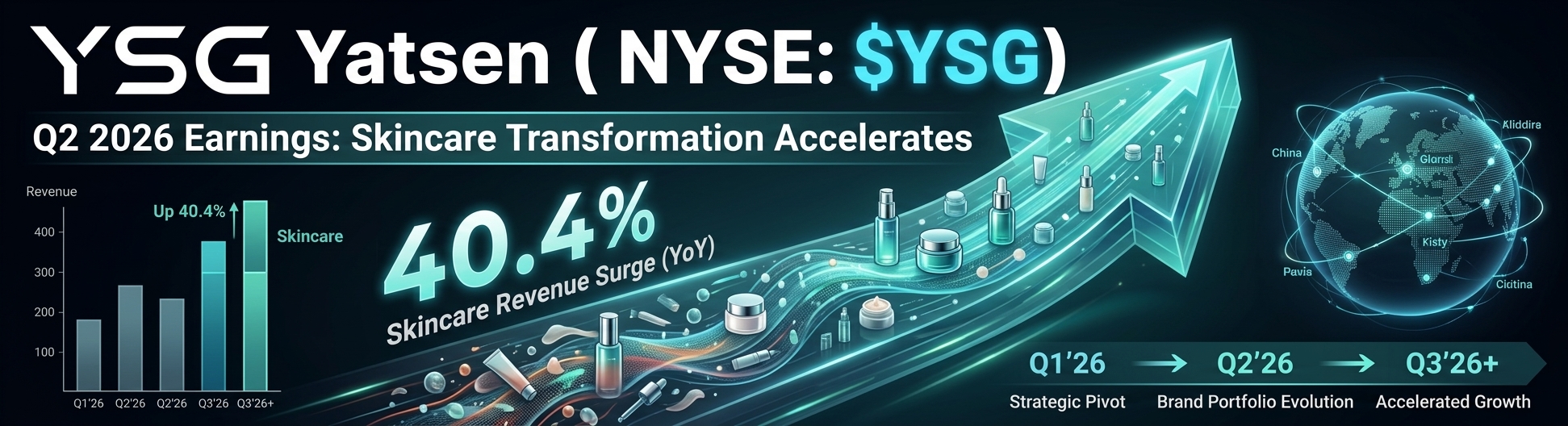
Yatsen reported second-quarter 2026 revenue of RMB1.14 billion, or approximately $168.3 million, up 5.1% year over year. That modest consolidated growth masks a much more consequential shift beneath the makeup counter: skincare-brand revenue rose 40.4% to RMB816.1 million, accounting for 71.5% of total sales, compared with 53.5% a year earlier. For investors in NYSE: YSG, the important number is not simply 5.1%. It is 71.5%. That figure signals that Yatsen is rapidly becoming a skincare-led beauty group, one centered on Galénic, DR.WU and Eve Lom, rather than a company whose identity depends primarily on the crowded, promotion-heavy world of color cosmetics. The company’s color-cosmetics revenue declined 35.8% year over year, but skincare growth was strong enough to more than offset that drag at the consolidated level. There is a certain elegance to the strategy. Lipstick can be fashionable; skincare, at least in a well-run portfolio, can be habitual. Wall Street has historically shown a preference for the latter.
A portfolio reset, not a retreat
Management is explicitly trimming and rationalizing its color-cosmetics portfolio while directing resources toward higher-growth skincare categories. That means Yatsen is no longer trying to win every aisle, every SKU and every consumer whim. Instead, it is narrowing its aim around areas where premium positioning, clinical credibility and repeat-purchase behavior may offer a more durable commercial foundation. The timing has a logical industrial backdrop. China’s skincare market is projected to reach $62.9 billion in 2026 and is forecast to expand at a 7.19% compound annual growth rate through 2031, according to Mordor Intelligence. Premium skincare is expected to grow even faster, at an estimated 8.11% CAGR. That does not guarantee Yatsen a free ride, Chinese beauty consumers have never been accused of being easy marks, but it gives YSG a meaningful tailwind if it can keep its brands relevant and its marketing returns disciplined. Industry observers also point to rising consumer interest in science-oriented, clinical-grade and prestige skincare. That aligns unusually well with Yatsen’s decision to lean into Galénic, DR.WU and Eve Lom rather than attempt to out-discount every competitor in the cosmetics bazaar.
The overlooked operational improvement
The bears will correctly point out that Yatsen’s GAAP net loss widened to RMB90.8 million, or $13.4 million, from RMB19.5 million in the year-earlier quarter. Its non-GAAP result also swung to a RMB99.4 million loss from a RMB11.5 million profit. Gross margin declined to 73.9% from 78.3%, largely because of inventory provisions tied to the company’s proactive color-cosmetics cleanup. Those numbers matter. A strategic pivot only earns applause for so long before it must produce financial leverage. Still, there are encouraging signs in the expense architecture:
- Fulfillment expense fell to 4.9% of revenue from 5.8%, which management attributed to logistics efficiency gains.
- General and administrative expense declined to 6.6% of revenue from 7.7%, helped by lower share-based compensation expense.
- Research and development spending held near 3.3% of revenue, preserving investment in new-product capabilities even as the business reorganizes.
- Cash, restricted cash and short-term investments totaled RMB1.06 billion, or about $155.6 million, at June 30, essentially steady with the year-end 2025 balance.
In plain English, NYSE: YSG has not yet solved the profitability equation, but it has retained liquidity while removing some operational friction. That is a more promising setup than trying to execute a portfolio transformation with an empty wallet and a shipping bill that needs its own skincare routine.
Why the loss may be transitional
Yatsen spent heavily on selling and marketing during the quarter, with the category rising to RMB807.6 million, or 70.7% of revenue, from 66.5% a year earlier. The company cited investments in consumer awareness and brand equity for its core skincare brands, as well as higher traffic-acquisition costs on Douyin. For a skeptical investor, that is the central debate:
| Bullish interpretation | Bearish interpretation |
|---|---|
| Marketing investment can build awareness, customer acquisition and repeat purchasing for premium skincare franchises | Higher customer-acquisition costs may prove stubborn, limiting the payoff from sales growth |
| Color-cosmetics inventory actions may clear the deck for a cleaner, more focused portfolio | Inventory provisions and lower gross margin could persist if portfolio rationalization takes longer |
| Skincare’s 40.4% growth suggests brands are gaining commercial traction | The 35.8% decline in color cosmetics shows legacy business pressure remains acute |
| A stable RMB1.06 billion liquidity position provides runway for the transition | Operating cash outflow of RMB78.0 million shows the company must eventually convert strategy into cash generation |
The bullish case rests on the possibility that Yatsen is deliberately accepting near-term margin pain to assemble a business with better revenue quality. The company’s second-quarter operating loss was RMB131.9 million, while operating cash flow was negative RMB78.0 million, so this is not an argument for ignoring the financial statements. It is an argument for reading them as a work in progress.
What investors should watch next
Yatsen guided for third-quarter 2026 revenue of RMB898.6 million to RMB998.4 million, implying a year-over-year change between flat and down 10%. That is a conservative outlook, and investors should not pretend otherwise. The next few quarters should answer four practical questions:
- Can skincare sustain outsized growth? A repeat of strong growth in Galénic, DR.WU and Eve Lom would validate the strategic shift more persuasively than any investor presentation.
- Will the color-cosmetics reset become less dilutive? Investors should look for lower inventory-related pressure, a stabilizing revenue trend, or at least a declining drag from the segment.
- Can marketing become more productive? Selling and marketing at 70.7% of revenue is substantial. The investment thesis improves sharply if customer acquisition, brand awareness and repeat purchase begin translating into operating leverage.
- Does liquidity remain durable? With approximately RMB1.06 billion of cash, restricted cash and short-term investments, Yatsen has resources to execute. But sustained operating cash outflows would elevate the importance of cash discipline.
Yatsen also appointed Li Wang as co-chief financial officer, effective September 2, 2026. Wang previously served as CFO at Proya Cosmetics Co., Ltd. and is expected to succeed current CFO Donghao Yang following the filing of Yatsen’s 2026 Form 20-F. For investors, the planned handoff adds a degree of succession visibility while the company manages a complicated transition.
A Takeaway
The bullish case for Yatsen Holding Limited (NYSE: YSG) is not that the company produced a spotless quarter. It did not. The case is that its most valuable strategic engine, skincare, grew 40.4%, became more than 70% of revenue, and is increasingly aligned with the premium and clinical skincare categories that appear to hold stronger structural appeal in China. YSG is therefore better viewed as a transformation story than as a simple quarterly earnings trade. Revenue growth is modest, profitability has deteriorated and management’s near-term outlook is restrained. But the business mix is moving decisively toward skincare, the balance sheet still offers operating runway, and early evidence suggests the company’s premium-brand strategy has real commercial momentum. For investors comfortable with execution risk, NYSE: YSG may be developing into a classic “show-me” opportunity: not yet polished enough for consensus comfort, but perhaps far more interesting because the underlying business is starting to change before the income statement has caught up.
The Sources
- Yatsen Announces Second Quarter 2026 Financial Results PR Newswire
- Yatsen Announces Second Quarter 2026 Financial Results TradingView / PR Newswire
- Yatsen Q2 2026 Results: Skincare Revenue Jumps 40.4% Stock Titan
- Yatsen Announces Fourth Quarter and Full Year 2025 Financial Results Yatsen Investor Relations
- Yatsen Filed 2025 Annual Report on Form 20-F Yatsen Investor Relations
- Yatsen 2025 Annual Report on Form 20-F U.S. Securities and Exchange Commission
- Yatsen Announces Completion of First Tranche of Private Placement With Hillhouse Participation Yatsen Investor Relations
- China Skin Care Market Size, Share and Growth Trends Mordor Intelligence
- China Beauty Predictions for 2026 BeautyMatter
- 2026 China Beauty Market Trends Report Daxue Consulting
- China’s Professional Beauty Market Enters a New Era Kline Group
- 2025 Whitepaper: China’s Beauty and Skincare Market Analysis MooJing Global
Stay Updated with Vista Partners
Subscribe to receive market insights, investing ideas, and the latest updates directly in your inbox.