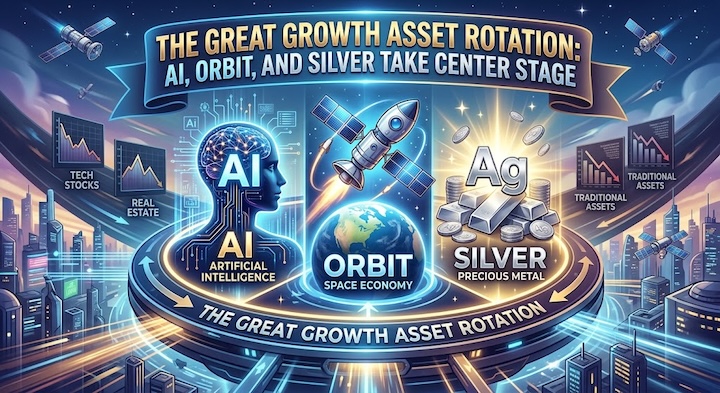
Wall Street has rarely lacked for ambition, but 2026 is offering an especially lavish menu: artificial intelligence firms approaching trillion-dollar valuations, a space company with revenue aspirations that would make many nations glance nervously at their GDP tables, and silver holding its ground as investors weigh inflation, geopolitics and industrial demand. The bullish throughline is clear. Capital is increasingly seeking businesses and assets tied to the infrastructure of the next economic cycle—AI models, data capacity, satellite connectivity, launch services and the metals that help electrify, connect and compute the world. The market may still deliver its customary bouts of indigestion, but the long-term opportunity set is becoming harder to ignore.
Anthropic’s IPO Could Redefine AI Valuations
Anthropic, or ANTH.PVT, is emerging as a leading contender for the largest IPO of 2026, according to prediction-market activity tracked by Polymarket. The company’s annualized revenue run rate is reportedly on track to exceed $65 billion in 2026, up from a $47 billion pace in May—a striking acceleration for a business that has yet to offer public investors a direct way to participate. That revenue momentum helps explain why private-market investors value Anthropic at roughly $1 trillion, ahead of OpenAI, or OPAI.PVT, at approximately $894 billion. Whether those valuation markers become public-market reality is an open question, but the strategic message is unmistakable: enterprise AI is evolving from an experimental software category into a central layer of corporate productivity and digital infrastructure. For investors, an eventual Anthropic listing would not merely be another high-profile IPO. It could become a fresh valuation benchmark for the wider AI ecosystem—from semiconductors and cloud computing to data-center power, networking and cybersecurity. In other words, the AI trade may be preparing for its next act, and the theater is likely to be sold out before the curtain rises.
SpaceX Is Making Orbit Investable
SpaceX (NASDAQ: SPCX) has already shown what happens when an iconic private company meets a public market hungry for moonshots with revenue. The company priced its June 2026 offering at $135 per share, opened at roughly $150, and closed its first session at $160.95—producing a 19.2% first-day gain and a market capitalization near $2.1 trillion. Shares later reached about $225 before retreating amid concerns surrounding lockups and capital spending, then rebounded to approximately $146, valuing the company around $1.93 trillion. The volatility is not a bug; it is practically part of the launch sequence. The central investment question is whether SpaceX can translate its powerful collection of assets—Starlink connectivity, launch capacity and AI infrastructure—into the kind of recurring revenue machine typically associated with the world’s largest technology platforms. Elon Musk has raised the bar further, saying SpaceX could reach $1 trillion in annual revenue by 2030, one year earlier than a prior 2031 target. The path depends heavily on aggressive expansion across Starlink, launch services and AI-related data infrastructure. SpaceX generated an estimated $18.67 billion in 2025 revenue, with Starlink accounting for $11.4 billion, launch services $4.1 billion and AI-related operations $3.2 billion. Reaching $1 trillion by 2030 would require a roughly 121.7% five-year compound annual growth rate—an extraordinary hurdle, even by Silicon Valley’s increasingly relaxed definition of “reasonable.”
Starlink Creates a New Connectivity Thesis
Starlink is the engine investors are watching most closely. With more than 13 million subscribers, the satellite-internet operation already represented 61% of SpaceX’s 2025 revenue, according to the cited analysis. The business could broaden from serving remote and supplemental connectivity markets toward competing more directly with terrestrial telecommunications providers. That creates an important read-through for publicly traded companies exposed to satellite communications, telecommunications and cloud infrastructure:
| Company | Ticker | Investor relevance |
|---|---|---|
| SpaceX | NASDAQ: SPCX | Public-market leader in satellite internet, launch services and orbital/terrestrial AI infrastructure |
| AST SpaceMobile | NASDAQ: ASTS | Direct-to-device satellite connectivity competitor working with terrestrial carriers |
| Rocket Lab | NASDAQ: RKLB | Launch and space-systems contender benefiting from growing orbital infrastructure demand |
| Amazon | NASDAQ: AMZN | Satellite connectivity ambitions and cloud/AI infrastructure through AWS |
| AT&T | NYSE: T | Potential beneficiary of satellite partnerships and expanded coverage capabilities |
| Verizon | NYSE: VZ | Potential participant in hybrid terrestrial-satellite connectivity expansion |
AST SpaceMobile (NASDAQ: ASTS) represents one of the clearest public-market expressions of direct-to-device satellite connectivity, while Rocket Lab (NASDAQ: RKLB) offers investors exposure to launch and broader space-system demand. Amazon (NASDAQ: AMZN) brings formidable capital resources through its satellite initiatives, AWS cloud platform and AI infrastructure ambitions. AT&T (NYSE: T) and Verizon (NYSE: VZ) could benefit if satellite networks extend coverage and reduce connectivity gaps rather than simply replace conventional cellular networks. The key point for investors is that space is no longer simply a defense, exploration or communications story. It is increasingly a distributed-infrastructure story—one that touches broadband, autonomous systems, AI workloads, logistics and national competitiveness.
Silver Holds Its Ground
While AI and space capture headlines with trillion-dollar adjectives, silver has been quietly delivering its own forceful message. September silver futures, tracked as SI=F, opened at $65.90 per ounce on August 18 and traded near $65.12 later that morning. Despite the modest daily decline, silver was up 1.6% over one week, 18.6% over one month and 73.6% year over year. The metal’s resilience reflects a useful dual identity. Silver can attract investor demand during periods of geopolitical and inflation uncertainty, while also serving industrial markets that depend on electrification, electronics, solar deployment and increasingly sophisticated computing hardware. It is, in effect, both a hedge and a hardware story—an unusually versatile job description for a metal. The near-term backdrop remains complicated. Stalled U.S.-Iran diplomacy, higher oil prices and rising Treasury yields have increased concern over inflation and economic uncertainty. Yet those crosscurrents can also reinforce demand for precious metals, particularly when investors seek an accessible alternative to higher-priced gold.
A Bullish, But Selective, Investment Map
The opportunity is not to buy every ticker that has ever appeared near the words “AI,” “space” or “silver.” The more compelling approach may be to focus on companies and assets with identifiable revenue engines, durable demand drivers and the financial capacity to execute during inevitable periods of market volatility.
- AI infrastructure: Anthropic (ANTH.PVT) and OpenAI (OPAI.PVT) underscore the scale of private-market enthusiasm for frontier AI. Public-market beneficiaries may include companies providing computing, cloud, power, networking and data infrastructure.
- Space and connectivity: SpaceX (NASDAQ: SPCX) has established a new benchmark for public investor interest in orbital infrastructure. AST SpaceMobile (NASDAQ: ASTS), Rocket Lab (NASDAQ: RKLB), Amazon (NASDAQ: AMZN), AT&T (NYSE: T) and Verizon (NYSE: VZ) offer varied ways to assess the satellite-connectivity theme.
- Strategic metals: Silver futures (SI=F) offer a more direct lens on the precious-metal and industrial-demand narrative, though investors should remember that silver’s volatility can be considerable. The metal fell roughly 32% within weeks after exceeding $113 per ounce in early January 2026, a useful reminder that even a powerful secular case does not eliminate tactical risk. The Global X Silver Miners ETF (SIL) is off ~3% today at $87.84.
The bullish case for the remainder of 2026 rests on a simple proposition: the economy’s most valuable assets are becoming more computational, more connected and more power-intensive. Anthropic’s prospective IPO, SpaceX’s sweeping commercial ambitions and silver’s durable bid each represent a different part of that same investment landscape. Investors should expect turbulence—because markets prefer a little drama with their upside—but the structural themes remain compelling. AI needs compute. Compute needs power. Power and connectivity need infrastructure. And infrastructure, it turns out, may increasingly reach all the way to orbit.
The Sources
- Yahoo Finance — Anthropic could beat Elon Musk’s SpaceX for largest 2026 IPO, prediction markets show
- Yahoo Finance — Silver prices today, Tuesday, August 18, 2026: Silver price holds as investors weigh inflation and geopolitical risks
- Yahoo Finance — Elon Musk Says SpaceX Will Hit $1 Trillion in Revenue by 2030: Here’s the Math Behind the New Number
Disclosure: This article is for informational purposes only and is not investment advice.
Stay Updated with Vista Partners
Subscribe to receive market insights, investing ideas, and the latest updates directly in your inbox.