The Bullish Case for Obsession
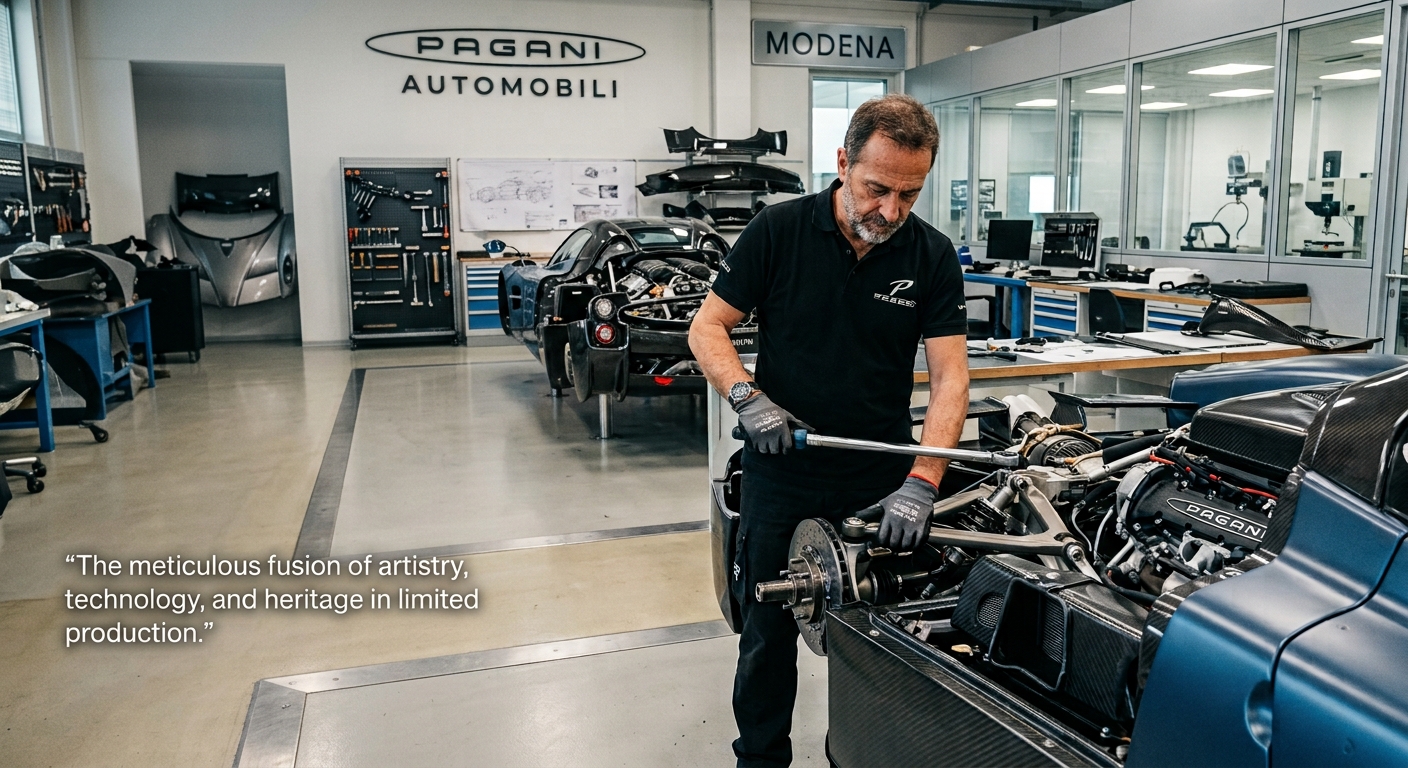
At Pagani Automobili, a bolt is not merely a fastener. It is a tiny titanium ambassador of a broader philosophy: if a component can be engineered beautifully, documented precisely and made memorable, why settle for merely functional? The Modena-based hypercar maker illustrates a powerful premium-market lesson. In an era when many manufacturers compete on volume, software features and monthly payment calculators, Pagani competes on scarcity, traceability and a kind of engineering theater that makes a watchmaker seem hurried. Its atelier delivered only 67 cars in the 12 months discussed in the video, with each vehicle taking roughly nine weeks to assemble after components are prepared. That constraint is not a bug in the business model. It is the business model.
Scarcity With Substance
The Utopia Roadster sits at the heart of the current story: a lightweight, non-hybrid, twin-turbo V12 hypercar whose official specifications cite 1,280 kilograms, 864 horsepower and 1,100 Nm of torque. Its engine is developed with Mercedes-AMG—part of a long-running relationship that gives Pagani access to industrial-grade powertrain capability without requiring it to build an engine empire in-house.
For investors studying luxury economics, the setup is appealing:
- Extreme supply discipline: Limited output keeps the brand’s desirability from being diluted by its own success.
- High-value customization: Direct client dialogue and bespoke commissions transform a purchase into a relationship—and a relationship into pricing power.
- Technical differentiation: Pagani uses more than 40 composite-material formulations in the Utopia Roadster, including Carbo-Titanium and Carbo-Triax variants.
- Collectible credibility: The brand’s low-production models combine hand assembly, documented provenance and specialized materials—attributes that collectors tend to prize long after the new-car scent has been replaced by auction-catalogue prose.
The company’s “Grandi Complicazioni” program takes this logic even further. A recent official Pagani release describes a model produced in only three units, built around direct client collaboration and tailor-made engineering. In luxury, that is less a manufacturing run than a three-part private treaty.
The $120,000 Bolt Lesson
The video’s most memorable calculation may also be its most commercially revealing: approximately 2,000 titanium bolts per car, each reportedly costing about £60, or roughly £120,000 in bolts alone. That is more than the price of an entry-level Porsche 911 Carrera, a sentence that is both absurd and, for Pagani, perfectly on-brand. Yet the point is not that expensive bolts automatically create a valuable company. The point is that Pagani has built a system in which microscopic details reinforce macroscopic brand equity. The bolts bear the Pagani logo etched to a depth of two microns. The aluminum steering wheel begins as a 43-kilogram billet and is machined down to roughly 1.7 kilograms through a process involving hundreds of programmed subroutines and additional hand polishing. In a mainstream factory, this might qualify as an efficiency seminar’s cautionary tale. At Pagani, it is product strategy. Customers are not simply buying acceleration. They are purchasing evidence that somebody cared about the dipstick.
A Different Kind of Moat
Pagani’s moat does not resemble that of a mass-market automaker. It is not dealer density, manufacturing scale or a finance arm. Instead, its advantage rests on a difficult-to-replicate combination of founder-led design authority, advanced composites expertise, a durable Mercedes-AMG relationship, accumulated collector prestige and an artisan workforce that produces consistency without sterilizing personality. Horacio Pagani’s early work in composites, including Modena Design’s role in advanced carbon-fiber engineering, supplied the technical foundation for the brand. Pagani Automobili followed with the Zonda, then the Huayra, and then the Utopia—each carrying forward a mix of low-volume production and material innovation.
The above video captures how that approach translates into operations:
- Every car is built from approximately 10,000 components.
- Fewer than 10 cars are generally assembled at one time.
- Buyers can follow their car’s construction, while documentation creates an unusually detailed ownership record.
- Components and design choices are treated as visible expressions of craftsmanship, even where owners may rarely see them.
That last point matters. Luxury brands thrive when the hidden parts are as persuasive as the visible ones. A customer may never inspect a wheel bearing at a concours lawn, but knowing it was engineered like jewelry can be strangely effective for the soul—and extraordinarily effective for gross-margin architecture.
Public-Market Read-Throughs
Pagani itself is privately held, so investors cannot buy its shares directly. But its strategy offers useful read-throughs for several public companies operating around the premium-performance, luxury and advanced-materials ecosystems.
| Company | Ticker | Investor relevance |
|---|---|---|
| Mercedes-Benz Group AG | MBG.DE | Mercedes-AMG’s bespoke V12 collaboration with Pagani demonstrates the strategic value of elite engineering capabilities that can enhance brand reach beyond Mercedes’ own vehicle lineup. |
| Porsche AG | P911.DE | Porsche provides the useful contrast: higher scale, deeper public-market liquidity and broad luxury appeal, while Pagani shows how scarcity can turn craftsmanship into an asset class of its own. |
| Ferrari N.V. | RACE | Ferrari remains the clearest listed benchmark for constrained supply, heritage, customization and pricing power in high-performance luxury automobiles. |
| Lamborghini’s parent, Volkswagen AG | VOW3.DE | Horacio Pagani’s composite-material career was shaped during his Lamborghini years, a reminder that talent and technical experimentation can create value far outside an original corporate home. youtube |
| Pirelli & C. S.p.A. | PIRC.MI | Pagani’s performance development and bespoke tire work underscore the premium opportunity for specialized tire technology in ultra-high-performance applications. youtube |
The real investment takeaway is not that every luxury automaker should start charging six figures for bolts. Finance departments may object, and not without grounds. Rather, Pagani demonstrates that luxury pricing power is strongest when scarcity is backed by capability, not merely marketing.
The Takeaway
The market often rewards businesses that can expand margins through automation, scale and repeatability. Pagani makes the contrarian case that there is also value in selective inefficiency—provided the inefficiency is visible to customers as mastery. Its operating formula is straightforward, if not easily copied: use advanced materials, preserve handcrafted execution, cap supply, invite customers into the production narrative and make every detail sufficiently distinctive that resale value becomes part of the conversation. For Mercedes-Benz Group AG (MBG.DE), Ferrari N.V. (RACE), Porsche AG (P911.DE), Volkswagen AG (VOW3.DE) and Pirelli & C. S.p.A. (PIRC.MI) investors, Pagani serves as an elegant market signal. Demand at the highest end of performance luxury is not simply about horsepower. It is about authenticity, engineering provenance and the rare ability to make a machined oil dipstick feel like a boardroom-worthy capital allocation decision. In Modena, even the fasteners appear to understand the importance of brand positioning.
The Sources
Sources
- Carwow — “Why Pagani BOLTS cost more than a Porsche 911!” (YouTube video)
- Pagani Automobili — Pagani Automobili at Auto e Moto d’Epoca 2025
- Pagani Automobili — Pagani Automobili at Salon Rétromobile 2026
- The Gentleman Racer — Inside The Pagani Factory: Touring Italy’s Hypercar Atelier
- CarsUp — Horacio Pagani: Carbon or Nothing
- Managing Composites — Horacio Pagani’s Relationship With Composite Materials
Disclosure: This article is for informational purposes only and is not investment advice.
Stay Updated with Vista Partners
Subscribe to receive market insights, investing ideas, and the latest updates directly in your inbox.