


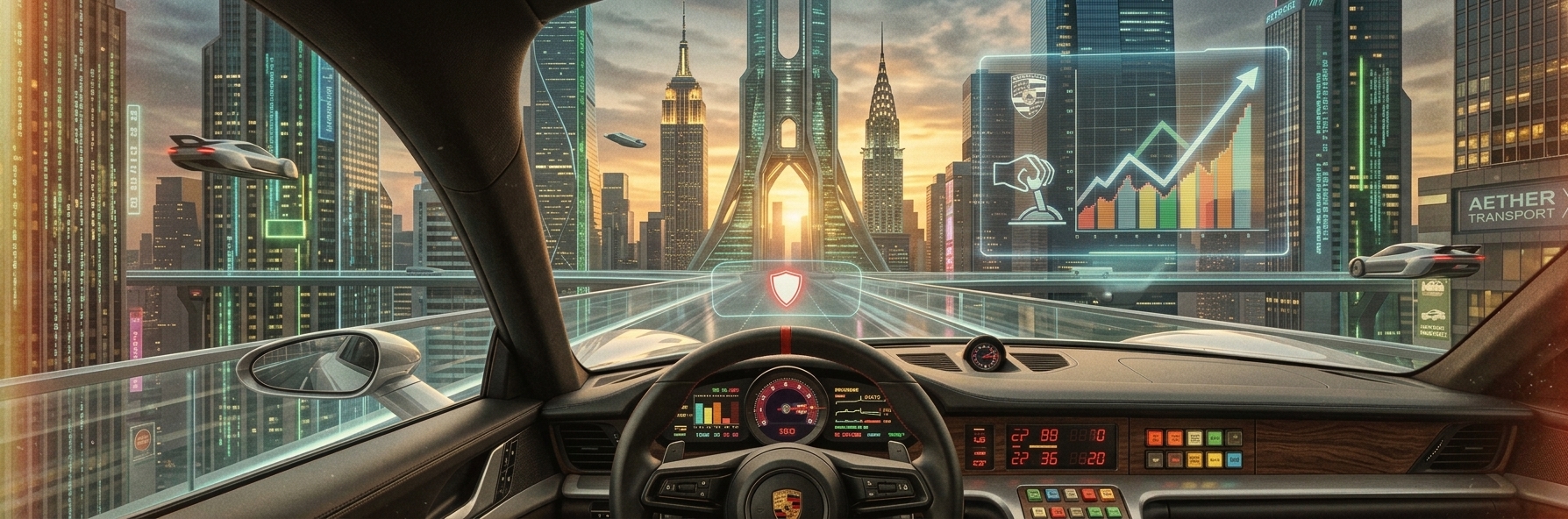
Porsche’s new mid-engine concept gives investors a compelling view of its luxury ambitions, pairing sports-car heritage with a strategy built around higher-value vehicles, personalization and stronger cash generation.
Porsche has unveiled something more interesting than another fast car: a potential new floor of the showroom where the prices, and ideally the profits, climb considerably higher. The Porsche Mission S, revealed October 15 in Queens, New York, previews a mid-engined super sports car platform positioned above the 911. Crucially, Porsche describes the planned offering as a permanent addition to its range rather than an occasional, limited-run hypercar. For Porsche AG investors, whose listed preference shares trade under P911 in Germany, P911.DE on financial platforms and on the OTC as POAHF, that distinction turns an arresting design study into a potentially meaningful business proposition. The bullish case is straightforward: Porsche wants to earn more from the desirability it has spent decades building. The Mission S gives that ambition a low roofline, broad shoulders and a rather persuasive reason for affluent customers to reconsider the meaning of “fully equipped.” It is not yet a production-ready vehicle. But it is a tangible expression of a strategy aimed at making Porsche more exclusive, less dependent on unit growth and more profitable.
What Is the Porsche Mission S?
The Mission S is a vision model that previews both Porsche’s evolving design language and a planned supercar offering above the 911. Its mid-engine architecture, driver-centered cockpit and deliberately restrained use of screens signal a product conceived around driving engagement rather than dashboard acreage. Porsche chose a particularly deliberate setting for the premiere: the same Queens pier where photographs of the mid-engined 550 Spyder were taken in 1953. The Manhattan skyline supplied the contemporary backdrop; the company’s archives supplied the investment in authenticity. Independent coverage in Business Day likewise identifies the central strategic shift: Porsche is envisioning a continuing supercar offering, not simply another brief appearance at the summit of its catalog. For many, that difference matters. A permanent model line could create recurring opportunities for premium derivatives, bespoke commissions and customer upgrades. Those are potential benefits, not disclosed Mission S earnings forecasts, but they explain why this concept deserves attention beyond the automotive enthusiast audience.
Above the 911, a New Opportunity to Sell Up
The 911 has long supplied Porsche with a remarkably durable identity. The Mission S suggests the company sees room to extend that identity upward without asking the 911 to occupy every conceivable price point. Chief Executive Michael Leiters told Bloomberg, in reporting carried by The Economic Times, that the future vehicle would cost “much more” than a 911. He also described a flexible mid-engine platform capable of accommodating combustion or gasoline-electric hybrid powertrains. Final engine specifications remain undisclosed. That flexibility is commercially important. It leaves Porsche room to match the eventual product to customer preferences and regulatory conditions rather than committing the entire proposition to a single propulsion answer years before launch. The underlying opportunity is not merely to sell a more expensive car. It is to provide existing customers with another reason to remain inside the brand as their spending capacity rises. In luxury, keeping the customer can be just as important as finding the next one.
The Numbers Already Offer a Reason to Pay Attention
Porsche’s recent performance provides a useful, if imperfect, foundation for the optimism. In the first half of 2026, revenue declined 5.1% to €17.23 billion, while operating profit increased 33.9% to €1.35 billion. Operating return on sales improved to 7.8% from 5.5%. Automotive net cash flow rose to €1.02 billion from €394 million. Those figures illustrate the attraction of a value-over-volume strategy: profitability can improve even when deliveries fall. They do not, however, prove that pricing and product mix alone drove the recovery. Porsche also reported a substantially smaller net burden from strategic realignment than in the prior-year period, alongside supplier settlements that enabled provision releases. A credible investment case should acknowledge those benefits rather than presenting every euro of improvement as evidence of newfound pricing power. The recovery also follows a difficult opening quarter. Porsche’s first-quarter operating profit fell to €595 million from €762 million, while revenue declined to €8.40 billion from €8.86 billion. The progression into the half-year therefore suggests improvement, but not a company already cruising without resistance. The Mission S enters this picture as a possible future contributor to richer product mix, not as an explanation for profits already earned.
The 911’s Resilience Supports the Sports-Car Thesis
The most encouraging demand signal may come from the model the Mission S would sit above. Porsche delivered 178,532 vehicles worldwide in the first nine months of 2026, down 16% from a year earlier. China deliveries fell 33%, underscoring the scale of the company’s challenges. Yet 911 deliveries rose 12% to 42,217 vehicles over the same period, according to reporting on the company’s delivery figures. That contrast does not establish demand for an unpriced future supercar. It does suggest that Porsche’s core sports-car appeal remains commercially relevant even as other parts of the portfolio face pressure. For the bullish thesis, this is the useful connection: Porsche is proposing to invest further in the identity that is displaying resilience, rather than seeking salvation in an unrelated business. The brand’s most promising growth avenue may be less about becoming something new than charging appropriately for being unmistakably itself.
Heritage Is Doing Commercial Work
The Mission S borrows selectively from Porsche’s history. Its round headlights and pronounced fenders recall the 911. Other elements reference the GT1, 959, 917 and 928, while the cockpit draws inspiration from the 550 Spyder and 356. This could have become an expensive exercise in automotive scrapbooking. Instead, Porsche uses those references to establish continuity around a different vehicle architecture. Monochrome’s assessment similarly places the Mission S within the lineage of Porsche’s most ambitious sports cars, while emphasizing that detailed performance specifications have not been supplied. For many, the relevant idea is brand extension with recognizable boundaries. A more expensive Porsche must justify its position above the 911 without looking as though it wandered in from someone else’s design department. Heritage does not guarantee margins. But it gives Porsche a language in which to explain why the next car deserves a higher price.
A Cockpit That Knows When to Stop Talking
The Mission S’s interior offers another intriguing form of differentiation: restraint. The concept combines physical controls with digital information, including five circular instruments and a central tachometer with an analogue needle. It omits a permanently installed center display and fixed passenger screen, instead providing a retractable smartphone solution when navigation or information is needed. Autoblog also highlights this reduced-screen approach as a defining feature of the concept’s driver-focused proposition. There is a commercially useful idea here. Premium need not mean more of everything. Sometimes it means removing what interferes with the experience the customer actually bought. A sports car that does not require its driver to administer a small electronics department has a certain appeal. Whether those details survive production remains uncertain. Their significance today is positioning: Porsche is presenting engagement, tactility and focus as desirable features in their own right.
Personalization Could Help Turn Desire Into Revenue
The Mission S is only one element of Porsche’s broader effort to increase value per vehicle. At its October 7 Capital Markets Day, Porsche outlined plans to increase average selling prices for its top-of-the-range models by about 20% over the medium term, supported by corresponding product improvements. It also aims to expand revenue from its Sonderwunsch individualization business sixfold. These are management ambitions, not achieved results. The opportunity extends beyond the initial transaction. More distinctive finishes, bespoke interiors and performance-oriented commissions can give customers additional ways to make a vehicle their own. Reporting published by El Confidencial in partnership with The Wall Street Journal likewise describes higher luxury pricing and a more demanding operating culture as central to Leiters’ turnaround program. For shareholders, the attraction is the combination: greater customer willingness to spend paired with tighter control of what it costs to deliver the product. An exceptionally tasteful paint specification is pleasing. An exceptionally tasteful paint specification sold within a disciplined cost structure is more pleasing to the finance department.
The Financial Road Map Is Bigger Than One Supercar
Porsche’s strategy sets out several medium-term ambitions:
- Group revenue of €41 billion to €45 billion.
- Group operating return on sales of 10% to 15%.
- Automotive net cash flow margin of 9% to 12%.
- A break-even point below 200,000 vehicles.
The company also plans to reduce model complexity, shorten development processes and lower costs. Importantly, Porsche says reaching the upper end of its financial targets requires a better macroeconomic, geopolitical and regulatory environment, successful additional value-creation initiatives, or some combination of those factors. These targets should not be confused with near-term guidance. At its March annual press conference, Porsche forecast 2026 revenue of approximately €35 billion to €36 billion and an operating return on sales of 5.5% to 7.5%, an outlook it reaffirmed with its half-year results. The Mission S therefore belongs in the medium-term strategic discussion. It is not a shortcut around the work required to improve the existing business.
What Many Should Watch Next
The most useful milestones are commercial and financial, not merely photographic.
- Production timing and capital requirements. A permanent supercar line becomes more investable when Porsche explains when it will arrive and what developing it will require.
- Pricing and customer demand. Management has indicated positioning well above the 911, but a final price, order book and allocation strategy would make the opportunity easier to assess.
- Evidence of sustained earnings quality. Many should watch whether operating improvement continues as restructuring charges, provision effects and product transitions move through the accounts.
- Progress in personalization and product mix. Porsche’s own strategy makes higher value per vehicle central to its profitability ambitions. Execution here matters before any future supercar reaches a customer garage.
- Resilience beyond the 911. The strength of Porsche’s core sports car is encouraging, but the broader delivery decline and weakness in China remain consequential.
The listed security also deserves precision. Porsche AG’s publicly listed preference shares are non-voting shares; its ordinary shares are unlisted. Investors should understand the security they own rather than treating the badge and the share structure as interchangeable.
The Case: More Porsche, Not Merely More Cars
The strongest bullish interpretation of the Mission S is not that one concept car will transform Porsche’s earnings. It is that the company is aligning its product ambitions with a coherent economic objective: offer more desirable vehicles, capture more value from each customer relationship and support that revenue with a leaner operating structure. The planned permanent supercar offering, expanded individualization business and lower break-even target all fit that direction. There are meaningful risks. The Mission S has no disclosed final production specification or launch date in Porsche’s unveiling materials, and Porsche’s delivery performance shows that brand strength does not eliminate difficult markets. Still, the concept gives many something more substantial than a promise to cut costs. It shows what Porsche intends to build toward. For a company seeking stronger margins, a permanent place above the 911 could be a particularly interesting destination. The engineering must still follow through, and the customers must still sign. But Porsche has at least made the next chapter look worth the reservation.
The Sources
- Porsche Newsroom: “Porsche Mission S: The Essence of the Sports Car Reinterpreted”
- Yahoo Finance: Porsche AG Stock Quote, P911.DE
- Porsche Newsroom: “Porsche Presents New Strategy Through to 2035”
- Business Day: “Porsche Mission S Previews a New Supercar Above the 911”
- The Economic Times: “Porsche Takes Aim at Ferrari With Luxury Supercar Concept”
- Porsche Newsroom: “Porsche AG Achieves Further Milestones and Stabilises Profitability”
- Porsche Newsroom: “Porsche AG Resolutely Pushes Ahead With Strategic Realignment”
- Porsche Newsroom: “Porsche Delivers 178,532 Cars Worldwide in the First Nine Months of 2026”
- Yahoo Finance: “Sports Carmaker Porsche Sees 16% Fall in Deliveries”
- Monochrome: “The New Porsche Mission S, an Ode to the Sports Car”
- Autoblog: “Porsche Mission S Previews a Future Mid-Engine Supercar Without Screens”
- El Confidencial / The Wall Street Journal: “Los entresijos del plan de Porsche: coches más caros, bonificaciones más exigentes y menos teletrabajo”
- Porsche Newsroom: Annual Press Conference 2026 and Financial Year 2025 Results
- Porsche AG Investor Relations: Shareholder Structure
- YouTube: Porsche Mission S Video Supplied With the Original Request
Stay Updated with Vista Partners
Subscribe to receive market insights, investing ideas, and the latest updates directly in your inbox.

