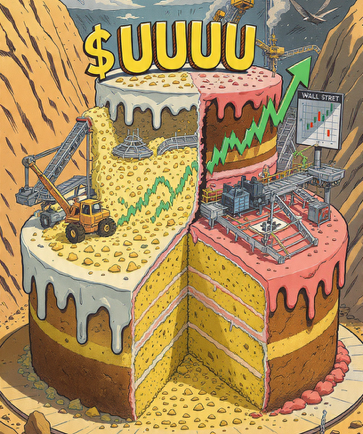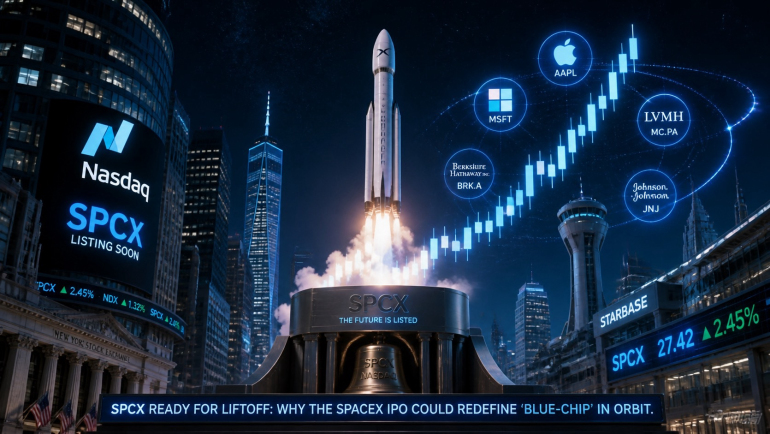
Elon Musk’s pledge, accelerating AI infrastructure revenue and a widening semiconductor recovery offer investors a bullish counterpoint to a housing market stuck in hesitation.
America’s next generation may receive its first stock certificate before its first driver’s license. Elon Musk said Monday that he plans to give one of his SpaceX (SPCX) shares to every child in America next year, a proposal that could introduce tens of millions of young people to equity ownership. The announcement comes as semiconductor stocks stage a powerful recovery, offering many two different expressions of the same enduring attraction: owning a piece of the future. The more consequential development for corporate earnings, however, may be taking place closer to the ground. A Yahoo Finance basket of 60 chip-related stocks recovered nearly $250 billion in market value during the session described in its report, with memory producers, chip designers and equipment suppliers participating. Nearly 90% of the basket advanced even as roughly 70% of S&P 500 stocks declined. Those figures represent a trading-session snapshot, not closing results. Taken together, the developments support a constructive investment thesis: America’s growth opportunities remain substantial, but many increasingly need to distinguish businesses building new productive capacity from sectors struggling with the cost of financing yesterday’s purchases. The operative word is selectivity. The future still looks investable. It simply does not trade at one uniform valuation.
SpaceX’s Giveaway Could Make Stock Ownership a Family Conversation
Musk’s proposal is straightforward in ambition and unfinished in execution. According to Yahoo Finance, the SpaceX (SPCX) founder intends to distribute one of his shares to every American child in 2027, although he did not specify an eligible age range or explain the distribution mechanism. CNBC separately reported that Musk had not provided implementation details. Its account cited approximately 72 million U.S. children under 18, based on Census Bureau data, illustrating the potential scale without establishing the eventual number of recipients. The Associated Press estimated the pledge’s value at approximately $10.66 billion using roughly 73 million children and prevailing share prices. That is an indicative valuation, not a finalized commitment with disclosed eligibility rules and execution terms. For many, the immediate distinction is important: transferring a founder’s existing shares is not the same transaction as issuing additional company stock. If the initiative proceeds entirely through Musk’s existing holdings, the transfer itself would not increase SpaceX’s share count. It would redistribute ownership rather than directly raise operating capital. The longer-term attraction is cultural. A child who owns a share has a reason to ask what a company does, how it earns money and why its valuation changes. A rocket launch could become both a science lesson and a shareholder update. That does not establish a higher fair value for SpaceX (SPCX). It does create a plausible avenue for broader familiarity with the business and with investing itself. Customer acquisition is expensive. Inspiring a dinner-table conversation about orbital mechanics is, at minimum, a more interesting approach.
The Chip Recovery Has More Than Sentiment Behind It
The semiconductor rebound offers a more immediate connection to measurable business performance. Yahoo Finance reported gains exceeding 2% for Micron Technology (MU) and Intel (INTC), alongside an advance of nearly 5% for Sandisk (SNDK) on Monday. Nvidia (NVDA), Advanced Micro Devices (AMD) and Western Digital (WDC) also participated. The breadth within that group matters. A rally concentrated in one celebrated stock can reflect enthusiasm for a single company. A recovery spanning memory, processors and storage is consistent with investors reassessing several layers of the computing supply chain. Still, recovered market capitalization is not new revenue, profit or cash flowing onto corporate balance sheets. It is a repricing of ownership claims. The bullish case becomes more persuasive when that repricing has operating results beneath it. In several important cases, it does.
Nvidia’s AI Business Is Delivering Revenue, Not Merely Adjectives
Nvidia (NVDA) reported fiscal second-quarter 2027 revenue of $96.2 billion, up 106% from a year earlier. Data Center revenue reached $89 billion, increasing 117%. The quarter ended July 26, 2026. Those figures establish the central point of the AI infrastructure investment case: demand is already translating into substantial reported sales. They also show why describing Nvidia (NVDA) principally as a gaming-chip company misses the financial center of gravity. Data-center computing now accounts for the overwhelming majority of its quarterly revenue. Also, note that Nvidia’s position depends not only on its chips, but also on the software and networking infrastructure surrounding them. For shareholders, the question is whether Nvidia (NVDA) can sustain growth and profitability as customers expand deployments and evaluate alternatives. Its latest reported quarter provides substantial evidence of demand, but it does not guarantee future returns at any purchase price.
Micron and AMD Show the Opportunity Extending Beyond One Winner
Micron Technology (MU) offers another important piece of the infrastructure story. The company reported fiscal 2026 revenue of $133.19 billion, compared with $37.38 billion in the previous fiscal year. Fourth-quarter revenue reached $54.23 billion. Its technology disclosures also provide a concrete link to advanced AI systems. In its fiscal third-quarter announcement, Micron Technology (MU) said HBM4, its high-bandwidth memory technology, was shipping in high volume for a lead customer’s platform. It also said development of HBM4E was underway, with volume production expected in calendar 2027. That production timeline remains a company expectation. The logic is that faster processors require supporting memory capable of feeding them data efficiently. A powerful accelerator without adequate memory bandwidth is rather like an executive jet waiting for its luggage: impressive machinery, limited progress. Advanced Micro Devices (AMD), meanwhile, reported second-quarter 2026 revenue of $11.5 billion, up 50% year over year. Its Data Center segment generated $6.7 billion, increasing 107% and accounting for 58% of company revenue. Those results support a broader interpretation of AI spending. The opportunity is not confined to the leading accelerator supplier. Server processors, competing accelerators and memory can all participate, although their margins, market positions and investment requirements differ. A bullish sector thesis need not assume that every supplier wins equally. It needs evidence that the underlying spending opportunity is large enough to support more than one successful business.
Intel Adds a Turnaround Dimension, With the Usual Fine Print
Intel (INTC) brings a different proposition to the semiconductor recovery. Yahoo Finance reported that JPMorgan Chase (JPM) upgraded Intel (INTC) to Neutral from Underweight, citing opportunities related to AI demand and chip scarcity. Neutral is not a declaration of corporate invincibility. It is, however, an improvement from a negative assessment, and changes in expectations can matter for a company attempting to rebuild investor confidence. The distinction between Intel (INTC) and faster-growing peers should remain clear. A turnaround thesis depends on execution and improving economics, not simply membership in a favored industry. The same Yahoo Finance report supplied a useful caution elsewhere in AI infrastructure: CoreWeave (CRWV) surrendered most of its premarket gains despite a Goldman Sachs (GS) upgrade to Buy, with financing needs remaining an investor concern. That contrast is instructive. Exposure to AI demand does not eliminate the importance of funding costs, capital intensity or balance-sheet resilience. The market may admire the destination and still inspect the fuel bill.
Tesla Connects the Musk Narrative to a Separate Operating Business
Tesla (TSLA) belongs in the discussion, but not as a financial substitute for SpaceX (SPCX). They are separate companies. A transfer of SpaceX (SPCX) shares would not, by itself, increase Tesla’s revenue, earnings or assets. The connection is Musk and the attention surrounding his businesses, not a shared entitlement to one another’s cash flows. Tesla’s own operating disclosures provide a more useful basis for evaluating its opportunity. In the second quarter of 2026, Tesla (TSLA) reported production of more than 450,000 vehicles, deliveries exceeding 480,000 vehicles and deployment of 13.5 gigawatt-hours of energy storage products. Its quarterly update described energy storage deployments as its second-highest quarterly total and said trailing-12-month deployments reached a record.[assets-ir.tesla] That gives many an additional operating dimension to monitor beyond vehicle volumes. The constructive thesis is not that a SpaceX announcement automatically makes Tesla (TSLA) more valuable. It is that Tesla has its own measurable exposure to electrification and storage, which deserves analysis on its own merits. Musk can connect the headlines. Financial statements should keep the companies apart, for now.
Housing’s Slowdown Makes the Growth Contrast More Visible
The housing market offers a less buoyant picture. Yahoo Finance reported that 14.5% of home-purchase deals fell out of contract in September, citing Redfin data. Outside the early pandemic months, that was the highest share on record. The report identified higher mortgage rates, financing problems, inspection issues and greater buyer choice as relevant pressures. Redfin’s underlying report similarly placed the cancellation measure at 14.5%, its highest reading apart from March and April 2020. This is not evidence that would-be homebuyers are redirecting down payments into semiconductor stocks. The cited reporting establishes no such flow of funds. Instead, housing provides an economic contrast. Households are showing hesitation around large, financed purchases, while major computing suppliers are reporting substantial revenue growth. Different parts of the economy can move at different speeds. For qualified homebuyers, more negotiating leverage may eventually create opportunities. For equity investors, the immediate lesson is to avoid treating a weak housing indicator as a comprehensive verdict on every corporate growth market. The economy is not one open house, and the stock market does not require every room to be renovated before finding something worth owning.
What Many Should Watch Next
The strongest bullish case rests on milestones that can be checked, not narratives that can only be applauded.
- SpaceX (SPCX): Watch for eligibility rules, custody arrangements, distribution timing and confirmation that the proposed gifts come from Musk’s existing shares. The announcement remains more specific about ambition than implementation.
- Nvidia (NVDA): Monitor whether Data Center growth remains strong and whether competitive alternatives pressure pricing or the surrounding software advantage.
- Micron Technology (MU): Track advanced-memory shipments, the planned HBM4E production ramp and whether revenue growth translates into durable financial performance.
- Advanced Micro Devices (AMD): Watch whether Data Center momentum continues as server processors and AI accelerators become a larger part of its business.
- Intel (INTC) and CoreWeave (CRWV): Separate improving market sentiment from evidence of execution, sustainable financing and attractive economics.
- Tesla (TSLA): Evaluate vehicle deliveries and energy storage performance independently of SpaceX-related publicity.
The Case Is Bigger Than a Giveaway
Musk’s proposed stock gift is the memorable headline. The semiconductor industry’s reported growth is the more substantial earnings story. SpaceX (SPCX) could broaden the conversation about ownership. Nvidia (NVDA), Micron Technology (MU) and Advanced Micro Devices (AMD) supply evidence that AI infrastructure demand is already producing significant revenue. Tesla (TSLA) adds a separate energy-storage business to the wider discussion of technology-led investment. The bullish interpretation is not that economic friction has disappeared. It is that housing weakness and uneven market breadth can coexist with powerful growth in particular industries. For many, that creates a demanding but potentially rewarding assignment: distinguish expanding businesses from expanding expectations, and pay attention to the price of both. America’s future may arrive by rocket. Shareholder returns still have to clear the accounting department.
Stay Updated with Vista Partners
Subscribe to receive market insights, investing ideas, and the latest updates directly in your inbox.