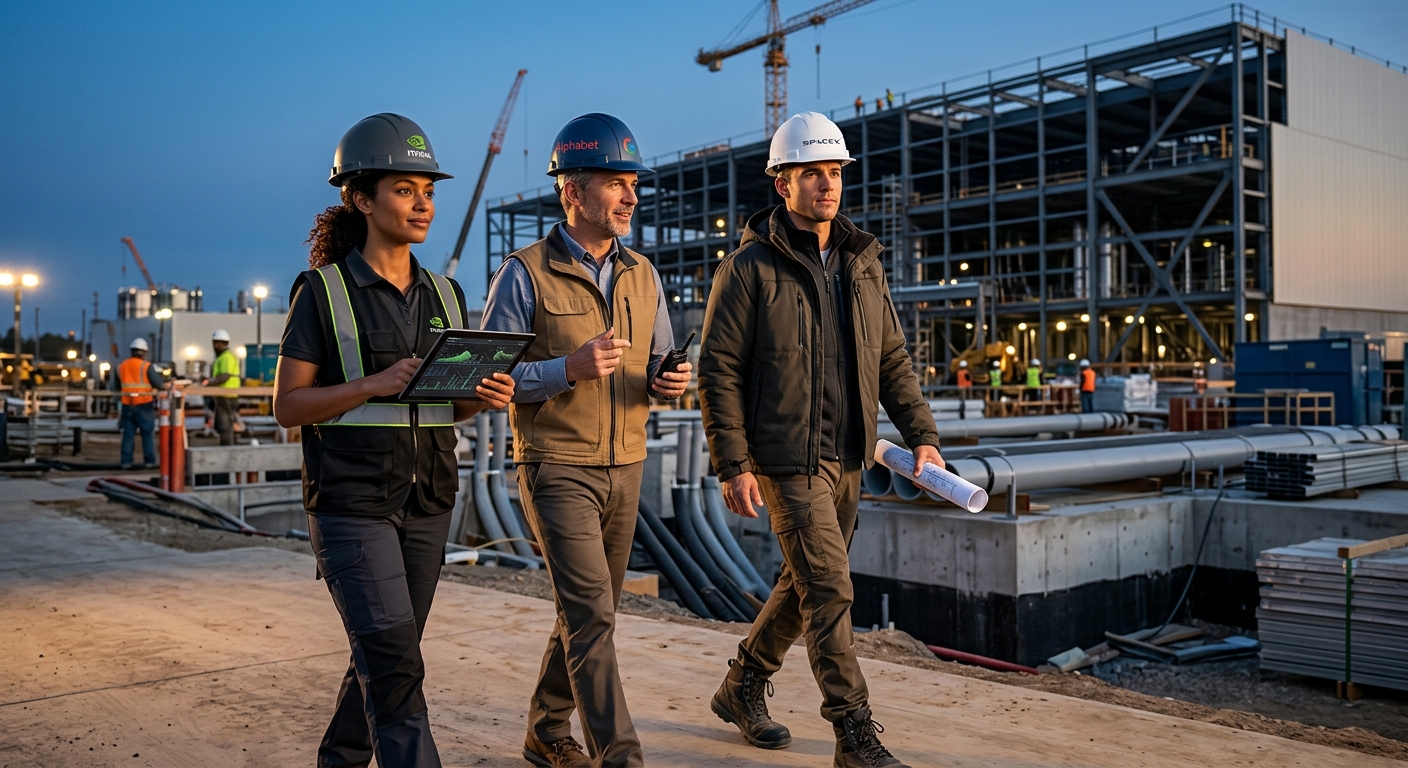
From advanced chip packaging to Wyoming data centers and rocket engines, the growth story is moving from promises to production capacity.
The next chapter of the technology boom may belong less to whoever delivers the most dazzling presentation and more to whoever can actually deliver the equipment. Nvidia (NASDAQ: NVDA) is expanding the manufacturing network behind its artificial-intelligence systems. Alphabet (NASDAQ: GOOGL, GOOG), Google’s parent, is taking control of a Wyoming data-center development alongside a planned $17 billion investment. Firefly Aerospace (NASDAQ: FLY) has secured an agreement worth more than $1.3 billion to supply engines, intellectual-property rights and engineering support to AST SpaceMobile (NASDAQ: ASTS). These are different businesses, but their latest moves point toward the same economic priority: securing capacity before someone else does. For many looking beyond the market’s daily turbulence, the common denominator is capacity. The bullish case is not that every large expenditure automatically produces an attractive return. It is that companies with substantial growth ambitions are increasingly committing capital to the physical constraints standing between demand and revenue. Nvidia’s supply commitments, Google’s infrastructure spending and Firefly’s engine agreement give that argument something more substantial than another slide about an enormous addressable market. Apparently, the future still requires factories, electricity and people who know how to operate a test stand.
Nvidia’s AI Opportunity Extends Beyond Designing Faster Chips
Nvidia’s competitive position increasingly depends on what happens after a processor is designed. A recent account describes a reported multibillion-dollar financing for factories and equipment at Siliconware Precision Industries, or SPIL, a subsidiary of ASE Technology Holding (NYSE: ASX). That reported financing amount should remain distinct from Nvidia’s publicly announced SPIL expansion, which confirms a capacity partnership but does not specify that particular funding total. What Nvidia has formally announced is significant enough on its own. On October 21, the company outlined a broad supply-chain expansion covering substrates, advanced packaging, semiconductor testing and optical engines. Its SPIL collaboration targets a 15-fold increase in optical-engine manufacturing capacity for co-packaged optics by mid-2027, with another doubling targeted by the end of 2028. That optical-engine initiative is distinct from the advanced chip-packaging financing described in the supplied account. The distinction matters. Advanced packaging and optical connectivity address different parts of the AI infrastructure challenge, but both can constrain how quickly powerful computing systems reach customers. Nvidia’s strategy is to help expand the supporting industrial network rather than simply wait for suppliers to catch up. Its October announcement also included a $1.1 billion capacity-reservation advance supporting semiconductor-testing facilities in the United States. This is not merely procurement with better stationery. It is an effort to make future production less dependent on whichever manufacturing step happens to become the next bottleneck.
Nvidia’s SEC Filings Show the Scale of the Commitment
Nvidia’s filings put hard numbers behind that strategy. As of July 26, 2026, Nvidia reported $279 billion in supply and capacity commitments, compared with $119 billion in the preceding quarter. The company said those commitments primarily supported memory and manufacturing facilities for data-center infrastructure systems across current and future product architectures. Some agreements allow adjustments, rescheduling or cancellation before firm orders are placed, so the total should not be mistaken for cash already spent. For comparison, Nvidia reported $50.3 billion in manufacturing production, long-term supply and capacity, and related commitments as of October 26, 2025. The categories and ordering horizons require care when comparing periods, but the direction is unmistakable: Nvidia is planning around a much larger industrial footprint. There is an operating business behind that ambition. Nvidia reported fiscal 2026 revenue of $215.9 billion, up 65%, followed by fiscal 2027 first-quarter revenue of $81.6 billion, up 85% from a year earlier. Those results do not guarantee future demand, but they explain why the company is treating supply availability as a strategic priority rather than a routine purchasing matter. The favorable interpretation is straightforward: more available capacity can help Nvidia convert demand into shipments. The counterweight is equally important. Commitments create exposure if customer deployment schedules slip or demand proves less durable than expected. Nvidia itself identifies land, power, buildings and financing as factors that can affect customers’ ability to deploy its infrastructure. A chip cannot generate much economic value while waiting for a data center to acquire electricity.
Google’s $17 Billion Wyoming Plan Turns AI Ambition Into Physical Infrastructure
Google’s Wyoming move illustrates the same capacity-first thinking at the customer end of the AI supply chain. Bloomberg reported that Google acquired Crusoe’s data-center site in southeastern Wyoming after the developer failed to secure customers. The transaction ended Crusoe’s pre-development role, which included site selection, governmental approvals and power strategy. Financial terms were not disclosed. Separately, Google announced plans to invest $17 billion in the Wyoming site. That distinction is essential: $17 billion is the planned project investment, not a disclosed acquisition price. The strategic appeal is control. Taking responsibility for development can give Google greater influence over how a campus is built and integrated into its computing network. It also brings construction, power and delivery challenges closer to home. Ownership does not eliminate execution risk. It merely makes it harder to blame the landlord. Alphabet’s spending shows why the project deserves attention beyond Wyoming. The company reported $80.6 billion in capital expenditures during the first half of 2026. Its third-quarter results showed $51.4 billion in quarterly property-and-equipment purchases, bringing the nine-month total to approximately $132 billion. These are not exploratory checks written to keep a strategic option warm. They represent an expanding physical foundation for the business.
Alphabet Has Growth Behind the Spending, but Returns Still Matter
The more constructive reading of Alphabet’s infrastructure expansion rests on the relationship between spending and operating demand. Alphabet reported third-quarter revenue of $127.6 billion, up 25%, while operating income increased 30% and operating margin reached 31.8%. Those results provide an important counterbalance to the scale of its capital program: the company is expanding infrastructure while its overall business continues to grow. Earlier in the year, Alphabet reported $462.3 billion in Google Cloud remaining performance obligations as of March 31. That backlog is not immediate revenue or guaranteed near-term cash flow, but it offers a more concrete demand indicator than generalized enthusiasm about AI adoption. There is also substantial financial exposure. Alphabet’s June-quarter filing described long-term supply commitments for technical infrastructure and inventory, alongside energy agreements that can include minimum purchase requirements and meaningful termination fees. The opportunity is to secure scarce resources ahead of growth. The risk is being committed to those resources if the timing or economics of that growth disappoint. For many evaluating Alphabet, the central question is therefore not whether AI spending is large. That has been established rather emphatically. The question is whether additional computing capacity produces durable revenue, useful services and attractive returns.
SpaceX Adds a Computing Dimension to Its Growth Story
SpaceX (NASDAQ: SPCX) adds another dimension to the infrastructure theme: the growing overlap between space systems, communications and computing. On November 6, Bloomberg reported that Elon Musk expected U.S. government agencies to account for less than 10% of SpaceX revenue in the current quarter, compared with 16.6% in the most recent quarter. Bloomberg connected the changing mix to the company’s growing embrace of computing deals.. That is a management projection, not a completed quarterly result. Still, it suggests a potentially important change in the revenue base. A broader commercial business could reduce dependence on one customer category while opening additional avenues for growth. It also changes the analytical task. Many following SpaceX must increasingly consider the economics of computing commitments alongside launch and communications activities. The attractive possibility is a company participating in several infrastructure markets. The challenge is that each market arrives with its own capital requirements and execution demands. Diversification can broaden opportunity without making the engineering any more forgiving.
Firefly’s $1.3 Billion AST SpaceMobile Agreement Makes Propulsion the Product
Firefly’s agreement with AST SpaceMobile may be the clearest example of scarce industrial capability becoming a commercial asset. The companies announced a three-year arrangement worth more than $1.3 billion covering 36 rocket engines, a license to engine intellectual property and engineering support for AST SpaceMobile’s new heavy-lift rocket. Firefly will supply 27 Miranda engines and nine vacuum-variant Vira engines for the first three rockets. The agreement also gives AST SpaceMobile rights to manufacture the engines. Firefly retains ownership of its engine intellectual property and says it will continue serving the broader government and commercial launch market. That structure is important. Firefly is not simply selling hardware. It is monetizing engineering knowledge and manufacturing capability while retaining the underlying technology. AST SpaceMobile, meanwhile, is working toward greater control over access to orbit. Bloomberg reported that its planned rocket will compete with SpaceX, making the Firefly agreement part of a larger effort to reduce dependence on outside launch providers. For Firefly, the appeal extends beyond the headline contract value. The company says the proceeds will support hiring, long-lead material purchases, equipment and additional test bays in Briggs, Texas. In principle, a major customer agreement can help finance the production system needed to serve subsequent customers. That is an attractive industrial loop when it works: win business, expand capacity, improve delivery capability and compete for more business.
Contract Value Is Not the Same as Cash in the Bank
The Firefly agreement also requires careful reading. Payment consists of cash and AST SpaceMobile Class A shares, with the shares subject to various lock-up periods. The headline value therefore should not be treated as an immediate all-cash payment or as revenue recognized at signing. Equity consideration introduces sensitivity to AST SpaceMobile’s share price. Engine deliveries and engineering services still require execution. Production expansion consumes resources before it necessarily produces attractive margins. Those qualifications do not erase the commercial significance of the agreement. They explain where the next evidence must come from. Firefly has scheduled discussion of the agreement for its November 10 third-quarter earnings call. Payment timing, production investment, delivery milestones and the relationship between the new work and existing programs will matter more than another enthusiastic adjective. Rocket science is difficult enough without asking the accounting to achieve escape velocity.
The Bullish Case: Own the Capability That Growth Cannot Bypass
The strongest connection among these developments is not that AI chips, data centers and rockets are interchangeable businesses. They plainly are not. It is that each company is addressing a constraint that can determine whether an ambitious growth plan becomes an operating reality. Nvidia is helping expand the manufacturing ecosystem behind its computing platforms. Google is securing direct control over a major development site. SpaceX’s changing revenue mix points toward a broader computing-linked business. Firefly is turning propulsion technology into a substantial hardware, licensing and services agreement. For many looking for the next phase of technology-led growth, that creates a useful distinction between companies that describe future demand and companies building the capacity to serve it. The opportunity belongs to businesses that can turn scarce capability into dependable delivery and, eventually, attractive cash generation. The spending and agreements are evidence of commitment. The returns will depend on execution. Wall Street can debate the future at considerable length. These companies are ordering the equipment.
The Sources
- Nvidia: Supply-chain capacity expansion announcement, October 21, 2026
- SEC.gov: Nvidia Form 10-Q for the quarter ended July 26, 2026
- SEC.gov: Nvidia Form 10-Q for the quarter ended October 26, 2025
- Nvidia: Fourth-quarter and fiscal 2026 financial results
- Nvidia: First-quarter fiscal 2027 financial results
- Bloomberg: Google takes over Wyoming data-center site, November 6, 2026
- SEC.gov: Alphabet Form 10-Q for the quarter ended June 30, 2026
- SEC.gov: Alphabet third-quarter 2026 financial results
- SEC.gov: Alphabet Form 10-Q for the quarter ended March 31, 2026
- Bloomberg: SpaceX stock listing and Nasdaq ticker
- Bloomberg: SpaceX computing deals and changing government-revenue exposure, November 6, 2026
- Firefly Aerospace: Engine agreement valued at more than $1.3 billion with AST SpaceMobile, November 6, 2026
- Bloomberg: AST SpaceMobile plans its own rocket using Firefly engines, November 6, 2026
Stay Updated with Vista Partners
Subscribe to receive market insights, investing ideas, and the latest updates directly in your inbox.