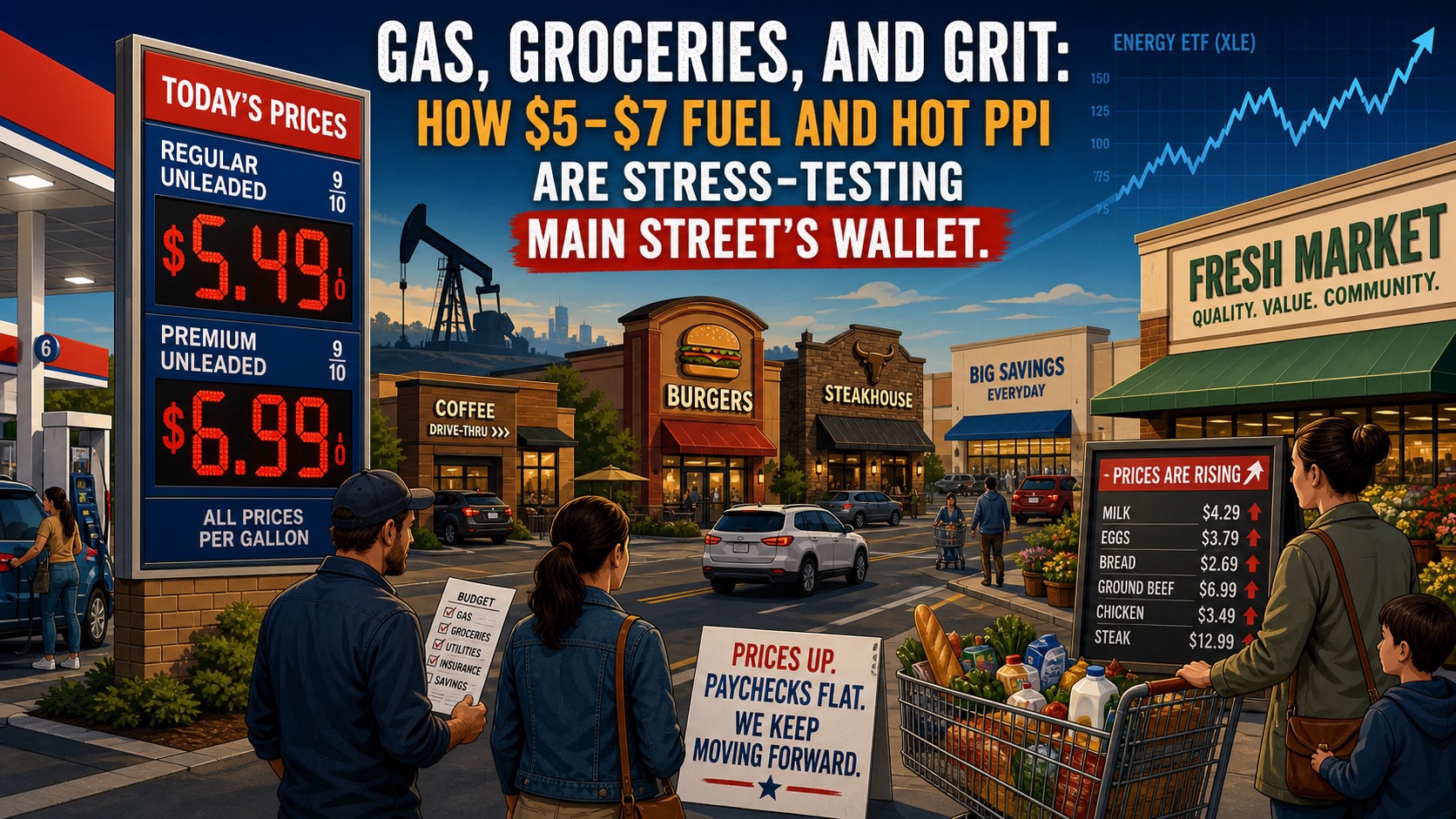
US producer prices just delivered a 6% year-over-year jolt in April, and $5 or $7 in the San Francisco Bay area plus gasoline at your local Chevron (CVX) station ,etc. is now less an economic footnote than a line item in the family drama of American household budgets. Yet, beneath the sticker shock and grim pump selfies, there are early signs that parts of the economy are adapting with the weary resilience of a seasoned New York commuter catching the last express train home.
Producer Prices: The Inflation Engine Redlines
Producer prices, the prices businesses receive for their goods and services, rose about 6% in April from a year earlier, underscoring that pipeline inflation is still very much alive. Recent government data show wholesale prices rising faster than many economists expected, extending a run of firm monthly gains.
This matters because the producer price index often acts as a preview of where consumer prices could head next, especially when the increases are concentrated in energy and other broad input categories. While core wholesale measures excluding food and energy have risen more modestly, the headline number is doing its best impersonation of a stubborn houseguest who missed the hint hours ago.
$5 Gas: Pain At The Pump, Pressure On The Checkout Line
Gasoline prices topping $5-$7 a gallon in parts of the country are eroding the purchasing power of lower-income households at a brisk clip, with analysts warning of “rapidly deteriorating” spending power at the bottom of the income ladder. Research tied to recent price spikes shows poorer households cutting gasoline consumption by around 7%, yet still spending roughly 12% more at the pump as prices surge.
For many low-income drivers, gas has quietly morphed from a routine expense into something closer to a “utility plus,” with some of the poorest households now funneling near double‑digit portions of their income into fuel while higher‑income households spend closer to 2–3%. The unavoidable nature of commuting means discretionary categories—dining out at your local McDonald’s (MCD), Dutch Bros (BROS) or Texas Roadhouse (TXRH), nonessential shopping, the occasional weekend splurge—are increasingly serving as the shock absorber for the monthly budget.
Households Rewrite Their Playbooks
Lower-income consumers are responding the way CFOs of cash-strapped companies do: cutting volume, reprioritizing, and finding cheaper substitutes. Bank and Fed data suggest spending growth on discretionary items has slowed for poorer households just as higher-income consumers continue to add to their nonessential purchases.
At the grocery store i.e. Walmart (WMT), food-at-home prices have been rising in the low single digits year over year, offering only modest consolation to households whose fuel bills are accelerating much faster. The net effect is an economy where the median family is still driving to work, but increasingly treating the latte and the streaming subscription as line items that must justify their existence like middle managers before budget season.
Markets Listen For The Fed’s Next Line
For markets, a 6% gain in producer prices and persistently high energy costs revive uncomfortable questions about how “transitory” any renewed inflation bump will prove. Bond traders have begun to reprice the odds that the Federal Reserve will stay on hold longer—or at least talk tougher—if wholesale and energy-driven pressure fails to cool.
Equity investors, meanwhile, are rerunning a familiar screen: companies with pricing power, lean cost structures, and loyal customers tend to navigate producer-price flare‑ups better than firms locked into fixed-price contracts and thin margins. In that sense, April’s PPI data serve as an informal stress test, separating those who can pass higher costs along from those who must quietly absorb them and smile for the quarterly earnings call.
The Silver Linings Investors Are Squinting To See
There are, if one squints like a trader staring at a too‑small Bloomberg chart, a few rays of optimism. Underlying wholesale inflation—excluding the usual food and energy suspects—has been running noticeably cooler than the headline, suggesting that not every part of the economy is overheating at once.
And for all the pain at the pump, high gasoline prices often sow the seeds of their own moderation, as demand cools and producers ramp up supply or shift flows. For long‑term investors, that means another moment to favor resilient balance sheets, essential goods and services, and companies whose customers grumble about higher prices—and pay them anyway.
The Sources
- U.S. Producer Price Index (PPI) – Official data and latest releases from the Bureau of Labor Statistics, tracking wholesale inflation trends across goods and services.bls
https://www.bls.gov/ppi/ - Producer Price Index news release summary – Monthly government summary of PPI moves, sector breakdowns, and underlying inflation signals watched by economists and markets.bls
https://www.bls.gov/news.release/ppi.nr0.htm - U.S. producer prices change – Time-series view of wholesale inflation, including recent readings around the 6% year-over-year mark investors are focused on.tradingeconomics
https://tradingeconomics.com/united-states/producer-prices-change - PPI inflation surprise: Producer prices rise more than expected – Coverage of hotter‑than‑forecast producer prices, with market reaction and economist commentary.aol
https://www.aol.com/articles/inflation-surprise-producer-prices-rise-130627692.html - US grocery prices rose in April – Report on food-at-home price trends that frame how higher fuel and wholesale costs filter into supermarket bills.finance.yahoo
https://finance.yahoo.com/news/us-grocery-prices-rose-april-041959684.html - $5-plus gas prices are starting to hammer low-income consumers – By-the-numbers breakdown of how elevated gasoline prices are pressuring lower-income households and reshaping spending.finance.yahoo
https://finance.yahoo.com/markets/article/5-plus-gas-prices-are-starting-to-hammer-low-income-consumers-by-the-numbers-132500078.html - Lower-income Americans hit hardest by gas price spike – Analysis of distributional effects of fuel inflation, showing how gas spikes widen inequality and squeeze discretionary spending.wlos
https://wlos.com/news/nation-world/lower-income-americans-hit-hardest-by-gas-price-spike-widening-inequalities-study-finds - US Inflation Accelerates as Gas, Food Prices Climb – Video segment discussing the latest inflation dynamics, including energy and food, and implications for consumers.youtube
https://www.youtube.com/watch?v=hhab2PNI5-4
Stay Updated with Vista Partners
Subscribe to receive market insights, investing ideas, and the latest updates directly in your inbox.