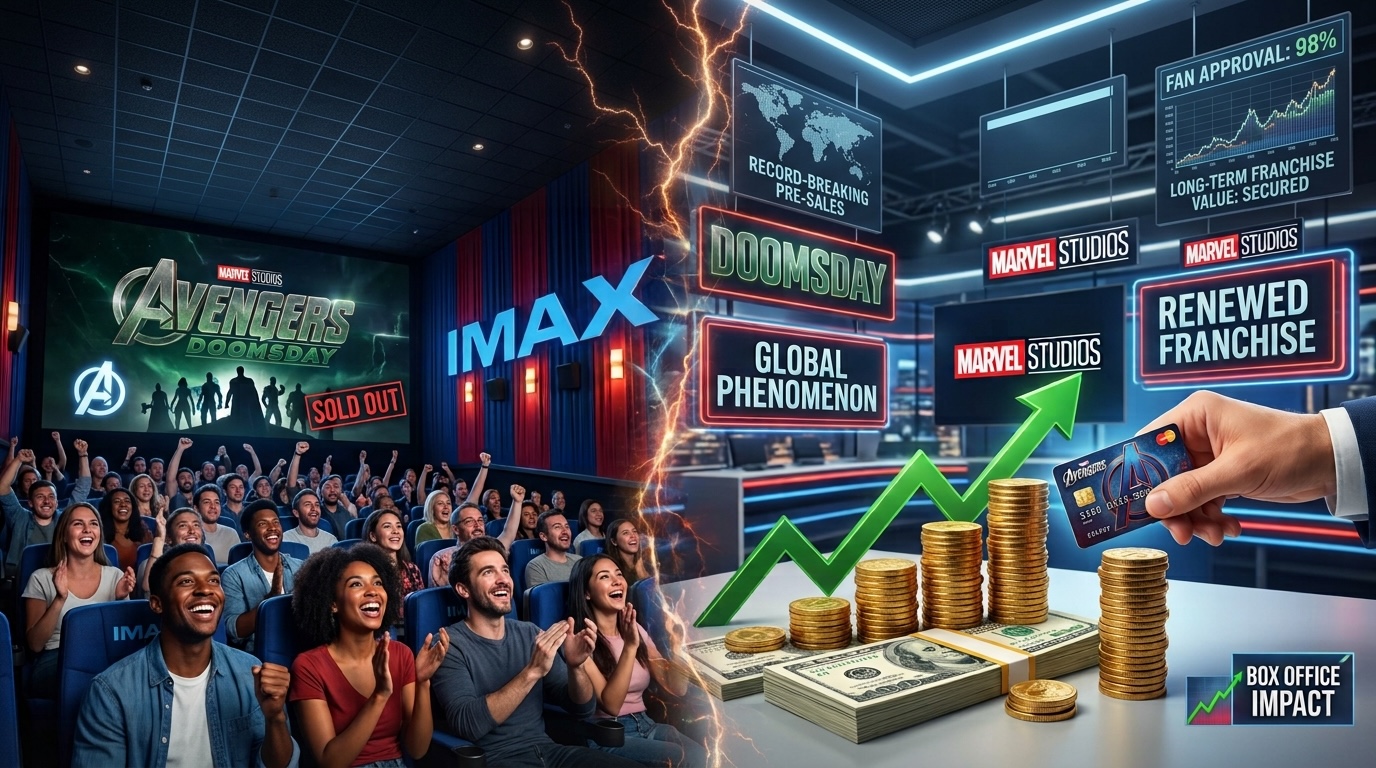
Disney’s Avengers: Doomsday marketing has begun to frame the December release as more than another cape-and-crossover exercise: it is positioning Victor von Doom as an event-scale antagonist and, potentially, a fresh ignition point for Marvel’s global commercial engine. For investors in The Walt Disney Company (NYSE: DIS), the opportunity is not merely opening-weekend box office—it is a multi-platform monetization moment spanning theaters, consumer products, Disney+, licensing, and theme-park experiences. Marvel Studios has set Avengers: Doomsday for a December 18, 2026 theatrical release, directed by Joe and Anthony Russo and featuring Robert Downey Jr. as Victor von Doom. The official “Special Look” focuses on Doom’s emotional rupture, villainous ambition, and unusually grand sense of menace—an encouraging sign that Marvel is selling narrative stakes rather than simply counting cameos.
Doctor Doom Meets Disney’s Flywheel
The essential bullish point for Disney (NYSE: DIS) is that a major Marvel release is not a single-product launch. It is an intellectual-property catalyst that can reverberate through the company’s studio, direct-to-consumer, experiences, and consumer-products businesses.
A successful Doomsday cycle can create value across:
- Theatrical distribution, through global ticket sales and premium-format demand.
- Streaming, as interest in the broader Marvel library can support Disney+ engagement and subscriber retention.
- Consumer products, including apparel, toys, collectibles, publishing, and gaming-adjacent licensing.
- Experiences, where Marvel characters and franchises give Disney a recurring source of attraction, retail, cruise, and international-park programming.
- Advertising and promotion, as Marvel’s cultural visibility can enhance Disney’s broader media ecosystem.
That flywheel matters because Disney is already reporting meaningful momentum beyond movie theaters. In fiscal third-quarter 2026 results, Disney reported $25.2 billion in revenue and $2.63 billion in net income, while its Experiences division posted approximately $10 billion in revenue, up 10%, and $3 billion in operating income, up 20%. In Hollywood, one clean hit can be nice. At Disney, a clean hit can show up wearing a cape in several different business segments.
The Trailer’s Real Message: Stakes, Not Spandex
The short promotional video is notably restrained. Rather than presenting a parade of quips, it introduces Victor as a once-kind and brilliant figure who becomes “broken” after loss, ultimately declaring, “Hell answers to me.” That is classic villain construction with a modern franchise purpose: establish a character audiences can fear before asking them to buy the lunchbox. For Marvel, this is strategically important. The most enduring comic-book films tend to work when the antagonist has ideological weight, emotional injury, and a clear claim on the audience’s attention. Doom is not being marketed as a disposable obstacle between set pieces; he is being cast as a central force in the next chapter of the Marvel Cinematic Universe. The casting also provides genuine event credentials. Marvel lists Robert Downey Jr., Chris Evans, Chris Hemsworth, Pedro Pascal, Paul Rudd, Anthony Mackie, Florence Pugh, Vanessa Kirby, Ebon Moss-Bachrach, and Wyatt Russell among the film’s cast, creating a convergence of legacy Marvel stars and newer franchise leaders.
A Wider Audience Funnel Than One Movie
Avengers: Doomsday arrives with structural advantages that many studio releases cannot replicate. The Avengers label has broad global recognition, while the cast offers Disney (NYSE: DIS) several audience-entry points: longtime Marvel fans, viewers drawn to the Fantastic Four, fans of the newer Avengers-era characters, and lapsed moviegoers who remember the cultural scale of earlier ensemble installments. That makes the release an unusually important opportunity to reactivate the Marvel ecosystem ahead of the holiday period. Disney’s December release window can also support a long runway for theatrical attendance, premium screens, gift-oriented consumer products, and holiday-season brand engagement. Disney’s fiscal reporting suggests the company is also becoming more deliberate about matching intellectual-property economics to the right reporting engine. Management has said it plans to move much of its consumer-products business from Experiences into Entertainment beginning in fiscal first-quarter 2027; merchandise tied to Avengers: Doomsday would therefore sit more directly within the Entertainment framework. For investors, that accounting shift may make the commercial influence of a strong Marvel merchandise cycle easier to observe. It does not make a Hulk figurine intrinsically more profitable, but it may make the green glow more visible.
The Investor Case for Disney
The bullish thesis on Disney (NYSE: DIS) does not depend on forecasting a specific box-office total for a film still months away from release. It rests on Disney’s ability to convert one globally recognizable story into repeatable, diversified earnings opportunities.
| Catalyst | Why it matters for Disney (NYSE: DIS) |
|---|---|
| Avengers: Doomsday theatrical release | A major event-film release can expand studio revenue and strengthen Disney’s cultural relevance during the holiday season. |
| Robert Downey Jr. as Doctor Doom | The casting creates a high-profile narrative hook and may help recapture attention from legacy Marvel audiences. |
| Disney+ library engagement | New Marvel releases can prompt viewers to revisit connected films and series, supporting engagement across the streaming ecosystem. |
| Consumer-product revenue | Disney is preparing to place much consumer-product revenue inside Entertainment, including merchandise connected to Doomsday. |
| Parks and Experiences | Disney’s Experiences segment delivered $10 billion in quarterly revenue and $3 billion in operating income, underscoring the value of major IP across physical destinations. |
| Franchise sequel potential | A successful Doom-led narrative can establish momentum beyond a single release and strengthen the next phase of Marvel storytelling. |
What Could Go Right
The key upside scenario is straightforward: Avengers: Doomsday restores the sense that a Marvel theatrical release is an appointment-viewing cultural event. The combination of the Russo brothers, Downey’s return to the Marvel universe in a new role, the Fantastic Four connection, established Avengers characters, and a holiday theatrical launch gives Disney a formidable commercial toolkit. That outcome could improve the tone around Disney’s broader Entertainment business at a time when its streaming, studio, and consumer-product priorities are increasingly interconnected. Disney’s streaming businesses, including Disney+ and Hulu but excluding certain pay-TV operations, generated $5.53 billion in revenue during the June quarter, up 11% year over year, according to reported quarterly results. The broader investment argument is that Disney’s best franchises are not content expenses in isolation. They are reusable assets with multiple distribution channels, global brand recognition, and a capacity to generate revenue long after a film leaves theaters.
Risks Worth Respecting
Even superheroes have execution risk. A large cast can create a major-event aura, but it also raises creative complexity. Audiences are likely to judge Avengers: Doomsday on storytelling discipline, emotional payoff, reviews, and the clarity of its connection to the wider Marvel universe—not just nostalgia or spectacle.
Other risks include:
- Rising production and marketing costs for tentpole theatrical releases.
- A competitive holiday movie season and uneven international box-office conditions.
- Franchise fatigue if the film does not deliver a distinct creative reason for viewers to return.
- The possibility that consumer-product demand or streaming lift trails theatrical enthusiasm.
- Avengers: Doomsday will not be in U.S. IMAX theaters for its opening release on December 18, 2026. Dune: Part Three secured exclusive rights to domestic IMAX screens for that window
- Avengers: Doomsday will not be on Netflix. It is a Marvel Studios movie distributed by Disney, so it will release exclusively in theaters on December 18, 2026, and will later stream on Disney+
Still, the trailer’s decision to foreground Doctor Doom’s menace and tragedy instead of treating the film as a corporate family reunion is constructive. It suggests Marvel understands that the next era needs a compelling reason to exist beyond the fact that multiverses are, apparently, excellent at generating calendar invites.
Bottom Line
Avengers: Doomsday gives Disney (NYSE: DIS) a credible chance to turn Marvel into a genuine event franchise again. The film’s December 18, 2026 release, Doom-centric storytelling, high-profile cast, and Disney-wide monetization pathways make it a meaningful catalyst for investors tracking the company’s Entertainment, streaming, consumer-products, and Experiences businesses. For bullish investors, the central question is not whether one movie can save Disney. It is whether one carefully executed Marvel event can accelerate an already improving collection of businesses. If Doom delivers at the box office, Disney shareholders may discover that the company’s most valuable superpower remains its ability to make one story work everywhere.
The Sources
- Marvel Entertainment — Avengers: Doomsday Special Look on YouTube
- Marvel — Avengers: Doomsday official film page and cast
- Disney — Avengers: Doomsday official video and December 18, 2026 release information
- The Walt Disney Company Investor Relations — Fiscal 2026 first-quarter earnings release
- CNBC — Disney (NYSE: DIS) fiscal third-quarter 2026 earnings coverage
- Variety — Disney fiscal third-quarter 2026 streaming, consumer-products, and earnings coverage
- Deadline — Disney earnings, theme parks, streaming, and Toy Story 5 coverage
- The Desk — Disney fiscal third-quarter 2026 revenue and streaming results
Stay Updated with Vista Partners
Subscribe to receive market insights, investing ideas, and the latest updates directly in your inbox.