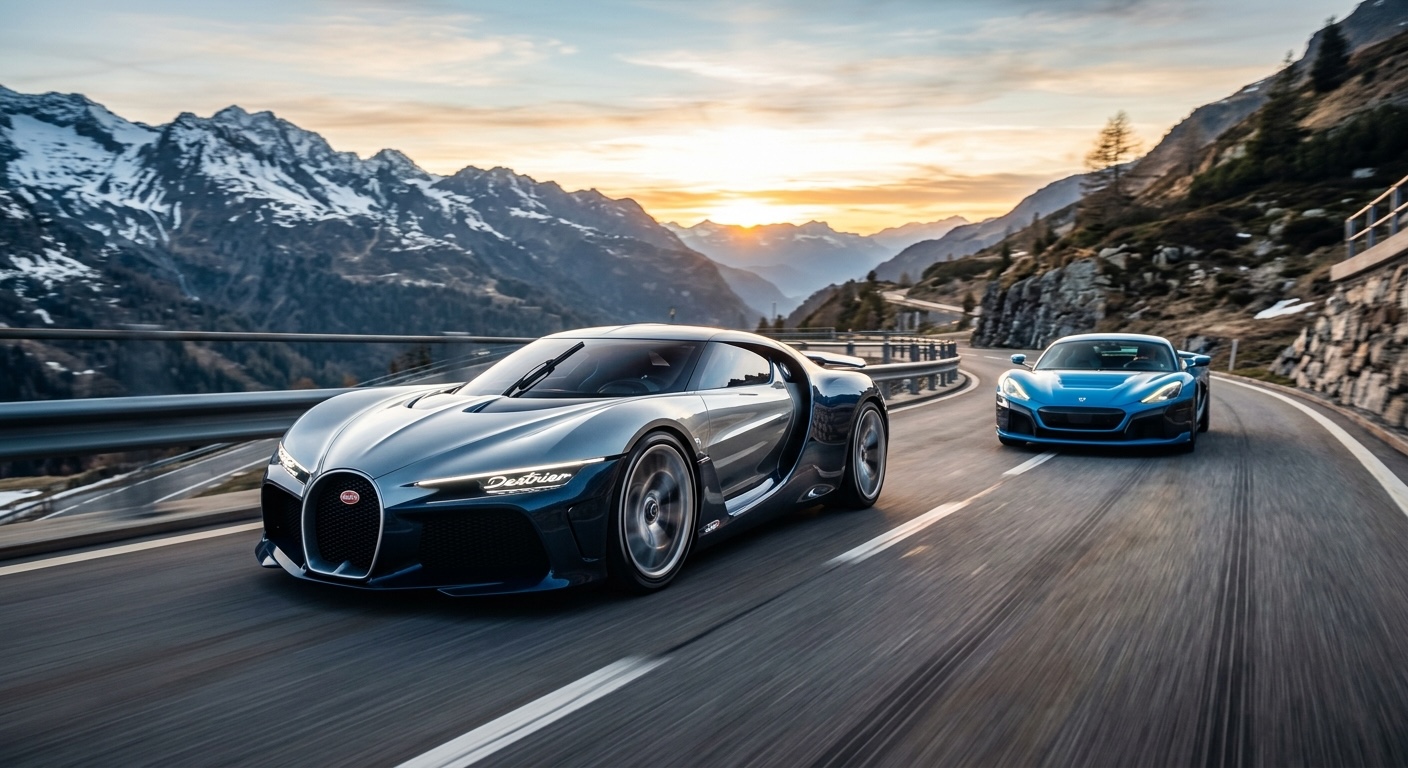
The Bugatti Destrier is not merely an outrageously rare hypercar. It is a high-margin demonstration of what happens when engineering scarcity, collector demand, and bespoke craftsmanship are allowed to share the same garage—without first consulting a committee that owns sensible shoes. For investors watching the luxury-performance ecosystem, the video conversation with Bugatti Rimac CEO Mate Rimac offers a compelling bullish read-through: Bugatti is pursuing profitability and brand elevation simultaneously, while Rimac Group expands its relevance across hypercars, electrification, batteries, and advanced powertrains. The important caveat is straightforward: Bugatti Rimac and Rimac Group are private, so investors cannot buy their shares directly. The accessible public-market angle includes Porsche AG (P911.DE), which agreed in 2026 to sell its former stakes in Bugatti Rimac and Rimac Group to an investor consortium led by HOF Capital.
Destrier: Scarcity With an Engineering Department
The Bugatti Destrier sits within the brand’s Solitaire coachbuilding program, its third one-off after the Brouillard and FKP Homage. Based around Bugatti’s track-focused Bolide architecture, it pairs a quad-turbocharged 8.0-liter W16 with approximately 1,600 horsepower and a stated weight near 1,800 kilograms. Its final running version is expected to require roughly two more years of development. That development timetable is precisely what separates this program from a fashionable paint-and-stitching exercise. Rimac describes aerodynamic simulation, suspension, steering, braking, tire work, physical test builds, and track validation—even for a single vehicle. In other words, the buyer is not simply purchasing an automobile; the buyer is purchasing a temporary seat in the product-development studio. The Destrier also makes a useful strategic statement: Bugatti’s best customers are being offered genuine participation in the brand’s creative process. They can help shape the car’s design direction, materials, character, and mission—track focus, road usability, luxury, or aerodynamic extremity. For ultra-high-net-worth collectors, that degree of involvement may be more valuable than a mere production-number plaque, however tastefully engraved.
A Business Model Built on Product, Not Volume
Mate Rimac’s central point is refreshingly unfashionable: build a great product, and the commercial structure improves around it. In the video, he says Bugatti Rimac produced €200 million of EBITDA in the prior year and views that as a starting point rather than a finish line. That assertion should be treated as management commentary rather than independently audited guidance, but it fits a broader pattern of operating momentum. Reported company metrics reinforce the picture. Mate Rimac said the broader Bugatti Rimac and Rimac Technology operations delivered 136 cars in 2025, produced 30,000 batteries and powertrain systems, and increased revenue from €310 million in 2024 to €860 million in 2025.
For investors, the proposition is unusually attractive in concept:
- Low-volume vehicles can command exceptionally high gross-profit dollars when scarcity, craftsmanship, heritage, and customer personalization reinforce pricing power.
- Bespoke projects create deeper customer relationships, which can support repeat purchases and long-term collector loyalty.
- Rimac Technology provides a more scalable industrial leg through battery and powertrain systems, helping offset the inherently limited volume of hypercars.
- The company’s engineering reputation extends beyond headline acceleration figures; it encompasses complex hybrid systems, software, battery development, lightweight packaging, and premium manufacturing.
This is luxury economics with carbon fiber under its fingernails: sell very few things, make each one deeply desirable, and ensure the customer is pleased enough not to ask what the service appointment costs.
Tourbillon Expands the Product Halo
The Destrier arrives beside the coming Bugatti Tourbillon, a model designed to replace the Chiron and redefine the flagship franchise. The Tourbillon combines a naturally aspirated 8.3-liter V16 developed with Cosworth with three electric motors for total system output of 1,800 horsepower. Production is limited to 250 units, with deliveries scheduled to begin in 2026 and pricing around $4 million. This matters because the Tourbillon is not a retreat from electrification. It is a more nuanced expression of it. Rimac has chosen a hybrid architecture that preserves the theater of a large naturally aspirated combustion engine while using electrification for responsiveness and performance. That positioning may resonate with collectors who want future-facing technology without having the emotional experience replaced by a very fast appliance. The video underscores the extent of the program’s technical ambition. Rimac describes a vehicle developed essentially from scratch, including the powertrain packaging, software, cooling, instrumentation, diffuser manufacturing, and regulatory work required to certify a large-displacement V16 globally. A 250-unit, multimillion-dollar model is not meaningful because it will flood the streets—it most certainly will not. It is meaningful because it can reinforce the broader Bugatti pricing umbrella, strengthen the brand’s collector ecosystem, and demonstrate technology and design capability at the highest possible end of the market.
Ownership Shift Adds a Fresh Capital Chapter
The corporate backdrop has also changed. In April 2026, Porsche AG (P911.DE) agreed to sell its 45% stake in Bugatti Rimac and its 20.6% interest in Rimac Group to a consortium led by HOF Capital. BlueFive Capital was identified as the consortium’s largest investor, alongside institutional investors from the U.S. and Europe. Before the transaction, Rimac Group owned 55% of Bugatti Rimac and Porsche held 45%. The move potentially gives Rimac and its new financial partners a cleaner runway to invest behind long-cycle product development, bespoke programs, electrification technology, and brand expansion. For Porsche AG (P911.DE), the sale should be viewed through a more balanced lens. The company is prioritizing its core automotive strategy, while the divestiture removes direct ownership exposure to Bugatti Rimac and Rimac Group. That makes Porsche a less direct way to participate in the Bugatti-Rimac story than it was previously.
Public-Market Watch List
| Company | Ticker | Relevance to the Bugatti-Rimac Thesis |
|---|---|---|
| Porsche AG | P911.DE | Former owner of a 45% stake in Bugatti Rimac and 20.6% of Rimac Group; agreed to sell both interests in 2026. |
| Volkswagen AG | VWAGY | Porsche AG’s majority shareholder and a major global automotive-industry reference point, but not a direct current Bugatti Rimac ownership proxy after the announced Porsche transaction. |
| Hyundai Motor Co. | 005380.KS | A strategic automotive name with historic investment relationships involving Rimac Group; investors should confirm current holdings through the latest company disclosures before treating it as a direct exposure vehicle. |
| Porsche Automobil Holding SE | PAH3.DE | Porsche holding-company exposure, relevant to the broader Porsche/Volkswagen structure but not a pure-play Bugatti or Rimac investment. |
The key investable lesson is simple: the most exciting asset in this narrative remains private. Public investors should resist the temptation to treat every adjacent automaker as a clean proxy. A Porsche badge on the cap table used to make that shortcut more plausible; the announced sale makes it less so.
Why the Bull Case Endures
Bugatti’s Destrier suggests that Rimac is not trying to win by selling more cars than rivals. It is trying to create more value per car, more meaning per customer relationship, and more technological relevance per engineering dollar.
That strategy has several bullish pillars:
- Pricing power: A one-off, deeply customized vehicle is structurally difficult to compare on price.
- Brand scarcity: The Solitaire program keeps exclusivity intact while allowing the brand to monetize collector imagination.
- Technology halo: The Tourbillon and Rimac’s powertrain work position the group as a credible builder of both combustion-hybrid spectacle and high-performance electrification.
- Operating leverage in technology: Battery and powertrain systems may provide a more scalable revenue opportunity than hypercar production alone.
- Long-duration demand: At the rarefied end of the collector market, the purchase decision is often driven by heritage, provenance, access, and rarity—not quarterly incentives or an especially persuasive dealership balloon.
The Destrier may never be a volume product, nor should it be. Its role is grander: to make the Bugatti brand more valuable, the customer relationship more intimate, and the Rimac industrial platform more credible. In the world of hyper-luxury, one perfectly placed masterpiece can do more strategic work than a thousand ordinary cars parked under fluorescent lights.
The Sources
- Top Gear — “New Bugatti Destrier: Makes The V16 Tourbillon Look Tame!”
- Porsche Newsroom — Porsche sells stakes in Bugatti Rimac and Rimac Group
- Rimac Group — Companies / Bugatti Rimac
- Motor Authority — Bugatti Tourbillon marks new era with 1,800-hp V16 plug-in hybrid
- Car and Driver — 2026 Bugatti Tourbillon: Specifications and overview
- DuPont Registry — 2026 Bugatti Tourbillon price, specifications, and production details
- Mate Rimac / Facebook — 2025 operating update: vehicle deliveries, batteries, and revenue
- Car and Driver — Porsche sells stakes in Bugatti Rimac and Rimac Group
Stay Updated with Vista Partners
Subscribe to receive market insights, investing ideas, and the latest updates directly in your inbox.