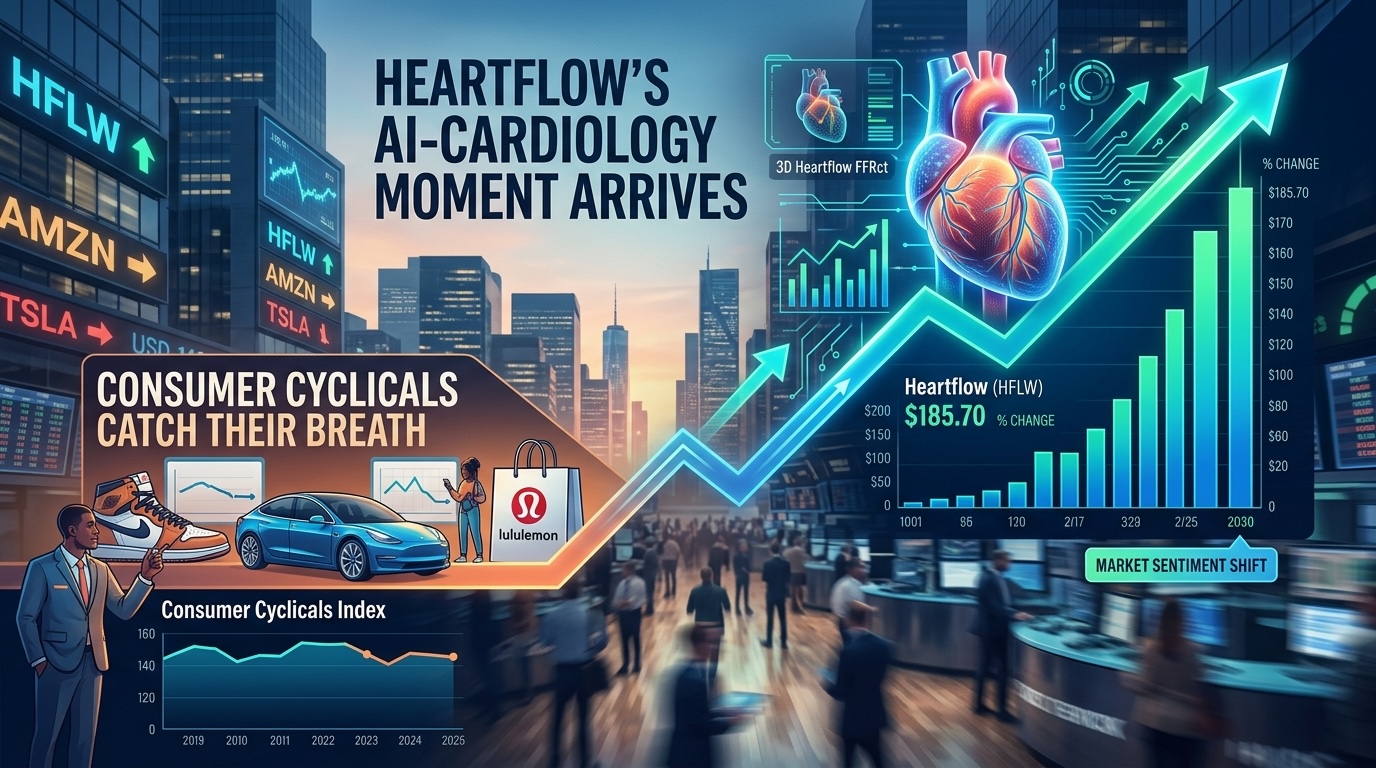
Heartflow, Inc. (NASDAQ: HTFL) is delivering the kind of growth story investors usually hope to find before it becomes obvious: rapid revenue expansion, rising gross margins, stronger adoption of a second product line, and a materially higher full-year outlook. In a market increasingly alert to a softer U.S. consumer, Heartflow’s progress offers exposure to an altogether different engine—clinical demand for more precise, less invasive cardiovascular care.
A Bullish Signal in a More Selective Market
Goldman Sachs expects real consumer spending growth to slow to roughly 1% to 1.5% in the second half as the temporary lift from tax refunds fades and real household cash flow stagnates. That outlook puts more pressure on discretionary retail bellwethers including Walmart Inc. (NYSE: WMT), The Home Depot, Inc. (NYSE: HD), Lowe’s Companies, Inc. (NYSE: LOW), and Target Corporation (NYSE: TGT), That is not necessarily a cue to abandon equities. It is a reminder that the market may increasingly reward businesses whose growth depends less on the contents of the shopping cart and more on the importance of the clinical decision. Coronary artery disease does not wait for the next tax refund, nor does a cardiologist generally delay a diagnostic decision because a promotional weekend fell short of expectations. Heartflow sits squarely in that more durable lane. The company uses AI to analyze coronary CT angiography images and help clinicians assess plaque, blood flow, and the functional significance of coronary disease without beginning with an invasive procedure. The investment proposition is not simply “AI in healthcare”—a phrase now broad enough to require its own zoning laws—but AI tied to a defined clinical workflow, substantial evidence generation, and commercial utilization.
The Quarter That Changed the Narrative
Heartflow recently reported second-quarter 2026 revenue of $64.1 million, up 48% year over year, including U.S. revenue growth of 51% to $59.6 million. Gross margin expanded to 83.0% from 75.5% a year earlier, evidence that higher case volumes and AI-enabled production efficiencies are beginning to show up where investors most like to see them: in the economics. Management raised its 2026 revenue guidance to $246 million to $250 million, representing expected annual growth of approximately 40% to 42%. The new range is well above its prior forecast of $228 million to $232 million, while expected non-GAAP gross margin increased to approximately 82% from about 81%. The combination matters. Growth without margin improvement can resemble an expensive dinner with no dessert. Heartflow is showing both expanding demand and better operating characteristics, even as it continues investing in sales capacity, technology, and clinical research.
Key second-quarter figures include:
- Revenue of $64.1 million, up 48% year over year.
- Gross profit of $53.2 million, compared with $32.8 million in the prior-year quarter.
- GAAP gross margin of 83.0%, up 750 basis points year over year.
- Adjusted EBITDA loss of $6.7 million, improved from a $10.1 million loss a year earlier.
- Cash, cash equivalents, and investments of $246.8 million as of June 30, 2026.
Two Commercial Engines, Not One
The core Heartflow FFRCT Analysis business remains the established contributor, but the emerging Plaque Analysis offering may be the strategic detail investors should not overlook. Management described Plaque as a rapidly developing second growth engine—one that can help win accounts, deepen physician use, and increase the value of the overall Heartflow platform. That distinction can change the conversation from a single-product diagnostic company to a potentially expanding cardiovascular intelligence platform. The company says its technology has been adopted by more than 1,800 institutions globally and has supported the care of more than 750,000 patients. It also cites a data foundation of more than 200 million annotated CTA images and support from more than 625 peer-reviewed publications. Those claims do not eliminate commercialization risk, but they do outline a sizable moat built from data, clinical validation, workflow integration, and customer familiarity. For investors evaluating health-tech businesses, the question is often whether a promising algorithm can move from the conference presentation to the hospital’s daily operating rhythm. Heartflow’s reported revenue acceleration and rising case-volume contribution suggest that this transition is underway.
The Defensive-Growth Healthcare Case
The broader consumer picture makes Heartflow’s profile more interesting, not less. Goldman’s warning does not suggest a consumer collapse; rather, it points to a slower spending backdrop after spring demand benefited from higher-than-expected tax refunds. Consumer-facing companies delivered healthy second-quarter sales gains, but future upside may become harder to manufacture if shoppers become more cautious and promotion-sensitive.
Heartflow’s demand drivers are fundamentally different:
- An aging population and the persistent burden of coronary artery disease.
- A clinical preference for personalized, earlier, and less invasive assessment.
- Greater use of coronary CTA as a front-line diagnostic tool.
- A business model that can benefit from higher test volumes and software-like efficiency.
- An expanding opportunity to add plaque analysis to a workflow already familiar with FFRCT.
This does not make HTFL recession-proof, and no serious investor should treat healthcare utilization as immune to reimbursement changes, budget pressures, or slower hospital purchasing cycles. Still, it offers a more specialized growth path than companies leaning heavily on the willingness of consumers to buy another patio set, appliance, or cart full of discretionary merchandise.
Amwell Offers a Smaller, Telling Footnote
American Well Corporation (NYSE: AMWL), known as Amwell, recently granted restricted stock units covering 6,679 Class A shares to two new non-executive employees under its inducement plan. The awards vest over roughly four years, subject to continued employment. By itself, this is not a thesis-changing event for AMWL. It is, however, a small reminder that digital-health companies continue to recruit and retain talent through equity alignment, even as the sector’s valuation reset has made investors far more discerning. Amwell’s second-quarter revenue declined to $52.0 million, though its reported net loss improved to $9.9 million and first-half operating cash flow turned positive at $9.7 million. The contrast is useful. AMWL represents a turnaround-and-execution story in virtual care, while HTFL currently presents a higher-growth, expanding-margin story in AI-enabled cardiovascular diagnostics. Both belong to the broader digital-health conversation, but their investor cases are meaningfully different.
What Investors Should Watch Next
Heartflow’s raised guidance creates a higher bar, which is the pleasant burden of good news. The bullish case now rests on evidence that the company can preserve its momentum while keeping its margin gains intact.
Investors should watch for:
- Continued growth in FFRCT case volumes and customer utilization.
- Plaque Analysis adoption, revenue contribution, and account penetration.
- Progress toward operating leverage as sales and R&D investments scale.
- Reimbursement coverage and clinical guideline support.
- Cash deployment, potential dilution, and the pace toward sustainable profitability.
- Competitive offerings in cardiac imaging, AI diagnostics, and coronary-care workflows.
The near-term economy may be asking retailers to work a little harder for each incremental sale. For Heartflow, the more relevant question is whether it can keep converting clinical need, proprietary data, and physician adoption into a scalable diagnostic franchise. Its second-quarter report suggests that the answer is increasingly constructive—and that investors looking for growth outside the consumer spending cycle may want to keep Heartflow (HTFL) on the monitor.
The Sources
- Yahoo Finance — Goldman Sachs warns of consumer spending slowdown as tax refund boost fades
- Yahoo Finance / Heartflow — Heartflow Reports Second Quarter 2026 Financial Results and Raises Full-Year 2026 Guidance
- Yahoo Finance / Amwell — Amwell Makes Grant to Employees Under Inducement Plan
- Nasdaq / GlobeNewswire — Amwell Makes Grant to New Employees Under Inducement Plan
- Politico — Paging Micah Lasher
- Jan Hatzius, LinkedIn — Comments on U.S. jobs, wage growth, tax refunds, and consumer spending
- MarketBeat — Heartflow Q2 2026 Earnings Report
- Newsquawk — U.S. Daily Equity Opening News: Heartflow Q2 Results and Updated Guidance
Disclosure: This article is for informational purposes only and is not investment advice. Investors should conduct independent research and consider financial objectives, risk tolerance, valuation, competition, reimbursement dynamics, and company filings before making investment decisions.
Stay Updated with Vista Partners
Subscribe to receive market insights, investing ideas, and the latest updates directly in your inbox.