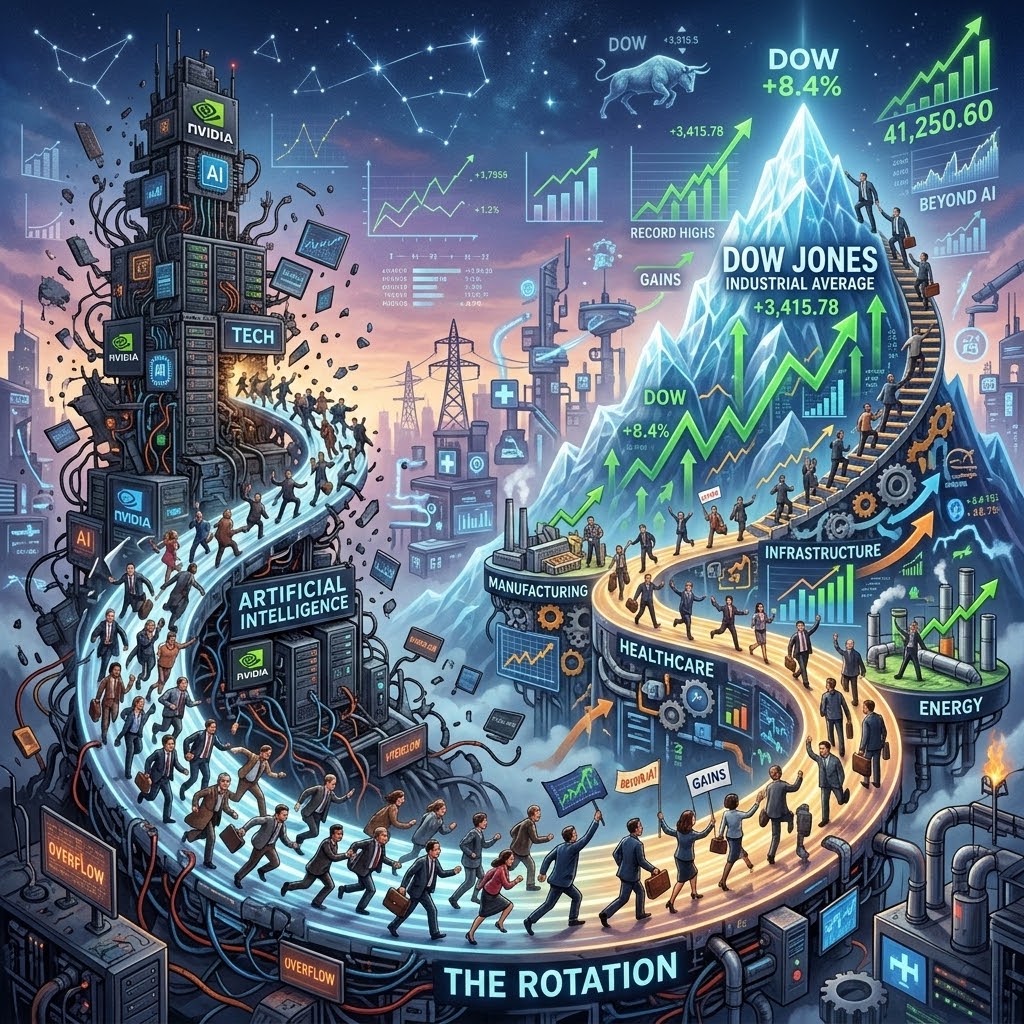
U.S. stocks advanced Thursday, October 15, with the Dow Jones Industrial Average gaining 556.21 points, or 1.08%, to 52,177.69 in the supplied market snapshot. The S&P 500 rose 0.33%, the Nasdaq Composite edged up 0.08%, and the Russell 2000 climbed 1.31%, making small-cap stocks the strongest performers among the four major benchmarks. The session’s defining theme was rotation: investors found opportunities outside the artificial intelligence trade while reassessing the cost of financing its expansion. Falling Treasury yields helped support the recovery, even as hotter-than-expected wholesale inflation complicated the Federal Reserve’s policy outlook.
Stock Market Performance: October 15, 2026
| Index | Supplied index level | Point change | Percentage change |
|---|---|---|---|
| Dow Jones Industrial Average | 52,177.69 | +556.21 | +1.08% |
| S&P 500 | 7,744.06 | +25.12 | +0.33% |
| Nasdaq Composite | 26,713.03 | +20.16 | +0.08% |
| Russell 2000 | 2,765.21 | +35.68 | +1.31% |
The gap between the Dow’s advance and the Nasdaq’s modest gain illustrated a shift in leadership. Healthcare, consumer staples and selected retailers attracted buyers as investors questioned whether some AI infrastructure companies could generate cash quickly enough to justify their borrowing and capital spending. During the session, Walmart (WMT) and Merck (MRK) each advanced approximately 2%, while Nike (NKE) gained more than 5%.
Macroeconomic Report: Wholesale Inflation Surges, Retail Spending Holds Up
Thursday’s economic releases presented an uncomfortable combination for policymakers: accelerating producer prices and stronger-than-expected headline retail spending, alongside signs that consumers were becoming more selective.
| September economic indicator | Reported result | Consensus expectation |
|---|---|---|
| Producer Price Index, month over month | +1.3% | +0.6% |
| Producer Price Index, year over year | +6.3% | +5.5% |
| Core PPI excluding food and energy, month over month | +0.7% | — |
| Core PPI excluding food and energy, year over year | +5.0% | — |
| Retail sales, month over month | +0.8% | +0.4% |
Energy pressure is spreading beyond fuel
The September Producer Price Index recorded its largest monthly increase since March 2022 and its biggest annual advance since December 2022. Energy was a major contributor, but the 0.7% monthly increase in core PPI showed that the pressure was not confined to food and fuel. CNBC also reported evidence that higher diesel costs were affecting other parts of the production chain. That matters for corporate earnings as well as monetary policy. When input costs rise, companies face a choice between absorbing the increase through lower margins and attempting to pass it along to customers. Thursday’s report therefore raised questions about both future consumer prices and the durability of profit growth. The release followed Wednesday’s Consumer Price Index report, which showed headline inflation of 3.7% year over year, above the 3.6% consensus estimate. Together, the reports weakened the argument that inflation was moving steadily toward a more comfortable level.
Retail sales show resilience, but also a spending squeeze
Retail sales increased 0.8% in September, twice the expected pace. However, sales excluding autos and gasoline stations rose only 0.25%, slowing from approximately 1.1% in the previous month. The distinction is important: a strong headline spending figure does not necessarily indicate equally strong demand across the consumer economy. The slower increase outside autos and gasoline suggested that elevated fuel costs may be leaving households with less room for other purchases. For the Federal Reserve, the combination creates a difficult balance. Inflation argues against easing policy, while signs of pressure on discretionary spending caution against assuming that consumers can absorb higher prices indefinitely.
Why Treasury Yields Fell Despite Hot Inflation
The 10-year Treasury yield at 5.09%, down approximately 0.10 percentage point, or 10 basis points. The VIX volatility index fell 2.37% to 16.47. Although stronger inflation can put upward pressure on yields, Thursday’s trading reflected another force: demand for government bonds as investors reduced exposure to technology and AI financing risk. That decline provided support for interest-rate-sensitive stocks. Homebuilders including Lennar (LEN), D.R. Horton (DHI), PulteGroup (PHM), Toll Brothers (TOL) and KB Home (KBH) advanced intraday as investors anticipated potential relief in financing conditions. Lower Treasury yields can ease pressure on mortgage rates, although the relationship is not one-for-one. The bond rally should not be mistaken for proof that inflation concerns disappeared. Instead, it showed that investors were weighing inflation risk against concerns about growth, valuations and corporate financing.
Nvidia and CoreWeave Put AI Financing Under the Microscope
CoreWeave (CRWV) remained a focal point after falling approximately 15.5% Wednesday. Its shares recovered into positive territory during Thursday’s trading, but weakness in its debt continued to signal investor concern about financing the company’s AI infrastructure expansion. Nvidia (NVDA) CEO Jensen Huang expressed confidence in CoreWeave (CRWV) at an event in Stockholm, saying its financial strength was improving and describing himself as optimistic. His comments carried particular significance because Nvidia (NVDA) is both an important supplier to and an investor in the company. According to Yahoo Finance, Nvidia (NVDA) invested $2 billion in CoreWeave (CRWV) earlier this year as the companies expanded their relationship. CoreWeave (CRWV) committed to using Nvidia (NVDA) technology to develop more than five gigawatts of AI computing facilities by 2030. The broader issue is no longer simply whether demand for AI computing will grow. Investors are scrutinizing how much debt companies need to meet that demand, what the borrowing costs, and when contracted business will translate into cash. Thursday’s divergence between recovering shares and stressed corporate debt underscored why the financing side of the AI boom deserves attention alongside revenue growth.
KFC Switches to Coca-Cola in a New Beverage Deal
KFC, owned by Yum! Brands (YUM), announced that its U.S. restaurants will replace PepsiCo (PEP) beverages with Coca-Cola (KO) products. CNBC reported that the chain expects the transition to be completed by the end of the first quarter of 2027. The decision breaks with a supplier relationship rooted in PepsiCo’s (PEP) acquisition of KFC in 1986. PepsiCo (PEP) later spun off the restaurant businesses that became Yum! Brands (YUM), but the U.S. beverage relationship remained in place for decades. For KFC, the switch forms part of a broader effort to attract customers and refresh its offerings. For Coca-Cola (KO) and PepsiCo (PEP), restaurant partnerships provide both beverage sales and highly visible exposure to consumers. The announcement is strategically notable, although the supplied report does not establish its financial impact or isolate its effect on either company’s stock.
Gold, Oil and Bitcoin Advance
| Asset or indicator | Supplied reading | Reported change |
|---|---|---|
| Gold | $4,193.80 | +$85.90; +2.09% |
| November 2026 crude oil contract | $96.25 | +$2.35; +2.50% |
| Bitcoin | $82,271.02 | +$594.30; +0.73% |
| VIX | 16.47 | −0.40; −2.37% |
| 10-year Treasury yield | 5.09% | Approximately −10 basis points |
Oil’s advance reinforced the importance of energy to the economic outlook. Thursday’s inflation report already showed the effects of elevated energy costs, making persistent fuel-price pressure a continuing challenge for businesses, households and policymakers.
Market Outlook: Broader Participation Faces an Inflation Test
Thursday’s benchmark gains showed that weakness in the AI trade did not prevent other parts of the market from advancing. CNBC also reported that more than half of S&P 500 constituents were trading above their 200-day moving averages, compared with roughly 40% in late September, evidence that participation had broadened beyond a narrow group of leaders. The durability of that improvement remains tied to three questions: whether Treasury yields stay lower, whether consumer spending outside fuel remains resilient, and whether AI infrastructure companies can demonstrate that their financing obligations are manageable. Thursday offered a recovery in equities, but the inflation data and corporate-credit signals left those questions unresolved.
Here’s The VP Watchlist Updates
Amwell® (NYSE: AMWL)
Amwell® (NYSE: AMWL), a leading provider of a comprehensive SaaS-based software platform for technology-enabled healthcare, closed at $12.38, +1.89%.
AMWL announced (Sept 8) announced the Department of Veterans Affairs (VA) has declared its intent for the Company to deploy its virtual health platform within the VA enterprise and help power the modernization of the VA’s digital health infrastructure. The VA anticipates the Amwell platform will support a broad range of clinical services, enhance care coordination, and improve access for our Veterans across the VA enterprise. The Letter of Intent follows a comprehensive evaluation process by the VA, in which it determined that Amwell’s virtual health platform aligns with the Department’s strategic objectives to expand access to high-quality, secure, and reliable virtual care services for Veterans nationwide through the VA’s current electronic health record modernization efforts. Specifically, the capabilities Amwell demonstrated in scalable video consultations, interoperability, cybersecurity compliance, and support for integrated care delivery were significant factors in this determination.
Amwell® has received Frost & Sullivan’s 2026 United States Technology Innovation Leadership Recognition in the Technology-Enabled Care Platforms Industry. The recognition validates Amwell’s ability to address healthcare fragmentation through a unified platform that orchestrates consumer experiences, clinician workflows, care programs, and partner solutions.
The Company also reiterated recently its objective to achieve positive cash flow from operations in the fourth quarter of 2026.
Serina Therapeutics (NYSE: SER)
Serina Theraeuptics (NYSE: SER, $1.79, +4.68%) is a clinical-stage biotechnology company developing a pipeline of wholly owned drug product candidates to treat neurological diseases and other indications. Serina’s POZ PlatformTM provides the potential to improve the integrated efficacy and safety profile of multiple modalities including small molecules, RNA-based therapeutics and antibody-based drug conjugates (ADCs). Serina is headquartered in Huntsville, Alabama on the campus of the HudsonAlpha Institute of Biotechnology.
On Thursday, September 24, 2026, Serina CEO Steve Ledger discussed discuss Serina’s programs’ progress during Tribe Public’s “A New Approach to Advanced Parkinson’s Disease: Serina Discusses SER-252’s Clinical Progress”webinar, followed by a live Q&A. You may view it below.
SER announced (Sept. 9) that the independent Safety Monitoring Committee (SMC) has completed its blinded review of Cohort 1 of the ongoing Phase 1b registrational study of SER-252 in patients with advanced Parkinson’s disease and recommended that the study advance to Cohort 2. Cohort 1 evaluated the lowest dose level in the single-ascending-dose portion of the study. In addition to supporting continued dose escalation, blinded Cohort 1 observations showed a pharmacokinetic profile consistent with the sustained apomorphine exposure SER-252 is designed to provide and included sustained periods of improvement in motor function in individual patients on exploratory clinical measures.
Eupraxia Pharmaceuticals Inc. (EPRX)
Eupraxia Pharmaceuticals Inc. (EPRX, $6.77, +2.73%), a clinical-stage biotechnology company leveraging its proprietary Diffusphere™ technology designed to optimize local, controlled drug delivery for applications with significant unmet need, announced (Oct. 15) that the ongoing RESOLVE study evaluating the safety and efficacy of EP-104GI for the treatment of Eosinophilic Esophagitis (“EoE”) has reached its enrollment target. “This is a significant milestone for the RESOLVE trial and the development of EP-104GI as a potential treatment option in EoE” said Dr. James Helliwell, Chief Executive Officer of Eupraxia. “We look forward to our interim analysis in December where we will be reporting on symptoms, histologic findings and safety in the first 60 patients in Phase 2b to reach 6 months. Data will also be available on the patients at 3, 9- and 12-month timepoints giving a fulsome interim look at the RESOLVE Trial”.
Modular Medical, Inc. (NASDAQ: MODD)
Modular Medical, Inc. (NASDAQ: MODD, $2.16, +10.77%), a commercial-stage medical device company preparing for the commercial launch of its next-generation Pivot™ tubeless patch pump, announced (September 4) that it has secured a contract with a national U.S. pharmacy benefit manager (PBM) in the United States. Pursuant to the contract, the Company’s Pivot insulin delivery system is now available through the national PBM. The Company believes the engagement with this national PBM represents a significant step forward in broadening patient access to the Company’s Pivot tubeless patch pump and will further validate the Pivot pump as an accessible therapeutic option for people living with diabetes.
MODD announced (September 3) that the U.S. Food & Drug Administration (FDA) has cleared a set of software enhancements to its Pivot insulin delivery system, further expanding the system’s functionality and providing users with greater flexibility and customization options in bolus dosing, an enhanced user-interface (UI), and other software upgrades.
MODD CEO, Jeb Besser, co-hosted a Tribe Public’s CEO Presentation and Q&A Webinar Event titled “The Road To Revenue: Modular Medical’s Strategy For Launching Pivot,” that was held Friday, September 4, 2026 (8:30am PT / 11:30 am ET). You may watch the event video below now if you missed it below now.
MODD announced (Aug. 3) plans to initiate the first phase of commercialization of its Pivot tubeless patch pump across five strategically selected U.S. markets beginning in October 2026. The initial rollout will include Atlanta, Cincinnati/Lexington, Dallas, Houston, and Philadelphia, representing a foundational step in the Company’s capital efficient commercialization strategy with its mission to expand access to simplified insulin delivery solutions for all people living with diabetes.
MODD recently (July 22) announced the formation of its Pivot Innovation Council, a cross-functional group of leading clinicians and healthcare experts established to help guide the company’s clinical and commercial strategy. Diabetes care expert Robert Gabbay, MD, PhD, FACP was appointed as chair of the Pivot Innovation Council. The council will provide insights on target patient populations, support optimization of clinical workflows, inform evidence-generation initiatives, and help refine the Pivot product roadmap and go-to-market approach, as the Company continues to scale its differentiated offering.
LG Display Co., Ltd. (LPL)
LG Display Co., Ltd. (NYSE: LPL, $2.66) has spent the last few years doing something many hardware companies talk about but few execute well: turning a technology pivot into a full‑blown business transformation that everyday investors can actually follow. Instead of chasing commoditized LCD TV panels in a race to the bottom, LPL is leaning into Gaming OLED, CES‑worthy innovation, and premium automotive displays – and the press trail tells a surprisingly investor‑friendly story.
Yatsen Group (NYSE: YSG)
Yatsen Group (NYSE: YSG, $2.65, +6%), a leading China-based beauty group, delivered the sort of quarter that can make a turnaround investor sit up straighter: reported revenue grew, its strategically important skincare operation accelerated sharply, and the company is increasingly built around clinical and premium brands rather than a pure color-cosmetics play. The results are not yet a victory lap, losses widened and third-quarter guidance is cautious, but YSG’s transformation is beginning to look less like a cosmetic touch-up and more like a genuine renovation.
YSG announced (July 8) a landmark collaboration to bring its flagship brand, Perfect Diary, to Sephora in China. This partnership integrates Yatsen’s rigorous scientific infrastructure with the world’s leading prestige beauty retailer, marking a significant milestone in Yatsen’s continuing evolution into a global beauty technology powerhouse.
Doximity, Inc. (NYSE:DOCS)
Doximity (NYSE: DOCS, $31.50, +5.28%) is the leading digital platform for U.S. medical professionals. The company’s network members include more than 85% of U.S. physicians across all specialties and practice areas. Doximity provides its verified clinical membership with digital tools built for medicine, enabling them to collaborate with colleagues, stay current on medical news and research, manage their careers and on-call schedules, streamline documentation and administrative paperwork, and conduct virtual patient visits.
DOCS announced (Oct. 13) it has extended its 13-year partnership with U.S. News & World Report, the nation’s most trusted source of independent healthcare information, rankings and guidance to help patients identify the best care for their needs.
Sable Offshore Corp. (SOC)
Sable Offshore Corp. (NYSE: SOC, $3.32). JPMorgan Chase (NYSE: JPM) initiated coverage of Sable Offshore (NYSE: SOC) with an Overweight rating and a $10 price target October 2. That target implies an approximately 178% gain from today’s prices that are in the $3.59 range. It is an attention-getting valuation gap, even by the standards of an industry accustomed to looking beneath the surface. The more substantive opportunity, however, lies offshore California. Sable is already generating revenue from its Santa Ynez Unit, while preparing to restart Platform Hondo and expand the infrastructure needed to move more oil to market. The bullish thesis is therefore more advanced than a bet on dormant assets: it is a wager for many that an operating business can overcome its remaining bottlenecks and convert additional barrels into stronger cash generation.
Nvidia (NVDA, $217.23, -1.84%)
NVIDIA Corp. (NASDAQ: NVDA). AM Intelligence (“AMI”), the AI infrastructure platform set up by Promoters of Greenko, announced (Oct. 5) two further firm and binding orders for 20,000 NVIDIA Rubin GPUs, to be deployed as NVIDIA Vera Rubin NVL72 rack-scale systems. Building on its first AI factory in Hyderabad, the expansion is designed to give cloud providers, enterprises and AI developers access to large-scale computing capacity closer to where they build and deploy AI.
NVDA recently has seemingly has given many a two-part bullish signal: a record-sized $150 billion increase to its share-repurchase authorization and a new AI-agent safety platform aimed at making autonomous software more secure for enterprise deployment. The combination suggests a company using extraordinary financial strength not merely to reward shareholders, but to expand its influence from AI computing into the governance, security and operating layer of the AI economy. The timing is notable. Markets are beginning the week with a cautiously constructive tone, even as investors brace for jobs, inflation and manufacturing data that could reset the outlook for interest rates. In that environment, NVIDIA is making a familiar but potent argument: its AI franchise is generating enough cash to finance innovation, deepen its ecosystem and return meaningful capital to shareholders, all at once. That is not an everyday corporate trick. It is closer to juggling bowling balls while also building the bowling alley.
The Sources
- CNBC: Stock Market Today Live Updates for October 15, 2026
- CNBC: KFC to Switch to Coca-Cola Beverages in U.S. Restaurants
- CNBC: September Producer Price Index and Retail Sales Report
- Yahoo Finance: Dow and S&P 500 Rise as Treasury Yields Sink
- Yahoo Finance: Nvidia CEO Jensen Huang Addresses CoreWeave Stock Plunge
Stay Updated with Vista Partners
Subscribe to receive market insights, investing ideas, and the latest updates directly in your inbox.