Wednesday, October 14, 2026
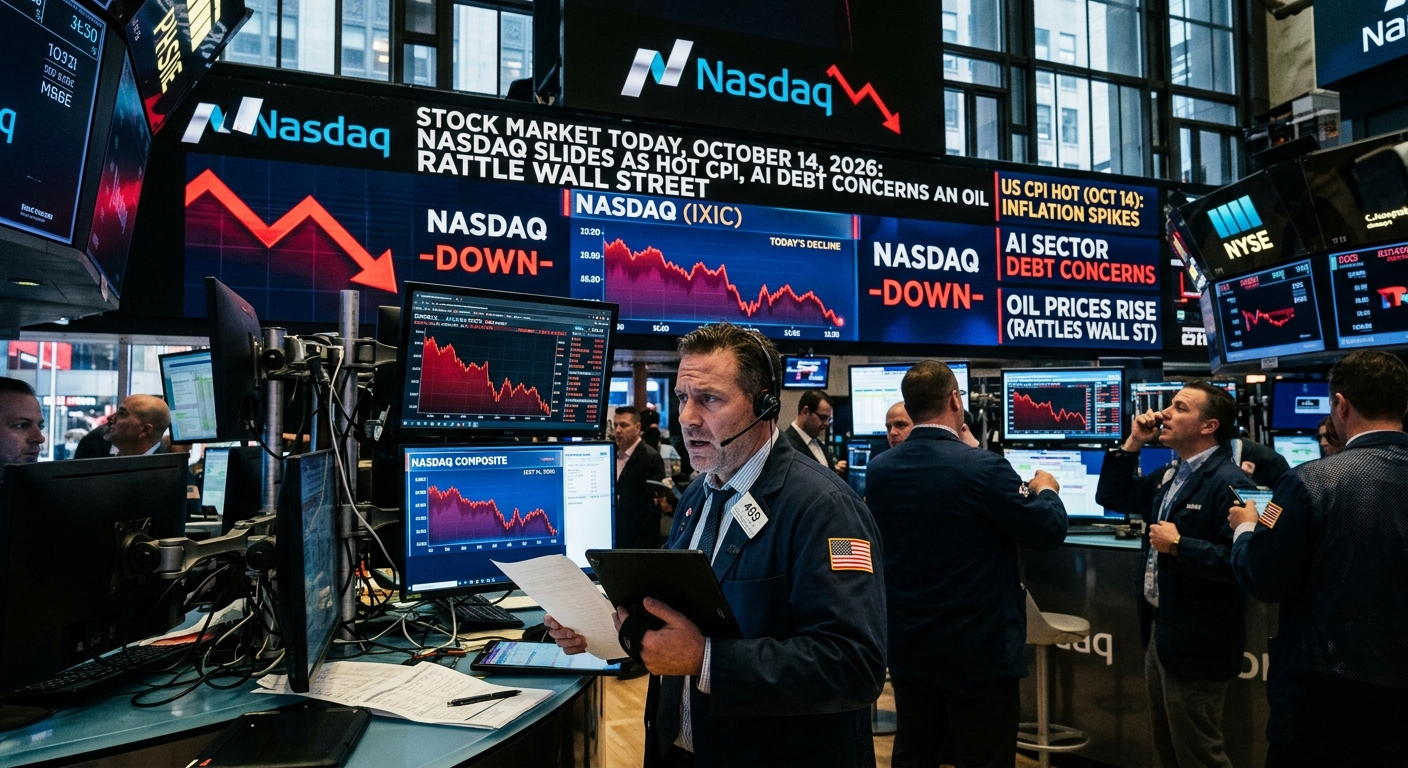
U.S. stocks traded lower Wednesday as hotter-than-expected September inflation, renewed scrutiny of artificial intelligence financing and escalating threats to Middle Eastern shipping weighed on investor confidence. The S&P 500 fell 1.11%, the Nasdaq Composite declined 1.88% and the Russell 2000 lost 1.93%. The Dow Jones Industrial Average proved comparatively resilient, slipping just 0.09%. The session’s defining theme was inflation. Consumer prices rose 3.7% from a year earlier in September, exceeding forecasts, while core inflation also surprised to the upside. Meanwhile, another commercial ship sank in the Strait of Hormuz, reinforcing concerns that energy disruptions could complicate the Federal Reserve’s effort to restore price stability. Wall Street had plenty of earnings to analyze, but the cost of money and the cost of fuel kept commandeering the conversation.
Market Performance: Nasdaq and Small Caps Lead the Decline
| Market indicator | Supplied level | Point or dollar change | Percentage change |
|---|---|---|---|
| S&P 500 | 7,718.94 | −86.51 | −1.11% |
| Dow Jones Industrial Average | 51,621.48 | −48.62 | −0.09% |
| Nasdaq Composite | 26,692.87 | −511.51 | −1.88% |
| Russell 2000 | 2,729.53 | −53.84 | −1.93% |
| Cboe Volatility Index, VIX | 16.87 | +1.60 | +10.48% |
| 10-year Treasury yield | 5.19% | −0.03 percentage points | −0.52% |
| Gold | $4,119.50 | −$57.80 | −1.38% |
| WTI crude oil, November 2026 contract | $95.08 per barrel | +$0.94 | +1.00% |
| Bitcoin, U.S. dollars | $81,704.31 | −$1,635.34 | −1.96% |
The Dow’s modest decline contrasted sharply with the Nasdaq’s technology-heavy retreat. CNBC reported that gains in UnitedHealth Group (UNH) and Amgen (AMGN) helped cushion the blue-chip benchmark, while AI infrastructure and semiconductor shares pulled the broader market lower. The nearly 2% decline in the Russell 2000 showed that weakness extended beyond large technology companies. At the same time, the VIX’s double-digit percentage increase indicated a rise in expected equity-market volatility..
September CPI: Energy Was Not the Entire Story
September’s Consumer Price Index report delivered an uncomfortable combination: a sharp monthly increase in headline prices and a smaller, but meaningful, upside surprise in underlying inflation.
| Inflation measure | September result | Consensus expectation |
|---|---|---|
| Headline CPI, month over month | +0.6% | +0.6% |
| Headline CPI, year over year | +3.7% | +3.6% |
| Core CPI, month over month | +0.3% | +0.2% |
| Core CPI, year over year | +2.6% | +2.5% |
Actual readings are supported by the Bureau of Labor Statistics; consensus estimates were reported by CNBC. Headline inflation accelerated from 3.4% in August to 3.7% in September. Core inflation, which excludes food and energy, increased from 2.4% to 2.6% over the same period. Higher fuel prices drove much of the headline pressure, but the core readings made it harder to dismiss the report as an energy-only disturbance.
Macroeconomic Commentary: A More Difficult Growth-and-Inflation Trade-Off
The economic concern is not simply that gasoline became more expensive. It is that a sustained energy shock can raise operating costs while leaving households with less money for other purchases. In that setting, businesses face pressure on margins at the same time that consumer demand becomes more vulnerable. The reported combination of rising fuel costs and firmer core inflation illustrates that policy challenge. For many, the distinction between headline and core inflation matters. An energy-led price surge can potentially reverse if supply conditions improve. Stronger core readings raise a separate question: whether inflation is becoming more persistent across the economy. September’s report increased that concern without, by itself, establishing a lasting trend.
Federal Reserve Outlook: Rate-Hike Risk Returns to the Conversation
The inflation report complicated expectations for the Fed’s meeting later this month. Yahoo Finance reported that traders had largely anticipated unchanged rates, but the September data increased attention to the possibility of another hike. CNBC’s broader inflation analysis also described expectations for additional tightening in December and into 2027. Those are market expectations, not announced policy decisions. An important distinction: the Federal Reserve’s formal 2% inflation objective applies to the Personal Consumption Expenditures price index, not CPI. Wednesday’s CPI report nevertheless provided another important signal about the direction of consumer-price pressure. The longer-term issue is inflation expectations. CNBC reported that the New York Fed’s September survey showed one-year inflation expectations rising to 3.9%. Cleveland Fed President Beth Hammack has warned that repeated elevated inflation readings could encourage households and businesses to treat persistent price increases as normal. That matters because expectations can influence wage demands, pricing decisions and spending behavior. The Fed’s challenge is therefore broader than responding to one monthly report: it must prevent today’s price pressures from becoming tomorrow’s default assumptions.
Strait of Hormuz: Shipping Attacks Reinforce Oil-Supply Concerns
A container ship, the Singapore-registered GFS Pride, sank in the Strait of Hormuz after being struck by an unidentified projectile and catching fire, according to CNBC’s reporting of the Singapore maritime authority’s account. All 21 crew members were evacuated safely, with no injuries reported. Iran’s Revolutionary Guard claimed a container ship had struck a naval mine, but the maritime security firm cited by CNBC said there was no independent evidence confirming that explanation for the GFS Pride’s sinking. The cause should therefore not be presented as a verified mine attack. The broader supply picture remained troubling. According to shipping data cited by CNBC:
- Crude exports through Hormuz averaged 8.5 million barrels per day in the week ended October 12, nearly 40% below prewar levels.
- Total regional shipments, including alternative pipeline routes, stood at approximately 14 million barrels per day, nearly 20% below prewar levels.
- More than 20 vessels had come under attack during October across Hormuz, the Persian Gulf and the Gulf of Oman.
WTI crude was quoted at $95.08 per barrel, up 1.00% on the day. Energy producers attracted interest during the session. Exxon Mobil (XOM), Chevron (CVX) and ConocoPhillips (COP) reached record intraday highs, according to CNBC, before pulling back from those peaks. Their strength contrasted with pressure on technology shares and highlighted the uneven market effects of higher oil prices.
AI Stocks: Many Scrutinize the Financing Behind the Build-Out
Wednesday’s technology weakness was not solely an inflation story. Investors also questioned how much debt some companies were using to finance AI infrastructure expansion. CNBC reported intraday declines of more than 16% for CoreWeave (CRWV) and approximately 9% for Oracle (ORCL).
Semiconductor shares also fell during the session:
- Advanced Micro Devices (AMD) declined approximately 5%.
- Intel (INTC) and Sandisk (SNDK) each fell approximately 4%.
- Micron Technology (MU) declined approximately 3%.
The analytical distinction is between demand for AI and the financial structure supporting it. Strong demand does not eliminate the need to evaluate borrowing costs, capital spending and the eventual return on infrastructure investment. Wednesday’s selling suggested many were paying closer attention to that second half of the equation. There were still signs of durable equipment demand. ASML (ASML) said some customers were expressing interest in orders for 2029 and 2030. Yahoo Finance also identified Thursday’s scheduled earnings from Taiwan Semiconductor Manufacturing Company (TSM) as the next important checkpoint for the AI and semiconductor outlook,
Bank Earnings: Strong Results Did Not Guarantee Strong Shares
Financial-company earnings produced a mixed picture, with investors weighing operating performance against regulatory expenses and a difficult macroeconomic backdrop.
Bank of America (BAC)
Bank of America (BAC) reported approximately $30 billion in quarterly revenue, below analyst expectations, and net income of $6.93 billion. Results included a roughly $1.2 billion regulatory penalty. Yahoo Finance reported adjusted earnings of $1.08 per share excluding the penalty, compared with reported earnings of $0.91 per share. Shares traded lower during the session..
Morgan Stanley (MS)
Morgan Stanley (MS) reported earnings of $3.03 per share on revenue of $20.34 billion, exceeding expectations of $2.91 per share and $19.95 billion. Equities trading revenue reached $5.79 billion, beating the cited consensus by more than $900 million. Despite the earnings beat, CNBC reported that shares were trading nearly 4% lower later in the session.
BlackRock (BLK)
BlackRock (BLK) provided a brighter earnings-related counterpoint. CNBC reported that shares rose more than 2% intraday after better-than-expected quarterly earnings, while assets under management increased to $15.49 trillion from $13.46 trillion a year earlier.
The takeaway from the group was that earnings beats alone were not enough to insulate every stock from the broader selloff. Company-specific results mattered, but investors were also reassessing inflation, financing conditions and market risk.
Treasury Yields, Gold and Bitcoin: Timing Matters
The 10-year Treasury yield at 5.19%, down approximately three basis points. Gold fell 1.38% to $4,119.50 in the supplied snapshot, while Bitcoin declined 1.96% to $81,704.31. Neither posted a gain in those readings despite the heightened geopolitical uncertainty, a reminder that different assets need not respond identically to the same headlines.
What Many Are Watching Next
Three questions now frame the market outlook:
- Can energy supply stabilize? Further shipping disruptions could sustain oil-price pressure and complicate the inflation outlook.
- Will underlying inflation cool? September’s core CPI readings increased the importance of subsequent data when assessing whether price pressures are broadening.
- Can AI-related earnings support investment expectations? Taiwan Semiconductor Manufacturing Company (TSM) earnings offer the next scheduled test of semiconductor demand, while the session’s selling highlighted concerns about debt-funded expansion.
Wednesday’s market split was clear: the Dow held up relatively well, while technology and small caps absorbed larger losses. For the next phase of trading, the central tension is whether corporate earnings can continue to support valuations as inflation and energy disruptions make the interest-rate outlook less comfortable.
Here’s The VP Watchlist Updates
Amwell® (NYSE: AMWL)
Amwell® (NYSE: AMWL), a leading provider of a comprehensive SaaS-based software platform for technology-enabled healthcare, closed at $12.15.
AMWL announced (Sept 8) announced the Department of Veterans Affairs (VA) has declared its intent for the Company to deploy its virtual health platform within the VA enterprise and help power the modernization of the VA’s digital health infrastructure. The VA anticipates the Amwell platform will support a broad range of clinical services, enhance care coordination, and improve access for our Veterans across the VA enterprise. The Letter of Intent follows a comprehensive evaluation process by the VA, in which it determined that Amwell’s virtual health platform aligns with the Department’s strategic objectives to expand access to high-quality, secure, and reliable virtual care services for Veterans nationwide through the VA’s current electronic health record modernization efforts. Specifically, the capabilities Amwell demonstrated in scalable video consultations, interoperability, cybersecurity compliance, and support for integrated care delivery were significant factors in this determination.
Amwell® has received Frost & Sullivan’s 2026 United States Technology Innovation Leadership Recognition in the Technology-Enabled Care Platforms Industry. The recognition validates Amwell’s ability to address healthcare fragmentation through a unified platform that orchestrates consumer experiences, clinician workflows, care programs, and partner solutions.
The Company also reiterated recently its objective to achieve positive cash flow from operations in the fourth quarter of 2026.
Serina Therapeutics (NYSE: SER)
Serina Theraeuptics (NYSE: SER, $1.71) is a clinical-stage biotechnology company developing a pipeline of wholly owned drug product candidates to treat neurological diseases and other indications. Serina’s POZ PlatformTM provides the potential to improve the integrated efficacy and safety profile of multiple modalities including small molecules, RNA-based therapeutics and antibody-based drug conjugates (ADCs). Serina is headquartered in Huntsville, Alabama on the campus of the HudsonAlpha Institute of Biotechnology.
On Thursday, September 24, 2026, Serina CEO Steve Ledger discussed discuss Serina’s programs’ progress during Tribe Public’s “A New Approach to Advanced Parkinson’s Disease: Serina Discusses SER-252’s Clinical Progress”webinar, followed by a live Q&A. You may view it below.
SER announced (Sept. 9) that the independent Safety Monitoring Committee (SMC) has completed its blinded review of Cohort 1 of the ongoing Phase 1b registrational study of SER-252 in patients with advanced Parkinson’s disease and recommended that the study advance to Cohort 2. Cohort 1 evaluated the lowest dose level in the single-ascending-dose portion of the study. In addition to supporting continued dose escalation, blinded Cohort 1 observations showed a pharmacokinetic profile consistent with the sustained apomorphine exposure SER-252 is designed to provide and included sustained periods of improvement in motor function in individual patients on exploratory clinical measures.
Eupraxia Pharmaceuticals Inc. (EPRX)
Eupraxia Pharmaceuticals Inc. (EPRX, $6.50), a clinical-stage biotechnology company leveraging its proprietary Diffusphere™ technology designed to optimize local, controlled drug delivery for applications with significant unmet need, has added a potentially important chapter to its eosinophilic esophagitis, or EoE, story: a single administration of its investigational localized therapy, EP-104GI, continued to show clinical-remission signals at 52 weeks in the highest-dose cohorts of the ongoing RESOLVE study. For a chronic disease in which swallowing can become a calculated exercise rather than an automatic human function, durability is more than a tidy line on a clinical slide. It is central to the value proposition. The latest data suggest Eupraxia’s localized, extended-release approach may be building toward a differentiated position in a market already led by a formidable incumbent: Sanofi S.A. (NASDAQ: SNY) and its biologic franchise, Dupixent. The clinical data remain early, open-label, and small in patient count, biotech investors should keep both feet on the ground, even when the data seem to float, but the one-year observations give EPRX a meaningful argument for continued investor attention ahead of interim randomized Phase 2b results expected in December 2026.
Modular Medical, Inc. (NASDAQ: MODD)
Modular Medical, Inc. (NASDAQ: MODD, $1.95), a commercial-stage medical device company preparing for the commercial launch of its next-generation Pivot™ tubeless patch pump, announced (September 4) that it has secured a contract with a national U.S. pharmacy benefit manager (PBM) in the United States. Pursuant to the contract, the Company’s Pivot insulin delivery system is now available through the national PBM. The Company believes the engagement with this national PBM represents a significant step forward in broadening patient access to the Company’s Pivot tubeless patch pump and will further validate the Pivot pump as an accessible therapeutic option for people living with diabetes.
MODD announced (September 3) that the U.S. Food & Drug Administration (FDA) has cleared a set of software enhancements to its Pivot insulin delivery system, further expanding the system’s functionality and providing users with greater flexibility and customization options in bolus dosing, an enhanced user-interface (UI), and other software upgrades.
MODD CEO, Jeb Besser, co-hosted a Tribe Public’s CEO Presentation and Q&A Webinar Event titled “The Road To Revenue: Modular Medical’s Strategy For Launching Pivot,” that was held Friday, September 4, 2026 (8:30am PT / 11:30 am ET). You may watch the event video below now if you missed it below now.
MODD announced (Aug. 3) plans to initiate the first phase of commercialization of its Pivot tubeless patch pump across five strategically selected U.S. markets beginning in October 2026. The initial rollout will include Atlanta, Cincinnati/Lexington, Dallas, Houston, and Philadelphia, representing a foundational step in the Company’s capital efficient commercialization strategy with its mission to expand access to simplified insulin delivery solutions for all people living with diabetes.
MODD recently (July 22) announced the formation of its Pivot Innovation Council, a cross-functional group of leading clinicians and healthcare experts established to help guide the company’s clinical and commercial strategy. Diabetes care expert Robert Gabbay, MD, PhD, FACP was appointed as chair of the Pivot Innovation Council. The council will provide insights on target patient populations, support optimization of clinical workflows, inform evidence-generation initiatives, and help refine the Pivot product roadmap and go-to-market approach, as the Company continues to scale its differentiated offering.
LG Display Co., Ltd. (LPL)
LG Display Co., Ltd. (NYSE: LPL, $2.66) has spent the last few years doing something many hardware companies talk about but few execute well: turning a technology pivot into a full‑blown business transformation that everyday investors can actually follow. Instead of chasing commoditized LCD TV panels in a race to the bottom, LPL is leaning into Gaming OLED, CES‑worthy innovation, and premium automotive displays – and the press trail tells a surprisingly investor‑friendly story.
Yatsen Group (NYSE: YSG)
Yatsen Group (NYSE: YSG, $2.50, +3.31%), a leading China-based beauty group, delivered the sort of quarter that can make a turnaround investor sit up straighter: reported revenue grew, its strategically important skincare operation accelerated sharply, and the company is increasingly built around clinical and premium brands rather than a pure color-cosmetics play. The results are not yet a victory lap, losses widened and third-quarter guidance is cautious, but YSG’s transformation is beginning to look less like a cosmetic touch-up and more like a genuine renovation.
YSG announced (July 8) a landmark collaboration to bring its flagship brand, Perfect Diary, to Sephora in China. This partnership integrates Yatsen’s rigorous scientific infrastructure with the world’s leading prestige beauty retailer, marking a significant milestone in Yatsen’s continuing evolution into a global beauty technology powerhouse.
Doximity, Inc. (NYSE:DOCS)
Doximity (NYSE: DOCS, $29.92) is the leading digital platform for U.S. medical professionals. The company’s network members include more than 85% of U.S. physicians across all specialties and practice areas. Doximity provides its verified clinical membership with digital tools built for medicine, enabling them to collaborate with colleagues, stay current on medical news and research, manage their careers and on-call schedules, streamline documentation and administrative paperwork, and conduct virtual patient visits.
DOCS announced (Oct. 13) it has extended its 13-year partnership with U.S. News & World Report, the nation’s most trusted source of independent healthcare information, rankings and guidance to help patients identify the best care for their needs.
Sable Offshore Corp. (SOC)
Sable Offshore Corp. (NYSE: SOC, $3.36). JPMorgan Chase (NYSE: JPM) initiated coverage of Sable Offshore (NYSE: SOC) with an Overweight rating and a $10 price target October 2. That target implies an approximately 178% gain from today’s prices that are in the $3.59 range. It is an attention-getting valuation gap, even by the standards of an industry accustomed to looking beneath the surface. The more substantive opportunity, however, lies offshore California. Sable is already generating revenue from its Santa Ynez Unit, while preparing to restart Platform Hondo and expand the infrastructure needed to move more oil to market. The bullish thesis is therefore more advanced than a bet on dormant assets: it is a wager for many that an operating business can overcome its remaining bottlenecks and convert additional barrels into stronger cash generation.
Nvidia (NVDA, $221.30, -3.16%)
NVIDIA Corp. (NASDAQ: NVDA). AM Intelligence (“AMI”), the AI infrastructure platform set up by Promoters of Greenko, announced (Oct. 5) two further firm and binding orders for 20,000 NVIDIA Rubin GPUs, to be deployed as NVIDIA Vera Rubin NVL72 rack-scale systems. Building on its first AI factory in Hyderabad, the expansion is designed to give cloud providers, enterprises and AI developers access to large-scale computing capacity closer to where they build and deploy AI.
NVDA recently has seemingly has given many a two-part bullish signal: a record-sized $150 billion increase to its share-repurchase authorization and a new AI-agent safety platform aimed at making autonomous software more secure for enterprise deployment. The combination suggests a company using extraordinary financial strength not merely to reward shareholders, but to expand its influence from AI computing into the governance, security and operating layer of the AI economy. The timing is notable. Markets are beginning the week with a cautiously constructive tone, even as investors brace for jobs, inflation and manufacturing data that could reset the outlook for interest rates. In that environment, NVIDIA is making a familiar but potent argument: its AI franchise is generating enough cash to finance innovation, deepen its ecosystem and return meaningful capital to shareholders, all at once. That is not an everyday corporate trick. It is closer to juggling bowling balls while also building the bowling alley.
The Sources
- CNBC: Stock Market Today, October 14, 2026, Live Updates
Market coverage, AI-related stock declines, bank earnings, energy stocks and oil prices. - CNBC: Container Ship Sinks in Strait of Hormuz as Iran Steps Up Attacks
Shipping disruptions, the GFS Pride incident and regional oil-export risks. - CNBC: How High Inflation Became a “Fact of Life” in the U.S.
Persistent inflation, consumer expectations and implications for Federal Reserve policy. - Yahoo Finance: Stock Market Today, Hot Inflation Report Drops Tech, Drives S&P 500 and Nasdaq Down
Equity-market developments, Treasury yields, bank earnings and the semiconductor outlook. - Yahoo Finance: CPI Inflation Live Updates, Prices Rose 3.7% in September
September inflation readings, fuel-price pressures and interest-rate expectations. - U.S. Bureau of Labor Statistics: Consumer Price Index Summary
Official headline and core CPI data. This rolling release page updates when subsequent reports are published. - U.S. Bureau of Labor Statistics: Consumer Price Index Data and Releases
Official CPI tables, category-level inflation data and release resources. - CNBC: Consumer Prices Rose at a 3.7% Annual Rate in September as Gas Costs Skyrocket
September CPI results and comparisons with economists’ expectations. - Federal Reserve: Why Does the Federal Reserve Aim for Inflation of 2 Percent Over the Longer Run?
Explanation of the Fed’s inflation objective and its use of the Personal Consumption Expenditures price index. - Federal Reserve: Statement on Longer-Run Goals and Monetary Policy Strategy
The Fed’s framework for price stability, maximum employment and monetary-policy decisions. - Federal Reserve: What Is Inflation, and How Does the Federal Reserve Evaluate Changes in the Rate of Inflation?
Background on inflation measurement and the distinction between CPI and PCE inflation.
Stay Updated with Vista Partners
Subscribe to receive market insights, investing ideas, and the latest updates directly in your inbox.