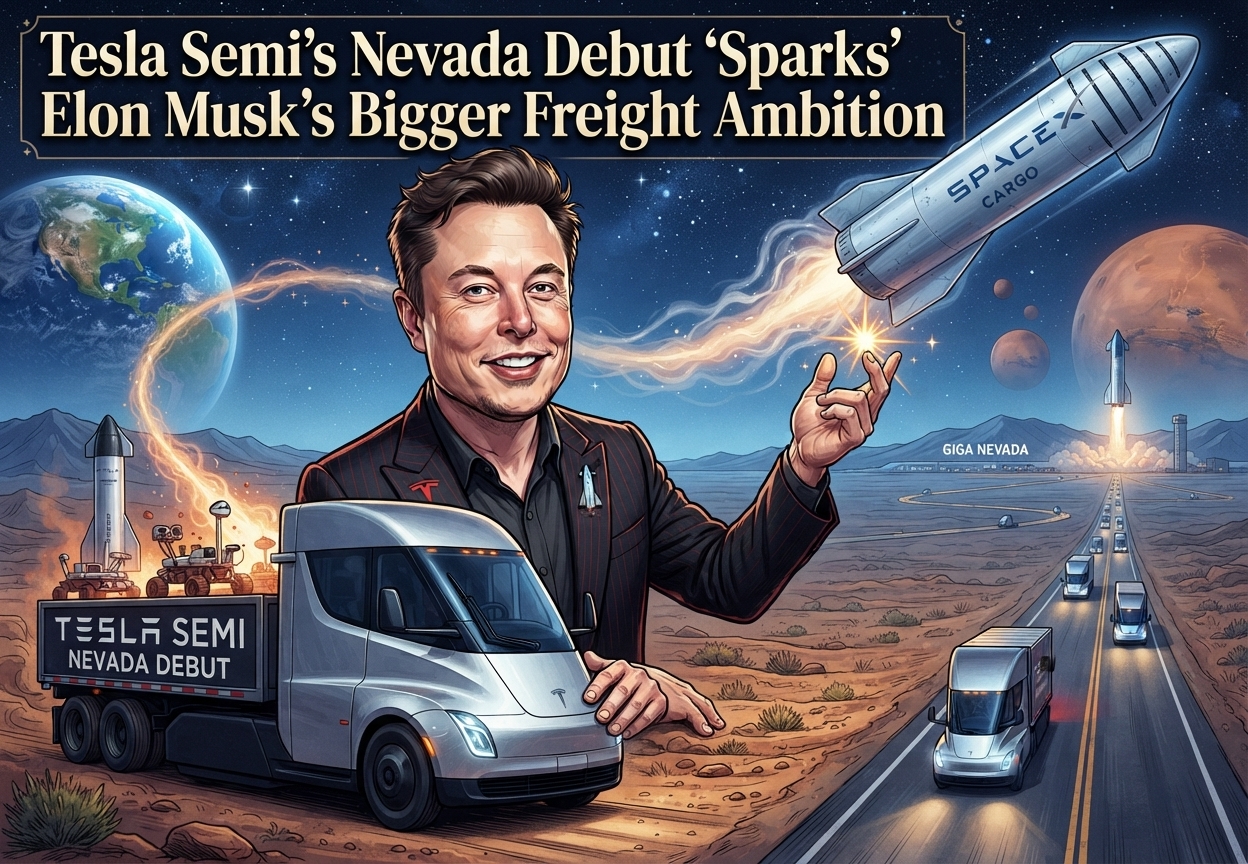
Tesla, Inc. (NASDAQ: TSLA) has opened its dedicated Tesla Semi factory in Sparks, Nevada, turning the company’s electric-truck program from a long-running promise into a visible industrial ramp. The event’s central message was straightforward: Tesla believes the next meaningful EV battlefield is not merely the driveway, it is the loading dock, the distribution center and the long highway corridor where diesel has ruled with a very loud, very expensive exhaust note. The company’s new Nevada facility is designed to support eventual output of up to 50,000 Tesla Semi trucks annually, according to reporting around the launch. For investors, the milestone adds a potentially material commercial-vehicle and charging-infrastructure layer to the broader Tesla story, though execution, production scale, fleet economics and charging deployment will determine whether this becomes a major profit pool or simply a very impressive piece of factory theater.
A Truck Built for the Economics
At the rollout event, Tesla executives emphasized a familiar corporate religion: first-principles engineering, lower cost and relentless simplification. This time, however, the product was a Class 8 freight truck rather than a crossover with a panoramic roof. Tesla said its pilot Semi fleet, consisting of just under 200 trucks, has accumulated roughly 17.5 million real-world miles hauling freight. The company framed that data set as the proving ground for a redesigned production vehicle shaped by commercial use in snow, rain, desert heat and mountain terrain, including California’s Donner Pass. The important point is not that a truck can look futuristic in a product video; it is whether it can wake up every morning, haul a heavy load and avoid making a fleet manager regret his optimism before lunch. The company says the Long Range Tesla Semi can travel more than 500 miles on a charge while fully loaded at approximately 82,000 pounds. Tesla also introduced a Standard Range version with a targeted range of 325 miles, intended for regional and depot-based routes where buying excess battery capacity would be a bit like bringing a yacht to a car wash. Tesla’s executives also stressed that efficiency gains allowed the new Semi to use a lighter, lower-energy battery pack while retaining the previously demonstrated range. The production version is shifting from purchased 2170 battery cells to Tesla’s in-house 4680 cells, a move the company says supports lower mass, reduced cost and stronger manufacturing integration.
The Megacharger Becomes the Other Half
Range alone does not transform freight. Freight needs uptime, predictable schedules and charging that works at commercial scale. Tesla’s answer is the Megacharger network. At the Nevada event, Tesla demonstrated a live charging session at roughly 1.2 megawatts. The company said it plans to have more than 30 Megacharger stations and more than 200 megawatt-capable charging posts online by year-end, while also offering depot and overnight charging configurations for fleets. Tesla’s lower-power base charging option, around 125 kilowatts, is designed for off-shift charging—plug in after a route, walk away and let the electrons work the night shift. Tesla’s broader charging experience matters here. The company noted it has deployed more than 80,000 Supercharger connectors globally, and it is seeking to apply that operational knowledge to heavy-duty freight. Independent reporting indicates Tesla has mapped Megacharger expansion along major U.S. freight corridors, although coverage is expected to be uneven initially, with stronger concentration in regions such as California, Texas and the East Coast. That dual strategy, public corridor charging plus private depot installations, could be pivotal. Long-haul fleets need fast-turn infrastructure, while dedicated-route operators may prioritize lower-cost overnight charging at their own facilities. Tesla is positioning itself to sell both the truck and part of the operating system around it.
A Better Driver’s Office
Tesla has not ignored the cab. The production Semi includes several upgrades drawn directly from pilot-fleet feedback:
- A full roll-down window replaces the earlier pop-out design, addressing the decidedly unglamorous but essential realities of toll booths, badge readers, call boxes and human civilization.
- Acoustic glass and additional insulation are intended to reduce cabin noise.
- Driver profiles can automatically carry seat, mirror and interface preferences from truck to truck.
- Dynamic trip planning is designed to account for weather, traffic, charging availability and changing payloads.
- Tesla says the vehicle is engineered around uptime and simplified maintenance, a critical issue for fleet operators whose trucks earn money only when they are rolling.
This is a meaningful distinction. A commercial EV must sell not only to a sustainability office but also to dispatch, maintenance, finance and the driver who will spend long hours inside it. The new Semi’s driver-focused software and cab changes suggest Tesla understands that commercial adoption is won in the operational details, not in a PowerPoint slide with a leaf icon in the corner.
Why TSLA Investors May Care
For shareholders of Tesla (NASDAQ: TSLA), the Semi does not instantly rewrite the income statement. It does, however, create a new route into a large and traditionally conservative transportation market. The investor case has several moving parts:
| Potential catalyst | Why it matters for Tesla |
|---|---|
| Dedicated Semi production | A specialized Nevada factory gives Tesla a clearer path to commercial-scale truck output rather than limited pilot deployment |
| Annual capacity target | Tesla and outside reporting have cited a potential capacity of up to 50,000 Semis per year, creating meaningful revenue potential if demand and production ramp materialize |
| 4680 battery integration | More in-house battery content could improve vehicle economics and give Tesla greater control over a key cost component |
| Charging hardware and installation | Megachargers, depot charging and related services could create recurring ecosystem value beyond the initial truck sale |
| Fleet software opportunity | Driver profiles, route planning, charging coordination and uptime data could strengthen Tesla’s commercial-fleet relationship over time |
| Lower operating-cost proposition | If fleets consistently achieve lower per-mile energy and maintenance costs versus diesel, adoption could accelerate on suitable routes |
Tesla’s management is betting that freight operators will ultimately respond to economics more than ideology. If the Semi can reliably lower the cost per mile while preserving payload, range, recharge speed and uptime, the truck could appeal to fleet buyers even before they place a premium on emissions reductions. That is a considerably more durable thesis than asking logistics companies to buy a truck because it photographs well beside a wind turbine.
Elon Musk, SpaceX and the Execution Question
Tesla CEO Elon Musk did not appear in person at the Semi launch, but delivered a recorded message describing the vehicle as a “game changer” for heavy shipping. He highlighted the truck’s high payload capability, megawatt-scale charging, driver appeal and the possibility of future self-driving features. Those autonomy comments should be read as forward-looking aspirations, not as a present commercial-autonomy capability or a guaranteed timetable. Musk’s broader technology ecosystem often amplifies investor interest in Tesla. His aerospace company, SpaceX (SPCX) is putting the finishing touches on the launchpad ahead of Starship’s 14th flight, currently slated for next week, because apparently even a giant stainless-steel rocket benefits from a proper dress rehearsal. Elon Musk’s company completed its countdown test on Thursday, Sept. 24 as it prepares for another milestone mission. Tesla is, of course, directly relevant to the Tesla Semi factory and vehicle program. The practical investment question is less about celebrity cross-pollination and more about manufacturing discipline. Tesla’s 2025 annual report said the company expects to ramp six new production lines across vehicles, energy storage, battery manufacturing and related operations during 2026. That underscores both the opportunity and the operational burden: Tesla is pursuing multiple capital-intensive ramps at once.
The Bull Case & the Fine Print
The bullish interpretation is compelling. Tesla is moving from a pilot fleet to a dedicated production plant, introducing two range configurations, leaning more heavily on proprietary battery technology and deploying charging hardware tailored to heavy freight. The company has also designed the Semi around a common commercial imperative: keep the asset moving, keep operating expenses controlled and avoid surprise maintenance. Still, a factory opening is the overture, not the opera. Tesla has to prove that it can ramp volume without sacrificing quality, build enough charging infrastructure where fleets actually run, secure battery supply at scale and deliver fleet economics that remain attractive as electricity prices, diesel prices, incentives and competitive offerings evolve. Recent reporting has also noted margin and free-cash-flow pressures at Tesla, meaning investors should separate the strategic excitement of the Semi launch from the near-term financial realities of scaling an entirely new vehicle category. For now, the Nevada Semi factory gives Tesla (NASDAQ: TSLA) a new and credible industrial narrative: the company is not merely selling electric vehicles; it is attempting to electrify the machinery that keeps shelves stocked, factories supplied and e-commerce packages arriving with suspiciously efficient timing. The Tesla Semi will need to earn its place mile by mile. But the first large-scale signal from Nevada is unmistakable: Tesla wants a larger share of the road, and it intends to take the heavy lane.
The Sources
- Tesla Semi Rollout Event: Everything Announced in 11 Minutes Tesla on YouTube
Official event video covering Tesla’s Nevada Semi factory opening, 1.2-megawatt charging demonstration, stated 500-mile Long Range capability, 325-mile Standard Range variant, 4680 cells, driver features and Megacharger plans - Tesla is beginning Semi electric truck deliveries Reuters
Reuters coverage of Tesla, Inc. (NASDAQ: TSLA) beginning Semi deliveries and its plan for a Nevada facility designed for 50,000 trucks annually - Tesla aims to scale Semi truck production with Nevada factory opening CNBC
CNBC reporting on Tesla’s opening of its first dedicated heavy-duty truck manufacturing facility in Sparks, Nevada. - Tesla opens new Semi factory: What you need to know CNBC Video
CNBC’s report on the Semi factory launch and Tesla’s commercial-trucking push. - Tesla Semi finally enters volume production, 7 years behind schedule Electrek
Industry coverage of Tesla’s dedicated Semi plant, its stated 50,000-truck annual capacity, and the transition toward high-volume production. - Tesla Semi Event Puts the Spotlight on Trucking Yahoo Finance
Background on the Semi event, the Sparks factory, the factory’s reported 1.7-million-square-foot footprint and Tesla’s planned scale-up. - Tesla opens Nevada Semi truck factory targeting 50,000 units a year Quartz
Coverage of Tesla’s Nevada plant, the 50,000-unit annual target, expected jobs and the company’s production-ramp ambitions - Tesla Semi Launches High-Volume Production at 50,000-Truck Nevada Megafactory TeslaNorth
Details on Tesla’s production launch, the reported 1.8-million-square-foot facility and Semi variants expected to share a production line. - Tesla Semi deliveries start as Nevada factory targets 50,000 trucks a year Runtime Wire
Useful context distinguishing the factory’s planned annual capacity from current output, while covering deliveries and Tesla’s stated Semi production objectives - Tesla SEC Filings and Investor Relations Tesla, Inc.
Tesla’s official investor-relations archive for annual reports, quarterly reports, current reports and other SEC filings relevant to Tesla (NASDAQ: TSLA) production, capital-expenditure and risk disclosures
Stay Updated with Vista Partners
Subscribe to receive market insights, investing ideas, and the latest updates directly in your inbox.