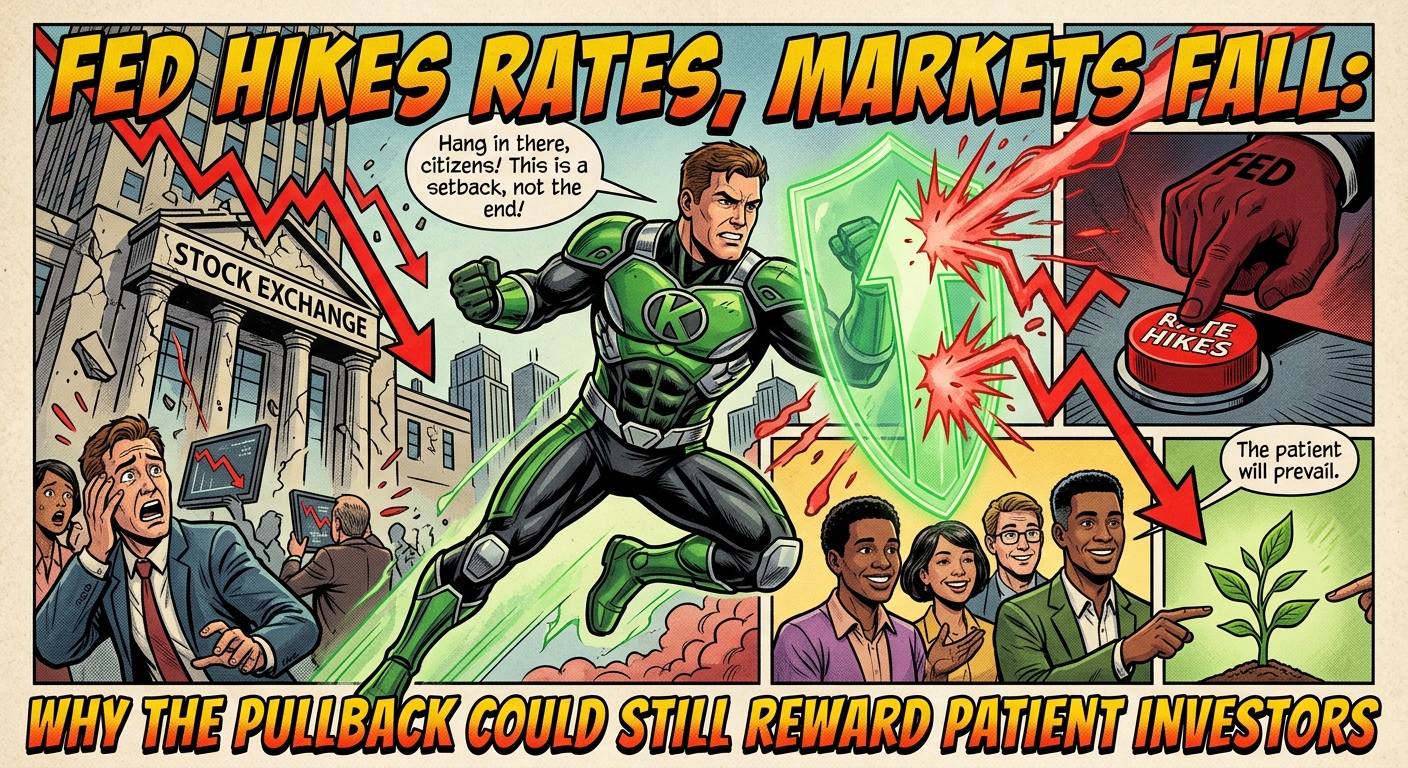
The Federal Reserve’s first rate increase in more than three years has given Wall Street a familiar case of indigestion: stocks fell after the announcement as investors weighed higher borrowing costs, another possible hike this year and a jump in Treasury yields. Still, the selloff looks more like a repricing of risk than a wholesale rejection of the U.S. growth story, and that distinction may create opportunity for investors willing to prioritize earnings, balance-sheet strength and durable themes such as artificial intelligence infrastructure. The Fed lifted its benchmark federal-funds target range by 25 basis points, to 3.75%–4.00%, in a unanimous 12–0 vote. Policymakers also signaled that another increase could come before year-end as they seek to control inflation that remains above the central bank’s 2% objective.
The Market Heard “Higher for Longer”
The rate increase itself was widely expected. Futures markets had assigned more than a 90% probability to a quarter-point hike shortly before the decision. What unsettled markets was less the first move than the message embedded in the Fed’s outlook: inflation has not cooled enough, oil-driven price pressures remain a concern and policymakers appear prepared to keep monetary conditions restrictive. The policy shift is meaningful because it resets the investment conversation. For much of the previous cycle, investors could debate whether rates would stay on hold, eventually fall or simply become someone else’s problem after the next earnings call. The Fed has now made clear that price stability remains its priority. The central bank expects headline personal-consumption-expenditures inflation of 3.7% this year and core PCE inflation of 3.4%, both slightly higher than its June estimates. Officials do not anticipate a return to the 2% goal until after 2028. That prospect has pressured equities because higher risk-free yields affect stock valuations, particularly for long-duration growth companies whose cash flows are expected further down the road. When the discount rate rises, the market becomes less willing to pay today for a profit that is scheduled to arrive sometime after several product launches, two strategy pivots and a well-attended investor day. Yet the market decline is not necessarily an argument against stocks. It is an argument for selectivity.
Bond Yields Set the Tone
The 10-year Treasury yield had already pushed above 5%, briefly reaching its highest level since 2007, before moderating around the Fed decision. The 30-year fixed mortgage rate climbed above 7.2%, and Mortgage News Daily put the average 30-year fixed rate near 7.19% to 7.22%. Those figures matter because they reach beyond the bond market:
- Higher Treasury yields increase the competition equities face for investor capital.
- Higher mortgage rates can cool housing activity and restrain interest-sensitive consumer spending.
- Costlier credit can pressure companies with near-term refinancing needs or weak free-cash-flow profiles.
- A flatter yield curve and softer customer activity could weigh on banks if the tightening cycle extends, according to Bank of America Securities.
The immediate effect is a market that must work harder to justify elevated valuations. That is not cheerful news for every stock, but it can be healthy for capital allocation. The era when every enterprise with a slide deck and a cloud subscription could be called “disruptive” was always likely to encounter a chaperone eventually.
The Economy Still Provides a Cushion
The bullish counterargument begins with economic resilience. The Fed modestly raised its 2026 GDP-growth projection to 2.3%, from 2.2%, while lowering its unemployment-rate projection to 4.1%, from 4.3%. Domestic spending has remained resilient, according to the Fed’s assessment. Recent consumer data reinforce that point. U.S. retail sales rose 1.2% in August, outperforming the 0.8% consensus estimate and reversing July’s 0.5% decline. Excluding autos, sales increased 1.4%; online retail sales climbed 2.6%, while electronics and appliance sales rose 1.6%. Retail sales were 6% above the prior-year period. This does not mean consumers are immune to elevated borrowing costs or energy prices. It means the economic foundation has not yet cracked under their weight. For many, continued consumer demand supports a more constructive view of companies with:
- Recurring revenue and essential products or services.
- Pricing power that can offset labor, logistics and input-cost pressure.
- Strong customer loyalty and an ability to gain share during volatile periods.
- Net cash or manageable debt maturities.
- Earnings models that do not depend on falling rates to meet consensus expectations.
Costco Wholesale Corp. (COST) is one example of the market’s preference for scale and value. Bank of America (BAC) maintained a Buy rating and cited Costco’s value proposition and higher-income member base as reasons it could continue taking share, even as the firm reduced its price target to $1,095 from $1,200 because supply-chain costs could pressure margins.
AI’s Earnings Test Gets More Important
A higher-rate market does not end the AI investment cycle. It raises the standard for participating in it. The strongest AI-linked companies may be those with real revenue growth, visible customer demand, pricing power and enough internal capital to fund expansion without depending on easy financing. Many are likely to differentiate more aggressively between businesses selling essential computing, networking and data-center capacity and those selling merely an ambitious adjective. Even amid wider market pressure, several AI-infrastructure names demonstrated investor interest. CoreWeave Inc. (CRWV) rose more than 4%, Nebius Group N.V. (NBIS) gained nearly 5%, Lumentum Holdings Inc. (LITE) advanced 8%, Coherent Corp. (COHR) climbed 6% and Dell Technologies Inc. (DELL) rose 5% after recent weakness. The moves underscore a key market reality: many may be reducing exposure to broad duration risk while still paying attention to the corporate spending cycle behind AI. Potential areas of focus include:
- Data-center compute and cloud-capacity providers.
- Optical networking and photonics suppliers.
- Semiconductor manufacturers and foundries.
- Enterprise hardware and server-infrastructure companies.
- Power, cooling and electrical-equipment providers serving data centers.
- Software companies that can demonstrate AI-driven productivity or incremental revenue rather than simply a new menu tab.
Intel Corp. (INTC) moved higher after reports that SK Hynix Inc. (SKHY) was in discussions to manufacture memory chips in the United States using Intel’s foundry operations, though SK Hynix said no partnership decision had been made. A finalized arrangement could support Intel’s manufacturing strategy and broader U.S. semiconductor-production ambitions; until then, investors should treat it as a developing possibility rather than booked revenue.
Inflation Is the Complication
The Fed’s concern is not abstract. Higher diesel and oil prices have intensified the inflation debate, with U.S. diesel prices reaching roughly $6 per gallon amid supply constraints linked to the Ukraine and Iran wars. Brent crude traded near $105 per barrel and West Texas Intermediate crude near $102 per barrel after pulling back from recent highs. Fuel costs can feed through transportation, shipping, agricultural production and consumer prices. That is why the Fed is tightening even though higher interest rates cannot produce one additional barrel of oil or persuade a tanker to speed up through geopolitics. The consequences were visible in transportation. J.B. Hunt Transport Services Inc. (JBHT) said third-quarter earnings could decline 5% to 10% sequentially amid higher driver, fuel and transportation expenses. Its shares fell more than 13% intraday, while C.H. Robinson Worldwide Inc. (CHRW), Old Dominion Freight Line Inc. (ODFL) and Werner Enterprises Inc. (WERN) also weakened. For many, the lesson is straightforward: inflation exposure deserves renewed scrutiny. Companies that can pass costs through, use long-term contracts, operate efficiently or have differentiated products may fare better than businesses whose margins are squeezed every time diesel prices develop a personality.
Volatility Can Be an Entry Point
Citi’s historical analysis argues that global stocks often wobble around the beginning of Fed tightening cycles but still rise over the following six and 12 months. The bank’s strategist cautioned that the outcome depends heavily on the macroeconomic backdrop: resilient growth and declining inflation make rising bond yields easier for equities to absorb. Citi still sees room for earnings-led upside into the middle of next year, even while advising near-term caution because of stagflation risks tied to geopolitics. That framing supports a disciplined rather than reflexive approach to a post-Fed selloff. Many may consider:
- Building positions gradually instead of trying to identify the precise intraday bottom.
- Favoring companies with reliable earnings, strong margins and manageable leverage.
- Reviewing exposure to heavily indebted businesses, rate-sensitive real estate and consumer-credit risk.
- Separating temporary share-price declines from deterioration in a company’s long-term earnings outlook.
- Keeping dry powder in short-duration fixed income, money-market funds or high-yield savings products while waiting for compelling equity entry points.
- Avoiding the temptation to confuse volatility with a complete investment thesis.
The Bullish Bottom Line
The Federal Reserve’s latest move has made the market’s job more difficult, and the initial stock decline reflects a rational reassessment of valuations, financing costs and inflation risk. The federal-funds rate now stands at 3.75%–4.00%, another hike remains possible this year and long-dated Treasury yields have returned to levels that demand investor attention. But a falling market after a Fed announcement is not automatically a broken market. The economic backdrop still includes projected GDP growth of 2.3%, a 4.1% unemployment outlook, resilient consumer spending and major corporate investment in AI, cloud infrastructure, networking and domestic semiconductor capacity. Those forces do not eliminate the risks from oil, inflation and higher rates. They do, however, give patient investors a framework for looking through the volatility. The next phase of this market may not reward indiscriminate optimism. It may reward businesses that produce cash, defend margins, manage debt and convert technological enthusiasm into actual earnings. For many, that is less a reason to leave the market than a reason to bring a sharper pencil.
Learn More Now
The Sources
- Yahoo Finance Fed raises interest rates by a quarter point in unanimous decision, marking first hike in 3 years
- Yahoo Finance What a Fed rate hike means for your bank accounts, loans, credit cards and investments
- CNBC Fed approves interest rate hike, signals one more to come this year
- CNBC S&P 500 rises ahead of pivotal Fed rate decision: Live updates
- Federal Reserve FOMC Meeting Calendars and Information
- Reuters Wall Street ends lower as oil spikes and benchmark Treasury yields rise
- Reuters Wall Street Week Ahead: Investors brace for possible Fed rate hike
- Reuters Global brokerages expect Fed rate hikes after strong inflation report
- KPMG Inflation Forces the Fed’s Hand: September 2026 Fed Primer
- U.S. News & World Report Strong Retail Sales Make Fed’s Case for Rate Hikes Easier
Stay Updated with Vista Partners
Subscribe to receive market insights, investing ideas, and the latest updates directly in your inbox.