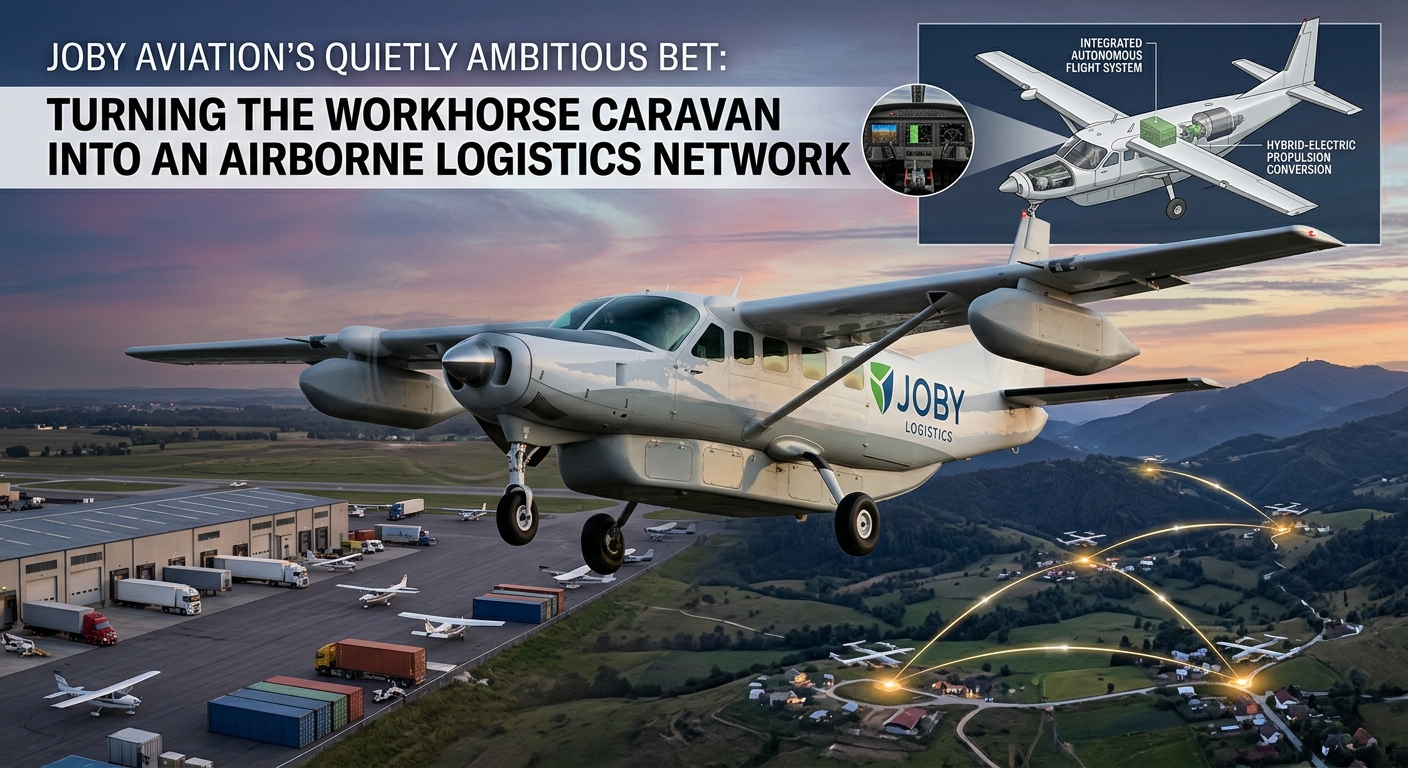
Joby Aviation, Inc. (NYSE: JOBY) is presenting a more expansive investment narrative than the familiar electric-air-taxi story. Its autonomous J208 program, a Cessna 208B Grand Caravan fitted with Joby’s Superpilot autonomy system, is a practical attempt to make regional cargo, emergency response and defense logistics more flexible, more available and potentially far less dependent on the traditional one-pilot-per-aircraft model. The appeal is not that a computer has suddenly discovered aviation. The appeal is that Joby is applying sophisticated autonomy to an aircraft operators, regulators and mechanics already understand. In an industry where novelty tends to arrive with a large bill and a long certification queue, that is a notably adult decision.
A Thesis Takes Flight
The J208 is designed to taxi, take off, navigate, detect hazards, land and shut down using onboard autonomy, while a ground-based remote pilot supervises the operation, manages flight-plan changes and communicates with air traffic control. For selected flights today, a monitoring pilot remains onboard, but the broader architecture is aimed at supervised uncrewed operations over time. That distinction matters. Joby is not pitching a science-fiction aircraft that needs every part of the aviation ecosystem rebuilt around it. It is pursuing a phased operating model:
- A certified and familiar fixed-wing platform: the Cessna Grand Caravan.
- An autonomy stack that handles perception, navigation, flight control and contingency management.
- A ground-based pilot who remains responsible for judgment, ATC coordination and mission oversight.
- A commercial pathway that can begin with cargo, logistics and public-sector missions before attempting broader passenger applications.
In plain English, the airplane handles the repetitive flying; the pilot handles the higher-order decisions. That may prove a more investable model than demanding that customers, or regulators, accept an empty cockpit on day one. The company has said the autonomous J208 has completed more than 400 flights and accumulated more than 800 automated flight hours in controlled and uncontrolled airspace. It has also participated in three U.S. military exercises. Those figures do not equal commercial certification, but they move the program beyond the familiar “beautiful rendering meets optimistic conference slide” stage that investors know all too well.
A Caravan With Silicon Under the Floorboards
The technological premise is straightforward but demanding. Joby’s system combines cameras, lidar, radar, onboard compute and AI-enabled perception to help the aircraft recognize runways, detect objects while taxiing and identify air traffic or other hazards during flight. The J208’s detect-and-avoid capability includes an internally developed active electronically scanned-array radar. In the video, Joby engineers describe a sensor-and-compute system that fuses radar, cameras and lidar data, while using GPU-class computing for vision workloads and certified processors for safety-critical functions. The stated objective is not merely to follow a programmed route, but to perceive conditions and respond within defined operating and safety constraints. That is a meaningful conceptual leap from conventional autopilot. Traditional automation can relieve workload and precisely follow instructions; autonomy must also interpret the world, manage contingencies and sustain safe behavior when the mission changes. Aviation, unsurprisingly, prefers evidence to adjectives. Joby’s approach appears deliberately pragmatic: build autonomy around a conventional cargo platform rather than begin with a clean-sheet aircraft. The company argues that integrating the system into an already-certified Caravan can provide a more immediate route to autonomous air-logistics operations. The strategy has the financial virtue of avoiding several problems at once. It lowers airframe-development risk, leverages an established maintenance and operating base, and focuses regulatory effort on the genuinely novel component: autonomy. It is the aerospace equivalent of renovating a well-built townhouse rather than first inventing concrete.
Why Cargo May Be the First Big Prize
Cargo is an especially logical starting point because many missions are repetitive, time-sensitive and poorly matched to the lifestyle economics of conventional piloting. Regional cargo pilots can face irregular schedules, extended downtime between short flight segments and demanding overnight routes. Joby’s thesis is that a remote-pilot model could make operations more productive: one qualified operator may supervise successive aircraft missions across different locations, while maintaining more conventional work patterns than an overnight cargo run allows. The proposed benefit is not simply labor reduction. It is aircraft utilization. A conventional cargo operation can effectively pair one aircraft with one crew journey. A remotely supervised network could eventually allow pilots to oversee missions as aircraft move through a scheduled logistics system, subject to regulatory approval and operating limits. If the model performs as intended, it could improve asset productivity while helping cargo operators address difficult pilot recruitment and retention dynamics. That is where the story becomes more interesting for many. The economics of autonomy are not limited to “remove a person, reduce a cost.” The larger prize is to make low-volume, high-urgency air freight economically viable on routes that are too small, too irregular or too time-sensitive for larger aircraft and conventional dispatch models. Potential early-use cases include:
- Overnight and regional package delivery.
- Medical supplies and organ-support logistics.
- Emergency and disaster-response missions.
- High-priority industrial parts delivery.
- Military resupply to dispersed operating locations.
- Remote-community freight missions.
A missing part for an F-35 is not especially interested in waiting for cargo consolidation. Joby has highlighted an Agile Flag military exercise in which its autonomous system helped deliver replacement parts that returned another aircraft to service roughly 24 hours sooner than a conventional logistics mission would have allowed. That is exactly the kind of operational proof point that defense customers, and eventually commercial customers, tend to remember.
Defense Could Become the Nearer-Term Catalyst
Joby’s autonomous aircraft program has a potentially valuable dual-use profile: commercial logistics on one side, defense and public-sector operations on the other. The company says the J208 has already participated in U.S. military exercises, including REFORPAC in 2025, where ground-control stations in Guam supervised operations nearly 4,000 miles away across the Pacific and Hawaii region. That demonstration suggests a use case well beyond the standard “drone delivers a box” narrative: distributed operations, sparse logistics networks and missions where sending a crewed aircraft may be inefficient or undesirable. For the U.S. military, the attraction is not hard to see:
- Smaller aircraft can move urgent payloads without waiting to fill a large cargo platform.
- Autonomous or remotely supervised systems can support distributed logistics.
- Ground-based operations can reduce exposure and ease personnel constraints.
- Existing utility-aircraft designs could enable lower-risk experimentation than a clean-sheet program.
- Fast delivery of critical parts can improve readiness for high-value assets such as fighter aircraft.
Joby is also developing a hybrid turbine-electric autonomous VTOL demonstrator with defense missions in mind. The company reported its first flight of that demonstrator in late 2025, describing it as a longer-range, dual-use platform that builds on its all-electric and autonomy programs. This gives JOBY multiple technological options: a conventional fixed-wing autonomous cargo aircraft for nearer-term use cases, plus a hybrid-electric vertical-lift platform aimed at more demanding future defense missions. The combination could matter. Pure electric aircraft can be compelling for short-range urban mobility. Hybrid systems may be more compelling where endurance, payload, austere operations and operational range take precedence over the virtues of a quiet ride to the airport.
The Cross-Country Tour Is More Than Theater
Joby’s current “Electric Skies” tour is carrying the J208 across 10 states to demonstrate commercial freight, emergency response and defense-logistics use cases. Stops include Phoenix, Fort Worth, Shaw Air Force Base, the Outer Banks, Raleigh, the Washington, D.C. region, Louisville, Wichita, Oklahoma City, Salt Lake City and Portland. Demonstrations at Fort Worth and Louisville are strategically notable. Fort Worth places the aircraft near a major industrial and logistics hub, while Louisville puts the concept in proximity to UPS Worldport, one of the world’s largest automated package-sorting facilities. The tour is not evidence of a signed commercial cargo contract, and investors should not treat it as one. But it is a sensible way to demonstrate a platform to potential government, logistics and infrastructure partners in the locations where those conversations matter. The company is also participating in the White House-backed eVTOL and Advanced Air Mobility Integration Pilot Program, or eIPP. Joby said it was selected in five applications covering 11 states, with potential activity spanning cargo delivery, passenger transportation, automation and medical response. For the autonomy effort, the policy significance is material: these programs could generate real-world operating data and help regulators, state partners and operators develop frameworks for integrating advanced aircraft into the National Airspace System. The aviation industry rarely awards points merely for having a vision. It awards them, slowly and with a clipboard, for accumulating operational data. Joby is working on the clipboard portion.
The Broader JOBY Story
Many typically view Joby through its electric vertical-takeoff-and-landing, or eVTOL, air-taxi program. That remains central. The company has been advancing FAA type-certification work for its electric air taxi while building manufacturing capability and preparing for commercial operations. Its partnership with Toyota Motor Corporation (NYSE: TM) supports manufacturing development, and Delta Air Lines, Inc. (NYSE: DAL) has been among the strategic partners associated with its commercial ecosystem. Autonomy could broaden the company’s addressable opportunity beyond passenger air taxis:
| Joby platform | Primary opportunity | Potential economic value |
|---|---|---|
| Electric eVTOL air taxi | Urban and regional passenger transportation | Premium mobility, airport transfers and networked short-haul service |
| J208 autonomous Caravan | Cargo, medical, emergency and defense logistics | Better utilization, urgent delivery and lower-friction regional operations |
| Hybrid turbine-electric autonomous VTOL | Longer-range and defense-oriented missions | Distributed logistics, endurance and flexible deployment |
This diversification is strategically important. Passenger eVTOL service requires aircraft certification, infrastructure, public acceptance, route design, operating certificates and dependable unit economics. Cargo and defense missions are not easy, but they may offer more targeted early markets where the value of rapid delivery can be clearer and the public acceptance hurdle is less emotionally charged. A package is generally less likely to complain about a remote pilot. It also does not request sparkling water.
What Bulls Should Watch Next
The bull case for JOBY is becoming less dependent on a single launch date. Instead, it rests on whether the company can create a reinforcing system of certification progress, real-world operations, strategic partnerships and potentially recurring government or logistics revenue. The most consequential milestones include:
- FAA progress and operating approvals. Demonstrations and test hours matter, but the commercial opportunity depends on the FAA’s evolving acceptance of autonomy, detect-and-avoid capability, remote operations and associated operating rules.
- J208 operational expansion. Investors should watch for additional supervised-autonomy missions, higher-complexity environments, greater remote-pilot responsibility and customer-backed deployments.
- Defense and government awards. Military exercises validate capability; funded procurement, long-term service agreements or operational contracts would validate demand.
- Commercial logistics partnerships. A relationship with an integrated carrier, medical-logistics company, freight operator or regional-cargo customer could turn an impressive technology demonstration into an economic platform.
- eIPP developments. State and federal pilot programs may offer a controlled pathway for operational learning and public-sector adoption.
- Cash discipline. Joby remains an investment-intensive aerospace company. It reported roughly $2.5 billion in cash equivalents and short-term investments at the end of the first quarter of 2026, while also forecasting material spending on certification, manufacturing scale-up and commercial readiness. Investors should weigh technological momentum against the capital needs inherent in bringing new aircraft systems to market.
The Risks Are Still Very Real
A bullish story should not pretend that aerospace has become a software business with wings. Regulatory approvals can take longer than anticipated. Certification of AI-heavy perception systems, GPU-enabled workloads, remote-pilot architectures and detect-and-avoid technology is technically and administratively complex. Other risks include:
- Commercial adoption may progress more slowly than test-flight milestones suggest.
- The economic case for remotely supervised cargo operations must be proven at scale.
- Defense demonstrations do not guarantee procurement contracts.
- Operational reliability, cybersecurity, communications-link resilience and airspace integration remain essential.
- Joby will likely continue to require substantial capital before its platforms generate mature commercial revenue.
- Competition spans eVTOL developers, conventional cargo carriers, drone-logistics firms, autonomous-system providers and established aerospace contractors.
Still, the J208 program carries a quality that investors often seek in emerging aerospace: it is visibly ambitious but not needlessly theatrical. Joby is pursuing autonomy using an aircraft that already has a place in the real economy, in missions that already have urgent customers, with pilots still firmly involved in the chain of command. That may be the most compelling part of the story. The future of flight may not begin when humans vanish from aviation. It may begin when humans stop having to sit in every cockpit to make aviation work.
Learn More Now
The Sources
- Joby Aviation Autonomous Aircraft Begins Cross-Country Tour
- Joby Aviation Investor Relations Joby to Begin U.S. Operations in 2026 Under White House Air Taxi Integration Program
- Aviation Week Joby Launches Tour To Showcase Autonomous Caravan’s Capabilities
- Joby Aviation Hybrid Turbine-Electric Autonomous VTOL Demonstrator Completes First Flight
- Joby Aviation Third Quarter 2025 Financial Results
- Joby Aviation Investor Relations SEC Filings and Financial Reports
- U.S. Federal Aviation Administration Advanced Air Mobility
- U.S. Department of Transportation Advanced Air Mobility and eVTOL Integration
- U.S. Transportation Command Official Website
- Cessna Caravan Textron Aviation Product Overview
Stay Updated with Vista Partners
Subscribe to receive market insights, investing ideas, and the latest updates directly in your inbox.