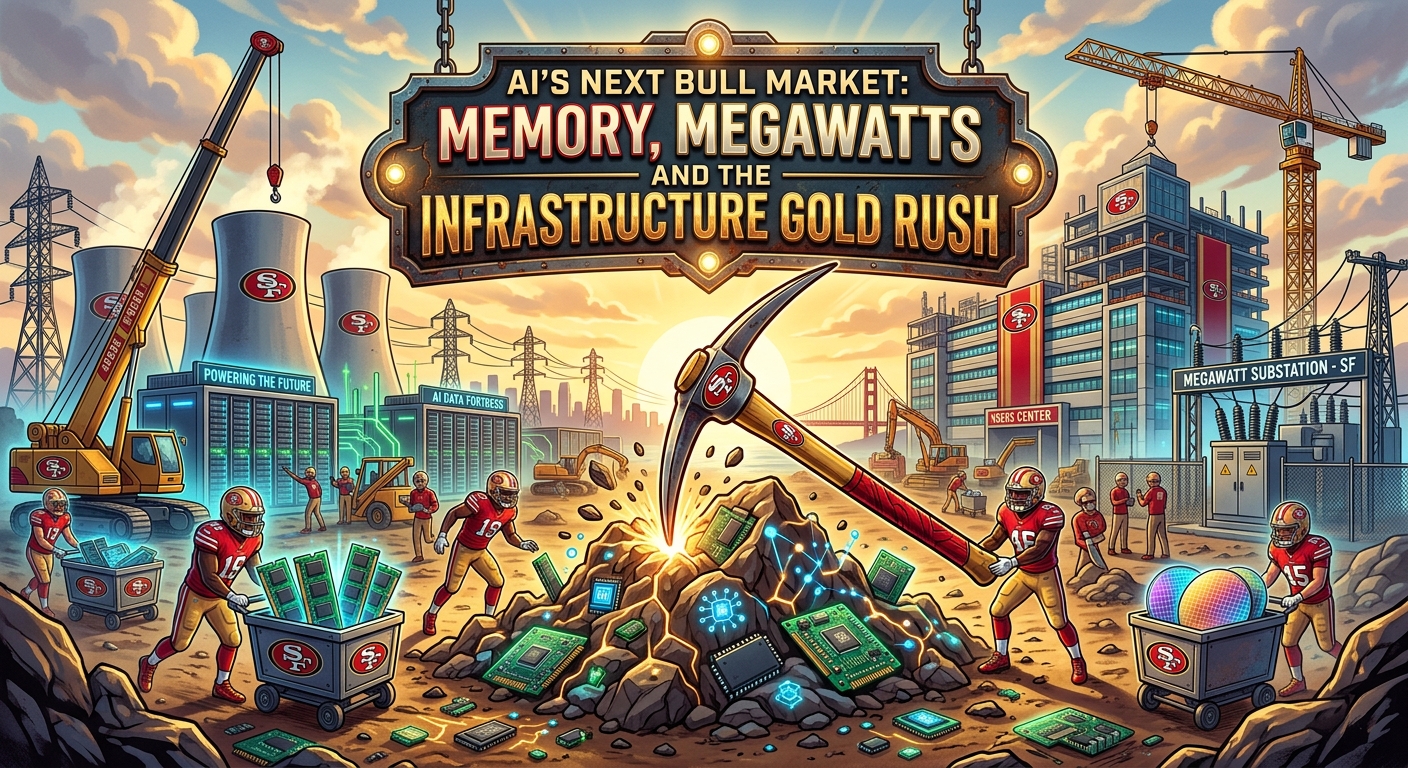
The artificial-intelligence trade is widening beyond chips and cloud capacity into the practical machinery of deployment: enterprise implementation, memory manufacturing, grid-aware data centers, and cloud delivery. The common denominator is simple: AI is no longer merely a model race; it is becoming an industrial buildout, and Wall Street tends to notice when software ambition starts acquiring infrastructure-grade revenue legs.
The New AI Stack: From Boardroom to Power Grid
The latest AI headlines tell a more mature story than the familiar “buy more GPUs” refrain. Capital and customer demand are moving into the layers that determine whether AI projects can leave the keynote stage, reach production, secure enough memory, access enough power, and actually generate a return on investment. That progression matters for investors. First came the silicon scramble led by NVIDIA Corporation (NASDAQ: NVDA) and other semiconductor beneficiaries. Then came cloud capacity and data-center expansion. Now the market is beginning to focus on the less glamorous but arguably more valuable question: who can make this machinery work reliably, economically, and at scale? The answer is developing across several fronts:
- Enterprise AI implementation is attracting rapid funding and early customer commitments.
- Memory supply is becoming strategically central to AI infrastructure.
- Power flexibility is emerging as a tool for speeding data-center deployment.
- Cloud ecosystems continue to create distribution channels for specialized AI providers.
In short, the AI economy is assembling a very expensive orchestra. The chip is still the first violin, but the conductor, the stage crew and the power company are all suddenly getting invited to the valuation party.
Hang Ten Systems: Enterprise AI Moves From Promise to Production
Hang Ten Systems’ additional $53 million seed round, bringing total funding to $85 million, is a notable signal that investors see enterprise AI implementation as a substantial commercial opportunity, not simply a consulting adjunct with a chatbot attached. The financing was led by Xora, a Temasek-backed fund, with participation from Mayfield and Aramco Ventures; Jerry Yang also joined the company’s board. Hang Ten’s proposition is built around an AI-native delivery model: agentic code generation, a reusable library of skills and domain-specific expertise aimed at building, changing and operating enterprise software more quickly and at lower cost than traditional systems integrators. The company said it signed several multi-million-dollar advisory and development engagements with global enterprises in the five weeks between its seed rounds, including work with Aramco and Siemens Gamesa Renewable Energy. That is the important part for the broader AI investment thesis. Corporate spending is becoming less about experimental access to large language models and more about redesigning real workflows in finance, software development, migrations and human resources. Enterprise customers generally do not reward a technology provider for being poetic; they reward it for meeting deadlines, integrating securely and avoiding a Monday-morning systems outage. For many, the implications extend to the companies whose technology, compute and enterprise ecosystems sit beneath this deployment wave:
| Public company | Ticker | Why it fits the enterprise-AI deployment theme |
|---|---|---|
| Intel Corporation | NASDAQ: INTC | CEO Lip-Bu Tan is listed among Hang Ten’s investors, while Intel remains a key participant in U.S. semiconductor-manufacturing discussions. |
| Micron Technology, Inc. | NASDAQ: MU | CEO Sanjay Mehrotra is listed among Hang Ten’s investors; Micron is also central to U.S.-based memory manufacturing. |
| Aramco | TADAWUL: 2222 | Aramco Ventures participated in Hang Ten’s funding, and Hang Ten is working with Aramco on operational AI applications. |
| Siemens Energy AG | XETRA: ENR | Siemens Gamesa Renewable Energy, part of Siemens Energy, is expanding its work with Hang Ten after an initial project. |
The investable message is not that a seed-stage company immediately changes these public companies’ earnings trajectories. Rather, it is that enterprise AI is gaining a more credible implementation layer, an encouraging sign for the broader providers of compute, cloud, memory, industrial software and specialized services.
Memory Becomes a Strategic Asset Again
SK Hynix (SKHY) shares rose nearly 3% after reports that the company was exploring potential arrangements with Intel Corporation (NASDAQ: INTC) related to manufacturing memory silicon wafers in the U.S. The company said it was reviewing options to reinforce global competitiveness but emphasized that no specific plans or arrangements had been finalized. The reported possibilities included leasing a portion of Intel’s Ohio facility or creating a joint venture involving SK Hynix, Intel and major cloud companies. Whether or not any transaction takes shape, the market reaction underscores a larger point: advanced memory has become increasingly strategic as AI systems require extraordinary quantities of high-bandwidth, high-performance memory alongside leading-edge compute. For years, the semiconductor industry treated memory as the cyclical relative who showed up late, ate everything and occasionally wrecked the furniture. AI has changed the family dynamic. Memory is no longer merely a component cost; it is a performance constraint, a supply-chain consideration and, potentially, a national industrial-policy issue. The reported interest in U.S.-based wafer manufacturing also comes as Washington seeks greater domestic semiconductor capacity and lower reliance on overseas supply chains. Yahoo Finance noted that Micron Technology, Inc. (NASDAQ: MU) is currently the only one of the largest memory manufacturers producing silicon wafers in the U.S., while SK Hynix and Samsung Electronics Co., Ltd. (SSNLF) have invested in areas such as packaging, research and development, and processors.
Stocks in the memory-and-AI infrastructure lane
| Company | Ticker | Investor relevance |
|---|---|---|
| SK hynix Inc. | SKHY | A leading AI-memory beneficiary; any meaningful U.S. manufacturing development could elevate its strategic profile. |
| Intel Corporation | INTC | Potentially benefits if its manufacturing footprint becomes a more flexible platform for partners and domestic supply-chain initiatives. |
| Micron Technology, Inc. | MU | Already holds a distinctive U.S. wafer-manufacturing position among major memory makers. |
| Samsung Electronics Co., Ltd. | SSNLF | A major global memory competitor with ongoing U.S. investments across several semiconductor activities. |
| NVIDIA Corporation | NASDAQ: NVDA | AI accelerator demand remains tightly linked to the availability and performance of supporting memory systems. |
| Advanced Micro Devices, Inc. | NASDAQ: AMD | Part of the broader AI semiconductor complex that moved higher alongside the memory-manufacturing report. |
| SanDisk Corporation | NASDAQ: SNDK | Participated in the broader chip-complex advance cited in the market report. |
| Western Digital Corporation | NASDAQ: WDC | Participated in the broader chip-complex advance cited in the market report. |
The caveat is equally important: SK Hynix said no agreement had been reached. Investors should treat the report as evidence of strategic optionality and a reinforcing industry signal, not as a completed transaction or a booked revenue stream.
Emerald AI, Google and NVIDIA Put Power on the AI Agenda
If memory is the limiting reagent inside the server, electricity is increasingly the limiting reagent outside the building. Emerald AI, Alphabet Inc.’s Google (NASDAQ: GOOGL; NASDAQ: GOOG) and NVIDIA Corporation (NASDAQ: NVDA) launched the AI Energy Management Alliance, or AEMA, to advance data centers that can adjust power consumption in response to electricity-grid conditions. The coalition’s thesis is that flexible data centers can help relieve grid stress, speed interconnection, improve reliability and limit pressure on ratepayers. The alliance includes 18 launch partners spanning AI, semiconductors, power and grid technology. Publicly traded participants include:
- AES Corporation (NYSE: AES)
- Analog Devices, Inc. (NASDAQ: ADI)
- Constellation Energy Corporation (NASDAQ: CEG)
- Fluence Energy, Inc. (NASDAQ: FLNC)
- National Grid plc (LSE: NG.; NYSE: NGG)
- NRG Energy, Inc. (NYSE: NRG)
- RWE AG (XETRA: RWE; OTC: RWEOY)
- Alphabet Inc. (NASDAQ: GOOGL; NASDAQ: GOOG)
- NVIDIA Corporation (NASDAQ: NVDA)
The alliance’s idea is economically compelling because AI infrastructure’s power problem is not strictly a matter of building more generation. It is also a timing and utilization problem. If certain workloads can be shifted, reduced or coordinated during peak stress, existing grid infrastructure may be used more effectively, potentially enabling projects to connect faster than they could under the old model of constant, inflexible power demand. That creates a broader bullish narrative for companies exposed to AI power demand, grid modernization, energy storage, power management and data-center infrastructure. The data center may still consume prodigious electricity, but a flexible data center has the manners to lower its voice when the neighborhood is trying to sleep.
Why the Bull Case Is Broadening
The most constructive takeaway is not that every AI-related stock becomes a buy. It is that the AI capital-expenditure cycle appears to be developing multiple, mutually reinforcing demand channels.
1. AI implementation is becoming a spend category
Hang Ten’s funding and reported customer wins point to enterprise demand for partners that can turn AI concepts into operating systems, workflows and measurable productivity gains.
2. Memory supply is gaining strategic importance
The SK Hynix–Intel discussion, even without a finalized arrangement, highlights how AI demand is elevating the importance of memory capacity, advanced packaging and domestic manufacturing options.
3. Power constraints create investable solutions
AEMA’s formation shows that AI leaders and energy companies increasingly view grid flexibility as a commercial and policy solution rather than an inconvenient footnote to data-center growth.
4. Ecosystems matter more than isolated products
Google Cloud partnerships and related cloud-channel relationships can give specialized AI and data platforms a path toward larger enterprise customers. In the current AI buildout, distribution, integration and deployment credibility may prove nearly as consequential as raw model performance. Recently, Seven Boson Group Ltd., a Sovereign AI company building a multimodal world model AI lab network, spanning data centers, energy infrastructure, and its Sovereign Agent Operating System (SAOS), for nations and enterprises, announced its participation in the Google Cloud Partner Advantage program. Seven Boson’s SAOS and its Guardian Layer governance system are active across its global network today, with continued growth planned over time. As part of that growth, Seven Boson intends to draw on Google Cloud technology, including open-source AI models, energy optimization tooling, high-throughput chips, and cybersecurity capabilities, as one part of a broader, multi-vendor approach to its infrastructure.
A Lens: Look for the Picks, Shovels and Switchgear
The AI boom is maturing from a narrow semiconductor trade into a wider infrastructure and productivity cycle. NVIDIA Corporation (NASDAQ: NVDA), Alphabet Inc. (NASDAQ: GOOGL; NASDAQ: GOOG), Intel Corporation (NASDAQ: INTC), Micron Technology, Inc. (NASDAQ: MU), SK hynix Inc. (SKHY), AES Corporation (NYSE: AES), Constellation Energy Corporation (NASDAQ: CEG), NRG Energy, Inc. (NYSE: NRG), Analog Devices, Inc. (NASDAQ: ADI), Fluence Energy, Inc. (NASDAQ: FLNC) and National Grid plc (NYSE: NGG) all touch different portions of that expanding opportunity set. For many, the next phase may reward discernment more than simple exposure. The strongest beneficiaries are likely to be companies that can demonstrate one or more of the following:
- Sustainable AI-related revenue rather than merely AI vocabulary.
- Scarce infrastructure, including memory, fabrication capacity, power access, grid flexibility or cloud distribution.
- Credible customer deployments and repeatable commercial models.
- Balance-sheet strength sufficient to finance a capital-intensive growth cycle.
- A clear position in the ecosystem where AI demand is translating into booked business.
AI’s first act was about proving that machines could generate an answer. Its next act is about proving that enterprises can deploy those answers, power them, finance them and make money from them. That may be less cinematic than a viral prompt, but it is usually where the more durable investment stories begin.
The Sources
- Hang Ten Systems Raises Additional $53 Million Led by Xora, Bringing Total Funding to $85 Million Yahoo Finance / Business Wire
- SK Hynix Stock Jumps as Memory Maker Responds to Report of Potential Deal With Intel Yahoo Finance
- Global Technology Pioneers Emerald AI, Google and NVIDIA Launch the AI Energy Management Alliance to Advance Flexible AI Data Centers Yahoo Finance
- Global Technology Pioneers Emerald AI, Google and NVIDIA Launch the AI Energy Management Alliance to Advance Flexible AI Data Centers Business Wire
- Seven Boson Group Achieves Google Cloud Partner Advantage Status Seven Boson Group
- Clean Energy Resources to Meet Data Center Electricity Demand U.S. Department of Energy
- AI Data Centres Pose Growing Threat to Electricity Systems Worldwide United Nations News
- Data Centers Are Ready to Negotiate Flexibility for Speed — Utility Dive
- AI Meets the Grid: Shaping the Data Centre Power Play — Capgemini Research Institute
- SK Hynix Bets on 3-D Stacking as the Next Frontier in AI Memory Korea JoongAng Daily
Stay Updated with Vista Partners
Subscribe to receive market insights, investing ideas, and the latest updates directly in your inbox.