


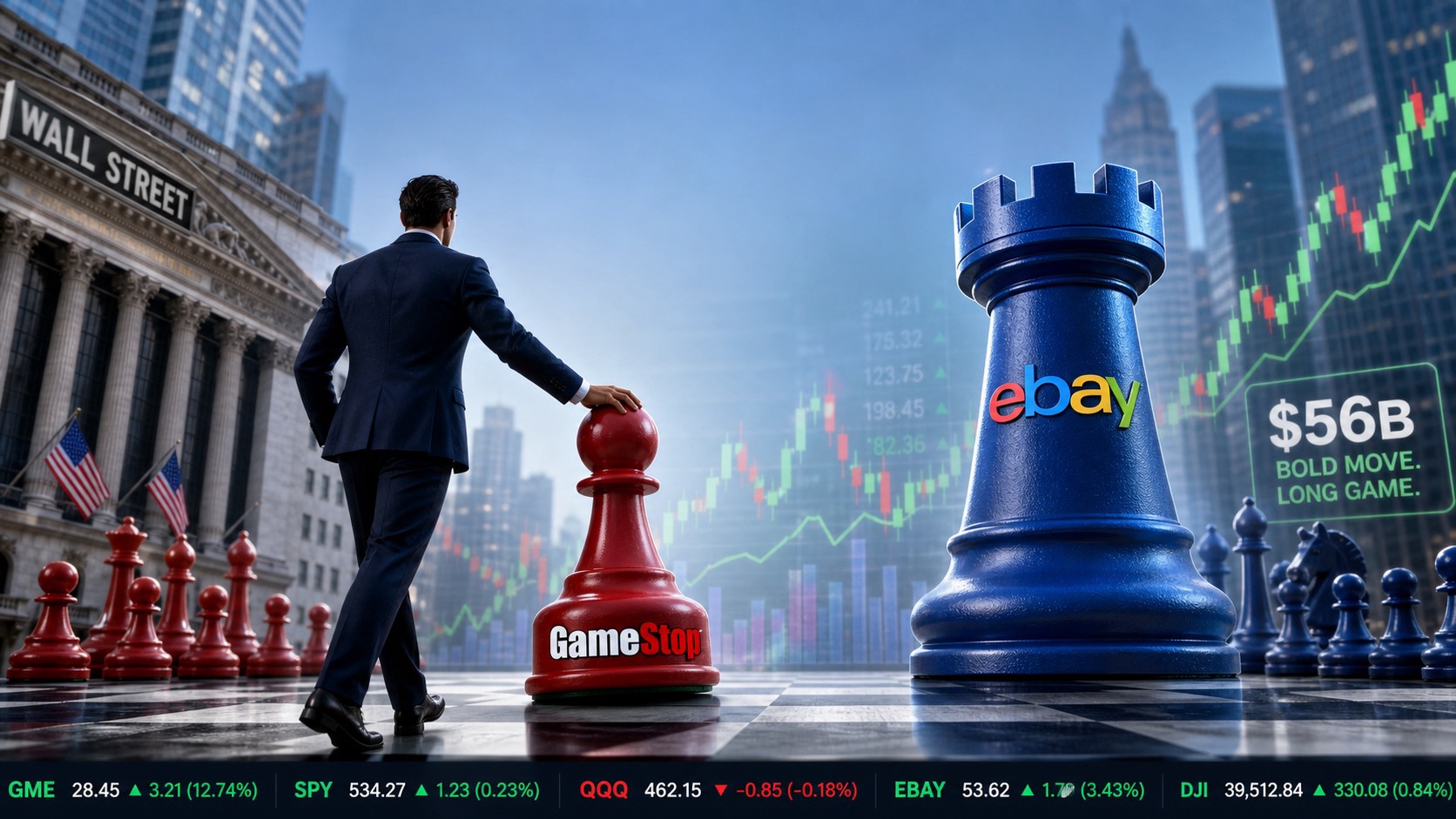
GameStop (GME) is trying on a new costume: from mall-based meme stock to would‑be e‑commerce juggernaut. The company has lobbed a roughly $55–56 billion cash‑and‑stock offer for eBay (EBAY), proposing $125 per share, a premium to where eBay traded before the news hit. For a retailer whose own market cap is a fraction of its target’s, the move lands somewhere between bold strategic pivot and capital‑markets tightrope act.
Financing: “The Details Are on Our Website”
The obvious question is how a company about one‑quarter eBay’s size plans to buy the whole thing. Publicly, Ryan Cohen’s answer has been equal parts confidence and ellipsis: it’s half cash, half stock, backed by around $9–9.4 billion of cash on GameStop’s balance sheet, a “highly confident” letter for up to $20 billion of debt, and the capacity to issue more shares. Pressed on the math in a CNBC interview, Cohen largely sidestepped, pointing analysts and anchors alike to the company website for the finer points.
Behind the bravado sits a very real gap: even with $20 billion of prospective debt and nearly $10 billion of cash, funding a deal valued north of $55 billion requires substantial equity issuance and likely additional outside capital. That arithmetic has left Wall Street intrigued but skeptical, with research notes openly questioning whether investors should treat the proposal as a fully financeable transaction or a high‑stakes opening bid in a game of corporate three‑dimensional chess.
Why eBay, and Why Now?
Cohen’s pitch is that eBay is the world’s “second‑largest commerce franchise” with underutilized potential, and that GameStop’s store footprint can supercharge its logistics, authentication and live‑commerce capabilities. GameStop envisions its roughly 1,600 U.S. locations as drop‑off and shipping hubs, as well as studios for live sales events where eBay inventory is showcased in real time. In theory, those stores pivot from selling discs and collectibles to becoming neighborhood on‑ramps to a global marketplace.
Strategically, the deal is framed as a way to challenge Amazon’s (AMZN) dominance rather than merely rescue a brick‑and‑mortar chain from secular decline. Cohen has spoken of turning GameStop into a company worth $100 billion or more, using eBay as the backbone of a much broader commerce ecosystem that extends far beyond video games. For investors who remember the meme‑stock mania, this is the sequel in which the protagonist tries to swap message‑board momentum for hard operating leverage.
The Hostile Question: Has Anyone Asked eBay?
There is one small formality: eBay has not exactly been waiting at the altar. GameStop has quietly built about a 5% stake in eBay, largely via derivatives and some common stock, making it one of eBay’s larger shareholders and giving it a toehold should the situation turn contentious. eBay’s board has acknowledged receiving the unsolicited, non‑binding offer and says it will evaluate the proposal with a focus on value, the quality of the GameStop stock component, and the bidder’s ability to deliver a binding deal.
Cohen has signaled he is prepared to go directly to shareholders if the board demurs, raising the prospect of a hostile approach rarely seen at this scale from a bidder of this size. That asymmetry—an $11–12 billion buyer pursuing a roughly $46 billion target at a deal value near $56 billion—practically invites the question of who is really in control: the prospective acquirer, or the capital markets that have to fund the adventure.
What’s at Stake for Investors
For GameStop shareholders, the upside story is seductive: leverage an existing retail footprint, graft on a global marketplace, and unlock operating efficiencies that, in Cohen’s words, could make the combined business far more profitable than the sum of its current parts. Yet every promise of future margin expansion comes with the counterweight of execution risk, integration complexity and a balance sheet that would almost certainly carry more debt than GameStop’s meme‑stock faithful are used to seeing.
For eBay investors, the calculus is more traditional: evaluate a premium offer, assess the credibility of the financing and decide whether the upside of staying independent outweighs the allure of cash plus a volatile, story‑driven stock. Until more concrete financing details emerge, the market may treat the proposal less like a done deal and more like an option—one whose value depends on whether Ryan Cohen can turn a punch line about “details on our website” into the fine print of an executable, multi‑billion‑dollar transaction.
The Sources
Here are key sources used, listed in numerical order and formatted for easy reference and SEO:
- NBC News – “Shares of eBay take off on a $56 billion buyout bid from GameStop’s Ryan Cohen”nbcnews
- Yahoo Finance (UK) – “GameStop makes bold $56 billion play for eBay, ready to go hostile”finance.yahoo
- Wall Street Journal – “GameStop Preparing Offer for eBay”wsj
- Wall Street Journal – “GameStop Offers to Buy eBay for $56 Billion”wsj
- Channel NewsAsia / Reuters – “GameStop makes unsolicited offer to buy eBay for about $56 billion”channelnewsasia
- YouTube / Reuters – “GameStop offers to buy eBay for about $56 billion”youtube
- Yahoo Finance – “GameStop makes $55.5bn takeover offer for eBay”finance.yahoo
- Reddit (Superstonk) – “GameStop Is Offering to Buy eBay for $56 Billion, CEO Ryan Cohen Says”reddit
- GameSpot – “GameStop Announces Shocking Buyout Offer For eBay Priced At $56 Billion”gamespot
- BBC News – “GameStop makes $55.5bn takeover offer for eBay”bbc
- Investors Business Daily – “GameStop Confirms Offer To Buy EBay For $56 Billion”investors
- Yahoo Finance – “Is GameStop’s $56B offer for eBay legit or just another meme?” (video)finance.yahoo
Stay Updated with Vista Partners
Subscribe to receive market insights, investing ideas, and the latest updates directly in your inbox.

Oil’s New Bull Case: Tight Supply, Restarting Barrels and LNG’s Long Game -( $SLB $SOC $XOM )