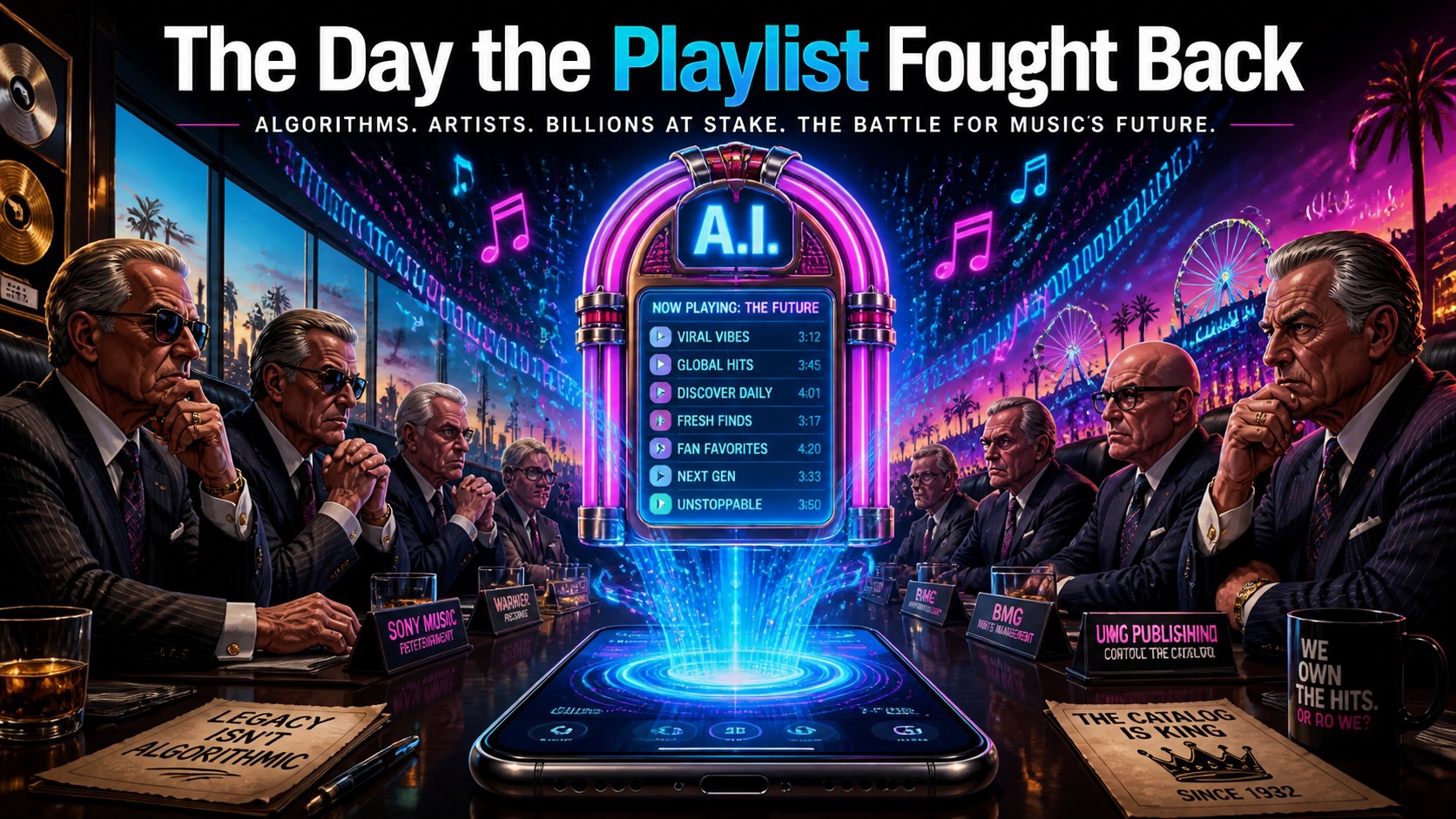
AI is quietly rewriting the music industry’s sheet music, shifting power from a handful of labels and gatekeepers toward whoever can best orchestrate data, algorithms, and rights.
A New Overture: From Gatekeepers to Code Keepers
For a century, the music business ran on a familiar score: labels financed talent, controlled distribution, and owned the catalogs, while artists hoped their royalties would eventually catch up with their tour schedules. Now, generative AI tools can spin up radio‑ready tracks in minutes, mimic iconic voices, and churn out endless variations of a hook long before a label A&R has finished their second espresso.
Industry executives are moving from outright panic to what might be called cautious optimism, recognizing that the real threat is not AI itself, but who owns and directs it. Just as streaming reordered the hierarchy from CD racks to platform playlists, AI is setting up a new contest between rights holders, tech platforms, and a growing class of AI‑native creators.
The New Power Players: Models, Catalogs and Compute
In the emerging AI‑music order, three assets matter most: data, rights, and compute. Models trained on vast libraries of recordings can now generate melodies, stems, and even full productions that sound uncannily like human‑made music, raising both creative possibilities and existential legal questions.
Major labels and publishers, once wary of “machine‑made hits,” are quietly repositioning as AI’s preferred data partners, leveraging deep catalogs as negotiating chips with model developers and platforms. Tech firms, meanwhile, control the infrastructure and algorithms that decide which tracks get surfaced, recommended, or buried—effectively becoming the new program directors of the global jukebox. In this environment, compute capacity and licensing sophistication may matter as much as a label’s historic ear for talent.
Synthetic Voices, Real Money
Perhaps the most controversial shift is the rise of synthetic vocals that can convincingly emulate star performers, living or dead. An artist’s voice, once considered a uniquely human instrument, is now a monetizable parameter—one that can be cloned, licensed, or, in the worst cases, pirated.
Legal frameworks are racing to catch up. International copyright still hinges on human authorship, meaning fully AI‑generated tracks often fall into a protection gray zone, while human‑guided AI creations may still qualify for conventional rights. Industry groups are pushing principles that keep human creativity at the center, calling for clear labelling of AI‑generated music and stronger personality rights to prevent unauthorized use of an artist’s voice or likeness. The punchline: in a world of infinite fake duets, authenticity—and enforceable contracts—may become the most valuable instruments on the balance sheet.
Artists, Algorithms and the Middle Class of Music
For working artists, AI is both a productivity tool and a competitive threat. On the one hand, creators can now separate stems, experiment with arrangements, master tracks, and even test different vocal textures with a level of speed and affordability that once required label budgets. On the other, forecasts of a “tsunami” of AI‑generated songs suggest an already crowded digital marketplace will become even more saturated, raising the bar for discovery and sustainable income.
Analysts warn that without thoughtful guardrails, AI could accelerate the erosion of the “middle class” of musicians, squeezing independents between a flood of low‑cost synthetic tracks and a small cohort of superstar brands that can afford bespoke AI tools and legal protection. Yet some see opportunity in artists who productize themselves—building owned fan communities, licensing their voice and style on their own terms, and treating AI as a studio extension rather than a rival act. The future working musician may look less like a touring purist and more like a diversified media company with a catalog, a dataset, and a personal brand.
Regulators, Rightholders and the Search for a New Deal
As AI seeps into everything from recommendation engines to rights administration, lawmakers and trade bodies are trying to sketch a new social contract for the creative economy. Jurisdictions from Japan to the EU to the U.S. are testing different approaches to training data, fair use, and opt‑out rights, with the outcome likely to determine which regions become AI‑music hubs and which remain net importers of innovation.
Industry associations are coalescing around a few core principles: protect human creators, ensure transparency when music is AI‑generated, recognize personality rights in voice and likeness, and avoid a race to the bottom where unlicensed training data becomes an accepted cost of doing business. Digital platforms, for their part, are experimenting with AI that can detect deepfake vocals and give labels and artists choices on whether to block, track, or monetize such content. If the streaming era was about who controlled the playlist, the AI era may hinge on who controls the definition of authorship itself.
The Encore: Human Intuition in a Machine Age
Despite the headlines, AI is not yet composing the end credits for human music. Rather, it is shifting the sources of leverage: from CD pressing plants to server farms, from radio promotion to recommendation algorithms, and from backroom publishing deals to explicit licensing for data and digital likeness.
In that context, artists, labels, and platforms that treat AI as an instrument—powerful, temperamental, and in need of rules—may find themselves best positioned in the next movement of the industry. The music business has survived vinyl, piracy, and streaming; its latest test is to prove that in a world of synthetic sound, human judgment still calls the tune.
The Sources
[1] The music industry’s AI stance is shifting toward cautious optimism https://www.cnbc.com/video/2026/05/21/the-music-industrys-ai-stance-is-shifting-toward-cautious-optimism.html
[2] How AI is reshaping the music industry https://www.musicbusinessworldwide.com/how-ai-is-reshaping-the-music-industry/
[3] The Sound Shift: How Generative AI is Redefining the Music … https://www.artefact.com/blog/the-sound-shift-how-generative-ai-is-redefining-the-music-industrys-business-model/
[4] How AI Is Changing the Music Industry | Bloomberg Tech – YouTube https://www.youtube.com/watch?v=h4rjoItWbb8
[5] Music Industry 5 Key Principles on Artificial Intelligence https://www.ukmusic.org/research-reports/music-industry-5-key-principles-on-artificial-intelligence/
[6] AI Music: What Musicians Need to Know – Berklee Online Take Note https://online.berklee.edu/takenote/ai-music-what-musicians-need-to-know/
[7] How AI is transforming the creative economy and music industry https://www.ohio.edu/news/2024/04/how-ai-transforming-creative-economy-music-industry
[8] AI Impact: How AI is transforming the music industry – YouTube https://www.youtube.com/watch?v=E1wDOAmYHSs
[9] AI’s Impact On Music In 2025: Licensing, Creativity And Industry … https://www.forbes.com/sites/virginieberger/2024/12/30/ais-impact-on-music-in-2025-licensing-creativity-and-industry-survival/
[10] AI-generated music is going viral. Should the music industry worry? https://www.cnbc.com/2025/07/17/ai-generated-music-is-going-viral-should-the-music-industry-worry.html
[11] What’s the future of the music industry after AI? – Reddit https://www.reddit.com/r/musicindustry/comments/1kwkm0c/whats_the_future_of_the_music_industry_after_ai/
[12] How AI will slowly destroy the music business – Facebook https://www.facebook.com/rickbeatoproduction/posts/how-ai-will-slowly-destroy-the-music-business/1323586889135256/
[13] How AI is Reshaping the Music Industry (2025) – YouTube https://www.youtube.com/watch?v=CokiSZ636sc
[14] How to Write Headlines Like The Wall Street Journal https://raganconsulting.com/5-tips-to-write-headlines-from-the-wall-street-journal/
[15] Prompt Library – ChatHub https://chathub.gg/prompt-library
Stay Updated with Vista Partners
Subscribe to receive market insights, investing ideas, and the latest updates directly in your inbox.