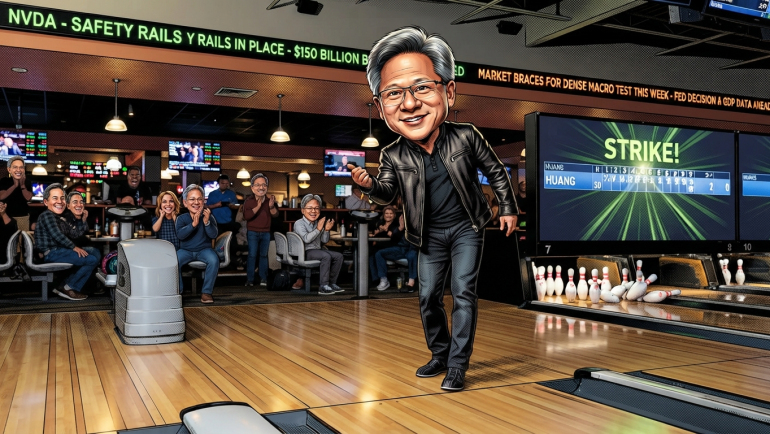
US stocks opened the first full week of May on the back foot, with all three major indices closing lower Monday as investors digested big AI‑software earnings against a still higher‑for‑longer macro and rates backdrop. The tone was risk‑off rather than panicked: selling was broad but orderly, and more about re‑rating growth and AI winners than pricing in an imminent hard landing
Index moves and risk tone
The major averages all finished in the red, with tech and growth areas bearing the brunt of the selling. Recent data and commentary coming into the session had highlighted that the S&P 500 and Nasdaq were coming off strong April gains, leaving them vulnerable to profit‑taking as yields pushed higher and geopolitical tension stayed elevated.
Under the surface, breadth weakened as cyclical and small‑cap shares struggled alongside large‑cap growth, a shift from the earlier pattern where megacap tech largely insulated the indices. Overseas, sentiment was similarly cautious, with global desks flagging the drag from higher U.S. yields, a firmer dollar, and lingering Middle East risk on both European and Asian risk assets.
Macro backdrop: slowing, not stalling
The macro narrative into Monday’s trade remains “cooling but not cracking.” Updated outlooks for 2026 peg U.S. real GDP growth in roughly the low‑2% range, helped by solid business investment and still‑resilient though slower consumer demand. Economists are flagging firmer energy prices and tariff pass‑through as modest drags, but not yet enough to derail the expansion, with forecasts generally clustering around 2.2%–2.3% growth.
Inflation, meanwhile, is expected to run a touch above the Fed’s target, with some forecasts placing 2026 PCE near the upper‑2% range, keeping policymakers in no rush to cut aggressively. Labor‑market projections show unemployment hovering in the mid‑4% area, consistent with a normalization from the ultra‑tight conditions of 2024–2025 rather than outright deterioration.
Rates, dollar, and commodities
The “all‑red” equity close came against a backdrop of higher yields and a stronger dollar. Strategists expect the 10‑year Treasury yield to sit in a range consistent with an economy growing a bit above 2% and with inflation slightly above target, a mix that has already forced markets to scale back the aggressive rate‑cut expectations that were in place going into 2025. A firmer dollar, in turn, is pressuring multinational earnings translations and tightening overall financial conditions at the margin.
Energy remains a complicating factor for the soft‑landing story. Recent commentary points to firmer crude prices (crude oil prices closed at $104.90/bbl) tied to Middle East tensions and supply concerns, which feed directly into headline inflation and, by extension, into rate expectations and risk appetite. For equities, that combination—rising real yields, strong dollar, and expensive energy—creates an environment where investors are quicker to punish misses, high‑multiple stories, and anything that looks like “growth at any price.”
Earnings pulse and the AI trade
Even with Monday’s pullback, earnings remain a key support. Sell‑side outlooks for 2026 continue to call for healthy profit growth, underpinned by AI‑driven productivity gains, capex in cloud and data infrastructure, and still‑solid nominal GDP. But leadership is narrow: a relatively small group of tech and communication names still contributes an outsized share of index‑level earnings growth, making the tape especially sensitive to news out of the AI and software complex.
That concentration showed up again as markets traded around big‑name AI and software prints. Recent quarters have illustrated a consistent pattern: when AI leaders deliver on revenue and free‑cash‑flow narratives, risk appetite broadens; when guidance or unit economics disappoint, selling ripples across the entire complex.
Palantir in focus: scaling into AI demand
Within that AI‑software cohort, Palantir (PLTR, 4146.03, +1.36%) remains a central bellwether. Coming into its Q1 2026 report, expectations were high: consensus called for roughly 70%‑plus year‑over‑year revenue growth to about $1.5‑plus billion, powered by strong AI platform demand and surging U.S. commercial and government business. Analysts flagged particularly strong momentum in U.S. commercial, where revenues were projected to nearly double, and highlighted a growing pipeline of large, multi‑year AI and data‑analytics deal.
Earlier results and commentary had already set the stage, with Palantir’s prior year showing about 70% revenue growth and more than $4 billion in annual sales, alongside sharply improved profitability and a strategic partnership with Nvidia to deepen its AI hardware‑software stack. That track record has elevated Palantir from a niche government data contractor into a perceived “core” AI platform name, making its quarterly cadence a de facto referendum on the durability of enterprise AI spending.
Takeaways for investors
For allocators, Monday’s all‑down close across the major indices is less a regime shift and more a reminder of how dependent this market is on both AI earnings and the soft‑landing macro narrative. On one side, an economy growing a bit above 2%, with only gradual labor cooling and moderate but sticky inflation, still supports mid‑single‑ to low‑double‑digit earnings growth. On the other, higher real yields, a strong dollar, and elevated energy prices mean equity multiples are unlikely to expand much further without continued upside surprises from AI, software, and productivity winners such as Palantir.
Positioning‑wise, that argues for a balanced approach: maintain exposure to quality AI and software names with visible demand and improving margins, pair them with cyclicals and value plays that benefit from steady nominal growth and higher energy, and keep some flexibility to add risk on volatility spikes driven by macro or geopolitical headlines. For the rest of this week, every key data print and major AI earnings update is effectively a small stress test of the soft‑landing thesis—and Monday’s red close shows that even a constructive macro base case does not leave much room for disappointment.
VP Watchlist Updates
Below is an update‑style snapshot on the VP Watchlist names for the week, focused on recent catalysts, positioning, and narrative rather than precise price moves.
GameStop (GME) & eBay (EBAY, $109.33, +5.05%)
GameStop (GME) is trying on a new costume: from mall-based meme stock to would‑be e‑commerce juggernaut. The company has lobbed a roughly $55–56 billion cash‑and‑stock offer for eBay (EBAY), proposing $125 per share, a premium to where eBay traded before the news hit. For a retailer whose own market cap is a fraction of its target’s, the move lands somewhere between bold strategic pivot and capital‑markets tightrope act.
Amwell® (NYSE: AMWL, $6.42, +4.90%)
Amwell® (NYSE: AMWL), a leading provider of a comprehensive SaaS-based software platform for technology-enabled healthcare, will report first quarter 2026 operating results after stock market trading hours on Tuesday, May 5.
FMC Corporation (NYSE: FMC, $14.56)
FMC Corporation (NYSE:FMC) reported (April 29) first quarter 2026 results above guidance with Adjusted EBITDA above high end of range, reaffirms full-year outlook. Their first quarter 2026 revenue of $759 million, down 4 percent versus first quarter 2025. First quarter 2026 revenue, excluding India, was $762 million, down 4 percent versus first quarter 2025, which included India. On a GAAP basis, the company reported a loss of $2.25 per diluted share in the first quarter, a decrease of $2.13 versus first quarter 2025. First quarter adjusted loss per diluted share of $0.23 was down 41 cents versus first quarter 2025. FMC Corporation also announced today that its board of directors declared a regular quarterly dividend of 8 cents per share, payable on July 16, 2026, to shareholders of record as of the close of business on June 30, 2026.
Eupraxia Pharmaceuticals (EPRX, $7.42)
Eupraxia Pharmaceuticals Inc. (EPRX), a clinical-stage biotechnology company leveraging its proprietary Diffusphere™ technology designed to optimize local, controlled drug delivery for applications with significant unmet need, announced on Friday, May 1, the appointment of Dr. Jeymi Tambiah as Chief Medical Officer (CMO) as well as the retirement of Dr. Mark Kowalski, Eupraxia’s current CMO. Dr. Jeymi Tambiah (MB ChB, FRCS, MS, FAPCR, FFPM), is a Board Certified Cardiothoracic Surgeon physician scientist who practiced at Guys and St Thomas’ Hospitals prior to entering the biopharmaceutical industry in 2008. Dr. Tambiah brings over 18 years of experience in clinical development, medical and regulatory strategy, and product commercialization across pharmaceutical and biotechnology organizations.
Eupraxia announced (April 21) 36-week tissue health and symptom data from patients in the highest dose cohort from its ongoing Phase 1b/2a part of the RESOLVE trial evaluating EP-104GI for the treatment of eosinophilic esophagitis (“EoE”). Dr. James A. Helliwell, Chief Executive Officer of Eupraxia stated, “We are very pleased with the robust and sustained response in both tissue health and symptom data in the highest dose cohort at 36 weeks. This data is consistent with the compelling results we observed at earlier timepoints at this dose level, highlighting the potential to achieve both strong and durable responses after a single administration of EP-104GI. We are also reassured by the excellent safety outcomes across all doses in the trial as we continue to observe no indication of drug related SAEs or spikes in glucose or cortisol. We look forward to the results of the placebo-controlled Phase 2b portion of the study where the same dose is being further evaluated”.
Eupraxia recently co-hosted a Tribe Public www.TribePublic.com, CEO Presentation & Q&A Webinar event, Wednesday, April 1 titled “Turning EOE Into a Once-a-Year Appointment.” The event featured James A. Helliwell, M.D., Co‑founder and CEO of Eupraxia Pharmaceuticals (NASDAQ: EPRX), who discusses the company’s precision drug‑delivery platform, its approach to Eosinophilic Esophagitis (EoE), and broader pipeline priorities, followed by a focused 5–10 minute Q&A. You may watch it now at this Youtube link.
Modular Medical (MODD, $4.07)
- Modular Medical, Inc. (NASDAQ:MODD), a leader in innovative, patient-centric insulin delivery, saw (May 1) CEO Jeb Besser join Tribe Public’s members to unpack a simple question with big implications: what happens when an “almost‑pumper” market finally meets an FDA‑cleared device built for the rest of us, not just the superusers? Tribe Public hosted its CEO Presentation and Q&A Webinar, “From FDA Wins to Scaling Manufacturing – What Investors Should Watch,” on Friday, May 1, 2026, at 8:00 a.m. PT / 11:00 a.m. ET. In keeping with Tribe’s reputation for efficient programming, the session ran approximately 30 minutes, pairing a focused prepared talk with a 5–10 minute live Q&A segment that allowed investors to drill into timelines, capital needs, and commercial strategy. Besser’s formal remarks were framed under the title “From FDA Wins to Scaling Manufacturing – What Investors Should Watch,” setting the tone for a discussion that sat at the intersection of regulation, innovation, and recurring‑revenue hardware. By registering, attendees also joined Tribe Public’s membership base, ensuring they will receive future invitations to CEO briefings, sector spotlights, and investor wish‑list events.
- Modular Medical announced (APRIL 19) the pricing of a registered direct offering consisting of 750,000 shares of the Company’s common stock at an offering price of $4.50 per share. The gross proceeds to the Company from the Offering are estimated to be approximately $3.4 million before deducting placement agent fees and other offering expenses. The Offering is expected to close on or about April 21, 2026, subject to the satisfaction of customary closing conditions.
- Modular Medical’s latest regulatory milestone upgrades the narrative: the company has now (April 9) secured FDA 510(k) clearance for its Pivot tubeless insulin patch pump, moving from “launch‑ready” to “launch‑approved” in the heart of the fast‑growing diabesity market. The FDA has cleared Modular Medical’s Pivot patch pump as a tubeless, removable insulin delivery system, formally validating the device’s design and performance for commercial use in U.S. adults living with diabetes. The clearance converts what had been a Q1 2026 launch “subject to FDA response” into a tangible commercial pathway, giving the company permission to sell into an insulin pump market that has been estimated at roughly 8 billion dollars globally. Pivot is engineered as a simplified, two‑part patch pump with a 3‑milliliter removable reservoir, no need for battery recharging, and the ability to bolus without a dedicated controller, aiming squarely at patients who have stayed on multiple daily injections because traditional pumps felt too complex, cumbersome, or costly. By clearing Pivot, the FDA is effectively endorsing Modular Medical’s attempt to make advanced insulin delivery feel less like adopting a gadget and more like upgrading a daily habit.
The InterGroup Corporation (INTG, $39.3, +.03%)
- InterGroup Corporation delivered (Feb. 17) a notably stronger quarter, highlighted by a 20% jump in total revenue to $17.3 million and a 27% surge in hotel revenue as renovated rooms returned to service and travel demand improved. The company swung from a prior-year net loss to $1.0 million in net income, with operating income more than doubling to $2.0 million, underscoring better cost control and improved operating efficiency. Management further enhanced liquidity and sharpened strategic focus by selling a non-core 12‑unit Los Angeles multifamily property, generating a meaningful gain and additional working capital while maintaining stable performance across its real estate portfolio.
Volato Group, Inc. (SOAR) & M2i Global, Inc. (MTWO)
- M2i Global, Inc., a company specializing in the development and execution of a complete global value supply chain for critical minerals, announced (April 28), in connection with the the Agreement and Plan of Merger and Reorganization, dated as of July 28, 2025, by and among M2i Volato Group, Inc. (“Volato”) (NYSE American: SOAR), and Volato Merger Subsidiary, Inc., , that the sole holder of M2i’s Series A Super Voting Preferred Stock, entitled to 10,000 votes per share of voting stock, voted by written consent in favor of the Company’s merger with Volato whereby M2i will become a wholly-owned subsidiary of Volato. At the closing of the merger, the name of Volato will change to M2i Global.
- Volato Group, Inc. (April 16) announced that it will hold a special meeting of shareholders on May 7, 2026 to vote on the previously announced proposed merger with M2i Global, Inc. (“M2i Global”). Shareholders of record as of the close of business on April 17, 2026 will be entitled to vote at the special meeting. The Company expects the merger to close shortly after the meeting, subject to shareholder approval and the satisfaction of customary closing conditions. Under the terms of the merger agreement, M2i Global will merge with a wholly owned subsidiary of Volato, with M2i Global continuing as the surviving entity and a wholly owned subsidiary of Volato. Upon completion of the transaction, existing M2i Global shareholders are expected to own approximately 85% of the combined company, while Volato shareholders are expected to own approximately 15%, on a fully diluted basis (excluding warrants). The combined company is expected to leverage M2i Global’s capabilities across mining, refining, and recycling of critical minerals alongside Volato’s expertise in software, data systems, and operational execution, creating a scalable, technology-enabled platform focused on strengthening domestic supply chains.
- Volato Group, Inc. (NYSE American: SOAR) (the “Company” or “Volato”) and M2i Global, Inc. (OTCQB: MTWO) (“M2i Global”) (April 13) announced that the U.S. Securities and Exchange Commission has declared effective the Registration Statement on Form S-4 (File No. 333-292132) relating to Volato’s proposed merger with M2i Global, formally advancing the transaction into its shareholder approval and closing phases. Volato is proceeding with distribution of the definitive proxy statement/prospectus and a special meeting of shareholders is expected to be held on May 7, 2026. Shareholders of record as of April 17, 2026 will be entitled to vote on the proposed transaction.
- flyExclusive (NYSE American: FLYX), the vertically integrated private aviation company, announced (March 25) two milestones in its proprietary technology development: the filing of a utility patent application for a novel aircraft schedule optimization architecture, and the availability of Contrails, its Flight Management System, to other Part 135 operators beginning in Q2 2026. Both announcements coincide with the company’s presence at the NBAA Schedulers & Dispatchers Conference 2026 in Cleveland. “We have spent years building flyExclusive into one of the most operationally capable private aviation companies in the country. Contrails is how we make that expertise available to the broader industry—and the intellectual property behind it reflects the depth of investment we have made in solving problems that matter to every serious operator. We believe the right technology, built by people who actually run flights, changes what is possible in this industry. Today we are unable to source lift for nearly 300 trip requests per day. We believe Contrails will allow us to address that demand far more efficiently—both within our own operation and through coordination with other operators—and that represents a material revenue opportunity for flyExclusive and for all participating operators.”
- Volato Group, Inc. announced (March 10) that it has entered into an amendment to its Aircraft Management Services Agreement with flyExclusive, Inc. (“FLYX”) providing for the sale of certain legacy intellectual property assets. The agreement provides for consideration valued at approximately $1.3 million, payable in FLYX Class A common stock, subject to customary conditions. The assets relate to legacy intellectual property developed during earlier stages of the Company’s technology initiatives and are not part of Volato’s current operating platforms. Volato continues to evaluate opportunities to streamline its asset base and focus resources on strategic priorities, including the continued development of its core software platforms and the pending business combination with M2i Global, Inc.
- On Feb. 4, M2i Global,Inc.along with Volato Group, Inc. announced that Titanium X has initiated its first shipment of titanium ore from Western Australia to the U.S. under its collaboration agreement.
Nokia (NOK, $13.14)
- Inseego’s (INSG) planned acquisition of Nokia’s fixed wireless access business is shaping up as one of those rare telecom deals where both sides can plausibly claim they got the better end of the bargain—and the market, at least for now, seems inclined to agree. Layer in Jim Cramer’s very public embrace of Nokia as a “winner” that’s “back,” and you get a story that reads less like a turnaround pitch deck and more like a quietly confident comeback chapter in global connectivity.
- Nokia recently served Wall Street a quietly confident Q1, the kind of quarter that doesn’t light up the meme feeds but does make long-only portfolio managers reach for their notebooks instead of the antacids.
NVIDIA (NVDA, $198.48, +.02%)
NVIDIA will host a conference call on Wednesday, May 20, at 2 p.m. PT (5 p.m. ET) to discuss its financial results for the first quarter of fiscal year 2027, which ended April 26, 2026. The call will be webcast live (in listen-only mode) on investor.nvidia.com.
McDonald’s (MCD, $284.10)
- Morgan Stanley (April 21) has adjusted its price target on McDonald’s (MCD) to $334, maintaining an Equal Weight stance on the stock . The firm’s analyst highlighted consumer strength heading into first-quarter results, noting that earnings quality will likely vary across the restaurant and food distribution landscape . While some operators may face headwinds, the underlying consumer backdrop remains robust, which could support McDonald’s performance as one of the industry’s quality players positioned to navigate the current environment .
Tesla (TSLA, $392.51, +.43%)
Reportedly, Tesla recently and unexpectedly swung to positive free cash flow in the first quarter, a neat trick for a company many on Wall Street still expected to be busily torching cash. The electric-vehicle maker has yet to fully open the spending spigots on artificial intelligence and added manufacturing capacity, suggesting the real splurge is still to come.
Reportedly, Ross Gerber of Gerber Kawasaki believes that combining Tesla and SpaceX could create a Berkshire Hathaway–style powerhouse focused on artificial intelligence.
Serina Therapeutics (NYSE: SER, $1.90, +4.57%)
Serina Therapeutics (NYSE: SER) (www.serinatx.com) seems to have have just traded itself into Wall Street’s good graces, pairing fresh capital with a late-session pop that suggests investors are finally starting to connect the dots between polymer chemistry and portfolio returns. In Huntsville, Alabama, Serina Therapeutics announced definitive agreements for a private placement of common stock and pre-funded warrants that could bring in up to 30 million dollars in gross proceeds. The first 15 million dollar tranche is expected to close on March 20, 2026, with a second tranche of up to 15 million dollars anticipated by April 30, 2026, subject to customary closing conditions.
What makes the deal stand out in a biotech tape crowded with discounts is the pricing: the securities are being sold at about 2.25 dollars per share, a roughly 68 percent premium to Serina’s March 17 closing price, signaling that insiders are willing to pay up for exposure to the company’s clinical agenda. The financing also adds board-level heft, with director Greg Bailey, M.D., stepping into a Co-Chairman role as he leads the investment, a move that effectively puts the capital and the governance on the same optimistic page. Learn more here.
The Sources
Stay Updated with Vista Partners
Subscribe to receive market insights, investing ideas, and the latest updates directly in your inbox.