


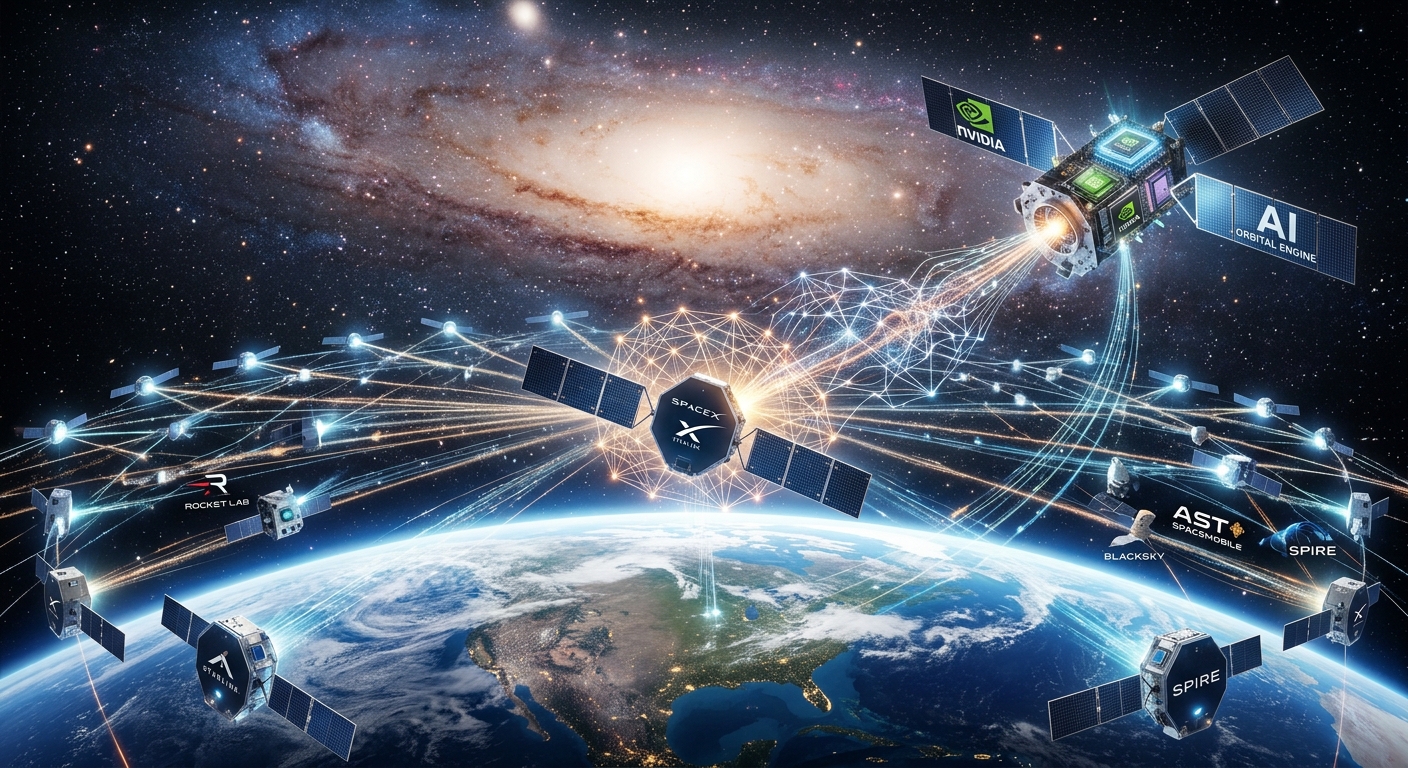
SpaceX’s million-satellite proposal points to an ambitious next chapter for artificial intelligence, with opportunities extending from advanced chips to spacecraft and solar power systems.
Artificial intelligence has spent the past several years moving into the cloud. Elon Musk would like many to consider a somewhat higher address. SpaceX (SPCX) has proposed a network of up to one million satellites designed to support orbital data centers, according to a Federal Communications Commission notice and Reuters reporting. The ambition is sweeping: harness solar energy in space to expand computing capacity beyond the constraints of terrestrial infrastructure. For many, the intriguing possibility is not simply another Musk moonshot. It is the potential convergence of two capital-intensive growth industries, artificial intelligence and commercial space, The bullish investment thesis does not require SpaceX to monopolize artificial intelligence or deploy anything close to one million satellites. It requires something more practical: evidence that useful computing workloads can operate economically in orbit, creating demand for processors, communications systems, spacecraft components and launch services. Early demonstrations and research programs suggest that possibility deserves serious attention, even if the commercial destination remains far from settled.
What the SpaceX FCC Filing Actually Reveals
The immediate catalyst is a SpaceX application filed on January 30, 2026. The FCC’s subsequent public notice describes a proposed non-geostationary satellite system of up to one million satellites operating as the “SpaceX Orbital Data Center.” That is a proposal, not a completed network, a revenue forecast or evidence that regulators have authorized the entire system. Reuters also notes that satellite operators sometimes request larger constellations than they ultimately expect to deploy, preserving flexibility in system design. Still, the strategic direction is significant. In its filing, SpaceX argues that solar-powered orbital computing could deliver substantial energy and cost advantages. It also ties the potential scale of the network to fully reusable launch vehicles such as Starship. Those are company assertions and development ambitions, rather than independently established operating economics. But they identify the essential business equation: cheaper access to orbit could make a new category of computing infrastructure conceivable. This linked Yahoo Finance article presents a more expansive interpretation. The paid promotional release describes investor James Altucher’s argument that Musk is positioning to control an AI industry worth $25 trillion annually. That figure and the “winner take all” framing belong to the promotion, not to a verified revenue opportunity established by the FCC filing. Many can remain enthusiastic without asking a regulatory application to double as an audited income statement.
Why AI’s Electricity Problem Makes Space Worth Studying
The most compelling foundation for orbital AI is not celebrity. It is electricity. The International Energy Agency projects that global data-center electricity consumption will more than double to approximately 945 terawatt-hours by 2030, representing just under 3% of worldwide electricity consumption. That estimate covers data centers broadly, not AI alone, although AI adoption is a major driver of the increase. This creates an infrastructure challenge that extends well beyond manufacturing more chips. Expanding computing capacity also requires sufficient electricity and the systems necessary to operate increasingly powerful servers. Orbital computing proposes a different architecture. Google’s research describes solar-powered satellites equipped with processors and connected through optical links, potentially operating in orbits that provide near-continuous sunlight. Such an arrangement could reduce dependence on heavy batteries and terrestrial power supplies. The opportunity is not that space makes engineering disappear. It is that space may change which engineering problems are worth solving. A data center above the atmosphere still needs reliable power, communications and heat rejection. The absence of a local utility bill does not mean the absence of a bill.
Nvidia Already Has a Foothold in the Orbital AI Story
For many, Nvidia (NASDAQ: NVDA) offers a tangible connection between today’s AI spending and tomorrow’s orbital experiments. Its existing business provides the financial foundation. Nvidia reported fiscal 2026 revenue of $215.9 billion, up 65%, with full-year Data Center revenue reaching $193.7 billion, up 68%. Those results reflect the terrestrial accelerated-computing market, not a meaningful orbital revenue stream. The space connection is nevertheless real. In October 2025, Nvidia described startup Starcloud’s plan to place an H100 graphics processing unit aboard a small satellite. The project sought to demonstrate that a data-center-class processor could perform advanced computing tasks in orbit. By December 2025, CNBC reported that Starcloud had trained a NanoGPT model in space and was running Google’s open Gemma language model on the orbiting H100. The training exercise used Shakespeare’s works, giving orbital computing an unusually literary debut. Starcloud’s own mission account also describes the November launch and subsequent in-orbit AI milestones. These demonstrations establish a technical foothold, not proof that large orbital data centers can outperform ground-based facilities economically. For Nvidia shareholders, that distinction is useful rather than disappointing. Orbital AI represents a possible additional market for accelerated computing, while the company’s established business does not depend on space-based data centers becoming commercially competitive. The investment appeal is optionality, not a need to replace current earnings with science fiction.
Alphabet’s Project Suncatcher Broadens the Opportunity
SpaceX is not the only organization exploring the idea. Google, part of Alphabet (NASDAQ: GOOGL, GOOG), announced Project Suncatcher in November 2025. The research initiative examines networks of solar-powered satellites carrying Google’s Tensor Processing Units, or TPUs, with optical communications connecting the spacecraft. Its initial announcement described a partnership with Planet Labs (NYSE: PL) to launch two prototype satellites by early 2027. A September 2026 update describes an initial prototype mission developed with Planet to test how TPU hardware handles radiation, launch stress and thermal conditions in space. The update reinforces an important point: this remains a research and validation effort, not a mature commercial service. For many, Alphabet’s participation strengthens the case that orbital AI is a serious infrastructure research category rather than a thesis resting entirely on one entrepreneur. Google’s technical analysis also supplies a valuable economic benchmark. Its researchers suggest that, under a sustained launch-cost learning curve, prices might fall below $200 per kilogram by the mid-2030s. Under that scenario, launch and operating costs for space-based computing could become roughly comparable with the reported energy costs of an equivalent terrestrial data center on a per-kilowatt-year basis. That is a conditional research comparison, not a forecast of total cost parity across every expense. Still, it gives many something more useful than a grand addressable-market number: a measurable cost threshold against which future progress can be judged.
Rocket Lab Offers Exposure to the Infrastructure Layer
An orbital computing industry would need much more than processors. It would require spacecraft, power systems, communications hardware and dependable access to orbit. Rocket Lab (NASDAQ: RKLB) operates across several of those categories. Its 2025 Form 10-K, filed with the Securities and Exchange Commission, describes a business spanning launch services, spacecraft manufacturing, optical systems and components. Its space systems portfolio includes solar cells and arrays, batteries, radios, reaction wheels and spacecraft software. Those capabilities make Rocket Lab relevant to the infrastructure discussion. They do not establish that the company has won contracts for SpaceX’s proposed orbital data centers, nor do they guarantee participation in any particular future constellation. The distinction matters because a useful investment thesis should connect actual capabilities to potential demand without quietly converting potential demand into booked revenue. Rocket Lab’s SEC filing also reports a December 2025 agreement with the Space Development Agency to provide 18 satellites for its Tracking Layer Tranche 3 program. The contract carries a potential value of $816 million, including $806 million in base value and $10 million in options, with final satellite delivery for launch expected in 2029. This is a defense satellite program, not an orbital AI contract. Its relevance is evidence of the company’s participation in substantial spacecraft manufacturing programs. The optimistic interpretation is straightforward: if computing becomes a larger part of space infrastructure, companies already building the hardware may gain another source of demand.
Why Several Companies Could Win
The promotional version of this story centers on one winner. The more investable version may involve several. Different layers of an orbital computing system could support different business models:
- Nvidia (NASDAQ: NVDA) has demonstrated processor exposure through Starcloud’s H100 mission, alongside its much larger existing AI infrastructure business.
- Alphabet (NASDAQ: GOOGL, GOOG) is researching an orbital architecture built around its own TPUs and optical satellite links.
- Planet Labs (NYSE: PL) is participating in Google’s prototype development effort, providing a concrete project connection rather than merely a thematic association.
- Rocket Lab (NASDAQ: RKLB) supplies launch services, spacecraft and components that could be relevant to future deployments, although thematic relevance is not evidence of an orbital AI contract.
These are different exposures, not interchangeable “space AI stocks.” For Nvidia and Alphabet, orbital computing is an emerging extension of substantial computing businesses. For Planet Labs, the connection includes a specific prototype partnership. For Rocket Lab, the case centers on infrastructure capabilities and the possibility of future customer demand. That diversity may be an advantage. Investors do not need to assume that the company providing transportation will also supply every processor, build every spacecraft and capture every dollar of computing revenue.
The Milestones That Could Turn Excitement Into Earnings
The next phase of this story should be measured in engineering and commercial evidence, not satellite-count superlatives. Several developments would make the investment case stronger:
Reliable Performance in Orbit
Early demonstrations show that sophisticated AI computing can occur in space. Longer operating records must establish how hardware performs under radiation exposure and thermal stress, which Google explicitly identifies as test objectives.
Lower Delivered Launch Costs
SpaceX’s proposed architecture relies on reusable launch capacity, while Google’s research highlights launch pricing as a central economic variable. The relevant question is not merely whether a rocket flies, but how consistently and economically it can deliver useful computing capacity to orbit.
Scalable Optical Connections
Google’s research treats optical inter-satellite links as a core part of distributed orbital computing. Demonstrating reliable connections between spacecraft is an important step beyond proving that a single processor works in space.
Commercial Commitments
For the public companies associated with this theme, stronger evidence would include identifiable orders, funded programs, recurring services revenue and financial disclosures that isolate the contribution from orbital computing. A prototype validates a possibility. A paying customer begins validating a business.
The Risks
A credible optimistic outlook should leave room for inconvenient physics and ordinary financial discipline. Google’s research acknowledges challenges involving communications, radiation and system design. Its cost analysis depends on future launch-price improvements rather than today’s proven commercial economics. SpaceX’s proposal also requires regulatory review. An application’s enormous scale does not resolve questions about feasibility or establish permission to deploy the requested network. Company-specific execution risk remains relevant as well. Rocket Lab’s SEC filing warns about spacecraft and component failures, launch risks, development delays and the need for sufficient financial resources. Nvidia’s filings similarly emphasize competition, technological change and the risks surrounding future demand and infrastructure deployment. Finally, business opportunity and investment return are not the same thing. Even a successful technology can disappoint shareholders if expectations outrun eventual cash generation. The sensible approach is to value established operations on their merits and treat orbital AI as an additional opportunity whose worth must rise with evidence.
The Case: A New Layer of AI Infrastructure
The strongest conclusion from SpaceX’s filing is not that Musk has secured ownership of artificial intelligence. It is that the industry’s infrastructure ambitions are expanding beyond terrestrial assumptions. The supporting evidence now spans an official FCC proposal, AI hardware operating in orbit, a major technology company’s research program, and public suppliers with relevant spacecraft capabilities. None establishes an inevitable commercial outcome. Together, they establish a theme worth following with more than passing curiosity. For many, the most attractive version of the story may be an expanding market rather than a single-company coronation: more demand for computing, more experimentation in power architecture and more opportunities for businesses capable of connecting the two. The cloud may be getting a higher ceiling. The companies that can turn that ceiling into productive infrastructure will have to earn their valuations the old-fashioned way.
The Sources
- Yahoo Finance: “A Single Filing Reveals Elon Musk’s Plan to Make Artificial Intelligence a ‘Winner Take All’ Game, Says Top AI Expert James Altucher”
The supplied article and starting point for the story. This is paid promotional material, not independent confirmation of its investment claims. - Federal Communications Commission: Public Notice Regarding SpaceX’s Orbital Data Center Application
Official notice describing SpaceX’s application for a proposed non-geostationary system of up to one million satellites. - Reuters: “SpaceX Seeks FCC Nod for Solar-Powered Satellite Data Centers for AI”
Independent reporting on the proposal, its intended purpose and the distinction between requested satellite capacity and eventual deployment. - International Energy Agency: “Energy Demand From AI”
Analysis of data-center electricity consumption and projected demand through 2030. - Nvidia (NASDAQ: NVDA): Fiscal 2026 Form 10-K, SEC.gov
Annual SEC filing covering financial performance, business operations, competition and investment risks. - Nvidia (NASDAQ: NVDA): Fourth-Quarter and Fiscal 2026 Financial Results, SEC.gov
Earnings release supporting the article’s fiscal 2026 revenue and Data Center revenue figures. - Nvidia: “How Starcloud Is Bringing Data Centers to Outer Space”
Company account of Starcloud’s orbital computing plans and its use of an Nvidia H100 processor. - CNBC: “Nvidia-Backed Starcloud Trains First AI Model in Space”
Independent reporting on Starcloud’s in-orbit AI training and inference demonstrations. - Starcloud: Starcloud-1 Mission
First-party information about the satellite mission carrying an Nvidia H100 GPU and its computing demonstrations. - Google: “Project Suncatcher Explores Powering AI in Space”
Alphabet’s (NASDAQ: GOOGL, GOOG) announcement of its orbital AI research initiative and prototype partnership with Planet Labs (NYSE: PL). - Google Research: “Exploring a Space-Based, Scalable AI Infrastructure System Design”
Technical discussion of solar-powered computing satellites, optical communications, launch-cost assumptions and engineering challenges. - Google: “Behind Project Suncatcher, Our Moonshot to Put AI in Space”
Follow-up explanation of prototype testing, including hardware performance under radiation, thermal conditions and launch stress. - Rocket Lab (NASDAQ: RKLB): Fiscal 2025 Form 10-K, SEC.gov
Annual SEC filing documenting launch services, spacecraft manufacturing, component capabilities, major contracts and business risks.
Stay Updated with Vista Partners
Subscribe to receive market insights, investing ideas, and the latest updates directly in your inbox.

China’s Robot Economy Is Already Here, and Beauty Is Learning the Same Lesson -( $YSG )