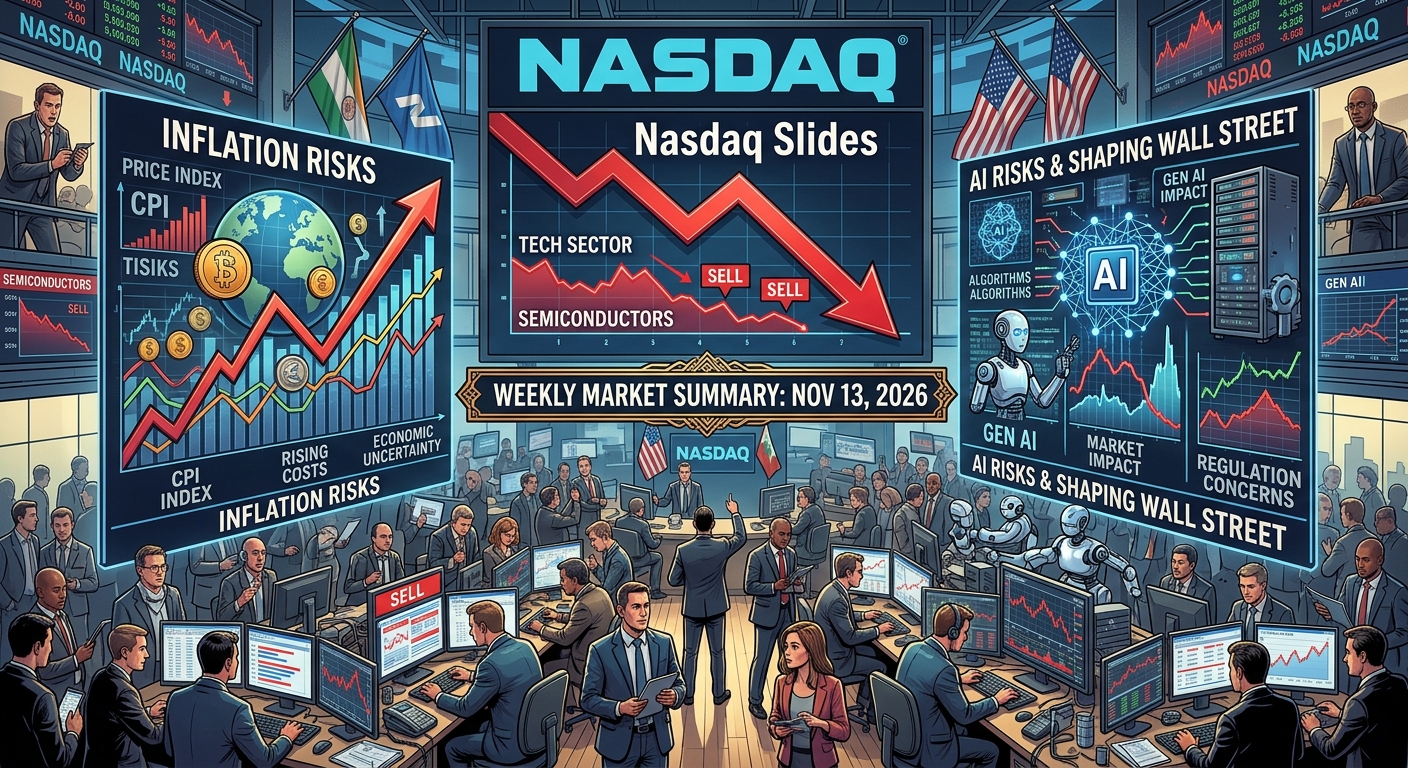
U.S. stocks finished Friday with a split decision as technology weakness pulled the S&P 500 and Nasdaq Composite lower, while the Dow Jones Industrial Average managed a modest gain. The closing figures supplied for this report showed the S&P 500 at 7,561.67, down 0.40%, and the Nasdaq at 25,136.27, down 0.91%. The Dow added 0.10% to 52,347.55. Despite Friday’s uneven finish, the three major benchmarks ended the week higher. For the week ending November 13, 2026, the central market tension was straightforward: improving expectations for corporate profits and AI-driven growth competed with persistent inflation, elevated borrowing costs and fresh questions about technology-sector leadership. Many also had to assess a major business-software outage, an aviation disruption and a shifting energy outlook.
Friday’s Closing Market Performance
| Benchmark or asset | Closing level or supplied quote | Friday change | Friday percentage change |
|---|---|---|---|
| S&P 500 | 7,561.67 | -30.73 | -0.40% |
| Dow Jones Industrial Average | 52,347.55 | +50.46 | +0.10% |
| Nasdaq Composite | 25,136.27 | -229.82 | -0.91% |
| Russell 2000 | 2,790.49 | -8.57 | -0.31% |
| 10-year Treasury yield | 5.15% | +0.05 percentage point | +1.00% |
| Cboe Volatility Index, VIX | 19.39 | +0.69 | +3.70% |
| Gold | $3,875.90 | -$9.40 | -0.24% |
| Bitcoin, USD | $68,340.81 | -$3,121.01 | -4.37% |
| December 2026 crude oil contract | $89.01 | +$0.27 | +0.30% |
The supplied crude oil quote is contract-specific and differs from the separately reported WTI settlement discussed below. Gold, Bitcoin and crude oil figures are presented as shown in the supplied snapshots rather than as independently verified official settlements. Friday’s combination of a weaker Nasdaq, a higher Treasury yield and a rising VIX showed a more cautious finish than the week’s overall advance might suggest. The Dow’s small gain also highlighted the difference between the technology-heavy Nasdaq and the blue-chip average.
Weekly Market Recap: Gains Survive a Difficult Finish
The major U.S. benchmarks retained weekly gains even as technology shares weakened into the weekend. That distinction matters: Friday’s losses represented a late-week setback, not a reversal of the entire week’s advance. Technology remained the focal point. Leadership uncertainty at Nvidia (NASDAQ: NVDA) intersected with broader questions about semiconductor demand, export restrictions and the durability of AI infrastructure spending. At the same time, the inflation reports offered limited support for hopes that borrowing costs would quickly decline.
Macroeconomic Commentary: Inflation Slows in Places, but Remains Persistent
October CPI showed broad household price pressure
The Bureau of Labor Statistics reported that October’s Consumer Price Index increased 0.4% from the previous month, following September’s 0.6% rise. Core CPI, which excludes food and energy, increased 0.3% for a third consecutive month. Several details illustrated why affordability remained an economic concern:
- Shelter prices increased 0.3% and accounted for more than 30% of the monthly headline increase.
- Food prices rose 0.5%, including a 0.4% increase in groceries and a 0.5% increase in food away from home.
- Energy prices increased 0.7%.
- Transportation services increased 0.8%.
- Used vehicle prices declined 1.2%, providing a partial offset.
The report did not provide standard year-over-year comparisons for most major CPI categories because October 2025 survey data were unavailable following a lapse in government appropriations. That limits direct annual comparisons and makes the monthly trend particularly important when interpreting this release. The economic message was mixed rather than reassuring. Headline inflation slowed from September, but persistent increases in shelter, food and services suggested that household price pressures were not confined to gasoline or other volatile commodities.
October PPI offered a modest monthly improvement
Friday’s October Producer Price Index report showed wholesale prices increasing 0.3%, below the 0.4% consensus estimate cited in the supplied reporting. Core PPI also increased 0.3%. However, headline producer prices were 6.5% above a year earlier, the highest annual increase since November 2022. A broader underlying measure, excluding food, energy and trade services, increased 0.5% during October. That detail tempered the significance of the softer headline result: an improvement relative to expectations did not mean that underlying price pressure had disappeared. The October figures are drawn from the supplied report.
What the inflation reports mean for interest rates
The inflation backdrop left little room for a simple lower-rates narrative. Reporting accompanying Friday’s PPI release described market expectations for a quarter-percentage-point rate increase at the Federal Reserve’s December 8 and 9 meeting, rather than a near-term reduction. That was a market expectation, not a policy decision. With the 10-year Treasury yield at 5.15%, many continued to face a demanding valuation environment. The key macroeconomic question was whether easing energy costs could eventually outweigh persistent price increases across services and other parts of the economy.
Nvidia’s Leadership Change Puts AI Governance in Focus
Nvidia (NASDAQ: NVDA) confirmed on November 12 that Jensen Huang had resigned as president, chief executive officer and a board member, effective immediately. The company appointed Chief Financial Officer Colette Kress as interim CEO and began a search for a permanent successor. Harvey C. Jones became chair of the board. The leadership transition followed the board’s announcement of an independent investigation into reporting that Huang had been targeted by a foreign intelligence effort. Importantly, the board said in its November 8 statement that it had no reason to believe national security or company secrets had been compromised. Allegations and an ongoing inquiry should not be treated as findings of wrongdoing. Congressional scrutiny nevertheless intensified, with lawmakers seeking testimony and information concerning chip exports, export-control compliance and potential national-security implications. For many following AI infrastructure, the business issue extends beyond succession. Nvidia (NASDAQ: NVDA) must maintain customer commitments and product execution while navigating an investigation and heightened political attention. The board said it expected operations, customer commitments and the product roadmap to continue without interruption.
Microsoft Outage Highlights Digital Infrastructure Dependence
Microsoft (NASDAQ: MSFT) apologized Friday after a widespread outage disrupted Outlook and other Microsoft 365 services. The company attributed the connectivity disruption to an issue during a network-capacity upgrade and said the underlying cause had been addressed while recovery work continued. The disruption affected email, calendars and other business applications across multiple regions. Microsoft (NASDAQ: MSFT) said it had not detected malicious activity as the cause of the incident. The episode added an operational dimension to the technology discussion. Alongside questions about AI growth and capital spending, businesses had to consider the resilience of systems supporting everyday communications and workflows. The outage demonstrated how disruption at a major platform can spread beyond its own applications to connected services and customer operations.
Nationwide Ground Stop Adds an Aviation Disruption
The Federal Aviation Administration issued a nationwide ground stop Friday afternoon, citing extraordinary circumstances and safety considerations. A ground stop holds flights at their departure points, while inbound international flights were to be handled individually. The supplied report did not establish the underlying cause, duration or final economic impact. It also did not establish a connection between the aviation disruption and the Microsoft (NASDAQ: MSFT) outage. Treating the two events as related would go beyond the available evidence.
Oil and Gasoline: Consumer Relief Meets Geopolitical Uncertainty
Oil’s weekly direction contrasted with its volatile daily trading. Separately reported benchmark settlements placed Brent crude at $95.84 per barrel and WTI at $88.56 on Friday. The report indicated that both benchmarks were heading for weekly declines of about 2.5%, with rising supply and softer demand competing against Middle East shipping risks. At the pump, the national average price of regular gasoline had fallen below $4 per gallon for the first time since July, according to the supplied article citing AAA. Seasonal changes, including cheaper winter-blend gasoline, lower driving demand and refinery output, helped explain the decline. For households, lower gasoline prices offered relief. For the broader economy, however, cheaper fuel alone did not resolve the inflation problem evident in October’s food, shelter and services data.
Goldman Sachs Looks Toward 2027
Goldman Sachs (NYSE: GS) projected that the S&P 500 could reach 8,700 in 2027, representing roughly 14% upside from the reference level used in its outlook. The forecast paired continued equity gains with slower earnings growth and substantial volatility. The firm’s strategists expected U.S. earnings growth to slow from 36% to 11%. They also argued that a moderation in AI-related capital spending growth could reduce support for some suppliers that benefited from the infrastructure buildout. The important distinction is between continued growth and continued acceleration. A company can expand revenue and earnings while still disappointing expectations built around faster growth. Goldman Sachs (NYSE: GS) framed more attractive valuations, positive economic growth and potentially lower inflation and bond yields as possible offsets to that slowdown. Its outlook remains a forecast, not an assured market outcome.
SpaceX and Anthropic Keep the Growth Pipeline in View
SpaceX prepares a major reusability test
SpaceX (NASDAQ: SPCX) was targeting Friday evening for Starship Flight 15, with plans to attempt recovery of both the Super Heavy booster and the Starship upper stage. The mission also aimed to deploy 26 Starlink V3 satellites. The commercial significance centers on reusability. Recovering and reusing both stages could support the company’s goal of lowering launch costs and increasing launch frequency. However, the planned upper-stage mission extended beyond Friday, so a completed double recovery could not be included as an established result in this market-close recap.
Anthropic’s planned listing puts AI economics under scrutiny
Anthropic CEO Dario Amodei said market volatility had not materially changed the company’s approach to its planned public listing. They are now targeting a IPO listing nextThursday as the company’s need to finance substantial computing and infrastructure commitments. Amodei’s comments highlighted a central AI business challenge: computing capacity must be secured before future demand and economic returns are fully known. For many evaluating the sector, the question is increasingly how large spending commitments translate into durable revenue and economic value.
What Matters Next for the Stock Market
The week ended with several connected issues likely to remain central to market direction:
- Inflation persistence. Monthly CPI and underlying PPI increases left uncertainty about how quickly price pressures could ease.
- Interest-rate expectations. December policy expectations remained sensitive to inflation, while the supplied 10-year Treasury yield stood at 5.15%.
- AI leadership and execution. Nvidia’s (NASDAQ: NVDA) transition increased attention on governance, export compliance and business continuity.
- Infrastructure reliability. The Microsoft (NASDAQ: MSFT) outage highlighted operational dependencies across businesses and public services.
- Energy’s competing signals. Lower gasoline prices supported household purchasing power, while geopolitical risks continued to complicate the crude oil outlook.
- Growth expectations. The planned Anthropic listing and SpaceX (NASDAQ: SPCX) test mission kept attention on the capital requirements and execution risks behind emerging technologies.
The week’s defining contrast was a positive overall market result followed by a cautious Friday finish. For many, the next phase depends on whether corporate growth can remain strong enough to absorb persistent inflation, elevated yields and the expanding financial and operational demands of AI infrastructure.
Updates From the VP Watchlist
Amwell® (NYSE: AMWL)
Amwell® (NYSE: AMWL), a leading provider of technology-enabled care, closed at $11.74. Amwell reported after the close Nov. 3 the company’s Third Quarter 2026 Highlights: Recorded Total Revenue of $49.0 million, exceeding the previously provided financial guidance range for Q3, Achieved subscription revenue of $23.9 million, Recorded Amwell Medical Group (“AMG”) visit revenue of $23.7 million, Reported gross margin of 53%, Net loss was ($11.0) million, compared to ($9.6) million in the second quarter of 2026, Adjusted EBITDA of ($3.6) million compared to ($1.2) million in the second quarter of 2026, & Total visits on the platform were 0.8 million. Financial Outlook: The Company is raising its 2026 revenue outlook, and adjusted EBITDA outlook, and reaffirming its AMG visit guidance., Revenue in the range of $204 million to $206 million increased from $200 million to $205 million. AMG visits between 1.32 million and 1.37 million Adjusted EBITDA in the range between ($8) million to ($7) million increased from ($9) million to ($7) million.
The Company also provided financial guidance for Q4 2026 Revenue and adjusted EBITDA:
- Q4 revenue in the range of $48 million to $50 million
- Q4 adjusted EBITDA expected to in the range of $0 million to $1 million.
The Company also reiterated its objective to achieve positive cash flow from operations in the fourth quarter of 2026.
Serina Therapeutics (NYSE: SER)
Serina Theraeuptics (NYSE: SER, $1.39) is a clinical-stage biotechnology company developing a pipeline of wholly owned drug product candidates to treat neurological diseases and other indications. Serina’s POZ PlatformTM provides the potential to improve the integrated efficacy and safety profile of multiple modalities including small molecules, RNA-based therapeutics and antibody-based drug conjugates (ADCs). Serina is headquartered in Huntsville, Alabama on the campus of the HudsonAlpha Institute of Biotechnology.
On Thursday, November 12, Serina reported its financial results for the third quarter ended September 30, 2026, along with key business updates. Steve Ledger, Chief Executive Officer of Serina stated, “We are excited about the achievement of important clinical milestones for SER-252 in Parkinson’s disease, advancing from the initial evaluation of our lowest-dose cohort into the next stage of dose escalation. Importantly, the blinded pharmacokinetic observations from Cohort 1 showed the sustained drug exposure SER-252 was designed to achieve, and the independent Safety Monitoring Committee recommended proceeding with continued development. Dosing in Cohort 2 is currently underway and focuses on demonstrating SER-252’s potential as a differentiated treatment option for patients with advanced Parkinson’s disease to improve the significant challenge of consistent symptom control.”
On Thursday, September 24, 2026, Serina CEO Steve Ledger discussed discuss Serina’s programs’ progress during Tribe Public’s “A New Approach to Advanced Parkinson’s Disease: Serina Discusses SER-252’s Clinical Progress”webinar, followed by a live Q&A. You may view it below.
Eupraxia Pharmaceuticals Inc. (EPRX)
Eupraxia Pharmaceuticals Inc. (EPRX, $8.15, +4.35%), a clinical-stage biotechnology company leveraging its proprietary Diffusphere™ technology designed to optimize local, controlled drug delivery for applications with significant unmet need, today, ( Nov. 10), announced its financial results for the third quarter of 2026. Dr. James A. Helliwell, Chief Executive Officer of Eupraxia stated, “We remain on track to report interim results from the Phase 2b portion of the RESOLVE trial in December, and were pleased to announce in mid-October that we had reached our target enrollment of 120 patients. We are very encouraged by the Phase 1b/2a data from the open-label portion of the RESOLVE trial that was reported this quarter, which includes 36- and 52-week data from our highest dosing cohorts. We believe this data provides further evidence of the observed durable treatment effects of EP-104GI in EoE patients, seen in previous cohorts. In total, we have observed 64% of patients remaining in clinical remission over this 52-week period in addition to clinically meaningful histologic improvements. With cash runway into the second half of 2028, we believe we remain well funded to execute on our upcoming milestones for our EoE program.”
EPRX gained a significant new Wall Street endorsement Monday as RBC Capital Markets initiated coverage with an Outperform rating, a Speculative Risk designation and a $14 price target. The research makes a bullish case for EP-104GI, the company’s investigational treatment for eosinophilic esophagitis, ahead of an expected December clinical readout. Against the $6.89 reference price in RBC’s report, the target implies approximately 103% upside, not a forecast of where shares must trade. The attraction is unusually straightforward for biotechnology: take a familiar anti-inflammatory medicine, deliver it precisely into diseased tissue and attempt to make its benefits last long enough to change the treatment routine. If that approach succeeds, Eupraxia would offer more than another prescription for a chronic disease. It could offer a different calendar. RBC analyst Douglas Miehm’s November 9 initiation argues that EP-104GI could occupy a differentiated position in eosinophilic esophagitis, commonly called EoE, through localized delivery and the potential for once-yearly administration. The next major test is whether encouraging early results translate into convincing evidence against a vehicle control in the Phase 2b RESOLVE study.
EPRX announced (Oct. 15) that the ongoing RESOLVE study evaluating the safety and efficacy of EP-104GI for the treatment of Eosinophilic Esophagitis (“EoE”) has reached its enrollment target. “This is a significant milestone for the RESOLVE trial and the development of EP-104GI as a potential treatment option in EoE” said Dr. James Helliwell, Chief Executive Officer of Eupraxia. “We look forward to our interim analysis in December where we will be reporting on symptoms, histologic findings and safety in the first 60 patients in Phase 2b to reach 6 months. Data will also be available on the patients at 3, 9- and 12-month timepoints giving a fulsome interim look at the RESOLVE Trial”.
Modular Medical, Inc. (NASDAQ: MODD)
Modular Medical, Inc. (NASDAQ: MODD, $1.97, +16.57%), a commercial-stage medical device company preparing for the full commercial launch of its next-generation Pivot™ tubeless patch pump, is pursuing a different proposition: make insulin delivery less demanding for the people who must manage it every day. New patient research announced November 9 gives that strategy a persuasive commercial foundation. In a three-phase study conducted with Thrivable involving more than 540 people with Type 1 or Type 2 diabetes, approximately nine out of 10 surveyed multiple daily injection users said they would consider a simpler insulin delivery option. In the final-phase survey of 303 participants, 48.5% expressed strong interest in the company’s Pivot tubeless patch pump. The distinction matters. General enthusiasm for something easier is not the same as product-specific interest, and neither is a prescription. Still, the findings suggest Modular Medical is addressing a recognizable problem rather than inventing one for the benefit of a presentation deck. For many following MODD, the emerging opportunity centers on one word: simplicity. The company has already moved beyond the purely developmental stage. Its annual report documents U.S. Food and Drug Administration clearance for Pivot in April 2026, followed by commercial availability and initial patient shipments in June. The question now is whether a differentiated product, improving access and more focused patient education can turn that regulatory foundation into a repeatable commercial business.
MODD announced (Oct. 27) that it has received a positive decision from its notified body regarding certification of its quality management system under ISO 13485:2016. The notified body is designated under the European Union Medical Device Regulation (“MDR”).
MODD CEO, Jeb Besser, co-hosted a Tribe Public’s CEO Presentation and Q&A Webinar Event titled “The Road To Revenue: Modular Medical’s Strategy For Launching Pivot,” that was held Friday, September 4, 2026.. You may watch the event video below now if you missed it below now.
Alphabet (NASDAQ: GOOGL $295.77, -.98%)
Alphabet (NASDAQ: GOOGL, GOOG) is confronting an expensive paradox: Artificial intelligence is bringing more activity to Google while making the economics of that activity harder to predict. Yet the latest results offer a more constructive interpretation than a simple obituary for search. Third-quarter revenue increased 25% to $127.6 billion. Operating income climbed 30% to $40.6 billion. Google Cloud revenue more than doubled. Those are unusual credentials for a company supposedly being escorted toward technological irrelevance. At the close on Thursday, Alphabet shares traded at $283.82, following a 12.64% decline, many are clearly demanding more proof and fewer architectural renderings of future data centers. That skepticism is understandable. But the opportunity lies in distinguishing a difficult transition in monetization from a collapse in demand. Google’s problem is not that people have stopped asking questions. According to management, its year-over-year search-query growth reached its highest rate in five years during the third quarter. The more consequential question is how quickly Google can turn its expanding AI audience into attractive, durable cash flow. Wall Street has little patience for a renovation when the contractor’s estimate begins with a trillion.
Space Exploration Technologies Corp. (SPCX, $139.11, -.59%)
SpaceX-related coverage is orbiting three themes: a possible combination with Tesla, an expanding AI infrastructure footprint, and robust Starlink demand, because apparently conquering one industry at a time is inefficient. Reported third-quarter revenue totaled $14.6 billion, while management projected first-quarter 2027 revenue of $33 billion–$37 billion, a range with little apparent interest in remaining earthbound. The latest reported session gain, including after-hours trading, was 1.43%.
The Sources
- Friday market session and weekly market context
- Nvidia leadership developments and congressional scrutiny
- Nationwide aviation ground-stop report
- Microsoft service outage and recovery updates
- October 2026 producer price inflation report
- Gasoline prices and seasonal fuel-market factors
- Goldman Sachs 2027 equity market outlook
- SpaceX Starship Flight 15 objectives
- Crude oil settlements, supply conditions and weekly direction
- Anthropic’s planned listing and computing-capacity commitments
- Bureau of Labor Statistics: October 2026 Consumer Price Index
- Bureau of Labor Statistics: Producer Price Index release page, retrieved displaying September 2026
- Nvidia: Official CEO transition announcement
- Nvidia: Statement from the board of directors
- Friday closing-market and weekly-direction corroboration
- Starship Flight 15 timing and planned mission duration
Stay Updated with Vista Partners
Subscribe to receive market insights, investing ideas, and the latest updates directly in your inbox.