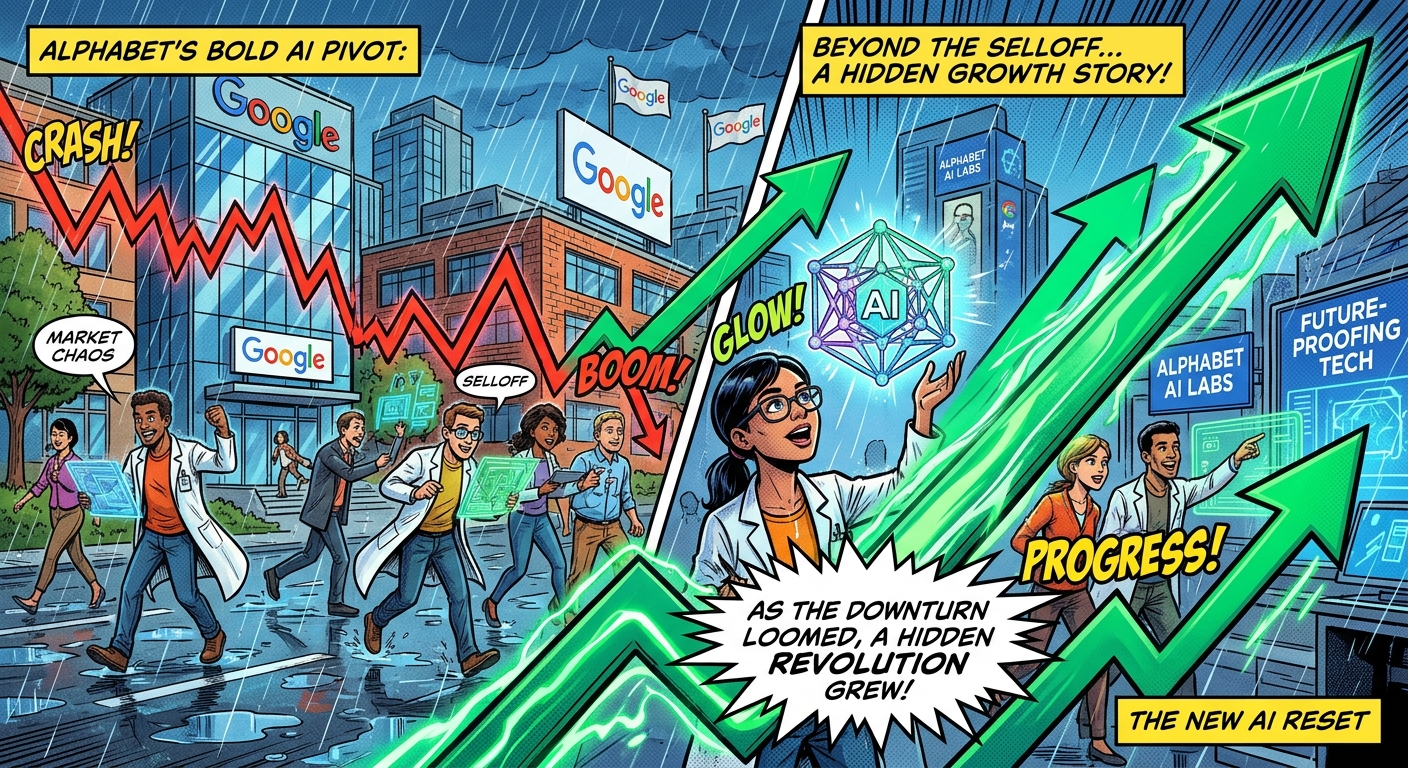
The Market Sees a Threat. Google Is Building Another Business.
Alphabet (NASDAQ: GOOGL, GOOG) is confronting an expensive paradox: Artificial intelligence is bringing more activity to Google while making the economics of that activity harder to predict. Yet the latest results offer a more constructive interpretation than a simple obituary for search. Third-quarter revenue increased 25% to $127.6 billion. Operating income climbed 30% to $40.6 billion. Google Cloud revenue more than doubled. Those are unusual credentials for a company supposedly being escorted toward technological irrelevance. At the close on Thursday, Alphabet shares traded at $283.82, following a 12.64% decline, many are clearly demanding more proof and fewer architectural renderings of future data centers. That skepticism is understandable. But the opportunity lies in distinguishing a difficult transition in monetization from a collapse in demand. Google’s problem is not that people have stopped asking questions. According to management, its year-over-year search-query growth reached its highest rate in five years during the third quarter. The more consequential question is how quickly Google can turn its expanding AI audience into attractive, durable cash flow. Wall Street has little patience for a renovation when the contractor’s estimate begins with a trillion.
Google Search Is Changing, Not Disappearing
Google Search and other advertising revenue increased 12% to approximately $63.3 billion in the third quarter. Total advertising revenue rose 11%. The core commercial engine continued to expand, even as the market questioned its future. That does not make the concern imaginary. Chief Business Officer Philipp Schindler acknowledged that strong growth in AI Mode queries affected search growth because of lower monetization in that format. He also identified currency movements and advertising-category dynamics as contributors to the slowdown. Treating the entire deceleration as evidence that rival chatbots are hollowing out Google would therefore go beyond what the company reported. The bullish interpretation is narrower and more credible: Google has attracted substantial engagement to a newer search experience before fully developing its advertising economics. Management says most AI Mode queries are incremental and that these interactions create additional commercial opportunities over time. That remains a company assessment, not independent proof that every new query will eventually earn an attractive return. Still, growing usage gives Google something valuable to work with. It is considerably easier to improve monetization when the audience has already arrived.
AI Search Advertising Is Moving Beyond the Experiment
Google is not responding to the monetization challenge with a philosophical essay. On October 28, the company announced that it was scaling AI Mode advertising into 10 additional countries, including Australia, Canada, India and Singapore. It also outlined plans for further expansion into markets including Brazil, Mexico and the United Kingdom during the fourth quarter. Separately, Google announced multiturn ads in the United States, extending advertising opportunities into follow-up questions within AI Mode. Sponsored placements will be labeled accordingly. These developments matter because conversational search does not follow the neat commercial choreography of an old-fashioned keyword query. A person researching a vacation, comparing products or narrowing a home-improvement project may reveal purchasing intent over several exchanges rather than in a single phrase. Google’s task is to make those exchanges commercially useful without turning the conversation into a department-store loudspeaker. The company says early experiments are encouraging and that click-through rates on sponsored product-list items in AI Mode are already similar to those on organic product-list items. That comparison is promising, but it does not establish equal revenue per query, equal profitability or parity with traditional search advertising. For many watching Alphabet stock, that distinction is central. The opportunity is real. The economics are still being assembled.
Google Cloud Is Becoming Too Large to Treat as a Supporting Character
The strongest counterweight to the search anxiety sits in Google Cloud. Third-quarter Cloud revenue increased 103% to $30.7 billion. Operating income more than tripled to $11.1 billion, while the segment’s operating margin expanded to 36.2%, from 23.7% a year earlier. This is no longer merely a promising business attached to an advertising giant. It is a substantial earnings contributor with a different customer base and a broader set of revenue sources. Cloud’s backlog reached $561 billion. Alphabet expects to recognize just over 55% of that amount as revenue over the next 24 months. Backlog is not cash in the bank, but it provides considerably more visibility than a presentation slide describing a large addressable market. Management also reported that Google Cloud now has 18 product lines generating more than $1 billion each in annual revenue. Its offerings span computing infrastructure, databases, analytics, cybersecurity and AI applications. The strategic advantage is straightforward: Alphabet does not need every dollar of future AI revenue to arrive through a sponsored search result. It can also earn money supplying the infrastructure, software and services that businesses use to deploy AI. Its SEC-filed annual report describes precisely that diversified model, including consumption-based infrastructure revenue, subscriptions, AI development tools and enterprise applications.
Google’s Chips Add Another Route to AI Revenue
Alphabet’s custom Tensor Processing Units, or TPUs, give the company another way to participate in AI spending. Google introduced its seventh-generation Ironwood TPU in 2025 with an emphasis on inference, the computing work involved in producing responses from trained AI models. Its technical documentation describes Ironwood’s TPU7x architecture as supporting large-scale training and inference. By the third quarter of 2026, management said TPU-system sales were a meaningful contributor to Cloud growth. The company expects those sales to continue scaling in the fourth quarter, followed by a meaningful revenue ramp in 2027. This does not mean Alphabet has become a pure-play semiconductor company. It means an internally developed capability is becoming an additional commercial product. Google Cloud also offers NVIDIA (NASDAQ: NVDA) GPUs alongside its own chips. Alphabet’s strategy is therefore broader than a winner-take-all contest between two silicon camps: It can serve customer demand across multiple computing architectures while building differentiation through its own hardware and software. That flexibility matters. In an industry changing this quickly, owning several doors into the building is preferable to arguing over which entrance deserves the largest sign.
From Answering Questions to Completing Purchases
Google’s commercial ambitions extend beyond placing advertisements beside answers. The company previewed Universal Cart in May as a shopping hub designed to connect product discovery, saved items and checkout across its services. Its proposed functions included tracking price changes, identifying availability and helping shoppers complete purchases. On October 15, Google launched Universal Cart in the United States across Search and the Gemini app. The service organizes products from multiple retailers, tracks price drops, identifies relevant promotional codes and supports checkout through Google Pay or a merchant’s own site.The potential business significance is not that every shopping assistant becomes a new revenue stream overnight. It is that Google is working to remain involved as consumer behavior moves from searching for information toward asking software to accomplish tasks. For advertisers, a useful interaction is one that produces a measurable business outcome. For Google, preserving its role between product discovery and purchase could help defend the relevance of its advertising platform even as the interface changes. That remains an execution opportunity, not a guaranteed replacement for today’s search economics.
The Trillion-Dollar Commitment Requires Careful Accounting
The scale of Alphabet’s infrastructure commitments deserves serious scrutiny. On its third-quarter call, the company reported $924 billion in future purchase commitments and another $152 billion in pre-commencement leases and other obligations. Management described these as maximum contractual amounts and said variable pricing and volume flexibility could result in lower spending.Those figures should not be casually described as a trillion-dollar bill payable immediately, nor should they be confused with annual capital expenditures. They represent different contractual categories and spending horizons. For perspective, Alphabet’s 2025 Form 10-K reported $149.1 billion in purchase commitments and other contractual obligations at that year-end, much of it related to technical infrastructure and inventory orders. The later commitment figures underscore how dramatically the scale of the buildout has changed, although the categories should not be treated as perfectly interchangeable. The more immediate financial pressure is visible in cash flow:
- Third-quarter operating cash flow totaled $42.3 billion.
- Capital expenditures reached $51.4 billion.
- Free cash flow was negative $9.1 billion.
- Trailing 12-month free cash flow remained positive at $19.7 billion.
Alphabet maintained its 2026 capital-expenditure forecast of $195 billion to $205 billion and said spending would increase significantly in 2027. That is above the $175 billion to $185 billion range announced with its fourth-quarter 2025 results. The bullish case cannot simply wave these costs away. It depends on new capacity producing sufficient revenue and cash flow to justify them.
Why the Earnings Decline Needs Context
Alphabet’s operating performance and bottom-line performance told different stories. Operating income increased 30% in the third quarter, but net income and earnings per share declined. Management attributed the decline to lower other income and expenses, including a substantial unrealized loss on an equity holding. That distinction matters because a mark-to-market investment loss is not the same thing as weakening profitability in Search or Cloud. It can materially affect reported earnings without describing the underlying trajectory of those operating businesses. At the same time, many should resist the temptation to replace one oversimplification with another. Strong operating growth does not erase negative free cash flow, rising depreciation or future financing demands. A clean valuation argument also requires consistent figures. The supplied trailing net-income figure carries a June 30 measurement date, while the supplied revenue and P/E figures carry September 30 dates. Those inputs should not be combined to declare Alphabet unusually cheap without reconciling the periods and the effect of investment gains and losses.The stronger bullish argument rests on operating evidence, not a convenient multiple.
What Could Turn Alphabet’s AI Spending Into a Stock Catalyst?
Alphabet’s next phase will be judged by the relationship between engagement, monetization and capital intensity. Three developments would strengthen the case:
- Search revenue growth improving as AI advertising expands, demonstrating that additional usage can translate into additional revenue.
- Cloud backlog converting into profitable revenue while the company manages capacity constraints and the cost of third-party computing.
- Free-cash-flow improvement showing that infrastructure spending is beginning to deliver returns rather than merely requiring another round of spending.
These are not arbitrary milestones. Management has identified lower AI Mode monetization, near-term Cloud margin pressure from third-party capacity, and continued cash-flow pressure from infrastructure and TPU inventory investment. Alphabet also enters this period with an established collection of large consumer platforms. Its 2025 annual report said Gemini models were already used across all 15 of its products with at least half a billion users, including seven with two billion users. That distribution gives the company numerous places to deploy new capabilities without first building an audience from scratch. By the third quarter of 2026, management reported that the Gemini app had reached one billion users. The same underlying AI investment can therefore support consumer subscriptions, search, enterprise software and infrastructure services, although success in one channel does not automatically guarantee success in another.
The Bullish Case Is About Adaptation, Not Nostalgia
Alphabet does not need the internet to return to ten blue links for its business to remain formidable. It needs to carry its commercial strengths into the next interface: useful products, broad distribution, advertiser relationships, enterprise services and increasingly valuable computing infrastructure. The latest quarter provides tangible support for that possibility. Search revenue continued to grow. Cloud revenue more than doubled. Operating income increased faster than consolidated revenue. The difficult part is that the infrastructure required to support the opportunity is consuming cash at an extraordinary rate.That is why the selloff can be read as a potential opening rather than an automatic bargain. The market is assigning a heavier penalty to uncertain returns. Alphabet now has to demonstrate that its expanding AI businesses can earn their cost of admission. Many will understandably wait for cleaner evidence. Others may see an established technology company building several routes to AI revenue while its share price reflects growing doubt. Google has spent decades organizing the world’s information. Its next assignment is more demanding: organizing the economics of the machine that answers back.
The Sources
- Alphabet: Third-Quarter 2026 Earnings Release
- Alphabet: Third-Quarter 2026 Earnings Call and Management Transcript
- SEC.gov: Alphabet 2025 Form 10-K
- SEC.gov: Alphabet Fourth-Quarter and Full-Year 2025 Earnings Release
- Google: Ads in AI Mode Expand to 10 New Countries
- Google: AI Mode Advertising Expansion and Multiturn Ads
- Google: Ironwood, the First Google TPU for the Age of Inference
- Google Cloud Documentation: TPU7x Architecture and Configurations
- Google: Introducing Universal Cart and New Shopping Capabilities
- Google: Universal Cart Launches in the United States
Stay Updated with Vista Partners
Subscribe to receive market insights, investing ideas, and the latest updates directly in your inbox.