A Shanghai Nightclub Offers an Unexpected View of the Next Growth Cycle
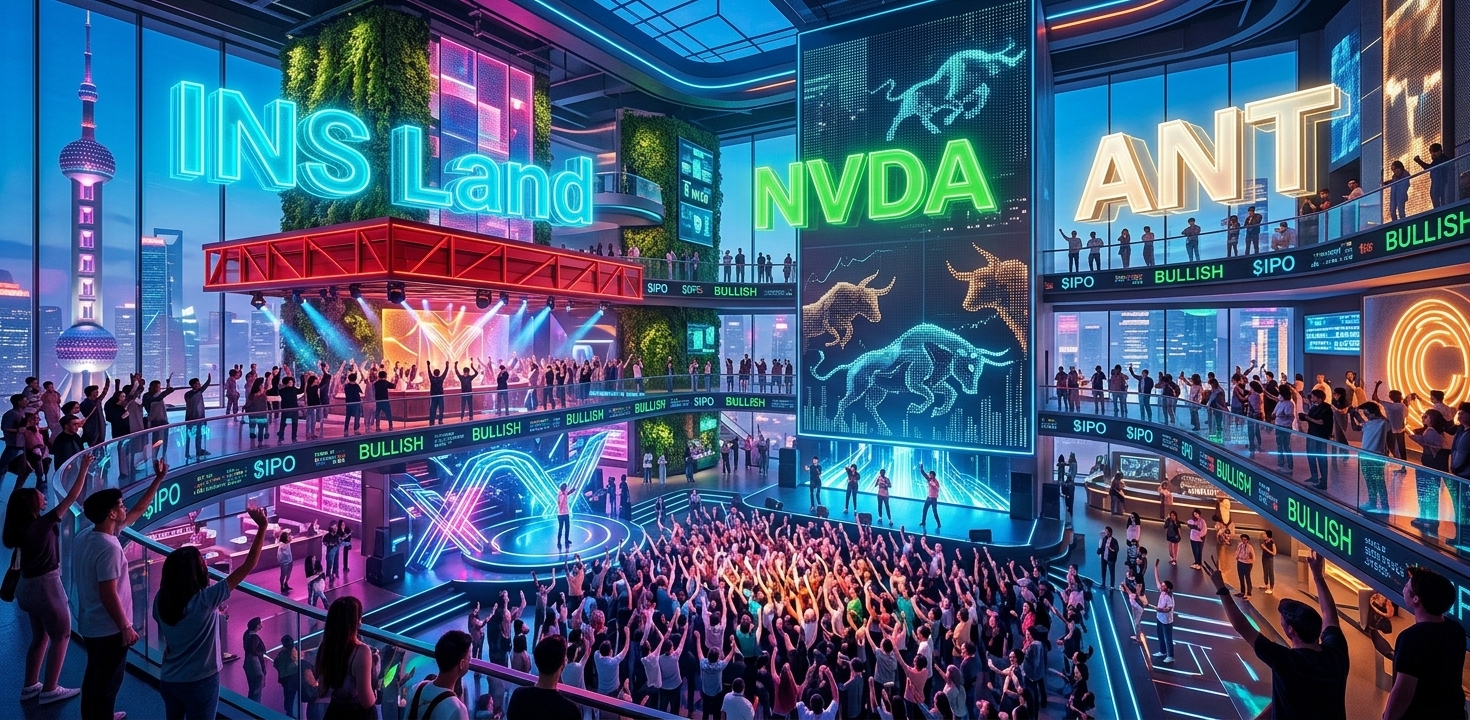
One of the more intriguing growth stories in China begins not with a semiconductor factory or an export terminal, but with a crowded dance floor. Shanghai’s INS Land brings together 20 venues, including nine clubs, in an entertainment complex inside Fuxing Park. Bloomberg’s October 29 feature describes a business bringing in $150 million a year, with live performances, celebrity appearances and an app that helps guests make connections on the spot. Its accompanying video presents a destination offering young adults an affordable night out against a difficult economic backdrop.For many watching global markets, the attraction is not simply that Shanghai still knows how to throw a party. It is that consumers appear willing to spend when a business assembles the right combination of variety, value and social relevance. The connection to NVIDIA (NASDAQ: NVDA) and Anthropic’s proposed initial public offering is thematic, not contractual. The cited reporting does not establish a commercial relationship between INS Land and either AI company. Instead, these businesses illuminate two complementary sources of demand: people paying for richer experiences, and companies paying for the computing power that makes increasingly capable digital services possible. The shared opportunity is engagement. Winning businesses give customers a reason to arrive, a reason to stay and, ideally, a reason to return before the accounting department notices how much fun everyone is having.
INS Land Turns a Night Out Into a Platform
INS Land’s appeal rests partly on its breadth. A single destination houses different music formats, live entertainment and social spaces, allowing guests to change the character of their evening without changing their address. Bloomberg describes an audience that includes Shanghai’s young nightlife crowd alongside occasional appearances by figures such as James Harden and Jackson Wang. The commercial logic is compelling. A conventional club makes a relatively narrow bet on a particular atmosphere and audience. A multi-venue destination can accommodate different tastes within the same group, reducing the likelihood that the evening ends because someone has declared the music a personal affront. That does not prove superior profitability. The available reporting does not provide the operating margins, capital requirements or venue-level returns needed to make that judgment. But it does identify a differentiated offering rather than another undistinguished claim on discretionary spending. INS Land has also gained recognition beyond its local market. An April announcement reported that the venue ranked No. 12 in DJ Mag’s 2026 Top 100 Clubs poll, first in China and third in Asia. The same announcement described plans for sister venues in major Asian cities. Those expansion ambitions remain plans, not established returns, but they suggest an effort to turn a successful destination into a repeatable concept. For many assessing consumer businesses, that distinction matters. A popular venue is an asset. A format that can travel may become a growth strategy.
Why the Experience Economy and AI Can Advance Together
The temptation is to describe physical entertainment and artificial intelligence as opposing forces: one pulls people away from screens, while the other makes screens more useful. A more constructive interpretation is that they compete for different parts of the same day. INS Land’s model addresses the desire for social connection and memorable experiences. Anthropic’s Claude addresses demand for increasingly capable digital assistance. Neither requires the other to fail. A person can use AI to finish a difficult assignment and still want somewhere interesting to go afterward. The bullish thesis is therefore not that every nightclub needs an AI valuation. It is that businesses capable of making time more productive or more enjoyable can remain attractive even when broad economic narratives turn gloomy. The distinction also imposes discipline. INS Land’s reported success is evidence about a particular entertainment concept, not proof that all Chinese discretionary spending has recovered. Likewise, rapid AI adoption does not guarantee attractive returns for every company attaching those two letters to a presentation.
NVIDIA Supplies the Infrastructure Behind the Digital Side
Unlike the thematic connection to Shanghai nightlife, NVIDIA’s relationship with Anthropic is direct and documented. In November 2025, Anthropic, Microsoft (NASDAQ: MSFT) and NVIDIA announced strategic partnerships that included a $30 billion Azure computing commitment from Anthropic and plans to contract additional capacity of up to one gigawatt. The announcement also outlined engineering collaboration intended to improve Anthropic model performance and efficiency on NVIDIA systems. NVIDIA and Microsoft (MSFT) committed to invest up to $10 billion and up to $5 billion, respectively, in Anthropic. Those were announced commitments, not a statement that every dollar had already been deployed. This relationship gives NVIDIA more than a distant association with a prominent AI developer. It places the company inside the infrastructure and optimization work required to deliver Claude at scale. Anthropic subsequently announced an agreement to use the computing capacity at the Colossus 1 data center, describing access to more than 300 megawatts of capacity and over 220,000 NVIDIA graphics processing units. That announcement provides another concrete example of Claude-related demand running on NVIDIA hardware. The scale of NVIDIA’s existing business gives the thesis a substantial foundation. In results furnished to the SEC, NVIDIA reported fiscal 2026 revenue of $215.9 billion, up 65%, and fourth-quarter revenue of $68.1 billion, up 73% from the prior year. These are historical results, not a forecast, but they demonstrate that the AI infrastructure opportunity has already produced significant commercial activity. For many seeking exposure to expanding AI usage, the attraction is straightforward: NVIDIA can participate in demand across numerous applications and infrastructure providers rather than depending on one consumer product becoming the permanent winner. The party can change venues. The computing bill still needs to be paid.
Anthropic’s IPO Brings the Application Layer Into Focus
Anthropic’s proposed IPO adds a new dimension to that infrastructure story. On October 26, 2026, Anthropic filed a registration statement on Form S-1 with the SEC for a proposed offering of Class A common stock. The company said it intends to list on the Nasdaq Global Select Market under the symbol ANT. Its announcement stated that the number of shares and proposed price range had not yet been determined, and that the registration statement had not yet become effective. ANT is therefore a proposed symbol, not an established trading ticker. That distinction is essential. Filing for an IPO is not the same as completing one, and enthusiasm for Claude cannot determine whether an eventual offering price represents good value. Still, the filing creates a potentially important public-market development: a route to evaluating a major AI application company alongside the listed businesses supplying its infrastructure. Anthropic had already announced a $30 billion Series G financing at a $380 billion post-money valuation in February 2026. The company said that round included part of the previously announced Microsoft and NVIDIA investments. That financing valuation is a historical private-market reference point, not a confirmed IPO valuation. The bullish opportunity is the possibility that growing demand for Claude supports an enduring software business while also sustaining demand for the hardware and cloud capacity beneath it. The analytical challenge is separating those two economic models. A model developer must convert usage into revenue while managing substantial operating costs. A chip supplier must maintain technological leadership, supply capacity and pricing power. Both may benefit from AI adoption, but their margins and risks do not move in lockstep.
The Strongest NVIDIA Thesis Does Not Require a Hardware Monopoly
Anthropic’s infrastructure strategy also provides an important qualification to the NVIDIA story. In April, Anthropic announced an expanded partnership with Google, part of Alphabet (NASDAQ: GOOGL, GOOG), and Broadcom (NASDAQ: AVGO) for multiple gigawatts of next-generation computing capacity. Anthropic said it trains and runs Claude on a range of hardware, including Amazon Web Services’ Trainium chips, Google tensor processing units and NVIDIA GPUs. Amazon Web Services is part of Amazon.com (NASDAQ: AMZN). For NVIDIA, this is both competition and evidence of the market’s breadth. The constructive case does not require NVIDIA to supply every calculation. It requires the company to retain a valuable position in a growing computing market, with systems that customers continue to choose for performance, flexibility and overall economics. Anthropic’s announced engineering partnership with NVIDIA supports that argument, while its use of alternative chips prevents the thesis from becoming complacent. For many, a diversified infrastructure approach may also make Anthropic’s growth story more credible. Matching workloads to different architectures can give the company more options as it expands. Whether those choices produce attractive financial returns will depend on the economics disclosed through the offering process and subsequent reporting.
Follow the Business Model, Not Just the Crowd
INS Land and the AI buildout invite the same useful question: what turns popularity into durable cash generation? At INS Land, the questions concern repeat visits, spending per guest, operating costs and the economics of expansion. Bloomberg’s $150 million annual-revenue framing establishes scale, but revenue alone does not answer those questions. For NVIDIA, the focus is whether expanding AI workloads continue to translate into profitable demand across its product portfolio. Its fiscal 2026 results establish a strong historical base, without removing the need to assess future competition and spending cycles.. For Anthropic, the IPO process should be judged on the relationship among revenue growth, computing requirements, financing needs and the eventual price of the shares. Its S-1 filing starts that public evaluation; it does not settle it. These are not objections to a bullish view. They are what distinguish a durable thesis from an expensive souvenir.
Two Growth Engines, One Constructive Market Perspective
Shanghai’s INS Land offers a reminder that consumers do not stop seeking enjoyment simply because the economic outlook becomes complicated. A well-designed destination can win attention by making a night out feel more varied, social and worthwhile. Bloomberg’s reporting and the venue’s international recognition point to a concept that has found an audience. NVIDIA and Anthropic represent the digital counterpart: infrastructure and applications designed to make computing more capable and useful. Their announced partnerships connect that ambition to actual capacity commitments, engineering work and financing. The bullish case is not that nightlife and AI share a balance sheet. It is that compelling experiences and useful technology can create their own demand rather than waiting patiently for a perfect economic forecast. For many looking beyond the next market headline, that is an appealing combination: businesses improving how people work, and businesses giving them a better reason to clock out.
The Sources
- Bloomberg: “China’s Hottest Night Club Is Bringing In $150 Million a Year,” October 29, 2026
- Bloomberg: “Inside Shanghai’s Changing Nightlife Scene,” October 30, 2026
- INS Land company announcement: “Shanghai’s INS Land Crowned China’s Best Club in DJ Mag’s Top 100,” April 15, 2026
- SEC.gov: Anthropic, PBC, Form S-1, filed October 26, 2026
- SEC.gov: Anthropic Form S-1 filing detail and document index
- Anthropic: “Anthropic Files S-1 With the SEC for Proposed Initial Public Offering,” October 26, 2026
- Anthropic: “Microsoft, NVIDIA, and Anthropic Announce Strategic Partnerships,” November 18, 2025
- Anthropic: “Higher Usage Limits for Claude and a Compute Deal With SpaceX,” May 6, 2026
- Anthropic: “Anthropic Expands Partnership With Google and Broadcom for Multiple Gigawatts of Next-Generation Compute,” April 6, 2026
- Anthropic: “Anthropic Raises $30 Billion in Series G Funding at $380 Billion Post-Money Valuation,” February 12, 2026
- SEC.gov: NVIDIA Announces Financial Results for Fourth Quarter and Fiscal 2026, February 25, 2026
Stay Updated with Vista Partners
Subscribe to receive market insights, investing ideas, and the latest updates directly in your inbox.