Wall Street Is Writing Checks for the Next Chapter of Medicine
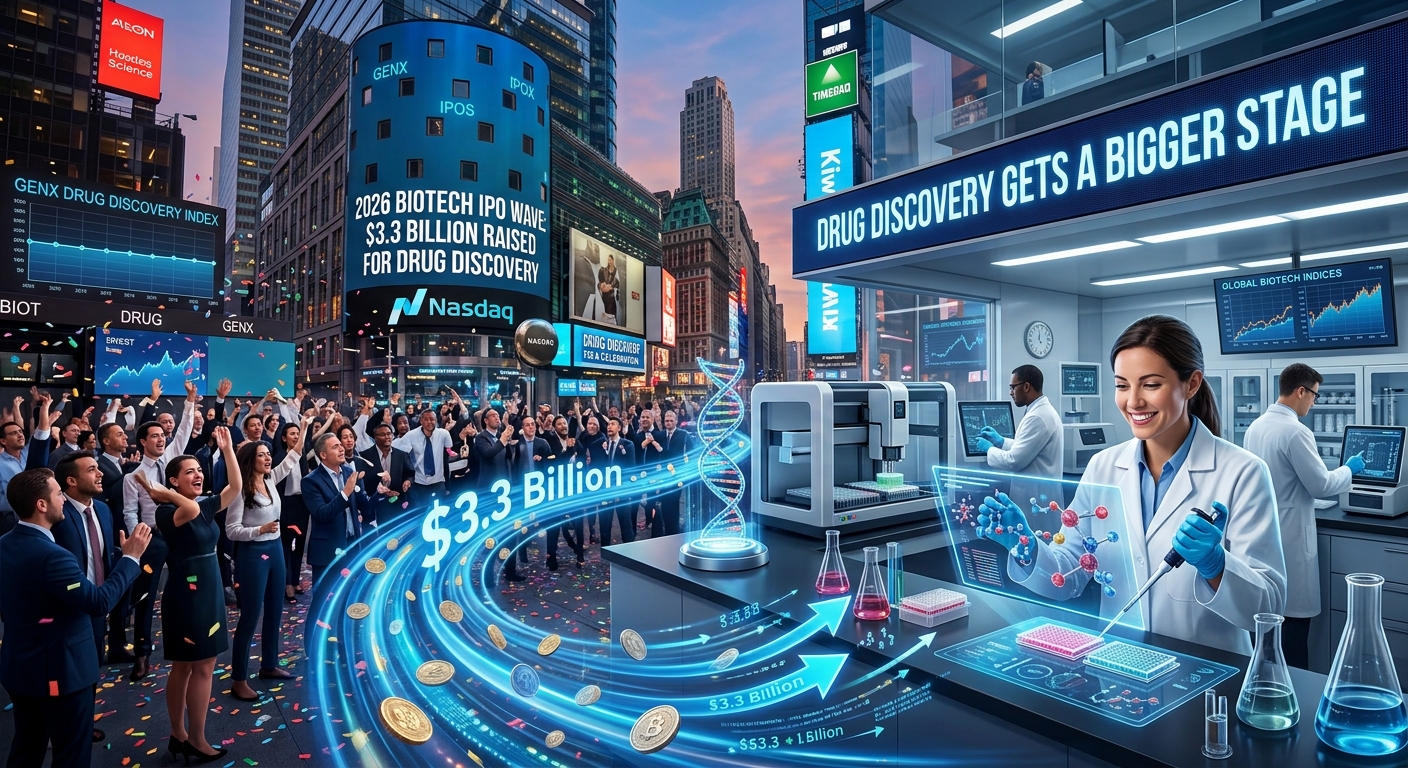
Biotechnology has found an effective way to get Wall Street’s attention in 2026: bring ambitious science, a credible development plan and an offering large enough to require a second look. Nine biotechnology companies account for approximately $3.3 billion in announced IPO proceeds. The group spans cancer, cardiovascular disease, pulmonary fibrosis, neuropsychiatry, sleep apnea and next-generation drug-design technologies. Several transactions expanded through additional share sales, underscoring the importance of distinguishing an offering’s opening announcement from its final closing figures. The bullish interpretation is not that every newly public biotechnology stock will become a winner. It is that substantial capital is reaching companies attempting to solve difficult medical problems, giving their development programs more room to produce the evidence that ultimately matters. In biotechnology, a promising molecule attracts attention. Enough cash to test it properly makes the conversation considerably more interesting.
The Biotech IPO Class of 2026 Has Breadth, Not Just One Fashionable Theme
The companies highlighted offer a useful cross-section of the market’s appetite:
- Parabilis Medicines (NASDAQ: PBLS): $770.5 million in gross IPO proceeds, including the full exercise of the underwriters’ option.
- Kardigan (NASDAQ: KARD): $460 million in gross IPO proceeds, reflecting 28.75 million shares sold at $16 each
- Braveheart Bio (NASDAQ: BRVE): approximately $439.9 million in gross IPO proceeds
- Generate Biomedicines (NASDAQ: GENB): $400 million in gross IPO proceeds.
- Avalyn Pharma (NASDAQ: AVLN): approximately $345 million in gross IPO proceeds, including the full exercise of the underwriters’ option
- Seaport Therapeutics (NASDAQ: SPTX): $260 million in gross IPO proceeds subsequently reported in its SEC-filed financial update, above the approximately $255 million shown in the graphic.
- Apnimed (NASDAQ: APMD): $220.8 million in gross IPO proceeds, including the full exercise of the underwriters’ option.
- City Therapeutics (NASDAQ: CTY): $230 million at closing, including the full exercise of the underwriters’ option, compared with the $200 million pricing figure in the graphic.
- Agomab Therapeutics (NASDAQ: AGMB): approximately $208 million in gross IPO proceeds, including a partial exercise of the underwriters’ option, compared with the initial $200 million offering.
These are financing figures, not company valuations, and gross proceeds precede underwriting discounts and other offering costs. Nor does this nine-company selection represent the entire biotechnology IPO market. It does, however, demonstrate that meaningful transactions have reached public markets across multiple therapeutic categories. For many, that breadth makes the story more compelling.
Parabilis Medicines Turns Difficult Biology Into a Substantial Financial Runway
Parabilis Medicines supplies the largest transaction in the group and one of its clearest examples of financing translating into development capacity. Its $770.5 million IPO was accompanied by a separate $75 million equity investment from Regeneron Pharmaceuticals (NASDAQ: REGN). The distinction matters: the private placement was additional financing, not part of the IPO headline. Parabilis is developing Helicons, stabilized helical peptides designed to address protein targets that conventional medicines have struggled to reach. Its lead investigational program, zolucatetide, targets the β-catenin:TCF interaction, a biologically important mechanism in its oncology development strategy. The company’s June 30 financial position helps explain the significance of its financing. Parabilis reported approximately $1.1 billion in cash, cash equivalents and marketable securities, with management expecting those resources to fund operations into 2030. That was a forecast made with its second-quarter results, not a guarantee of future spending or clinical success. There is also a strategic dimension. Its collaboration with Regeneron combines antibody technologies with the Helicon platform. Parabilis reported receiving $50 million in upfront consideration alongside the $75 million equity investment, with approximately $2.2 billion in additional potential milestone payments and potential royalties. Those milestones are contingent opportunities, not money already in the bank. The bullish case rests on the combination: a differentiated scientific approach, substantial funding and a major pharmaceutical collaborator. Any one of those can generate a headline. Together, they provide a more substantial foundation for execution.
Cardiovascular Biotechnology Commands Serious Capital
Kardigan and Braveheart Bio show that large offerings are not reserved for oncology or computational drug discovery. Kardigan’s IPO generated $460 million in gross proceeds and approximately $422.4 million in net proceeds. At June 30, the company reported $660.7 million in cash, cash equivalents and investments. Its business focuses on precision cardiovascular medicines intended to address underlying disease mechanisms. That financial base supports a development agenda with measurable clinical milestones. On November 6, Kardigan announced completion of enrollment in KATALYST-AV, its Phase 2b trial of ataciguat in people with aortic stenosis. Enrollment completion is not an efficacy result, but it is an operational step toward the evidence needed to evaluate the program. Braveheart Bio, meanwhile, raised approximately $439.9 million through its August IPO to support development of therapeutics for hypertrophic cardiomyopathy and other serious cardiovascular diseases. The company reported approximately $404.5 million in net IPO proceeds. The distinction between gross and net funding may lack the glamour of a breakthrough therapy, but laboratories do not pay their bills with headline proceeds. For many evaluating this group, the attraction is the pairing of focused disease strategies with meaningful development budgets. The next question is whether clinical results justify that financial confidence.
Generate Biomedicines Gives AI Drug Design a Public-Market Test
Generate Biomedicines brings a different proposition to the 2026 biotechnology IPO story. The company raised $400 million through the sale of 25 million shares at $16 each. Its platform integrates computational methods and experimental infrastructure to design protein therapeutics across different disease areas and protein modalities. Importantly, the story extends beyond a software platform. Generate’s IPO prospectus described a Phase 3 program in which the first patient had been dosed in January 2026, alongside plans to advance additional computationally generated oncology candidates into early clinical studies. That gives the AI-driven drug-discovery thesis a more demanding measuring stick. The relevant question is not merely whether an algorithm can propose an elegant molecule, but whether the resulting treatment can demonstrate safety, efficacy and useful differentiation in patients. Generate’s offering supplies capital to pursue that test. It does not settle the outcome. For many seeking exposure to the intersection of biotechnology and artificial intelligence, that distinction separates a development business from a technology slogan with a laboratory attached.
Better Delivery May Be as Valuable as a New Target
Not every promising biotechnology strategy requires discovering an entirely new biological mechanism. Sometimes the opportunity lies in getting an established therapeutic approach to the right place with fewer limitations. Avalyn Pharma raised approximately $345 million to support a business developing inhaled formulations of established antifibrotic medicines. Its approach aims to deliver treatment directly to the lungs, enhance local efficacy and reduce systemic side effects in pulmonary fibrosis and other serious respiratory diseases. These remain development objectives rather than established commercial outcomes. Seaport Therapeutics applies a related problem-solving mindset in neuropsychiatry. Its Glyph platform seeks to address limitations such as high first-pass metabolism, low bioavailability and side effects that have constrained otherwise promising drug mechanisms. Seaport’s second-quarter SEC-filed update reported $260 million in gross IPO proceeds and $427.3 million in cash, cash equivalents and investments at June 30. Management then expected that funding to support operations into 2029. Its pipeline included GlyphAllo in a potentially registration-enabling Phase 2b study for major depressive disorder. The commercial logic is appealing: improve the practical usefulness of a therapeutic mechanism, rather than asking the market to embrace biological novelty for its own sake. Medicine, like transportation, benefits when an impressive engine can actually reach its destination.
Apnimed Brings the Story Closer to a Regulatory Decision
Apnimed adds a later-stage dimension to the group. The company’s $220.8 million IPO supported a business developing oral therapies for sleep-related breathing diseases. Its lead program, AD109, is intended to address the neurobiology of obstructive sleep apnea. In a September SEC-filed update, Apnimed said the Food and Drug Administration had accepted the new drug application for AD109, with the proposed proprietary name Oxnimbi, and assigned a target action date of February 28, 2027. Acceptance of an application is not approval, but it places the program on a defined regulatory timetable. That timetable gives many a different framework from an early discovery-stage investment. The focus shifts toward the regulatory decision, the eventual product label if approved, and the company’s ability to move from development into commercialization. The opportunity is more concrete. So are the expectations.
City Therapeutics and Agomab Broaden the Opportunity Set
City Therapeutics illustrates both the market’s interest in RNA interference and the importance of following a transaction through closing. The company initially priced an approximately $200 million offering. Full exercise of the underwriters’ option increased final gross proceeds to $230 million. City is developing next-generation RNA interference therapeutics, giving the IPO group another distinct technology platform. Agomab adds a focus on fibro-inflammatory disease. Its first-half financial update reported approximately $208 million in gross IPO proceeds and €252 million in cash, cash equivalents and short-term cash investments at June 30. Management expected that financial position to support operations into the first half of 2029. The company subsequently announced positive Phase 1 results for AGMB-447 in patients with idiopathic pulmonary fibrosis. Early clinical findings do not establish the outcome of later trials, but the announcement shows how newly raised capital sits alongside an advancing clinical agenda. Together, these businesses reinforce the breadth of the financing story. Public-market funding is supporting multiple approaches to disease, not a single scientific fashion.
Why the Bullish Case Is About More Than IPO Proceeds
The strongest argument for this biotechnology cohort is not simply that the offerings were large. It is what the funding can make possible. Parabilis reported resources expected to support operations into 2030. Seaport projected funding into 2029. Agomab expected its cash position to extend into the first half of 2029. Those management estimates, issued with their respective financial updates, suggest room to pursue development milestones without making an immediate return to the capital markets the centerpiece of the business plan. That does not eliminate clinical risk, regulatory risk or future dilution. Kardigan’s quarterly filing, for example, explicitly describes an expectation of continued substantial losses as it advances research and development. Capital buys the opportunity to execute; it does not purchase a favorable trial result. Still, the distinction is economically important. A company funded to conduct meaningful studies has a different set of strategic options from one whose next financing overshadows its next experiment. For many, the central attraction of the 2026 biotech IPO class is therefore straightforward: substantial new capital is meeting differentiated science, identifiable development programs and, in several cases, multiyear financial runways. Wall Street has supplied the checks. The laboratories now have a better-funded chance to supply the evidence.
The Sources
- Goodwin: Parabilis Medicines’ $770.5 million IPO and $75 million concurrent private placement
- SEC.gov: Parabilis Medicines IPO pricing announcement and transaction terms
- SEC.gov: Parabilis Medicines second-quarter 2026 financial results and business update
- SEC.gov: Kardigan second-quarter 2026 Form 10-Q
- SEC.gov: Kardigan announces completion of enrollment in KATALYST-AV
- SEC.gov: Braveheart Bio second-quarter 2026 financial results and IPO details
- Goodwin: Generate Biomedicines’ $400 million IPO
- SEC.gov: Generate Biomedicines final IPO prospectus
- Goodwin: Avalyn Pharma’s $345 million IPO closing
- SEC.gov: Seaport Therapeutics second-quarter 2026 financial results and clinical progress
- Goodwin: Seaport Therapeutics IPO pricing and platform overview
- Goodwin: Apnimed’s $220.8 million IPO
- SEC.gov: Apnimed second-quarter 2026 results and regulatory update
- SEC.gov: Apnimed registration statement and AD109 development background
- City Therapeutics: Closing of $230 million IPO, including full exercise of the underwriters’ option
- SEC.gov: Agomab first-half 2026 financial results and financing details
- SEC.gov: Agomab announces Phase 1 results for AGMB-447 in idiopathic pulmonary fibrosis
Stay Updated with Vista Partners
Subscribe to receive market insights, investing ideas, and the latest updates directly in your inbox.