


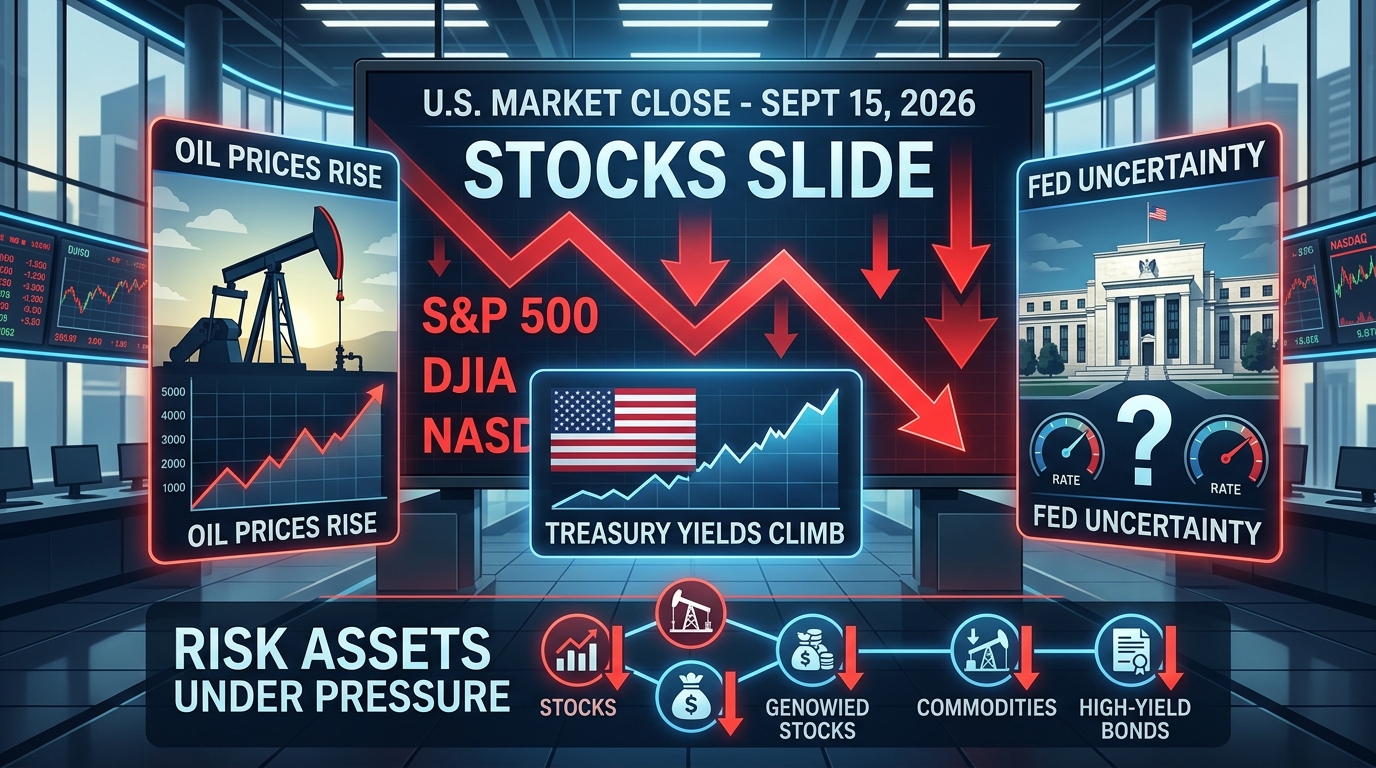
U.S. stocks closed broadly lower on Tuesday, September 15, 2026, as the 10-year Treasury yield’s move above 5%, elevated oil prices and anticipation of Wednesday’s Federal Reserve decision weighed on risk appetite. The selloff extended across blue chips, technology and small caps, while volatility ticked modestly higher and bitcoin fell sharply amid a U.S. crypto-policy setback.
Market At A Glance
| Index / Asset | Closing Level | Daily Change | Daily Performance |
|---|---|---|---|
| S&P 500 | 7,585.73 | -34.25 | -0.45% |
| Dow Jones Industrial Average | 52,093.11 | -328.09 | -0.63% |
| Nasdaq Composite | 25,981.57 | -204.84 | -0.78% |
| Russell 2000 | 2,870.29 | -21.95 | -0.76% |
| Cboe Volatility Index | 17.20 | +0.10 | +0.58% |
| Gold | $4,335.70 | -16.20 | -0.37% |
| Bitcoin | $75,767.91 | -$3,321.73 | -4.20% |
| Crude Oil, October 2026 Contract | $105.90 | +$4.51 | +4.45% |
The Nasdaq Composite’s 0.78% decline led the major equity benchmarks lower, while the Russell 2000 fell 0.76%, reinforcing the market’s concern that higher interest rates may weigh more heavily on smaller and more leveraged companies. The Dow Jones Industrial Average lost 328.09 points, or 0.63%, and the S&P 500 fell 0.45%. Crude oil’s 4.45% surge to $105.90 per barrel was the day’s most consequential cross-asset move. Rising energy prices can lift headline inflation, squeeze household purchasing power and complicate the Federal Reserve’s effort to return inflation to its 2% objective.
Why Stocks Possibly Fell Today
Tuesday’s weakness reflected a collision of three forces: higher long-term Treasury yields, an oil-driven inflation threat and the approach of the Federal Reserve’s interest-rate decision. The U.S. 10-year Treasury yield rose above 5% during the session, reaching its highest intraday level in roughly 19 years. That threshold is especially important for equity investors because Treasury yields influence borrowing costs, mortgage rates, corporate financing and the valuation framework applied to future corporate earnings. When yields rise sharply, investors often demand lower valuation multiples for growth-oriented and technology stocks. The Federal Reserve is scheduled to announce its policy decision Wednesday. Market participants have focused on whether policymakers will raise rates again, how officials characterize inflation risks and whether updated projections suggest a more extended period of restrictive monetary policy. At the same time, oil-market disruptions and geopolitical tensions elevated the risk of a renewed energy shock. Brent crude traded above $107 per barrel intraday and West Texas Intermediate crude exceeded $103 before the October crude contract closed at $105.90, up 4.45%.
Macro Commentary: The Fed’s Harder Trade-Off
New Census Bureau data showed that inflation-adjusted median household income rose 2.6% in 2025 to $87,460, while the official U.S. poverty rate fell to 10.2%. Those figures point to a consumer sector that entered 2026 with more resilience than many forecasters expected. However, markets are increasingly focused on the forward outlook rather than last year’s income gains. Inflation was reported at 3.4% year over year in August, above the Fed’s long-run target, while mortgage rates have moved above 7%. Higher energy costs could intensify those pressures by raising gasoline, transportation and input costs throughout the economy. The result is a more challenging policy environment:
- Strong consumer demand reduces the urgency for rapid rate cuts.
- Persistent inflation supports the case for keeping rates elevated.
- Higher oil prices increase the risk that headline inflation reaccelerates.
- Higher Treasury yields raise costs for households, businesses and the federal government.
- Equity markets must adjust to the possibility that capital remains expensive for longer.
For many, the crucial issue is not simply whether the Fed raises rates Wednesday. It is whether the central bank signals that inflation risks, especially from energy, require a prolonged restrictive stance.
Company, Sector And Crypto Focus
Select semiconductor and artificial-intelligence names showed relative resilience during parts of the trading session. NVIDIA Corporation (NASDAQ: NVDA) rose .57% to $212.17, while Advanced Micro Devices, Inc. (NASDAQ: AMD) gained roughly 2.19%. Micron Technology, Inc. (NASDAQ: MU) and Intel Corporation (NASDAQ: INTC) each climbed nearly 2% earlier in the session. Those moves underscore the market’s continued willingness to differentiate between macro-sensitive sectors and companies tied to AI infrastructure, advanced computing and semiconductor demand. However, sustained higher bond yields remain a broad valuation headwind for growth equities, including AI-linked stocks. Dave & Buster’s Entertainment, Inc. (NASDAQ: PLAY) came under pressure after reporting second-quarter results below expectations. The company posted revenue of $544.1 million, below the $556.8 million FactSet consensus estimate, adjusted EBITDA of $98.9 million versus expectations for $120.4 million, and an adjusted loss of 27 cents per share compared with consensus expectations for an 18-cent profit. Enova International, Inc. (NYSE: ENVA) also declined after it withdrew regulatory applications associated with its proposed acquisition of Grasshopper Bancorp, despite reaffirming guidance and accelerating its share-repurchase activity. Crypto-linked assets and equities were especially weak. Bitcoin closed at $75,767.91, down $3,321.73, or 4.20%, while the Senate blocked the CLARITY Act from advancing through a 50–49 procedural vote that fell short of the 60-vote threshold. Coinbase Global, Inc. (NASDAQ: COIN) fell 8% intraday and Circle Internet Group, Inc. (NYSE: CRCL) dropped 10%. The failed vote delays a proposed U.S. crypto-market-structure framework that would have assigned oversight responsibilities between the Securities and Exchange Commission and Commodity Futures Trading Commission. The immediate outcome is continued regulatory uncertainty for digital-asset exchanges, stablecoin-related businesses and the broader U.S. crypto ecosystem.
Geopolitics, Defense And Oil
The Congressional Budget Office estimated that the U.S. war with Iran had cost the Pentagon approximately $38.1 billion through August 1. The CBO estimated each additional month of fighting could add $2 billion to $3 billion in costs, with more than half of the spending associated with replacing expended missiles and other munitions. The report also warned that U.S. missile-defense interceptor inventories may have been reduced substantially, with replenishment potentially taking years even under increased production. That dynamic matters to markets because a prolonged conflict can influence defense budgets, global shipping, industrial supply chains and energy prices. For many, the most immediate consequence has been crude oil. The October crude contract’s 4.45% gain to $105.90 indicates that traders are assigning a higher risk premium to energy supply and transportation routes. If oil remains above $100 per barrel, investors will watch closely for its effect on inflation expectations, consumer spending and the Fed’s policy language.
What To Watch Wednesday
- Federal Reserve decision: The policy statement, economic projections and Chair Kevin Warsh’s press conference will determine whether markets view Tuesday’s pullback as a temporary repricing or the start of a more sustained higher-rates adjustment..
- Treasury yields: A durable move above 5% in the 10-year yield could pressure rate-sensitive sectors, including technology, utilities, real estate and small-cap companies.
- Crude oil: The October contract closed at $105.90, and continued gains could worsen inflation expectations and boost energy-sector leadership.
- Technology leadership: Investors will watch whether NVIDIA (NASDAQ: NVDA), AMD (NASDAQ: AMD), Micron (NASDAQ: MU) and Intel (NASDAQ: INTC) can retain relative strength as rates rise.
VP Watchlist Updates
Amwell® (NYSE: AMWL)
Amwell® (NYSE: AMWL), a leading provider of a comprehensive SaaS-based software platform for technology-enabled healthcare, closed at $13.67.
AMWL announced (Sept 8) announced the Department of Veterans Affairs (VA) has declared its intent for the Company to deploy its virtual health platform within the VA enterprise and help power the modernization of the VA’s digital health infrastructure. The VA anticipates the Amwell platform will support a broad range of clinical services, enhance care coordination, and improve access for our Veterans across the VA enterprise. The Letter of Intent follows a comprehensive evaluation process by the VA, in which it determined that Amwell’s virtual health platform aligns with the Department’s strategic objectives to expand access to high-quality, secure, and reliable virtual care services for Veterans nationwide through the VA’s current electronic health record modernization efforts. Specifically, the capabilities Amwell demonstrated in scalable video consultations, interoperability, cybersecurity compliance, and support for integrated care delivery were significant factors in this determination.
Amwell® has received Frost & Sullivan’s 2026 United States Technology Innovation Leadership Recognition in the Technology-Enabled Care Platforms Industry. The recognition validates Amwell’s ability to address healthcare fragmentation through a unified platform that orchestrates consumer experiences, clinician workflows, care programs, and partner solutions.
The Company also reiterated recently its objective to achieve positive cash flow from operations in the fourth quarter of 2026.
Serina Theraeuptics (NYSE : SER)
Serina Theraeuptics (NYSE : SER, $2.35) is a clinical-stage biotechnology company developing a pipeline of wholly owned drug product candidates to treat neurological diseases and other indications. Serina’s POZ PlatformTM provides the potential to improve the integrated efficacy and safety profile of multiple modalities including small molecules, RNA-based therapeutics and antibody-based drug conjugates (ADCs). Serina is headquartered in Huntsville, Alabama on the campus of the HudsonAlpha Institute of Biotechnology.
SER announced (Sept. 9) that the independent Safety Monitoring Committee (SMC) has completed its blinded review of Cohort 1 of the ongoing Phase 1b registrational study of SER-252 in patients with advanced Parkinson’s disease and recommended that the study advance to Cohort 2. Cohort 1 evaluated the lowest dose level in the single-ascending-dose portion of the study. In addition to supporting continued dose escalation, blinded Cohort 1 observations showed a pharmacokinetic profile consistent with the sustained apomorphine exposure SER-252 is designed to provide and included sustained periods of improvement in motor function in individual patients on exploratory clinical measures.
Hudson Pacific Properties (NYSE: HPP)
Hudson Pacific Properties (NYSE: HPP, $11.44) is a real estate investment trust serving dynamic tech and media tenants in global epicenters for these synergistic, converging and secular growth industries. Hudson Pacific’s unique and high-barrier tech and media focus leverages a full-service, end-to-end value creation platform forged through deep strategic relationships and niche expertise across identifying, acquiring, transforming and developing properties into world-class amenitized, collaborative and sustainable office and studio space. HPP turned in a quarter ( Aug. 5) that suggests the office malaise is not over, but it may finally be meeting resistance. Revenue came in above Wall Street’s expectations, occupancy moved higher for a fourth straight quarter, and management raised full-year guidance, a combination that does not make for a triumphant victory lap, but it does make for a more credible turnaround narrative. Learn more.
Eupraxia Pharmaceuticals Inc. (EPRX)
Eupraxia Pharmaceuticals Inc. (EPRX, $8.11, +.50%), a clinical-stage biotechnology company leveraging its proprietary Diffusphere™ technology designed to optimize local, controlled drug delivery for applications with significant unmet need, announced (Aug. 13) positive results from a new analysis of the RESOLVE study examining the effect of EP-104GI on symptom severity, including for the first time an analysis of the effect of EP-104GI on odynophagia (pain when swallowing). This is important because odynophagia scoring is a component of Dysphagia Symptom Questionnaire (DSQ), a commonly used patient reported outcome used in pivotal clinical trials in EoE patients.
Modular Medical, Inc. (NASDAQ: MODD)
Modular Medical, Inc. (NASDAQ: MODD, $2.41), a commercial-stage medical device company preparing for the commercial launch of its next-generation Pivot™ tubeless patch pump, announced (September 4) that it has secured a contract with a national U.S. pharmacy benefit manager (PBM) in the United States. Pursuant to the contract, the Company’s Pivot insulin delivery system is now available through the national PBM. The Company believes the engagement with this national PBM represents a significant step forward in broadening patient access to the Company’s Pivot tubeless patch pump and will further validate the Pivot pump as an accessible therapeutic option for people living with diabetes.
MODD announced (September 3) that the U.S. Food & Drug Administration (FDA) has cleared a set of software enhancements to its Pivot insulin delivery system, further expanding the system’s functionality and providing users with greater flexibility and customization options in bolus dosing, an enhanced user-interface (UI), and other software upgrades.
MODD CEO, Jeb Besser, co-hosted a Tribe Public’s CEO Presentation and Q&A Webinar Event titled “The Road To Revenue: Modular Medical’s Strategy For Launching Pivot,” that was held Friday, September 4, 2026 (8:30am PT / 11:30 am ET). You may watch the event video below now if you missed it below now.
MODD announced (Aug. 3) plans to initiate the first phase of commercialization of its Pivot tubeless patch pump across five strategically selected U.S. markets beginning in October 2026. The initial rollout will include Atlanta, Cincinnati/Lexington, Dallas, Houston, and Philadelphia, representing a foundational step in the Company’s capital efficient commercialization strategy with its mission to expand access to simplified insulin delivery solutions for all people living with diabetes.
MODD recently (July 22) announced the formation of its Pivot Innovation Council, a cross-functional group of leading clinicians and healthcare experts established to help guide the company’s clinical and commercial strategy. Diabetes care expert Robert Gabbay, MD, PhD, FACP was appointed as chair of the Pivot Innovation Council. The council will provide insights on target patient populations, support optimization of clinical workflows, inform evidence-generation initiatives, and help refine the Pivot product roadmap and go-to-market approach, as the Company continues to scale its differentiated offering.
Similarweb Ltd. (NYSE: SMWB)
Similarweb explores the many ways AI, apps, and other transformational forces are changing online shopping in its State of Ecommerce 2026 report, published on Sept 10. They reported that despite increasing more than 200% over the past year, direct referrals from dedicated AI platforms don’t produce a large volume of traffic to ecommerce marketplaces and online stores. In other words, compared with search, AI conversations don’t result in as much immediate click-through traffic. However, AI buying recommendations exert an outsize influence on purchases – in some cases, giving the recommended brand a 2-to-1 advantage over its competitors. Consumers are also making ChatGPT, Gemini, and other conversational AI tools a routine part of the buying process. However, that doesn’t mean they are abandoning search, 89% of the time, consumers who use AI in their shopping research also use search. “Consumers are not switching tools, they are stacking them,” said Daniel Reid, Principal Insight Analyst, Consumer Goods & Retail at Similarweb and the lead author of the report. “People are using AI to explore and narrow options while still turning to Search to move toward a decision. The most complex journeys, the ones that use both, convert the best. Retailers and brands who figure out how to master these new paths to product discovery stand to benefit.”
Similarweb Ltd. (NYSE: SMWB) and NIQ (NYSE: NIQ) have recently announced their planned Agentic Commerce Measurement solution aims to connect AI-based product discovery with consumer intent, traffic, conversion and verified sales outcomes. The first version is expected in the fourth quarter of 2026, initially across selected categories and markets. For many, the strategic appeal is simple: as AI becomes an increasingly consequential front door to commerce, the value may accrue not only to the companies building AI assistants, but also to the data-and-measurement providers that tell enterprises whether all that artificial intelligence is generating actual revenue, or merely very articulate window-shopping.
SMWB also recently delivered the sort of second-quarter report investors tend to enjoy: revenue and profitability exceeded guidance, full-year expectations moved higher, and AI demand translated into contracts rather than merely conference-call poetry. SMWB closed at $8.47. Learn More.
LG Display Co., Ltd. (LPL)
LG Display Co., Ltd. (NYSE: LPL, $3.08) has spent the last few years doing something many hardware companies talk about but few execute well: turning a technology pivot into a full‑blown business transformation that everyday investors can actually follow. Instead of chasing commoditized LCD TV panels in a race to the bottom, LPL is leaning into Gaming OLED, CES‑worthy innovation, and premium automotive displays – and the press trail tells a surprisingly investor‑friendly story.
Yatsen Group (NYSE: YSG)
Yatsen Group (NYSE: YSG, $2.56), a leading China-based beauty group, delivered the sort of quarter that can make a turnaround investor sit up straighter: reported revenue grew, its strategically important skincare operation accelerated sharply, and the company is increasingly built around clinical and premium brands rather than a pure color-cosmetics play. The results are not yet a victory lap, losses widened and third-quarter guidance is cautious, but YSG’s transformation is beginning to look less like a cosmetic touch-up and more like a genuine renovation.
YSG announced (July 8) a landmark collaboration to bring its flagship brand, Perfect Diary, to Sephora in China. This partnership integrates Yatsen’s rigorous scientific infrastructure with the world’s leading prestige beauty retailer, marking a significant milestone in Yatsen’s continuing evolution into a global beauty technology powerhouse.
Doximity, Inc. (NYSE:DOCS)
Doximity (NYSE: DOCS, $25.81) is the leading digital platform for U.S. medical professionals. The company’s network members include more than 85% of U.S. physicians across all specialties and practice areas. Doximity provides its verified clinical membership with digital tools built for medicine, enabling them to collaborate with colleagues, stay current on medical news and research, manage their careers and on-call schedules, streamline documentation and administrative paperwork, and conduct virtual patient visits.
Doximity, Inc. (NYSE: DOCS) announced (Aug. 6) results of its fiscal 2027 first quarter ended June 30, 2026. Jeff Tangney, co-founder and CEO of Doximity, “We’re proud that our clinical AI assistant, Doximity Ask, was the top-performing U.S.-based model in the NOHARM benchmark while we delivered another quarter of record engagement. In Q1 we had accelerated revenue growth along with workflow active prescriber growth of more than 30% year-over-year and AI Search query growth of over 25% quarter-over-quarter.”
Fiscal 2027 First Quarter Financial Highlights
All comparisons, unless otherwise noted, are to the three months ended June 30, 2025.
- Revenue: Revenue of $156.6 million, versus $145.9 million, an increase of 7% year-over-year.
- Net income and non-GAAP net income: Net income of $24.3 million, versus $53.3 million, representing a margin of 15.5%, versus 36.5%. Non-GAAP net income of $55.0 million, versus $71.9 million, representing a margin of 35.1%, versus 49.2%.
- Adjusted EBITDA: Adjusted EBITDA of $74.8 million, versus $79.8 million, a decrease of 6% year-over-year, representing adjusted EBITDA margins of 47.7%, versus 54.7%.
- Diluted net income per share and non-GAAP diluted net income per share: Diluted net income per share was $0.13, versus $0.27, while non-GAAP diluted net income per share was $0.29, versus $0.36.
- Operating cash flow and free cash flow: Operating cash flow of $42.0 million, versus $62.1 million, a decrease of 32% year-over-year, and free cash flow of $39.6 million, versus $60.1 million, a decrease of 34% year-over-year.
Financial Outlook
Doximity is providing guidance for its fiscal second quarter ending September 30, 2026 as follows:
- Revenue between $170 million and $171 million.
- Adjusted EBITDA between $80.5 million and $81.5 million.
Doximity is updating guidance for its fiscal year ending March 31, 2027 as follows:
- Revenue between $671 million and $681 million.
- Adjusted EBITDA between $309 million and $329 million.
Sable Offshore Corp. (SOC)
Sable Offshore Corp. (NYSE: SOC, $4.96, +2.90%) has moved from the awkward “pre-revenue restoration project” phase into something much more recognizable to Wall Street: a company selling meaningful volumes of oil, generating operating cash flow, and building momentum into a potentially larger 2027 earnings base. The second-quarter report on Monday was not a polished victory lap—midstream bottlenecks and one-time costs made sure of that—but it offered something potentially more valuable: proof that the Santa Ynez Unit restart is translating into barrels, revenue, and operational traction. Learn more.
T1 Energy Inc. (NYSE: TE)
T1 Energy Inc. (NYSE: TE, $4.30) offers a different type of growth story: one rooted in domestic production, trade-policy tailwinds and execution on solar manufacturing capacity. T1 announced (Aug. 27) that local officials in Mo i Rana, Norway, have rezoned a portion of the company’s Giga Arctic campus, allowing for the development of a data center. T1 is pursuing multiple pathways to monetize this brownfield facility as part of a value optimization initiative.
T1 recently reported second-quarter net sales of $250.1 million, produced 935 megawatts of solar modules at its G1_Dallas facility and generated adjusted EBITDA of $10.7 million. The company also monetized $39.1 million of 2025 Section 45X tax credits and ended the quarter with $156.4 million in cash, cash equivalents and restricted cash, including $79.1 million unrestricted. The headline loss should not be ignored: T1 reported a $36.9 million net loss from continuing operations, while its adjusted EBITDA benefited from $24.4 million in tariff refunds recognized in cost of sales. Yet the more interesting investor question is whether the company is creating a viable U.S. solar-manufacturing platform at a time when supply-chain security and domestic energy capacity carry unusually high strategic value. The company expects its first solar cells from a planned 2.1-gigawatt manufacturing facility in the first quarter of 2027. With 3 gigawatts of firm contracts, a 641-megawatt offtake agreement with Clearway and 2026 output expected toward the upper end of its 3.1-to-4.2-gigawatt range, T1’s story is increasingly about turning production capacity into contracted revenue. For investors, TE is less a conventional earnings multiple story than an execution-and-optionality story. If domestic solar demand remains durable and manufacturing milestones stay on schedule, the market may ultimately value the company less like a troubled commodity producer and more like a strategically positioned industrial platform.
Nvidia (NVDA, $212.17, +.57%)
NVDA announced plans (Sept. 3) to acquire open-AI platform Hugging Face for approximately $13 billion, with closing expected in 2027. The move reinforces NVIDIA’s effort to deepen its position across AI infrastructure, development tools, and the open-source AI ecosystem. Learn More.
Nvidia once again delivered (Wed., August 26) results that made Wall Street’s estimates look rather conservative. After the bell on Wednesday, NVIDIA, for its fiscal second quarter, the AI-chip leader reported adjusted earnings of $2.22 per share, ahead of the $2.10 consensus forecast, while revenue reached $96.22 billion, comfortably above expectations of $92.17 billion. The performance underscores Nvidia’s central role in the global AI buildout, where demand for its computing hardware continues to turn ambitious data-center plans into exceptionally large purchase orders. In short: the company remains one of the market’s preferred ways to bet on artificial intelligence, and, judging by the numbers, the machines are still very much hungry.
The Sources
- CNBC Stock Market Today: Dow falls as 10-year Treasury yield rises
- CNBC Iran war has cost the Pentagon $38 billion and depleted missile stockpiles, CBO says
- CNBC Americans’ incomes rose and poverty fell in 2025, Census Bureau says
- CNBC Senate cloture vote on CLARITY Act fails, dealing regulatory blow to crypto industry
- Yahoo Finance Stock Market Today: Dow, S&P 500 and Nasdaq fall after 10-year Treasury yield rises
- Reuters U.S. poverty rate dips to lowest on record, Census Bureau says
- U.S. Census Bureau Income in the United States: 2025
- U.S. Census Bureau Poverty in the United States: 2025
- U.S. Department of the Treasury Daily Treasury Par Yield Curve Rates
- Congressional Budget Office The Budget and Economic Outlook
Stay Updated with Vista Partners
Subscribe to receive market insights, investing ideas, and the latest updates directly in your inbox.
Hudson Pacific’s Office Turnaround Picks Up Speed -( $HPP )