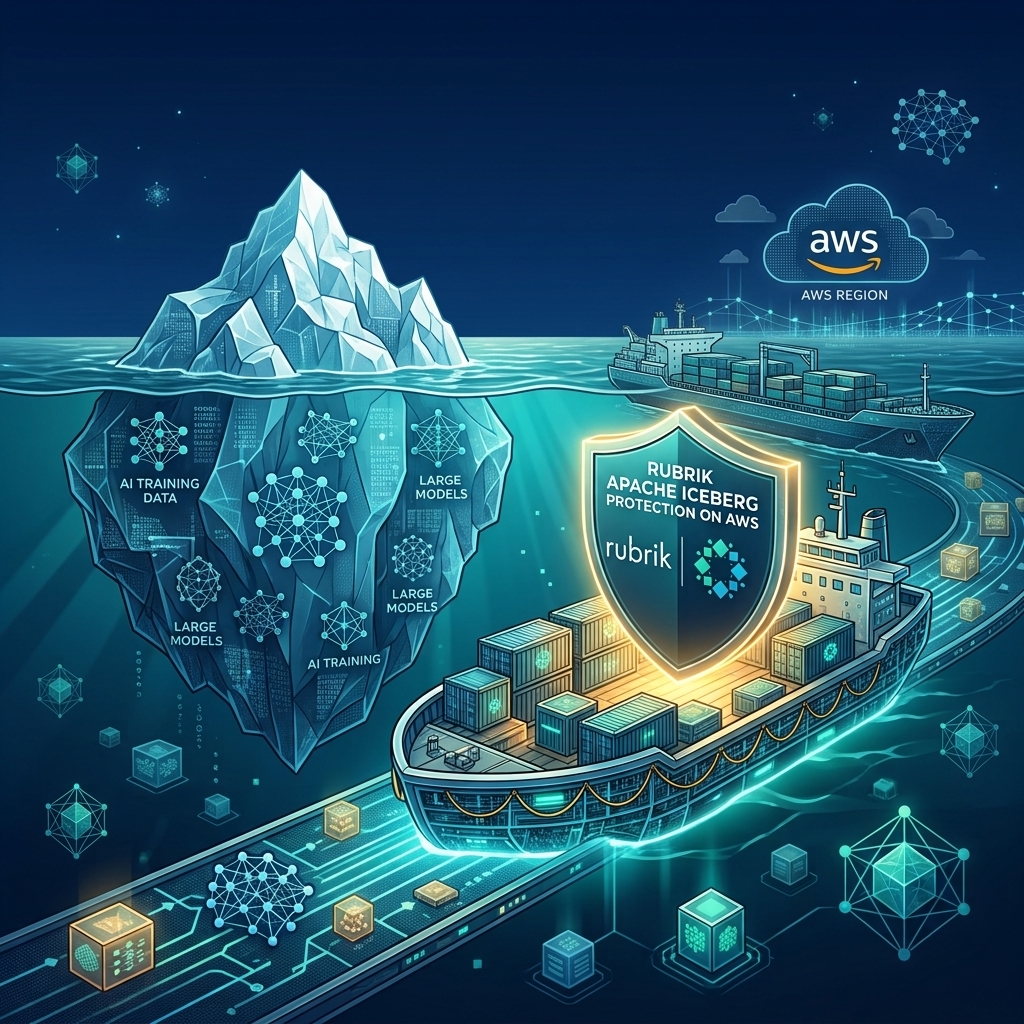
Rubrik, Inc. (NYSE: RBRK) is extending its cyber-resilience play deeper into the data infrastructure that powers enterprise AI. Its newly announced Apache Iceberg Protection for Amazon Web Services could matter because modern companies do not merely store data in cloud lakehouses, they increasingly ask AI agents to read it, reshape it and, on an occasionally adventurous day, overwrite it. The offering is designed to restore not simply raw files, but complete and immediately queryable Apache Iceberg tables after a cyberattack, accidental deletion or faulty AI-driven operation. For many, the more compelling point is strategic: Rubrik is positioning itself where cybersecurity, cloud-data operations, enterprise AI and recovery assurance increasingly meet.
The New Cybersecurity Problem: AI Can Be Productive and Occasionally Overconfident
Apache Iceberg has become an important open table format for cloud data lakehouses, supporting data environments that can be queried through tools including Amazon Athena, Apache Spark and Trino. AWS itself positions Iceberg as a foundation for lakehouse architectures that combine batch and near-real-time workloads. That flexibility comes with a practical catch. Iceberg creates snapshots, point-in-time versions of tables, which can support rollback and time-travel capabilities. Yet snapshots and the table metadata layer are not identical to an independent, immutable recovery system. If underlying data, metadata or catalog references are damaged, deleted or compromised, the work of returning a business-critical table to service can become far more complicated than merely locating a few Parquet files and wishing them well. This is where Rubrik (RBRK) sees an opening. The company’s Apache Iceberg Protection backs up both an Iceberg table’s data and the metadata that tells systems how to interpret it. Upon recovery, Rubrik says it can re-register the table in the catalog, allowing it to return as a queryable asset rather than a box of digital spare parts awaiting manual assembly. That may sound like a detail for data engineers. In the AI era, details have an alarming habit of becoming budgets.
Rubrik Protects the Lakehouse, Not Just the Files
Rubrik’s announcement addresses a meaningful operational gap: recovering the data files alone may not restore the structure and metadata needed to make a table immediately usable. The company says its Iceberg-aware recovery is intended to bring back complete tables that can be queried through Amazon Athena, Apache Spark or Trino, rather than requiring teams to reconstruct metadata and catalog connections manually. The product initially supports Iceberg tables in:
- AWS Glue Data Catalog
- Amazon S3 Tables
- Query environments including Amazon Athena, Apache Spark and Trino
Rubrik also says customers can store immutable backups in their own AWS accounts or use the company’s air-gapped Rubrik Cloud Vault. That in-account option is particularly relevant to enterprises that want tighter control over data residency, governance and recovery architecture, three phrases that may not light up a cocktail party, but tend to become extremely popular after a ransomware event. For companies operating at petabyte scale, Rubrik says its “forever-incremental” approach captures only the latest compacted snapshots after the initial protection process. It also allows customers to choose Amazon S3 storage classes, an important economic consideration when backup data is large, necessary and, ideally, rarely needed.
Why the AI Boom Raises Rubrik’s Strategic Value
The market’s attention has understandably focused on AI models, GPUs and agentic software. But enterprise AI ultimately depends on whether corporate data is accessible, governed, accurate and recoverable. OpenAI is pushing enterprise AI agents toward direct integration with systems of record. Its Frontier platform describes security, identity controls and scoped agent permissions as central components of deploying production-ready AI agents across business workflows. The implication is clear: as more AI agents are trusted with real enterprise systems, the consequences of bad permissions, flawed automation and erroneous changes become more tangible. That is useful context for Rubrik’s Iceberg launch. A rogue or poorly governed agent does not need malicious intent to create a recovery event; an inaccurate schema change, bad batch write or mass deletion can achieve similar results with considerably less drama and almost as much paperwork. Rubrik’s capability to create an on-demand backup before a high-risk operation, recover to an isolated Iceberg branch, validate the data and schema, and then promote the table to production speaks directly to that emerging AI-operations reality. In other words, the AI economy needs more than brilliant models. It needs an adult in the data room.
NVIDIA’s AI Infrastructure Tailwind Extends Beyond Chips
NVIDIA Corporation (NASDAQ: NVDA) remains the best-known beneficiary of enterprise AI investment, but its own AI Data Platform vision underscores why resilient data infrastructure is becoming part of the larger AI spending cycle. NVIDIA describes its AI Data Platform as a reference design that combines accelerated computing, enterprise storage and AI software to improve data handling, retrieval and security for AI agents and retrieval-augmented generation workloads. This matters for Rubrik because AI infrastructure is not a one-company story. NVIDIA supplies much of the accelerated computing foundation; cloud providers such as Amazon.com, Inc. (NASDAQ: AMZN) provide the elastic infrastructure and services; OpenAI and other model developers advance enterprise AI capabilities; and cyber-resilience vendors such as Rubrik seek to ensure that the valuable data feeding those systems can survive an attack, error or agentic mishap. The takeaway is not that Rubrik will become a GPU company, there are already enough people wearing leather jackets at that table. Rather, it is that the AI buildout is expanding the addressable need for data governance, identity security, immutability and recovery.
The AWS Relationship Gives the Story More Weight
Rubrik’s Iceberg Protection is being launched on AWS, where enterprise data estates increasingly include cloud-native databases, object storage, analytics pipelines, SaaS applications and AI services. The company previously announced a strategic collaboration agreement with AWS aimed at expanding cyber resilience on AWS and supporting secure AI adoption, including use cases connected to Amazon Bedrock. The new Iceberg capability advances that relationship from broad cloud-data protection into a more specialized and potentially valuable part of the data stack: the lakehouse table layer. That matters because the technology market is shifting from protecting endpoints and servers alone toward protecting the business context embedded in data. In a lakehouse, the data is valuable, but the surrounding metadata, catalog entries, permissions, pipelines and queryability are what make it operationally useful. Recovering only the files can be like saving every page of a novel but losing the order, chapter headings and the last 30 pages. Technically encouraging; commercially inconvenient.
Rubrik’s Growth Profile Strengthens the Bull Case
The Iceberg announcement arrives while Rubrik’s operating metrics continue to show momentum. The company reported $1.66 billion in subscription ARR as of July 31, 2026, with average subscription dollar-based net retention above 119% and 3,084 customers contributing at least $100,000 in subscription ARR. For its fiscal second quarter of 2027, Rubrik reported:
| Metric | Reported result |
|---|---|
| Subscription ARR | $1.66 billion |
| Subscription ARR growth | 33% year over year |
| Subscription revenue | $407 million |
| Subscription revenue growth | 37% year over year |
| Cloud ARR | $1.48 billion |
| Cloud ARR growth | 39% year over year |
| Cloud ARR as share of subscription ARR | 89% |
| Full-year subscription ARR outlook | $1.88 billion to $1.885 billion |
Those figures do not guarantee future returns, and investors should never confuse a product release with a quarter of revenue. Still, they help explain why the launch deserves attention. Rubrik is not presenting a standalone feature from a company waiting for its first customer; it is layering a new AI-era data-protection capability onto a subscription business already reporting rapid cloud and ARR growth.
A Thesis: Resilience May Become an AI Budget Line
The bullish case for RBRK rests on a simple premise: the faster enterprises operationalize AI, the more valuable reliable, recoverable and governed data becomes. Rubrik’s Apache Iceberg Protection could strengthen its position in several ways:
- It broadens Rubrik’s relevance from traditional backup and cyber recovery into cloud lakehouse and AI-data operations.
- It addresses a technical problem with business consequences: restoring complete queryable tables rather than only underlying storage files.
- It supports enterprise demands for immutable backups, data sovereignty and validation before risky schema or batch changes reach production.
- It aligns with the expansion of AI infrastructure across NVIDIA (NVDA), Amazon (AMZN), enterprise cloud environments and agentic platforms associated with organizations such as OpenAI.
- It creates another potential land-and-expand conversation within Rubrik’s installed base as customers modernize analytics and AI workloads.
Rubrik says Apache Iceberg Protection is expected to become generally available later this month. As with any new offering, investors will want to monitor adoption, customer traction, pricing, competitive responses and whether the capability translates into larger platform deals or stronger retention.
Bottom Line
Rubrik’s Apache Iceberg launch is a timely bet that the most valuable part of enterprise AI may not be the model alone, but the trusted data beneath it. With AI agents moving closer to systems of record, companies need a credible answer to an uncomfortable question: What happens when a cyberattack, bad delete, flawed batch operation or overly enthusiastic software agent turns a mission-critical lakehouse table into an archaeological dig? Rubrik’s answer is to recover the table, its metadata and its queryability, not simply the debris. For Rubrik (NYSE: RBRK), that is a strategically sensible extension of its cyber-resilience platform. For investors watching the broader AI ecosystem, spanning NVIDIA (NASDAQ: NVDA), Amazon.com (NASDAQ: AMZN) and OpenAI’s enterprise-agent ambitions, it is a reminder that every AI gold rush eventually requires sturdy vaults, careful recordkeeping and someone responsible for the keys.
The Sources
- Rubrik Launches Lakehouse Protection with Apache Iceberg Data on AWS Yahoo Finance
- Rubrik Launches Apache Iceberg Data Protection on AWS Investing.com
- Rubrik Extends Data Protection to Apache Iceberg Tables on AWS SiliconANGLE
- Rubrik Launches Iceberg Protection for AWS Lakehouses Security Brief Australia
- Rubrik Investor Relations Company Overview
- Rubrik, Inc. (RBRK) Q2 FY2027 Earnings Call Transcript Yahoo Finance
- Rubrik Q2 FY2027 Earnings Call Transcript The Globe and Mail
- Using Apache Iceberg on AWS AWS Prescriptive Guidance
- Apache Iceberg Maintenance and Snapshots Documentation
- Monitoring Apache Iceberg Metadata on AWS Using AWS Lambda, Glue and CloudWatch AWS Big Data Blog
- Rubrik Signs Strategic Collaboration Agreement With AWS Rubrik
- NVIDIA AI Data Platform for Enterprise Infrastructure NVIDIA Corporation (NASDAQ: NVDA)
- NVIDIA AI Enterprise and AI Factory Infrastructure NVIDIA Corporation (NASDAQ: NVDA)
- OpenAI Frontier: Enterprise Platform for Secure AI Agents OpenAI
Disclosure: This article is for informational purposes only and should not be construed as investment advice, a recommendation, or an offer to buy or sell any security. Market data are subject to revision, and investors should conduct independent due diligence before making investment decisions. Investments may involve substantial risk, including the potential loss of the entire investment. Investors should conduct independent due diligence and consider their individual objectives and risk tolerance. See The Complete Disclosure via this link & at the top of the page.
Stay Updated with Vista Partners
Subscribe to receive market insights, investing ideas, and the latest updates directly in your inbox.