The market’s most investable theme today is not simply artificial intelligence, healthcare or macroeconomics in isolation. It is possibly the increasingly visible convergence of all three: businesses finding ways to monetize AI, healthcare platforms turning operational discipline into financial leverage, and policymakers framing growth, not austerity, as the preferred route through an uncomfortable global debt overhang. For many, this is a constructive setup. It does not eliminate risks, markets have never been so obliging, but it does seemingly offer a clearer map of where revenue, productivity and capital spending may be headed next.
OpenAI’s Ad Break Is Really a Monetization Milestone
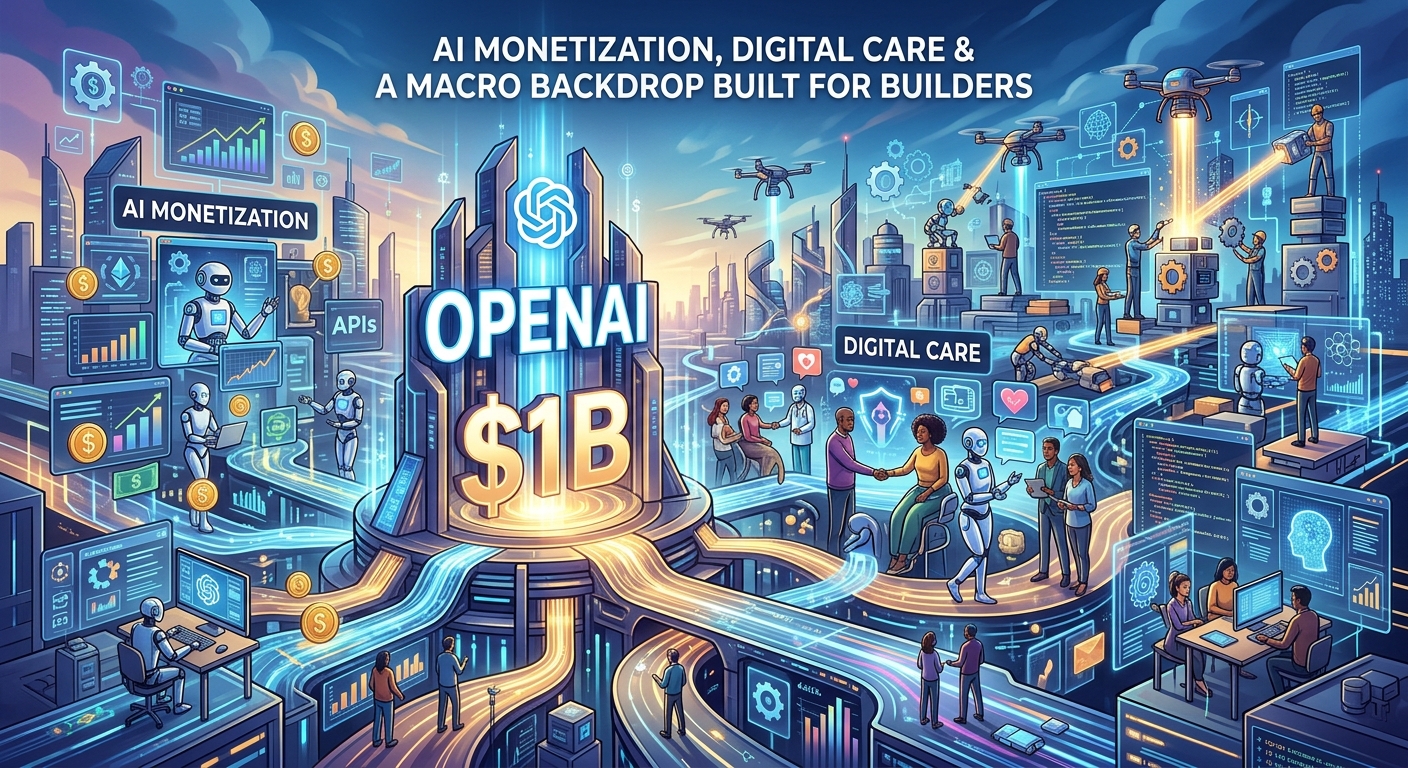
OpenAI’s reported $1 billion annualized advertising-revenue run rate is an important proof point for the commercial future of generative AI and possibly for its upcoming IPO. The company said its advertising business reached that mark roughly 200 days after launch, with ChatGPT Ads now available in more than 40 countries and self-service expansion beginning across India, Europe, the Middle East and North Africa. The larger message is that AI’s enormous user base is becoming economically actionable. OpenAI says ChatGPT has 1 billion weekly active users, with ads aimed primarily at the free tier and Go subscribers. That makes the platform less like an experimental software tool and more like a new digital distribution channel, one that has begun to resemble search, social media and app-store discovery, albeit with a conversational interface and a much more demanding expectation of relevance. OpenAI again remains private, so there is no public equity ticker attached to the company itself. But the development is meaningful for the listed firms supplying the compute, advertising infrastructure and enterprise plumbing of the AI economy:
| Public company | Ticker | Why investors may care |
|---|---|---|
| NVIDIA Corp. | NASDAQ: NVDA | Sustained AI product expansion strengthens the case for continued demand for accelerated computing and data-center infrastructure. |
| Microsoft Corp. | NASDAQ: MSFT | Microsoft’s strategic partnership with OpenAI makes broad ChatGPT commercialization relevant to Azure consumption, enterprise AI adoption and software distribution. |
| Alphabet Inc. | NASDAQ: GOOGL | Conversational advertising validates the opportunity while intensifying the competitive challenge to traditional search monetization. |
| Meta Platforms Inc. | NASDAQ: META | OpenAI’s progress underscores the strategic value of AI-led ad targeting, measurement and new ad formats, areas Meta already operates at global scale. |
| The Trade Desk Inc. | NASDAQ: TTD | A growing market for performance-oriented AI advertising could expand the long-term addressable market for independent ad-tech and measurement platforms. |
| Amazon.com Inc. | NASDAQ: AMZN | The rise of intent-rich AI interfaces reinforces the value of commerce media, cloud capacity and AI-enabled customer engagement. |
There is a sophisticated irony here: for years, the technology industry debated whether advertising would spoil the purity of AI assistants. Wall Street, with its customary lack of sentimentality about purity, is likely to view the development differently. A scalable product with a billion weekly users and multiple monetization paths is not a philosophical problem; it is a revenue model with excellent posture. OpenAI says advertisements are clearly labeled, do not influence chatbot answers and do not provide advertisers with access to private conversations. Those safeguards will be vital. If conversational AI is to become a trusted commercial venue rather than a particularly articulate billboard, user confidence must remain part of the product.
The G20’s Growth Doctrine Supports Risk Assets
At the G20 finance ministers and central bank governors meeting in Asheville, Federal Reserve Chair Kevin Warsh described the current environment as a period of “secular growth” and a global investment surge, with artificial intelligence helping direct capital toward business expansion. Treasury Secretary Scott Bessent struck a similar note, arguing that growth is the practical way through the world’s post-financial-crisis and post-pandemic debt burden. He acknowledged a U.S. debt load of about $40 trillion and the prospect of a $2 trillion fiscal 2026 deficit, but emphasized an economic strategy centered on expanding real incomes and productive capacity. For manys, the significance is straightforward: an official emphasis on investment, productivity and growth can provide a more favorable backdrop for companies funding infrastructure, deploying automation and expanding high-value services. The G20 also brought a notable private-sector guest list. Executives from Goldman Sachs Group Inc. (NYSE: GS), JPMorgan Chase & Co. (NYSE: JPM), Truist Financial Corp. (NYSE: TFC), Eli Lilly and Co. (NYSE: LLY), Deere & Co. (NYSE: DE), Medtronic plc (NYSE: MDT) and 3M Co. (NYSE: MMM) attended, according to CNBC. That attendance matters symbolically as well as practically. It suggests policymakers increasingly view executives not merely as people who complain about regulation at conferences, but as essential participants in deploying the capital needed for an investment-led expansion.
The beneficiaries can span several sectors:
- AI infrastructure: NVIDIA (NASDAQ: NVDA), Microsoft (NASDAQ: MSFT), Amazon (NASDAQ: AMZN) and Alphabet (NASDAQ: GOOGL) remain central to the buildout of computing capacity and AI services.
- Healthcare innovation: Eli Lilly (NYSE: LLY) and Medtronic (NYSE: MDT) represent the high-value therapeutic and medical-technology side of a broader healthcare modernization cycle.
- Industrial productivity: Deere (NYSE: DE) can benefit when automation, precision technology and capital investment become economic priorities rather than merely PowerPoint adjectives.
- Financial intermediation: JPMorgan (NYSE: JPM), Goldman Sachs (NYSE: GS) and Truist (NYSE: TFC) stand to participate if corporate investment, capital markets activity and credit formation remain resilient.
Bonds Are Still the Adult Supervision
The macro story is constructive, but the bond market remains the market’s chief compliance officer, stern, observant and rarely impressed by anyone’s slide deck. Bessent defended the administration’s bond-market intervention and accelerated Treasury debt repurchases, arguing that U.S. bonds have been the best-performing bond market since the president took office and that yields had been broadly flat in that period. His comments responded to criticism from Stanley Druckenmiller, who argued that liquidity tools cannot permanently solve a solvency challenge and may postpone, rather than resolve, the underlying fiscal conversation. Both arguments deserve investor attention. The bullish interpretation is that Treasury officials are focused on liquidity, market function and avoiding disorderly yield spikes that could disrupt housing, corporate financing and broader risk appetite. Lower or stable long-term yields can support equity valuations and reduce financing costs for capital-intensive sectors from AI data centers to hospitals and industrial manufacturers. The caution is equally clear: fiscal deficits, inflation persistence and heavy government borrowing can keep upward pressure on yields. Fed Chair Warsh recently indicated that further progress on inflation may be necessary, while suggesting higher interest rates could be required if inflation does not return convincingly toward the Fed’s 2% target. For many, the takeaway is not to fear every tick in Treasury yields. It is to own companies capable of producing earnings growth that does not depend entirely on rate cuts arriving on a white horse. The strongest franchises can grow through a higher-for-longer world; everyone else may discover that “adjusted” is not a synonym for “immune.”
Amwell’s Turnaround Gains Clinical and Financial Shape
Amwell Inc. (NYSE: AMWL) offers a more company-specific example of the market’s current preference for measurable operational improvement over broad digital-health promises. The telehealth and healthcare-platform company reported second-quarter 2026 revenue of $52.0 million, at the top end of its prior guidance range. Subscription revenue reached $25.7 million, Amwell Medical Group visit revenue was $24.4 million, gross margin was 53%, and total platform visits were approximately 0.8 million. More important for the investment thesis, the company continued narrowing losses. Net loss improved to $9.6 million from $10.3 million in the prior quarter, while adjusted EBITDA improved to a loss of $1.2 million from a $3.1 million loss in the first quarter. Amwell also raised the low end of its 2026 revenue outlook to $200 million–$205 million, improved its adjusted EBITDA outlook to a loss of $7 million–$9 million from its prior loss range of $12 million–$16 million, and reiterated its objective of achieving positive operating cash flow in the fourth quarter of 2026. The balance sheet provides additional strategic flexibility: Amwell reported $195.9 million in cash and cash equivalents as of June 30, 2026, with total liabilities of $92.9 million. The bullish case for AMWL rests on four connected points:
- Recurring mix is improving. Subscription revenue approaching half of total revenue can make the business more durable and potentially more scalable than a model driven primarily by episodic virtual visits.
- Margins are showing progress. A 53% gross margin and sharply improved adjusted EBITDA indicate that management’s cost and operating initiatives are beginning to register in the numbers.
- The Defense Health Agency opportunity matters. Management characterized the DHA’s intent to make Amwell a prime contractor as a strong endorsement of its platform. The relationship also carries execution and renewal risk, so investors should track contract terms, deployment progress and revenue contribution closely.
- AI-powered care is a credible strategic angle, but must become a commercial one. Amwell’s opportunity lies in applying AI to care navigation, clinical workflows, behavioral health and patient access while preserving the compliance, trust and integration standards healthcare demands. The company is not yet profitable, and telehealth remains highly competitive and regulated. Still, the investment setup has improved from “show us the dream” to “show us the cash flow,” which is usually where more serious institutional attention begins.
The Bullish Through Line
Today’s market story is increasingly about monetizable intelligence. OpenAI’s advertising milestone suggests that generative AI can become a substantial commercial platform, not merely an expensive technological marvel. The G20 discussion reinforces an investment-led economic narrative in which AI, industrial modernization and healthcare innovation are treated as engines of productivity. And Amwell’s results show how a digital-health company can become more investable when recurring revenue, cost discipline and cash-flow targets start moving in the right direction The common denominator is execution. Many should watch whether:
- OpenAI’s advertising expansion accelerates the strategic urgency around AI monetization for MSFT, GOOGL, META, AMZN, NVDA and TTD.
- Treasury yields remain orderly enough to support long-duration growth equities and capital-intensive infrastructure investment.
- Corporate spending translates the G20’s growth rhetoric into actual orders for DE, LLY, MDT, JPM, GS, TFCand other publicly traded leaders.
- Amwell (NYSE: AMWL) delivers on its fourth-quarter positive operating cash-flow objective and converts its platform momentum into durable recurring growth.
The optimistic conclusion is not that risk has left the building. It has merely been asked to sit quietly in the lobby while growth, monetization and operational leverage take the meeting upstairs.
The Sources
- CNBC OpenAI’s ad business hits $1 billion annualized revenue run rate
- CNBC G20 meeting live updates: Bessent and Warsh open summit with growth-focused remarks
- CNBC Bessent pushes back on Druckenmiller’s critique of bond-market intervention
- Yahoo Finance Amwell Announces Results for the Second Quarter 2026
Disclosure: This article is for informational purposes only and is not investment advice, a recommendation or an offer to buy or sell any security. Investors should conduct independent research and consider their own financial circumstances before making investment decisions.
Stay Updated with Vista Partners
Subscribe to receive market insights, investing ideas, and the latest updates directly in your inbox.