


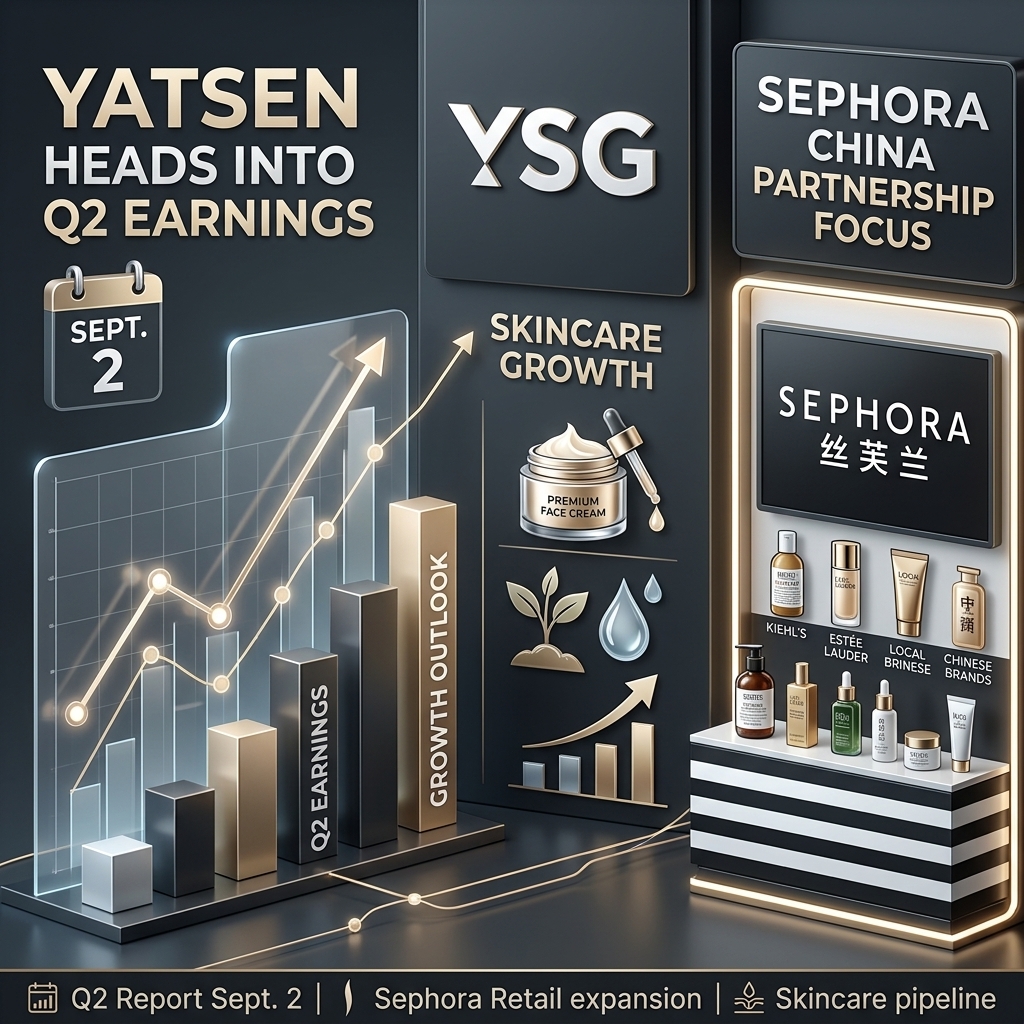
Yatsen Holding Limited (NYSE: YSG) is approaching a consequential earnings date with a more compelling narrative than the market may be pricing in: a China beauty platform shifting from online color-cosmetics challenger to science-led, premium omnichannel operator. Its partnership to place Perfect Diary in Sephora China’s network adds distribution credibility, while a fast-growing skincare business gives investors a measurable reason to watch the company’s second-quarter report on September 2. The beauty business has never been shy about selling aspiration. Yatsen’s current opportunity is more concrete: turn research spending, prestige distribution, and a broader brand portfolio into durable revenue growth, and eventually, into profits that require less concealer.
The Thesis
Yatsen, traded in the U.S. under YSG, owns and operates a collection of Chinese and international beauty brands spanning mass-market color cosmetics, premium skincare and clinical-oriented products. The portfolio includes Perfect Diary, Little Ondine, Pink Bear, Galénic, mainland China operations for DR.WU, and Eve Lom. That breadth matters because it gives Yatsen multiple ways to pursue consumer spending across price points rather than relying on one makeup trend or a single viral product launch. The more important change is strategic. Yatsen is pitching itself less as a pure-play digital cosmetics seller and more as a beauty-technology company built around skincare, product research, premiumization and selective physical retail. Its consumer-facing evidence is the July partnership between YSG and Sephora China, which will bring Perfect Diary products into roughly 300 Sephora outlets, including major Tier 1 markets such as Beijing, Shanghai, Guangzhou and Shenzhen. For many, Sephora is not merely another shelf. It is a high-visibility validation channel in prestige beauty. Products that can perform in an environment designed for discovery, testing and premium comparison have an opportunity to move beyond digital customer-acquisition economics into a more diversified and potentially more resilient sales model.
Sephora Gives Perfect Diary a Premium Address
Yatsen’s Perfect Diary entry into Sephora China is the centerpiece of the bullish case. The collaboration puts a flagship Chinese brand in front of a prestige beauty audience through a retailer that operates in 36 markets, employs roughly 55,000 people and maintains an omnichannel footprint of more than 3,400 stores globally. Sephora is part of LVMH Moët Hennessy Louis Vuitton SE (OTC: LVMUY), although the partnership is with Sephora China rather than an indication of a direct investment by LVMH in Yatsen. The arrangement could matter in several ways:
- Prestige positioning: Sephora’s selection can reinforce Perfect Diary’s move toward higher-value, science-supported products instead of competing only on price or promotional intensity.
- Physical discovery: Makeup and skincare remain highly tactile categories. A shopper can test shade, texture and finish in person—an old-fashioned luxury in an age when much of retail is a thumb scroll with free shipping.
- Omnichannel leverage: A physical presence can complement Yatsen’s digital capabilities rather than replace them, potentially improving awareness, repeat purchases and online conversion.
- Brand halo: A successful Sephora rollout could support future expansion into Hong Kong and additional international markets, which management identified as part of its broader internationalization strategy.
The company has tied the launch to products designed to blend cosmetics with skincare-oriented claims. Perfect Diary’s Biolip Essence Lipstick 3.0 and Biolip Essence Matte Lipstick 3.0 use proprietary technology intended to mimic aspects of skin biology and form a protective film, while its Translucent Blurring Setting Powder uses Smartlock material technology developed with the Shanghai Institute of Ceramics, Chinese Academy of Sciences. These claims should be viewed as product-positioning tools rather than guarantees of commercial success, but they demonstrate the sort of differentiated product story premium retailers tend to favor.
R&D Is Becoming a Commercial Asset
Yatsen says it has invested about $100 million, or RMB 700 million, in research and development since 2020, with research centers in China and Europe. The goal is to build a portfolio that can command consumer trust through ingredient science, product performance and premium innovation, not simply through influencer spending. That effort appears increasingly aligned with where its growth has been strongest. In the first quarter of 2026, Yatsen reported net revenue of RMB 1.02 billion, up 22.5% year over year. Skincare revenue rose 58.5%, partially offsetting a 5% decline in color-cosmetics revenue. Gross profit increased 24.3% to RMB 819.2 million, and gross margin expanded to 80.2% from 79.1% a year earlier. Those figures create a more interesting setup for investors than a simple “China cosmetics recovery” trade. Skincare’s faster growth and the expansion in gross margin suggest that product mix may be improving. A business that can sell more science-led skincare and premium beauty while preserving or expanding gross margin has a better chance of funding brand investment without permanently sacrificing economics. The caveat is equally important: Yatsen remained unprofitable in the first quarter, posting a net loss of RMB 61.9 million versus a RMB 5.6 million loss a year earlier. Operating loss widened to RMB 99 million from RMB 34.1 million. The bull case therefore rests on operating leverage arriving behind the revenue recovery, not merely on revenue getting a more attractive haircut and a Sephora tote bag.
September 2 Is the Next Test
Yatsen is scheduled to report unaudited second-quarter 2026 results before U.S. markets open on Wednesday, September 2, followed by a management call at 7:30 a.m. Eastern Time. Management previously guided for second-quarter revenue of RMB 1.20 billion to RMB 1.30 billion, implying year-over-year growth of approximately 10% to 20%. Hitting or exceeding the upper half of that range would bolster the argument that the skincare-led recovery is extending beyond a single quarter. Investors should possibly consider focusing less on whether one quarter looks cosmetically perfect and more on whether four underlying indicators continue moving in the right direction:
| What to watch | Why it matters for YSG |
|---|---|
| Revenue versus RMB 1.20B–RMB 1.30B guidance | Tests whether demand and execution support management’s 10%–20% growth outlook |
| Skincare growth | Indicates whether Yatsen’s premium, science-led pivot remains the primary growth engine |
| Gross-margin trend | Shows whether higher-value mix and operational discipline are strengthening unit economics |
| Operating-loss trend | Determines whether growth is beginning to translate into credible progress toward profitability |
| Sephora rollout commentary | Could reveal early evidence of distribution quality, consumer reception and broader expansion potential |
The earnings release may also give investors the first meaningful management commentary on the timing and initial implications of the Sephora partnership. Because the agreement was announced in July, immediate revenue impact may be limited, but forward-looking details around store rollout, product assortment, sell-through and marketing support could be more important than near-term contribution.
Why the Bull Case Could Have Legs
The attractive scenario for YSG is not that Perfect Diary instantly becomes a global luxury label. It is that Yatsen steadily proves it can operate a better beauty business: one with premium products, more balanced channels, faster-growing skincare, stronger gross margins and a pathway to lower operating losses. Several elements are already in place:
- First-quarter revenue growth of 22.5% showed that the company’s top-line recovery had traction heading into the second quarter.
- Skincare grew 58.5% year over year in the first quarter, offering evidence that Yatsen has found a higher-growth engine within its portfolio.
- Gross margin improved 110 basis points to 80.2%, a favorable early sign for the premiumization thesis.
- Sephora China provides broader physical-market access and prestige positioning for Perfect Diary across approximately 300 stores.
- The company’s roughly $100 million R&D commitment supports a differentiated narrative at a time when consumers increasingly expect efficacy alongside aesthetic.
For a smaller U.S.-listed China consumer name, that combination could become meaningful if execution follows strategy. Beauty stocks often earn higher valuations when investors see evidence of brand durability, pricing power and a credible path to earnings, not just a parade of new lipsticks marching bravely into the algorithm.
Risks Worth Respecting
A constructive outlook should not confuse a promising setup with a risk-free one. Yatsen faces clear execution hurdles:
- The company is still loss-making, and its first-quarter net loss widened despite higher sales and gross-profit growth.
- The color-cosmetics segment declined 5% in the first quarter, underscoring that a skincare-led recovery needs to offset softness in legacy categories.
- Sephora distribution raises the stakes on product quality, replenishment, merchandising and consumer response; shelf space is valuable, but it is not a lifetime achievement award.
- China’s beauty market remains competitive, with domestic and global brands fighting for affluent, digitally fluent consumers.
- As a U.S.-listed China-based company, YSG can experience substantial volatility related to company-specific results, consumer demand, investor sentiment and broader cross-border market risks.
Bottom Line
Yatsen Holding Limited (NYSE: YSG) offers a developing turnaround-and-premiumization story heading into its September 2 earnings report. The investment case is increasingly supported by skincare momentum, expanding gross margin, deep R&D investment and a strategically important Sephora China partnership for Perfect Diary. The key question is whether Yatsen can convert those assets into sustained growth and a narrowing path to profitability. If second-quarter results affirm management’s RMB 1.20 billion to RMB 1.30 billion revenue outlook and provide encouraging evidence on skincare, margins and the Sephora launch, YSG could begin attracting investors looking for an under-followed beauty-platform recovery with real brand-building catalysts—not simply another reflexive bet on consumer spending.
The Sources
- Yatsen to Announce Second Quarter 2026 Financial Results on September 2, 2026 Yahoo Finance
- Yatsen Group Announces Partnership With Sephora China, Cementing Its Position as a Science-Led Beauty Innovation Leader Yahoo Finance
- Yatsen Investor Relations Company News, Earnings Releases and SEC Filings
- Yatsen Filed Its 2025 Annual Report on Form 20-F Yatsen Investor Relations
- Yatsen Announces Completion of First Tranche in Previously Announced Private Placement and Hillhouse Participation Yatsen Investor Relations
- Yatsen Q1 2026 Earnings Call Transcript: Revenue Growth, Skincare Momentum and Loss Trends Investing.com
- Yatsen Holding Limited (NYSE: YSG) Stock Quote, News, Financials and Earnings Calendar Yahoo Finance
- Yatsen Q2 2026 Financial Results Set for September 2, 2026 Stock Titan
- Yatsen to Release Q2 2026 Financial Results on September 2 Intellectia
- Sephora Corporate and Brand Information Sephora
- LVMH Annual Reports and Financial Information LVMH Moët Hennessy Louis Vuitton SE
- U.S. Securities and Exchange Commission: Yatsen Holding Limited Filings
Disclosure: This article is for informational and editorial purposes only and does not constitute investment advice, a recommendation, or an offer to buy or sell any security. Investors should review company filings, earnings materials and their own risk tolerance before making an investment decision.
Stay Updated with Vista Partners
Subscribe to receive market insights, investing ideas, and the latest updates directly in your inbox.

