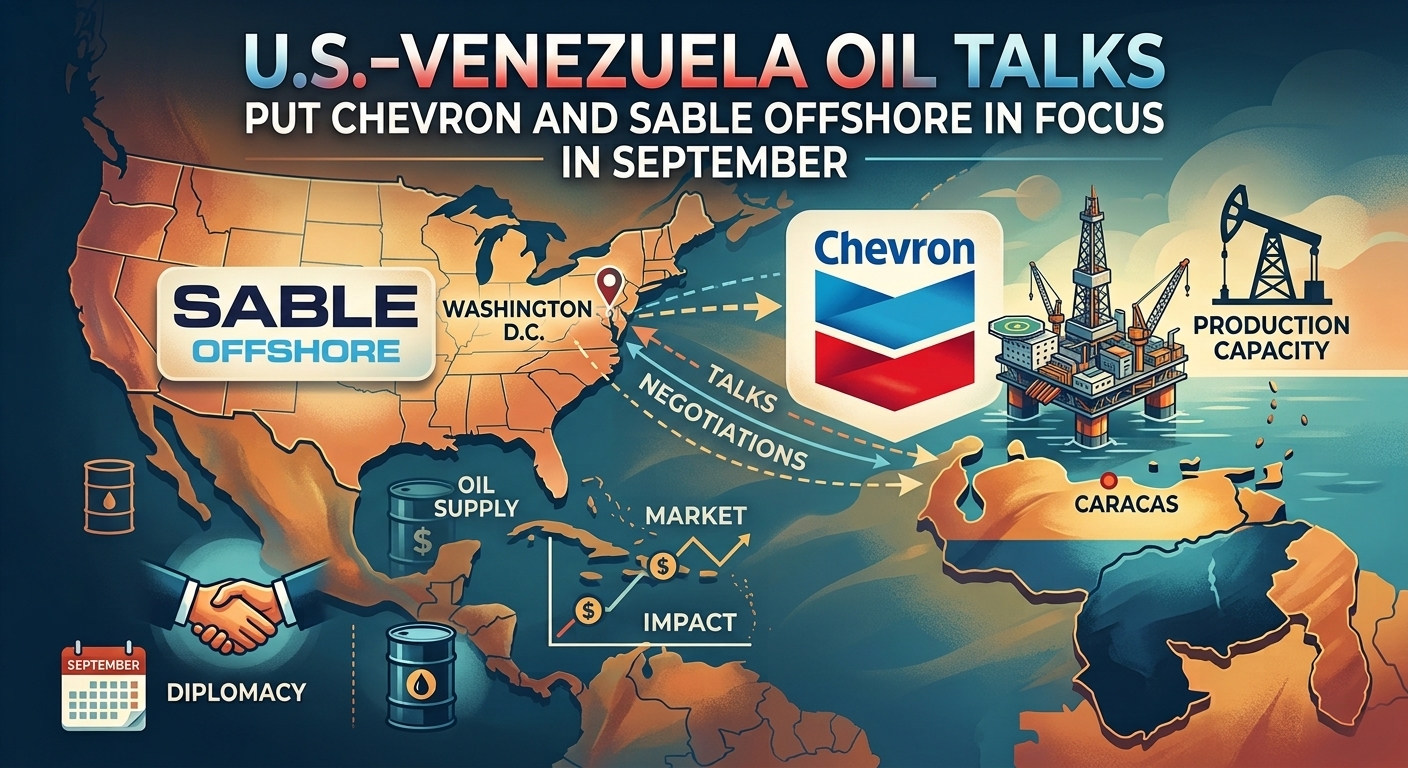
The oil market is rarely short on drama, but today’s setup offers investors something more useful: tangible operating momentum, a policy-driven reshaping of Western Hemisphere supply, and a small-cap producer beginning to show what a restarted asset can do. Sable Offshore Corp. (NYSE: SOC) sits squarely in that intersection where California barrels, infrastructure scarcity and a more strategic U.S. approach to regional energy security may turn operational execution into equity torque. For many, the appeal is not that every uncertainty has evaporated. It most certainly has not, this is oil, after all, where even the pipelines have opinions. The bull case is that Sable has begun converting a long-awaited restart into rising production, positive operating cash flow and a potentially more favorable marketing setup just as Washington appears intent on treating hemispheric oil supply as a strategic asset rather than a distant commodity.
A Western Hemisphere Oil Reset
Reports have circulated that indicate that the United States is discussing a long-term arrangement with Venezuela that could grant U.S. interests substantial access to certain Venezuelan oil fields, potentially through a lease structure and eventual allocation of development opportunities to American producers. The discussions are ongoing, with terms still subject to negotiation, legal scrutiny and political change. Still, the direction of travel is unmistakable: Washington is seeking more secure supply channels closer to home amid global supply-chain and geopolitical pressure. That does not automatically translate into an immediate windfall for every U.S. oil stock. Venezuela’s vast reserves require capital, technical work, durable legal arrangements and significant infrastructure investment before large volumes can be restored reliably. But it does reinforce several themes that matter for public energy equities:
- U.S. policymakers appear increasingly focused on hemispheric energy security.
- American operators with operating expertise, capital discipline and existing regional credentials could become strategically more valuable.
- Refineries and buyers may place a higher premium on dependable, nearby barrels during periods of global trade disruption.
- Domestic production remains valuable, not merely as a commodity business, but as an industrial-security asset.
Chevron Corp. (NYSE: CVX) is the most obvious large-cap name tied to any expansion in Venezuelan oil activity because it has maintained a longstanding operating footprint in the country. Recent reporting has indicated Chevron’s Venezuelan joint-venture output has grown materially and could expand further under the existing framework, though the pace and scope remain subject to regulatory permissions and market conditions. Yet investors should not overlook the parallel domestic angle. While foreign barrels may offer strategic optionality, California-produced oil carries a different attraction: it is already close to local demand centers and, in Sable’s case, is being restarted from existing offshore infrastructure rather than discovered in a slide deck with a particularly optimistic color palette.
Sable Offshore’s Production Ramp Is Becoming Visible
Sable Offshore’s second-quarter results offered the clearest indication yet that the Santa Ynez Unit restart is moving beyond promise and toward measurable commercial momentum. The company reported:
- $137.1 million in second-quarter revenue.
- $9.4 million of positive operating cash flow, the company’s first full quarter of revenue generation and positive operating cash flow since inception.
- Approximately 21,000 net barrels per day of average oil sales during the quarter.
- Approximately 40,000 net barrels per day of oil sales at quarter-end, representing a 149% increase from the first day of the quarter.
- Preliminary July sales of about 38,000 gross barrels per day and an August-to-date average of about 42,000 gross barrels per day through August 9.
Those figures are important because the investment narrative for Sable Offshore (NYSE: SOC) has always centered on restart execution. The question was never whether oil existed at the Santa Ynez Unit; the real question was whether Sable could restore production, move the barrels, control capital spending and turn a complicated California operating environment into cash flow. Second-quarter results suggest the company is making progress on all four fronts, even if the road is not perfectly smooth. Sable reported average production of 723 barrels of oil per day per well from an average of 35 producing wells during the quarter. By July, an average of roughly 47 wells at Platforms Harmony and Heritage were online, producing an average 721 gross barrels per day per well. The company expects all 77 wells on those two platforms to be online during the third quarter and expects Platform Hondo to restart in September. That is a meaningful ramp in a business where fixed-cost absorption, production throughput and realized pricing can alter financial outcomes quickly.
Platform Hondo Could Be the Next Catalyst
The scheduled restart of Platform Hondo is arguably one of the most closely watched operational milestones for Sable investors. Beyond adding productive capacity, Hondo is expected to contribute lower-sulfur crude, which management believes could help normalize field-wide sulfur content and improve the marketability of Santa Ynez barrels. Sable also plans to bring online five completed perforation additions at Hondo that are forecast to contribute roughly 600 gross barrels of oil per day each. Four additional perforation additions are targeted for early fourth-quarter completion, also with estimated incremental production of about 600 gross barrels per day per well. These are company forecasts, not guarantees, but they illustrate the operational upside embedded in the existing asset base. The broader point is that Sable’s production profile may not depend solely on turning more wells back on. Well optimization, perforation additions, crude-quality improvements and higher-throughput marketing channels could each contribute to the next phase of the recovery. For a stock like SOC, the market may be less interested in a beautifully worded promise than in the unglamorous mathematics of barrels actually sold. So far, the operating trajectory seems to be heading in the right direction.
The Constraint Is Also the Opportunity
Sable’s second quarter included an inconvenient reality: California’s refining and marketing system was not fully prepared for the rapid return of Pacific Outer Continental Shelf crude. The company incurred $18.5 million in non-recurring demurrage costs as local refineries displaced imported cargoes and adjusted to the new supply stream. Downstream partners also temporarily limited Sable to approximately 40,000 average gross barrels per day of sales throughput beginning in July. At first glance, those details look like negatives, and investors should treat them as real risks. But they also reveal the commercial opportunity. California refineries have historically relied on imported crude, and Sable is seeking to displace part of that supply with local production. Management expects refineries to adjust their crude procurement beginning in September to accept more Santa Ynez barrels and fewer imports, potentially easing the temporary throughput constraint.Sable is also pursuing waterborne marketing solutions through existing Los Angeles-area marine terminals. If successful, those options could improve crude-market flexibility and reduce the company’s dependence on a narrower set of buyers and logistics channels. Importantly, Sable states that its current guidance does not assume benefits from waterborne marketing solutions, chemical treatments or wider California infrastructure improvements. That creates a potentially attractive asymmetry: the company’s formal outlook already incorporates a difficult near-term marketing environment, while several operational and logistical improvements remain possible upside rather than required assumptions.
Capital Discipline Is Becoming Part of the Story
The market tends to reward production growth more generously when it is accompanied by restraint. Sable reduced the midpoint of its planned second-half 2026 capital expenditure budget by 41% to $85 million, directing spending toward asset integrity, throughput improvement, high-return perforation additions and well optimization. The company’s 2027 outlook calls for gross average daily sales of 50,000 to 55,000 barrels of oil equivalent per day, with net sales of 42,500 to 47,500 BOE/d and an approximately 100% oil mix. It also guides to 2027 lease operating expense of $9 to $12 per net BOE and cash G&A expense of $3.50 to $6.50 per net BOE. These are management targets and carry execution risk, but the combination of higher volumes and lower unit costs is precisely the operating leverage investors typically seek in a restart story. Sable has also put in place Brent-based collars with a $65 per barrel floor across designated hedge volumes through 2028. The costless collars cap some upside an old-fashioned reminder that protection is seldom free, but they may provide a measure of downside support during the crucial ramp period. The balance-sheet picture warrants close attention. Sable’s refinancing included a $675 million senior secured term loan due in December 2028 with a 15% annual coupon, mandatory amortization and an excess-cash-flow sweep, alongside $345 million of 6.5% convertible notes due in 2031 and $115 million of common stock issuance. That is a high-cost capital structure, and it raises the stakes for production and cash-flow execution. In other words, Sable has room to run, but it is expected to run rather than admire the scenery.
Why SOC Could Attract Investors
The central bullish thesis for Sable Offshore Corp. (NYSE: SOC) is straightforward:
| Potential catalyst | Why it matters |
|---|---|
| Rising production and sales | Higher daily volumes can improve revenue, fixed-cost absorption and operating cash flow |
| Full Harmony and Heritage ramp | Sable expects all 77 wells at the two platforms online in the third quarter |
| Platform Hondo restart | Adds productive capacity and could improve overall crude sulfur quality |
| Perforation additions | Offers incremental production potential from an existing asset base |
| California refinery adjustments | Could relieve current throughput constraints and reduce import displacement friction |
| Waterborne marketing options | Could expand buyer access and improve realized-price flexibility |
| Reduced capex guidance | Suggests management is prioritizing cash generation and debt amortization |
| U.S. energy-security policy | A greater national focus on nearby and domestic supply supports the strategic case for reliable Western Hemisphere barrels |
The distinction investors should make is between policy optionality and direct policy exposure. Sable is not the obvious public-market proxy for Venezuelan oil negotiations; Chevron (NYSE: CVX) holds the more direct Venezuelan connection. But Sable may benefit from the same underlying market logic: nearby barrels matter, secure supply matters, and refiners prefer crude that does not require a geopolitical weather report before breakfast. The United States’ potential pursuit of long-term Venezuelan access underscores a broader reality: dependable Western Hemisphere energy is becoming more strategically relevant. In that environment, a producer restoring meaningful California oil output from existing infrastructure could command more attention than its market capitalization might suggest.
Risks That Keep the Story Honest
A bullish investment case is stronger when it acknowledges what can go wrong. For SOC, investors should monitor several material risks:
- California permitting, regulatory oversight and environmental scrutiny can create delays, costs and operating restrictions.
- Throughput limitations and crude-quality discounts could persist longer than management expects.
- Platform Hondo’s restart, perforation additions and higher-volume guidance are forward-looking operational targets, not completed achievements.
- Sable’s debt structure is expensive, with a 15% coupon on its term loan and mandatory amortization requirements.
- Oil-price volatility remains consequential despite the company’s hedge floors.
- The company’s assets are geographically concentrated, increasing exposure to local operational, weather, infrastructure and regulatory disruptions.
- Any Venezuelan arrangement remains unconfirmed and may face legal, political and implementation risks.
The Bottom Line
Sable Offshore is evolving from a speculative restart narrative into a more concrete production-and-cash-flow story. Its second-quarter performance showed accelerating sales, first positive operating cash flow, improving well activity and a management team focused on lifting volumes while reducing planned capital spending. The next chapter rests on logistics, Platform Hondo, well optimization and the company’s ability to transform California’s initial adjustment to new offshore supply into a durable local-market advantage. If those pieces fall into place, Sable Offshore (NYSE: SOC) could become one of the market’s more compelling high-beta domestic oil recovery stories. Meanwhile, the reported U.S.–Venezuela discussions add a larger strategic backdrop: energy security is increasingly being negotiated in the Western Hemisphere, and oil assets with proximity, infrastructure and credible operating plans may be worth more than the market initially assumes.
The Sources
- U.S. Nears Deal to Secure Long-Term Access to Venezuela’s Oil Reserves Reuters
- U.S. in Talks With Venezuela to Take Major Stake in Oil Fields Bloomberg via Yahoo Finance
- Sable Offshore Corp. Reports Second Quarter 2026 Financial and Operational Results Sable Offshore Corp.
- Venezuela’s Oil Production Grows at a Crucial Time OilPrice.com
- Trump Administration in Talks to Take Stake in Venezuelan Oil Fields Yahoo Finance Canada
- Trump Administration Weighs U.S. Ownership Stake in Venezuela Oil Economic Times
- Chevron Advances Strategic Exploration Program With Angola Block 0 Discovery Chevron Corp.
Disclosure: This material is for informational and editorial purposes only and does not constitute investment advice, an offer to buy or sell securities, or a recommendation regarding Sable Offshore Corp. (NYSE: SOC), Chevron Corp. (NYSE: CVX), or any other security. Energy equities involve substantial risks, including commodity-price volatility, leverage, operating disruptions, political developments and regulatory uncertainty.
Stay Updated with Vista Partners
Subscribe to receive market insights, investing ideas, and the latest updates directly in your inbox.