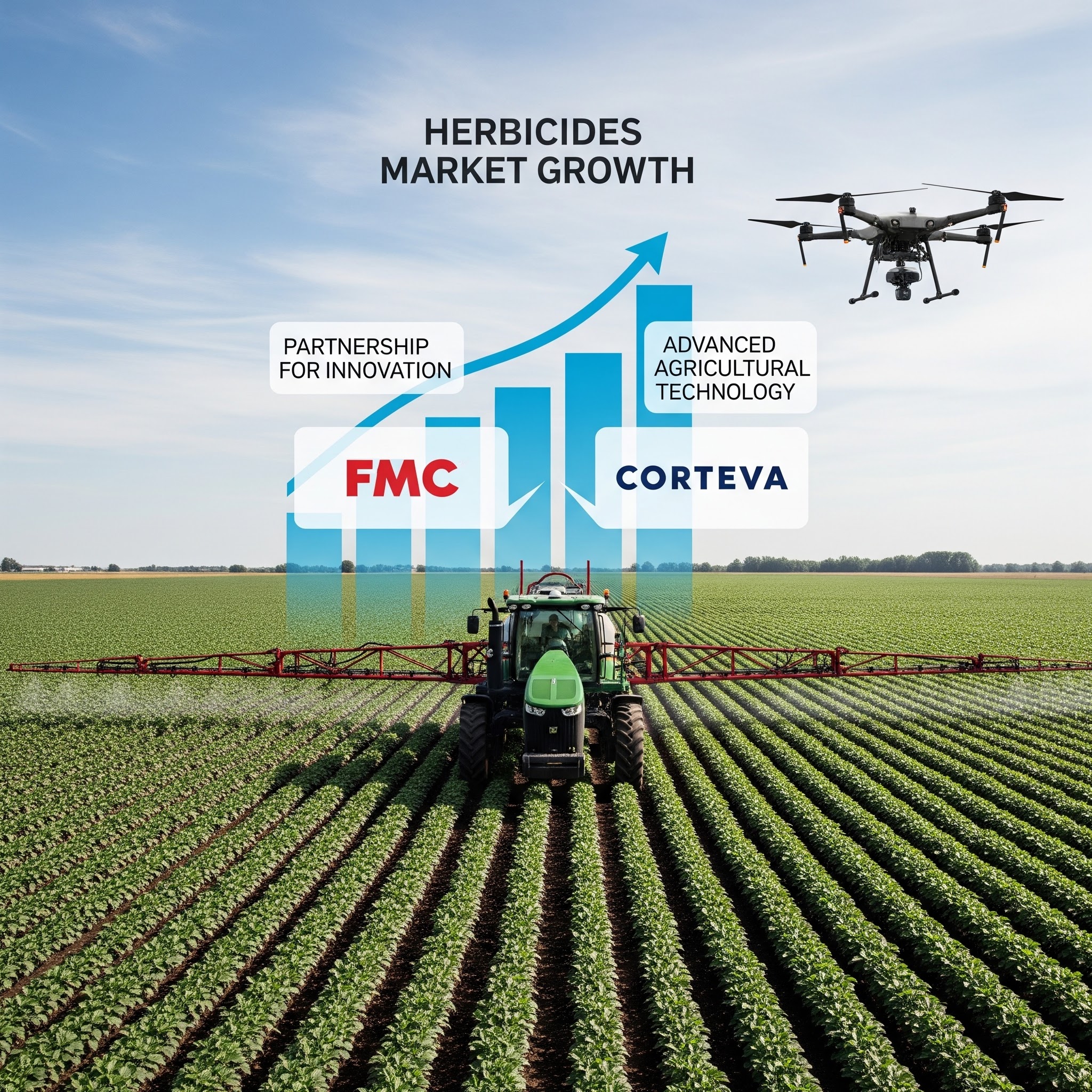
Global herbicides are quietly becoming one of Wall Street’s more durable growth stories, and the latest FMC Corporation (FMC) –Corteva (CTVA) deal suggests this is a weed problem investors may actually want more of. The combination of steady market expansion, rising resistance to old chemistries, and capital‑light licensing economics is creating an underappreciated structural tailwind in crop protection.
A Market That Just Keeps Growing
After years of being treated as the sleepy cousin of seeds and fertilizers, herbicides have emerged as a reliable global growth engine. Various industry forecasts now see the market expanding from the mid‑$30 to mid‑$40 billion range in the mid‑2020s to somewhere between the low‑$60s and low‑$100 billion by the mid‑2030s, implying mid‑single to high‑single‑digit annual growth. Asia‑Pacific remains the largest regional consumer, while North America is lining up as one of the fastest‑growing markets as farmers grapple with resistant weeds and tighter labor markets. The product mix is also shifting in ways that matter for investors. Grains and cereals already account for more than 40% of herbicide demand and are expected to grow faster than the market as growers lean harder on chemistry to protect yield per acre. At the same time, new formulations and modes of action are being pushed through the R&D pipeline to address environmental pressures and resistance, a combination that tends to support premium pricing and more defensible intellectual property.
When Resistant Weeds Meet Wall Street
Resistant weeds have gone from agronomic nuisance to full‑blown profit driver. Farmers in key corn and soybean regions are facing yield losses and higher operating costs as traditional chemistries lose effectiveness, opening the door for new active ingredients that promise better control and longer‑lasting performance. In practice, that means growers are increasingly willing to pay for differentiated solutions that can protect both yield and simplicity in their spray programs. This is exactly where FMC’s rimisoxafen enters the narrative. The molecule has been positioned as a next‑generation herbicide designed to tackle some of the most economically damaging resistant weeds in North and South American corn and soybean systems. For investors, the agronomy matters because it underpins pricing power, brand loyalty, and multi‑year adoption curves—the sort of slow‑burn growth story that rarely makes headlines but compounds quietly in the background.
The FMC–Corteva Pact: A Quietly Big Deal
In mid‑June, FMC and Corteva announced a co‑exclusive strategic supply and license agreement around rimisoxafen that essentially turns a weed problem into a shared profit pool. FMC retains ownership of the active ingredient and will supply it to Corteva, while both companies develop and commercialize their own exclusive premix formulations for corn and soybean growers across North and South America. The agreement stretches over the next decade and includes an initial prepaid product purchase of about 200 million dollars from Corteva, underscoring the commercial confidence behind the chemistry. Strategically, the structure is elegant. FMC converts years of R&D into a high‑margin, supply‑plus‑royalty‑like revenue stream without having to build a parallel branded channel everywhere rimisoxafen can play. Corteva, for its part, plugs a differentiated active into a powerful seed and crop protection platform, sharpening its value proposition to growers while avoiding the time and cost of discovering a similar molecule from scratch. The result is a classic “coopetition” model: two fierce competitors agreeing that some weeds are simply too profitable to fight alone.
Why This Matters for Long‑Term Investors
The deal slots neatly into a broader pattern: crop protection innovators increasingly favor flexible supply and license structures over capital‑heavy, go‑it‑alone commercialization. As resistance challenges mount and regulatory scrutiny tightens, the winners are likely to be those who can repeatedly deliver new modes of action and then monetize them across multiple channels, geographies, and partner ecosystems. That dynamic tends to tilt returns toward IP‑rich platforms with strong balance sheets and disciplined portfolio management.
For institutional and sophisticated retail investors, several themes stand out:
- Innovation as a yield hedge: New herbicides such as rimisoxafen effectively act as insurance policies on global yield, a critical asset in a world balancing food security and climate volatility.
- Capital‑efficient scaling: Long‑dated supply and license agreements convert scientific risk into contractual visibility, often with attractive upfront payments and multi‑year volume commitments.
- Portfolio positioning: Herbicides sit at the intersection of agriculture, chemistry, and sustainability, creating exposure to both cyclical acreage trends and structural productivity gains.
In other words, this is not just an “ag” story; it is a durable cash‑flow story wrapped in agronomic clothing, with optionality tied to future formulations and extended crop labels.
From Fields to Cash Flows
For those crafting market narratives, the herbicide space now offers a surprisingly rich backdrop. You have a global market expanding at mid‑single‑digit to high‑single‑digit rates, a clear catalyst in resistant weeds, and a set of scaled players increasingly willing to collaborate where it counts. Layer in the FMC–Corteva pact, with its decade‑long horizon and nine‑figure upfront economics, and you have the makings of a quietly compounding story that can sit comfortably in quality‑growth, income, and thematic ESG‑tilted portfolios alike. If the equity market’s attention has been captivated by artificial intelligence, this is the parallel “agricultural intelligence” trade: using targeted chemistry and data‑driven agronomy to squeeze more yield from every acre while reducing the risk profile of the global food system. For investors willing to look beyond the usual mega‑cap narratives, a simple question presents itself: in a world where weeds never sleep and resistance never retreats, why should compounders in herbicides remain under the radar?
The Sources
- FMC Corporation and Corteva – “FMC Corporation and Corteva Expand Access to Breakthrough Rimisoxafen Herbicide Technology” (press release via Yahoo Finance)
https://finance.yahoo.com/healthcare/articles/fmc-corporation-corteva-expand-access-210000240.html - Herbicides market overview – “Herbicides Market Size to Surpass [USD figure] by 203x” (Yahoo Finance commodities / market analysis)
https://finance.yahoo.com/markets/commodities/articles/herbicides-market-size-surpass-usd-094500493.html - Global herbicides market forecasts – Fortune Business Insights, “Herbicides Market Size, Share, Trends, Growth Report” (long‑term projections and CAGR data)
https://www.fortunebusinessinsights.com/herbicide-market-108411 - Herbicides market outlook – additional independent research on size, growth, and regional demand (Mordor Intelligence, The Business Research Company, etc.)
Example: https://www.mordorintelligence.com/industry-reports/global-herbicides-market-industry - Sustainable agriculture and innovation context – FAO and Field to Market reports on agricultural innovation, yield, and sustainability themes
- FAO agricultural innovation overview:
https://openknowledge.fao.org/server/api/core/bitstreams/0225024c-ff5e-42a1-b25d-72a67b8e06be/content - Field to Market financial innovations in sustainable agriculture:
https://fieldtomarket.org/blog
- FAO agricultural innovation overview:
Stay Updated with Vista Partners
Subscribe to receive market insights, investing ideas, and the latest updates directly in your inbox.