Oil is reminding Wall Street that it remains both a commodity and a geopolitical referendum again on Monday. As fresh U.S.-Iran hostilities raised concerns around the Strait of Hormuz, Brent crude pushed above $90 a barrel and U.S. benchmark WTI moved above $86, giving energy producers, refiners and select offshore operators a timely tailwind. For many, the bullish takeaway is not simply that “oil went up.” It is that a tighter and more complicated global energy system is increasing the value of secure production, flexible logistics, spare refining capacity and companies that can convert higher prices into durable cash flow. In a market that has spent years treating energy as yesterday’s trade, the sector is once again behaving like an asset class with a pulse and perhaps a rather expensive one.
The Hormuz Premium Returns
The immediate catalyst was a renewed direct exchange of fire between U.S. and Iranian forces, including reported U.S. strikes on Iran’s Larak Island near the Strait of Hormuz. The location matters enormously: Hormuz is one of the world’s most strategically important oil-transit corridors, and even a modest perceived threat to navigation can add a premium to crude prices quickly. Brent crude futures rose more than 2% intraday to exceed $90 per barrel, while WTI futures climbed roughly 4% above $86. The reaction reflected more than headlines. Many are pricing the possibility that disruption could extend beyond crude shipments and into refined fuels, where the system already appears tight. Goldman Sachs (GS) strategists cited by Yahoo Finance said refinery attacks in the Middle East and Russia have constrained global refining capacity and driven refined-product margins higher. Their analysis points to an expected decline of roughly 7 million barrels per day in global refined-product runs, a reminder that crude production is only the first step in the energy value chain. Gasoline, diesel and jet fuel do not emerge from the ground with a loyalty card. That distinction seems to favor a broad group of energy businesses:
- Integrated majors such as Exxon Mobil (NYSE: XOM) and Chevron (NYSE: CVX), which combine upstream production, refining, trading and global distribution.
- Refiners such as Valero Energy (NYSE: VLO), which can benefit when refined-product margins widen, though crude-price volatility can complicate feedstock costs.
- Oilfield-services providers such as Halliburton (NYSE: HAL), which may see stronger activity and pricing if higher oil prices encourage incremental drilling and completions.
- Independent producers and more specialized operators, including Occidental Petroleum (NYSE: OXY) and Sable Offshore Corp. (NYSE: SOC), whose equity values can carry greater operational and commodity sensitivity.
Energy Leads While the Broader Market Pauses
Energy has been standing out on the final trading day of August while the broader market traded more cautiously amid renewed geopolitical concerns and growing expectations for a possible September interest-rate increase. The Energy Select Sector SPDR Fund (NYSE Arca: XLE) led sector performance as crude prices rose, while technology shares, represented by the Technology Select Sector SPDR Fund (NYSE Arca: XLK), were broadly flat. Chevron (NYSE: CVX, $204.44, +1.28%) and Exxon Mobil (NYSE: XOM, $159.31. +1.66%) in intraday trading are among the beneficiaries of the crude-price rally. That leadership is important because it suggests investors were not merely chasing an oil-futures spike; they were moving into the large, liquid equities best positioned to translate a higher-price environment into earnings and shareholder returns.
The market contrast is notable:
| Market Theme | Companies/Tickers | Investor Read-Through |
|---|---|---|
| Rising oil prices | Chevron (NYSE: CVX), Exxon Mobil (NYSE: XOM), Occidental Petroleum (NYSE: OXY) | Higher realized pricing can support upstream earnings and operating cash flow |
| Tight refinery system | Valero Energy (NYSE: VLO) and integrated major refiners | Product scarcity can bolster refining margins, though crude-cost volatility remains a risk |
| Potential service-cycle support | Halliburton (NYSE: HAL) | Sustained higher prices may improve drilling and completion economics |
| Energy-sector momentum | Energy Select Sector SPDR Fund (NYSE Arca: XLE) | Offers diversified large-cap energy exposure for investors who prefer not to pick one wellhead |
| Utility-specific pressure | PG&E Corp. (NYSE: PCG), Edison International (NYSE: EIX), Utilities Select Sector SPDR Fund (NYSE Arca: XLU) | California wildfire-liability uncertainty weighed on utilities, underscoring the sector rotation toward energy producers |
In other words, many are seeing a familiar but increasingly consequential market split: energy companies are receiving a bid as geopolitical risk rises, while utilities face their own regulatory and liability questions. Markets can be philosophical, but they do appreciate a revenue stream with fewer court dates.
The Venezuela Wild Card
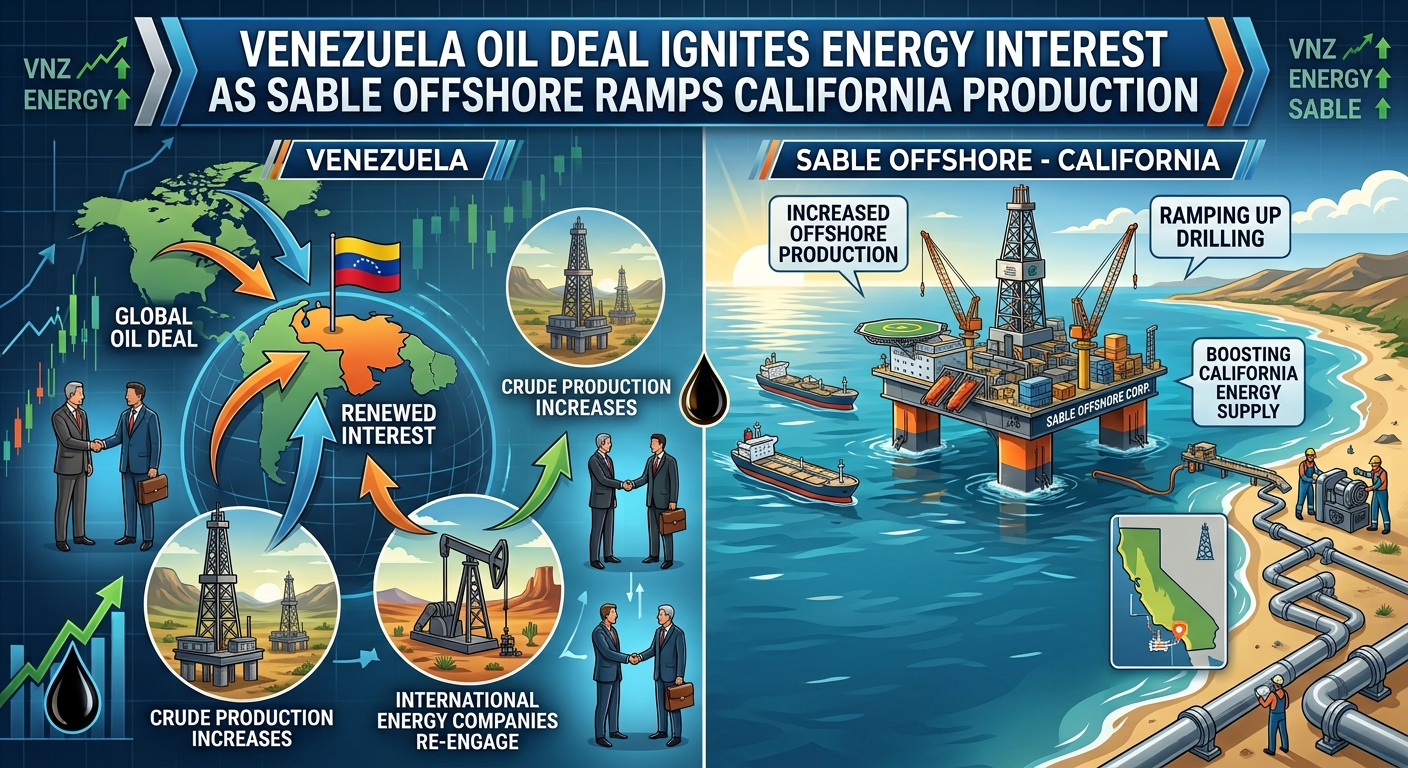
The emerging U.S.-Venezuela oil arrangement adds a second, longer-duration layer to the energy story. The reported agreement involves development rights tied to 17 Venezuelan oil fields containing an estimated 65 billion barrels of proven reserves. Public reports indicate the U.S. would receive 55% of the new venture’s effective output through a mix of ownership and at-cost offtake rights, while important commercial details—including the private operator, investment commitments and exact legal structure—remain unresolved. Venezuela’s interim president, Delcy Rodríguez, has said the agreement is expected to span 25 years and targets more than 1.5 million barrels per day of production. That is an ambitious objective, not an overnight barrel count. Venezuela’s oil infrastructure will require substantial capital, technical expertise, contracting clarity and time before any large supply increase becomes meaningful in world markets. For many, the near-term implication is more nuanced than a simplistic “Venezuela means cheaper oil” narrative:
- The agreement could eventually create substantial opportunities for U.S. producers, service companies, equipment suppliers, refiners and trading firms.
- It is unlikely to solve an immediate shortage of transportable crude or refined fuels, because project execution, infrastructure rehabilitation and field development take years, not a long weekend and a fresh PowerPoint deck.
- Greater Venezuelan output could ultimately moderate global supply tightness, but that potential future supply must be weighed against current geopolitical disruption in the Middle East and continuing bottlenecks in refining.
- The identity of the eventual private operator remains undisclosed, so many should be wary of assuming that every major U.S. oil company has a direct claim on the opportunity.
The recent New York Times reporting highlighted that the arrangement relies on a politically consequential and divisive private-sector partner, emphasizing why transparency, contract terms and governance will be central to assessing its commercial value.
Sable Offshore: A High-Beta California Production Story
Among smaller public energy names, Houston-based Sable Offshore Corp. (NYSE: SOC) presents a distinctly different bullish proposition: not global scale, but operational ramp, domestic production exposure and meaningful torque to oil prices. Sable reported $137.1 million in second-quarter 2026 revenue and $9.4 million in positive operating cash flow its first full quarter of revenue and positive operating cash flow since inception. The company averaged approximately 21,000 net barrels of oil per day in sales during the quarter, then exited the period at approximately 40,000 net barrels per day, representing 149% entry-to-exit oil-sales growth. The company’s more recent operating data point to continued momentum:
- July preliminary oil sales were approximately 38,000 gross barrels per day.
- August sales averaged approximately 42,000 gross barrels per day through August 9.
- Sable expected all 77 production wells at Platforms Harmony and Heritage to be online during the third quarter.
- Platform Hondo was expected to restart in September, with well-optimization work and perforation additions designed to add production.
That is the bullish operating case: rising production volumes during a period of stronger oil pricing can create a powerful earnings and cash-flow setup, particularly for a company whose revenue base is expanding from a relatively low level. Sable also reduced its second-half 2026 midpoint capital-expenditure outlook by 41% to $85 million, seeking to optimize cash flow and accelerate debt amortization. For 2027, management guided toward gross sales of approximately 50,000 barrels of oil equivalent per day, with oil representing roughly 100% of the expected mix.
The Fine Print Investors Should Respect
The bullish thesis for Sable Offshore (NYSE: SOC) is compelling only if investors also acknowledge the constraints. The company reported $18.5 million in nonrecurring demurrage charges during the second quarter, tied to California marketing and refinery constraints. It also faced a temporary downstream throughput cap of roughly 40,000 gross barrels per day beginning in July, although management expected relief as California refiners adjusted their crude slates and as additional marketing options developed. Its capital structure also matters. Sable refinanced with a $675 million senior secured term loan due in December 2028 carrying a 15% annual coupon, alongside $345 million of 6.5% convertible senior notes due in 2031. The company has begun a commodity-hedging program with a $65-per-barrel Brent floor, but collars also cap some upside through sold calls, including a $89.39 call ceiling for covered 2026 volumes. That makes SOC less of a pure “oil goes up, stock goes up” trade and more of an execution story with multiple moving parts:
- Production-ramp performance.
- California logistics and refinery throughput.
- Crude-quality and sulfur-related deductions.
- Debt-service and deleveraging progress.
- Commodity prices after hedging effects.
- Regulatory and operational risk tied to a concentrated offshore California asset base.
Why the Energy Trade Looks Interesting
The bullish case for energy is becoming more multifaceted. The sector is no longer relying on one variable, such as OPEC production policy or a single demand forecast. Instead, investors are confronting a stack of supportive forces: geopolitical risk around Hormuz, elevated refined-product margins, constrained refinery capacity, stronger commodity prices, an emerging Venezuelan development opportunity and renewed capital discipline among producers. For conservative folks, Exxon Mobil (NYSE: XOM) and Chevron (NYSE: CVX) offer diversified exposure to higher prices, global assets and integrated operations. For sector-level exposure, the Energy Select Sector SPDR Fund (NYSE Arca: XLE) provides a liquid way to participate in the trend. Investors looking for more operational leverage may examine Occidental Petroleum (NYSE: OXY), Halliburton (NYSE: HAL), Valero Energy (NYSE: VLO) and smaller, higher-risk production-ramp stories such as Sable Offshore Corp. (NYSE: SOC). The caveat is straightforward: crude prices can reverse quickly if shipping conditions improve, conflict de-escalates, demand softens or new supply reaches the market faster than expected. Yet at the moment, the market is signaling that reliable barrels, productive infrastructure and operating flexibility command a premium. For an energy sector that was once routinely described as unloved, that is a rather flattering change of circumstances. The market may not be writing poetry about drill bits, pipelines and refinery turnarounds, but it is increasingly willing to pay f
The Sources
- Yahoo Finance: Oil prices surge higher as U.S. and Iran exchange fire for first time in a month
- Yahoo Finance: Energy stocks lead in subdued final trading day of August; utilities under pressure
- The New York Times: Trump’s Venezuelan Oil Deal Relies on a Powerful and Divisive Partner
- Fox News: JD Vance speaks on U.S.-Iran relations and Venezuela oil deal
- Yahoo Finance: Sable Offshore Corp. Reports Second Quarter 2026 Financial and Operational Results
- Reuters: Experts, lawyers puzzled over U.S.-Venezuela oil deal, call for contract transparency
- Reuters: Venezuela’s interim president says U.S. energy deal will last 25 years
- PBS NewsHour: What we know about Trump’s deal giving U.S. access to vast oil reserves in Venezuela
- Axios: U.S. close to striking “massive” deal for Venezuelan oil fields
- Investor’s Business Daily: Oil jumps on U.S.-Iran attacks; Chevron rises amid Venezuela deal
- TradingKey: Energy stocks gain pre-market as escalating U.S.-Iran conflict pushes oil prices higher
Disclosure: This article is for informational and editorial purposes only and is not individualized investment advice, a recommendation to buy or sell any security, or a solicitation of an offer to transact. Energy, commodity and small-cap securities can be volatile, and investors should conduct independent due diligence.
Stay Updated with Vista Partners
Subscribe to receive market insights, investing ideas, and the latest updates directly in your inbox.