


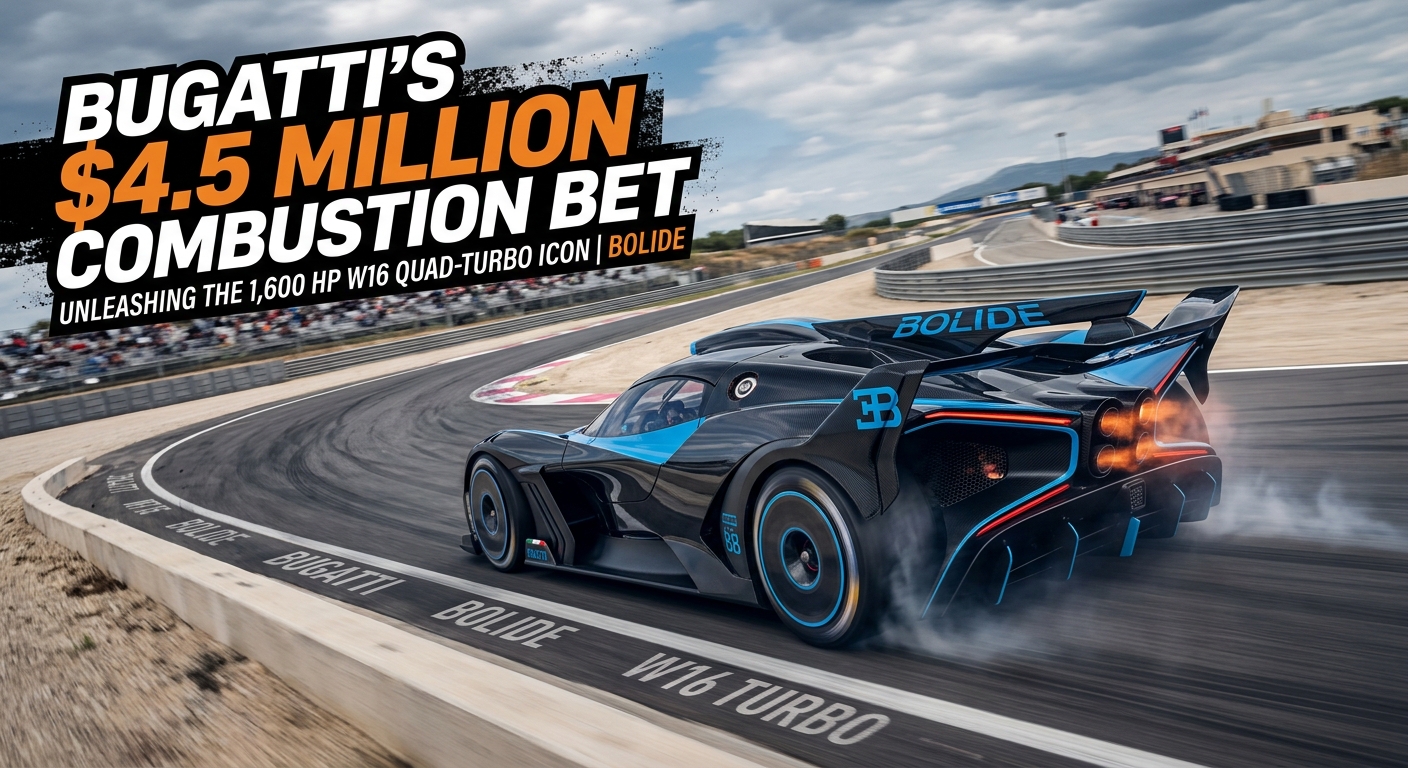
The electric-vehicle revolution has not so much canceled the internal-combustion engine as promoted it to luxury status. At the mass-market end, batteries, software and lower-cost Chinese competition are reshaping the auto business; at the rarefied end, the V12 and V16 are becoming mechanical heirlooms, objects of engineering theater whose scarcity, sound and customization can command extraordinary pricing. That creates an investor-friendly distinction: the future of transportation may be electric, but the future of the highest-margin automotive storytelling may still arrive with pistons, bespoke leather and an exhaust note impolite enough to wake a Swiss watchmaker.
Bugatti’s Mechanical Luxury Bet
Mate Rimac, the CEO of Bugatti Rimac and founder of the eponymous EV company, argues that the supercar business has entered its “Swiss watch phase.” The analogy is compelling: smartwatches offer more functions at lower cost, yet elite mechanical watches remain prized precisely because they are not the utilitarian choice. They are craftsmanship, legacy and signaling, timekeeping with a family office attached. Bugatti is applying that logic to the Tourbillon, a hybrid hypercar combining an 8.3-liter naturally aspirated V16 rated at 1,000 horsepower with electric motors, for a total of 1,800 horsepower. Only 250 will be built. The cars are sold out at a starting price of roughly $4.5 million, and buyers reportedly add an average of $600,000 to $700,000 each in personalization. That turns options—paint, leather, stitching, materials and design details—into a remarkably lucrative second act after the initial sale. The product is not a rejection of electrification. It is a shrewd hybridization of it: electric technology delivers performance and helps meet modern engineering demands, while the naturally aspirated V16 supplies the sensory drama that a spreadsheet cannot quite reproduce. In a market increasingly able to buy speed, Bugatti is selling scarcity, ceremony and mechanical complexity. Rimac’s ambition is to grow profits while keeping annual output in the “low three-digit numbers,” a reminder that exclusivity is not a production bottleneck in this corner of the economy, it is the business model. Bugatti Rimac generated €200 million in EBITDA last year, according to Rimac, and the CEO said the company’s valuation is substantially above $2 billion, though the company is private and that valuation was not independently disclosed in the CNBC report.
Personalization Is the Margin Engine
For investors, the more durable takeaway may be less about cylinder counts than about pricing power. Personalization transforms a vehicle from a manufactured product into a high-value platform for incremental revenue. The factory builds the chassis; the customer’s taste funds the margin expansion. Ferrari N.V. (NYSE: RACE) offers the public-market blueprint. In its second-quarter 2026 results, Ferrari reported that personalization represented more than 20% of cars-and-spare-parts revenue. Higher personalization, together with a richer product mix, helped lift that segment’s revenue even as unit shipments declined. Ferrari reported quarterly EBITDA of €755 million, representing a 39.0% margin, and raised its full-year 2026 outlook. Ferrari’s business underscores that a company does not need to chase every unit of global auto demand to create shareholder value. It needs affluent customers who value limited supply, brand heritage and the privilege of choosing exactly the right shade of red or, presumably, the shade that assures neighboring collectors their garage remains insufficiently interesting. Lamborghini, owned by Volkswagen AG (OTC: VWAGY; XETRA: VOW3), provides further evidence that customization is not merely decorative. Lamborghini delivered a record 10,747 vehicles in 2025 and reported record revenue of €3.20 billion. Crucially, 94% of delivered vehicles included at least one personalized feature, which the company described as a central contributor to value creation and record revenue.
The Market Is Splitting in Two
Rimac’s central thesis is that automotive demand is bifurcating. Mainstream buyers will increasingly prioritize affordability, software features, charging convenience and total cost of ownership, areas where EVs, particularly lower-priced models, are positioned to compete aggressively. The high-end collector market, by contrast, is buying a different proposition: emotionally resonant hardware, limited production, craft and unmistakable identity. This is not a forecast that every gasoline-powered luxury vehicle will flourish. Regulatory pressure, changing consumer preferences and the cost of developing compliant combustion powertrains remain real constraints. The investable proposition is narrower: companies with rare brands, disciplined production and affluent repeat customers may continue to monetize combustion heritage and hybrid technology long after the mass market has moved further toward battery power.
| Segment | Customer priority | Likely economic driver | Illustrative players |
|---|---|---|---|
| Mass-market vehicles | Cost, efficiency, connectivity and convenience | Scale, supply chain, software and battery economics | Global EV and conventional auto manufacturers |
| Premium performance | Brand, technology, design and exclusivity | Product mix and pricing | Porsche AG (OTC: POAHY), Ferrari N.V. (NYSE: RACE) |
| Ultra-luxury / hypercars | Rarity, bespoke craftsmanship and collectibility | Personalization, limited editions and one-off commissions | Bugatti Rimac (private), Ferrari N.V. (NYSE: RACE), Lamborghini via Volkswagen AG (OTC: VWAGY; XETRA: VOW3) |
The distinction matters because a $50,000 electric vehicle can now offer acceleration once reserved for exotic machinery. Rimac himself has noted that pure performance is becoming less differentiating. The luxury buyer, in his view, is increasingly paying for what the object represents: human skill, art, engineering and an experience that cannot be downloaded in an over-the-air update.
A Changing Ownership Story
The Bugatti Rimac ownership structure is also evolving. Porsche AG (OTC: POAHY; XETRA: P911) agreed in April to sell its 45% stake in Bugatti Rimac and its 20.6% stake in Rimac Group to a consortium led by HOF Capital, with BlueFive Capital participating as a major investor. Porsche and Rimac had formed Bugatti Rimac in 2021, with Rimac Group holding 55% and Porsche 45%. The deal remains subject to regulatory approvals and is expected to close before the end of 2026. Upon completion, Rimac Group is expected to take control of Bugatti Rimac, while HOF Capital becomes the largest shareholder in Rimac Group alongside Mate Rimac. Financial terms were not disclosed by Porsche. For Porsche investors, the transaction represents a portfolio reshaping rather than a direct public-market opportunity to own Bugatti. For luxury-auto investors more broadly, it highlights the strategic value assigned to premium performance brands and the capital-market interest in businesses that combine a powerful heritage marque with advanced EV and hybrid engineering capabilities.
A Takeaway
The bullish argument is not that combustion engines will reclaim the global auto market. They almost certainly will not. It is that in the most exclusive slice of the market, internal combustion may become more valuable because it is less common, more regulated and more difficult to reproduce. Three points stand out:
- Scarcity supports pricing. Bugatti’s 250-unit, sold-out Tourbillon run at roughly $4.5 million per vehicle illustrates how deliberately constrained supply can turn exclusivity into commercial leverage.
- Customization magnifies revenue quality. Bugatti’s reported average personalization spend of $600,000 to $700,000 per Tourbillon, Ferrari’s personalization contribution of more than 20% of cars-and-spare-parts revenue, and Lamborghini’s 94% personalization penetration all point to a high-margin industry playbook.
- Public investors have clearer access through established luxury manufacturers. Ferrari N.V. (NYSE: RACE) is the most direct listed expression of ultra-luxury automotive pricing discipline. Volkswagen AG (OTC: VWAGY; XETRA: VOW3) provides exposure to Lamborghini, although within a far broader automotive group. Porsche AG (OTC: POAHY; XETRA: P911) remains a premium-performance name to watch despite its planned exit from Bugatti Rimac.
The premium-car market may therefore be headed toward a curious but highly investable compromise: EVs for transportation, hybrids for the bridge, and combustion engines for the collectors who regard “practical” as a word best left to other people’s garages.
The World of BUGATTI at Monterey Car Week
The Sources
- CNBC Bugatti CEO Mate Rimac Says the Future of Supercars Is Old-School Combustion Engines
- Porsche Newsroom Porsche Sells Its Stakes in Bugatti Rimac and Rimac Group
- Ferrari Investor Relations and Financial Results
- Ferrari Second-Quarter 2026 Financial Results
- Lamborghini Lamborghini Achieves Record Growth in 2025
- CNBC Porsche to Sell Bugatti Rimac Stakes to HOF Capital-Led Consortium
- Volkswagen Group Annual Reports and Investor Relations
- Porsche AG Investor Relations
- Rimac Group Official Website
- Bugatti Official Website
Stay Updated with Vista Partners
Subscribe to receive market insights, investing ideas, and the latest updates directly in your inbox.

