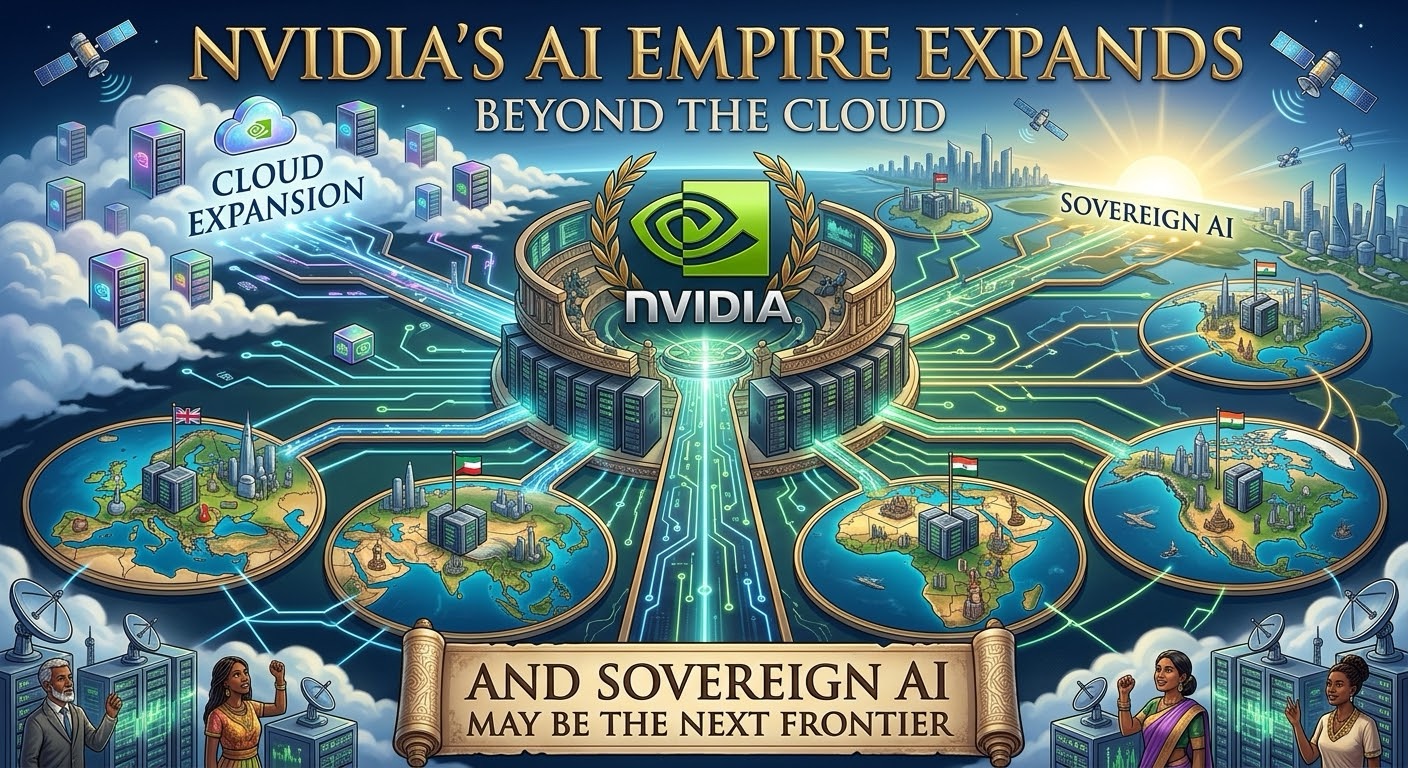
NVIDIA Corporation (NASDAQ: NVDA) delivered an earnings-call message Wall Street rarely hears from a company already operating at historic scale: demand remains so strong that supply, not customer appetite, is the practical limit on growth. With record quarterly revenue of $96 billion, data-center revenue of $89 billion, and a $108 billion third-quarter outlook, NVIDIA is increasingly selling not just chips, but the industrial plumbing of the intelligence economy.
The Bull Case: AI Has Graduated to Infrastructure
The most consequential takeaway from NVIDIA’s fiscal Q2 2027 call was not simply its revenue beat. It was management’s description of a market changing from a hyperscaler-led GPU buying cycle into a global build-out of “AI factories”—complete systems spanning accelerators, CPUs, networking, software, power planning, cooling, and deployment expertise. NVIDIA reported total revenue of $96 billion, up more than 100% year over year, and forecast third-quarter revenue of $108 billion, plus or minus 2%. Management’s preliminary outlook calls for roughly 70% revenue growth in fiscal 2028, despite describing that forecast as constrained by available supply. That distinction matters. A company facing weak demand trims its outlook. NVIDIA is effectively telling investors that it has more demand than it can currently fulfill, a much better sort of operational inconvenience, like owning the only umbrella shop during a monsoon. The numbers supporting the narrative were equally muscular:
- Data-center revenue reached $89 billion, rising 18% sequentially.
- The company’s ACIE segment—AI cloud, industrial, enterprise, and related customers, generated $40 billion, up 25% sequentially and 138% year over year.
- NVIDIA said sovereign, regional, NeoCloud, and enterprise markets could ultimately account for roughly half of its data-center business.
- AWS, a unit of Amazon.com, Inc. (NASDAQ: AMZN), plans to deploy an additional 2 million NVIDIA GPUs through fiscal 2029, while also adopting elements of NVIDIA’s physical-AI stack.
For investors, this broadens the central question. The opportunity is no longer merely whether large cloud providers keep spending. It is whether virtually every region, industry, and organization that treats AI as strategic infrastructure becomes a future buyer of compute.
The Full-Stack Advantage Is Growing
NVIDIA’s strongest competitive argument is increasingly its ability to sell the entire AI factory rather than a component inside one. The company said its revenue opportunity per gigawatt has expanded from roughly $18 billion during the Hopper era to $25 billion with Blackwell and approximately $40 billion with Vera Rubin. That reflects a wider system footprint: Vera CPUs, Rubin GPUs, NVLink, InfiniBand or Ethernet, software, and specialized inference capabilities. This is a significant change in the investment case. The more of a customer’s data center NVIDIA can architect, connect, optimize, and support, the less the company resembles a cyclical chip vendor and the more it resembles a foundational infrastructure platform. NVIDIA has begun production shipments of its Vera Rubin platform and said it has purchase orders from every major hyperscaler, AI cloud, and system OEM. Management expects Vera Rubin to become its fastest product ramp to date. The company also highlighted CPU and networking growth:
- NVIDIA expects CPU revenue to more than double in fiscal 2028.
- Networking revenue increased 18% sequentially.
- Spectrum-X Ethernet revenue grew 2.6 times year over year.
- The company expects its Vera CPU to be adopted by major hyperscalers, NeoClouds, AI labs, and system manufacturers.
That is important because AI infrastructure is becoming a system-level performance problem. A brilliant GPU attached to an underwhelming network is rather like a Formula 1 car in airport traffic: technically impressive, strategically frustrated.
Sovereign AI Is Becoming a Powerful Demand Engine
One of the most investor-relevant themes in NVIDIA’s call was sovereign AI: governments and regions seeking to retain control over their data, AI models, computing capacity, security rules, and policy authority. NVIDIA said its sovereign-AI business, primarily served through regional NeoCloud partners, grew 35% sequentially and more than tripled year over year in the quarter. The company cited activity across regions including Armenia, Africa, Taiwan, India, Australia, Malaysia, Japan, South Korea, and Europe. This theme also aligns with the strategy described by Seven Boson Group Ltd., a private company positioning itself as a sovereign-AI and decision-intelligence provider. Seven Boson says its platform is designed to help nations deploy and govern advanced multimodal AI while preserving data residency, security-by-design, and policy authority rather than relying entirely on foreign providers. Seven Boson’s June announcement framed its offering as “Sovereign AI Decision Intelligence,” aimed at helping countries own, deploy, and govern frontier AI. Its focus includes decision intelligence and infrastructure designed for sectors such as healthcare, defense, cyber, finance, education, and communications. The strategic implication is straightforward: a sovereign-AI build-out requires more than a model. It requires trusted compute, secure data flows, resilient power systems, cooling, networking, cloud architecture, and cyber defense. That widens the investable surface area beyond GPUs.
A New Financing Model Could Deepen NVIDIA’s Moat
NVIDIA also outlined a potentially important evolution in its business model. The company is helping NeoCloud projects obtain financing through take-or-pay commitments and revenue-sharing arrangements, allowing data-center developers to secure capital while NVIDIA gains participation in usage-linked economics beyond the initial equipment sale. Management said it is working with Apollo Global Management, Inc. (NYSE: APO), BlackRock, Inc. (NYSE: BLK), Blackstone Inc. (NYSE: BX), Brookfield Asset Management Ltd. (NYSE: BAM), The Goldman Sachs Group, Inc. (NYSE: GS), and KKR & Co. Inc. (NYSE: KKR) on financing platforms intended to raise more than $500 billion in third-party AI-infrastructure capital. This deserves careful scrutiny. It introduces financing and ecosystem-exposure questions that investors should not ignore. Yet the upside is powerful: if NVIDIA can help bring capacity online faster, sell the hardware, and participate in subsequent revenue streams, the company could expand both its addressable market and the durability of its economic model. The bear argument will call this circular. The bull argument is that NVIDIA is helping finance the roads because it sells the tollbooths, the traffic-control systems, and a large share of the vehicles.
What $1,000 in NVIDIA’s IPO Could Be Worth
NVIDIA went public in January 1999 at $12 per share. Following six stock splits, one original IPO share corresponds to 480 shares today; the split-adjusted IPO price is roughly $0.025 per share based on the cumulative split history. Using the August 26, 2026 closing price of $209.66 cited in the earnings report, a $1,000 investment at NVIDIA’s IPO price would have purchased about 83.33 original shares. After the six splits, those shares would become approximately 40,000 shares today. 40,000 times $209.66 = $8,386,400. A $1,000 investment at NVIDIA’s IPO price would therefore be worth approximately $8.39 million today, excluding taxes, transaction costs, and any reinvestment of dividends. The calculation assumes the investor bought at the IPO offering price and held continuously through every split. Historical returns, naturally, are marvelous storytellers but unreliable fortune tellers.
Risks Worth Respecting
The bullish case remains substantial, but disciplined investors should watch several variables:
- NVIDIA expects gross margin to decline from 75% in Q2 to approximately 74% in Q3, with a projected Q4 trough of 71% to 72%, driven largely by tight memory supply and rising component costs.[l
- Management included no China data-center-compute revenue in its forward outlook amid geopolitical and regulatory uncertainty.
- NVIDIA’s ecosystem financing, strategic investments, and credit support may increase execution complexity and draw greater investor attention to capital allocation.
- Competition in custom AI silicon, inference hardware, networking, cloud platforms, and national AI projects will remain intense.
- The capital intensity of AI infrastructure means power availability, land, grid interconnection, cooling, construction labor, and financing can become bottlenecks alongside chips.
Still, NVIDIA’s call suggests that the AI trade is becoming less narrow, not less powerful. The company is moving deeper into the economic center of AI infrastructure just as sovereign demand, enterprise deployment, regional clouds, physical AI, and agentic workflows increase the number of customers that need a complete solution. For NVIDIA (NASDAQ: NVDA), the next phase may not be measured solely in GPUs shipped. It may be measured in gigawatts deployed, countries enabled, AI factories financed, and the growing realization that intelligence has become infrastructure.
Learn More “The Next Wave of AI Growth – Cheap, Opensource, Safe, and Sovereign”
The Sources
[1] NVIDIA Q2 2027 Earnings Report https://www.marketbeat.com/earnings/reports/2026-8-26-nvidia-co-stock/
[2] Seven Boson Group Launches Sovereign AI Decision https://www.globenewswire.com/news-release/2026/06/24/3316642/0/en/seven-boson-group-launches-sovereign-ai-decision-intelligence-service-for-the-agi-era.html
[3] Seven Boson Group https://sevenbosongroup.com/
[4] Chet White – Founder & CEO, Seven Boson | AI World Lab – LinkedIn https://www.linkedin.com/in/chet-white
[5] If You’d Invested $1,000 in Nvidia Stock 20 Years Ago, Here’s How … https://www.nasdaq.com/articles/if-youd-invested-1000-nvidia-stock-20-years-ago-heres-how-much-youd-have-today
[6] If You Bought 1 Share of Nvidia Stock at Its IPO, Here’s How Many … https://finance.yahoo.com/news/bought-1-share-nvidia-stock-093000093.html
[7] NVIDIA Corp (NVD.HA) Stock Earnings Call Transcripts https://finance.yahoo.com/quote/NVD.HA/earnings-calls/
[8] NVIDIA Sets Conference Call for Second-Quarter Financial … https://nvidianews.nvidia.com/news/nvidia-sets-conference-call-for-second-quarter-financial-results-6927195
[9] How Much Would $10000 Invested in Nvidia Stock 20 Years Ago Be … https://money.usnews.com/investing/articles/nvidia-corp-nvda-stock-investment-worth-today
[10] Seven Boson launches sovereign AI service enabl… – Pluang https://pluang.com/en/news-feed/seven-boson-group-luncurkan-layanan-keputusan-berbasis-ai-berdaulat-untuk-era
[11] A $1000 investment in NVIDIA’s IPO grew to millions after 27 years. https://www.kucoin.com/news/flash/nvidia-ipo-investment-of-1-000-grows-to-millions-after-27-years
[12] NVIDIA Corporation (NVDA) Earnings Call Transcripts https://seekingalpha.com/symbol/NVDA/earnings/transcripts
[13] NVIDIA (NVDA) Earnings Call Transcripts https://stockanalysis.com/stocks/nvda/transcripts/
[14] If one bought 1000 NVIDIA shares at its $12 IPO in 1999 and held … https://www.reddit.com/r/NvidiaStock/comments/1ofg947/results_if_one_bought_1000_nvidia_shares_at_its/
[15] Seven Boson Group Launches Sovereign AI Decision Intelligence … https://sevenbosongroup.com/press-releases/seven-boson-group-launches-sovereign-ai-decision-intelligence-service-for-the-agi-era/
Stay Updated with Vista Partners
Subscribe to receive market insights, investing ideas, and the latest updates directly in your inbox.