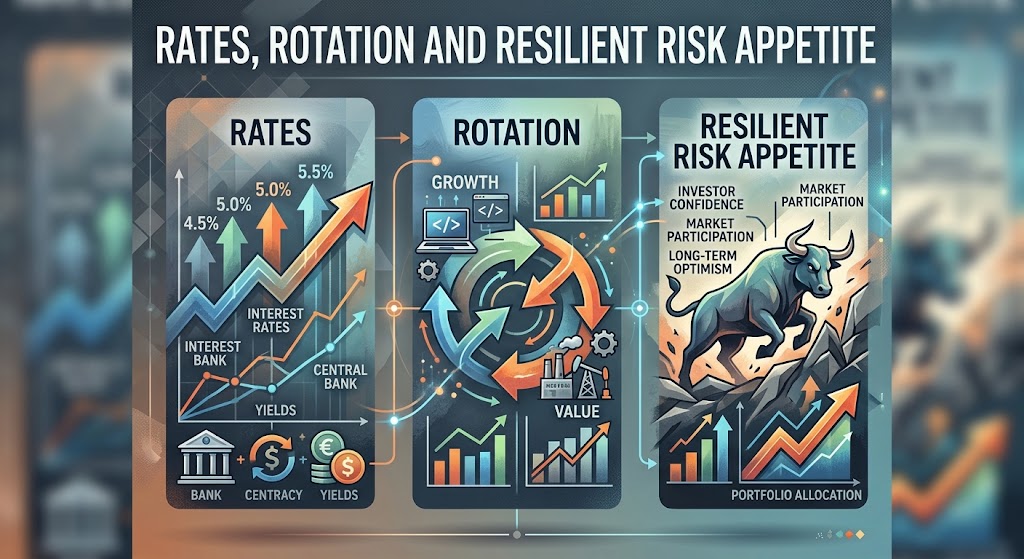
U.S. stocks staged a broad Friday rally to end a volatile week, but the major equity benchmarks still posted weekly losses as elevated Treasury yields continued to challenge high-multiple growth stocks. The close showed renewed risk appetite across equities, gold and Bitcoin, while the VIX fell sharply—yet the larger market debate remains whether long-term rates can stabilize without undermining valuation support.
Friday Market Snapshot
| Asset / Index | Friday close | Friday change |
|---|---|---|
| S&P 500 Index | 7,674.37 | +33.21, or +0.43% |
| Dow Jones Industrial Average | 53,277.01 | +517.80, or +0.98% |
| Nasdaq Composite | 26,180.46 | +113.29, or +0.43% |
| Russell 2000 Index | 3,017.87 | +25.43, or +0.85% |
| CBOE Volatility Index (VIX) | 15.16 | -0.85, or -5.31% |
| Gold | $4,674.80 | +$103.40, or +2.26% |
| Bitcoin (BTC-USD) | $77,290.06 | +$4,629.84, or +6.37% |
| Crude oil | $86.66 | -$0.17, or -0.20% |
The Dow outperformed Friday, gaining nearly 1%, while the small-cap Russell 2000 Index advanced 0.85%. The S&P 500 and Nasdaq Composite each gained 0.43%. The breadth of the rebound, together with the VIX’s 5.31% decline to 15.16, suggested investors regained some confidence after Thursday’s sharp risk-off move.
Weekly Market Performance
Despite Friday’s recovery, the week remained negative for the major indexes as higher long-term Treasury yields disrupted the market’s summer advance. Through Thursday’s close, the S&P 500 had lost 1.9% for the week and the Nasdaq Composite was down 2.5%; Friday’s advance narrowed those declines but did not fully reverse them.
| Index | Friday close | Weekly direction | Key weekly driver |
|---|---|---|---|
| Dow Jones Industrial Average | 53,277.01 | Lower | Pressure from higher yields and a Thursday selloff, partly offset by Friday’s value/cyclical rebound |
| S&P 500 Index | 7,674.37 | Lower | Broad valuation pressure as Treasury yields rose |
| Nasdaq Composite | 26,180.46 | Lower | Technology and semiconductor shares remained especially rate-sensitive |
| Russell 2000 Index | 3,017.87 | Mixed to lower | Friday’s improvement reflected renewed interest in economically sensitive smaller companies |
The market’s late-week action was important: Friday’s gains were not confined to a narrow set of mega-cap stocks. The Dow and Russell 2000 both outpaced the Nasdaq, pointing to a tactical rotation toward cyclicals, industrials, financials and smaller companies as investors reassessed rate exposure.
What Drove the Week
The Treasury market remained the central influence on risk assets. The 10-year Treasury yield traded near 4.7%, while the 30-year yield approached roughly 5.25% to 5.28% on Friday—levels that increase the discount rate investors use when valuing future earnings. That pressure is typically most acute for technology, software, artificial intelligence and semiconductor companies with earnings expectations weighted further into the future. Thursday captured that concern in a single session: the Dow fell about 1.3%, the S&P 500 lost approximately 0.9% and the Nasdaq declined roughly 1.0% as yields rose and risk appetite weakened. The U.S. Treasury Department’s discussion of expanding long-dated bond buybacks offered some support to sentiment. However, investors appear to view buybacks as a market-functioning and debt-management measure rather than a full solution to the structural issues behind higher yields: fiscal borrowing needs, Treasury supply, inflation uncertainty and term-premium risk.
Macroeconomic Report Commentary
The week reinforced an increasingly consequential macro theme: Federal Reserve policy and Treasury yields are no longer moving as one. Even if weaker employment conditions and moderating inflation limit the case for further near-term Fed tightening, a rise in long-term yields can independently tighten financial conditions.
That dynamic has several market implications:
- Higher Treasury yields raise corporate financing costs, affecting capital investment, commercial real estate, housing activity and leveraged balance sheets.
- Higher discount rates create a more demanding environment for richly valued growth stocks, particularly in AI-related technology and semiconductors.
- Equity leadership may increasingly favor companies with near-term cash flows, durable margins, low debt levels and clear pricing power.
- The Friday strength in the Dow and Russell 2000 may signal that investors are beginning to look beyond concentrated mega-cap technology exposure, although a sustained rotation will require yields to stabilize.
Commodity and alternative-asset performance added nuance to the macro picture. Gold gained 2.26% to $4,674.80, while Bitcoin (BTC-USD) surged 6.37% to $77,290.06. Their simultaneous advances suggest investors were pursuing both inflation and currency-hedge narratives alongside a selective return to risk assets. Crude oil’s modest 0.20% decline to $86.66 indicated that energy inflation worries remained present but did not intensify meaningfully on Friday. Note that crude oil prices rose +2.73% over the last 5-days.
Corporate and Sector Focus
Technology and semiconductor investors will be closely focused on Nvidia Corporation (NVDA, $214.72, -4,64% over the last 5-days), which is scheduled to report earnings next week. The results will serve as a critical test of whether AI infrastructure spending and data-center demand continue to support the sector’s elevated earnings expectations amid a higher-rate environment. Consumer and value-oriented shares also offered constructive signals. BJ’s Wholesale Club Holdings, Inc. (BJ, $96.42, +3.22% over the last 5-days) reported results that highlighted continued demand for value-focused retailing, while Ross Stores, Inc. (ROST, $239.04, +4,39% on Friday) moved higher after reporting stronger-than-expected quarterly results. Those results may reinforce investor interest in companies positioned for consumers who remain employed and spending but continue to seek value.
Week Ahead: Three Market Catalysts
- Nvidia earnings: Nvidia Corporation (NVDA) results will be closely watched as a barometer for AI infrastructure demand, enterprise technology budgets and semiconductor-sector earnings momentum.
- Jackson Hole: The Federal Reserve’s annual Jackson Hole Economic Symposium runs August 27–29. Investors will look to Fed Chair Kevin Warsh for insight into inflation, long-duration yields and the future policy path.
- U.S. growth and inflation data: The second estimate of second-quarter GDP and the Personal Consumption Expenditures price index are due next week. The PCE release is especially important because it is the Fed’s preferred inflation measure.
VP Watchlist Updates
Friday’s rebound improved the immediate technical tone, but the week’s decline underscored a market in transition. Investors are balancing confidence in earnings and AI-driven investment against a higher-for-longer Treasury-yield risk. The next leg higher will likely depend on whether incoming inflation data, Federal Reserve communication and corporate results confirm that long-term rates can moderate without a meaningful slowdown in economic growth.
Amwell® (NYSE: AMWL)
Amwell® (NYSE: AMWL) a leading provider of a comprehensive SaaS-based software platform for technology-enabled healthcare, closed at $11.90, +.93% on Friday. Amwell® (NYSE: AMWL) announced (Aug. 4) financial results for the second quarter ended June 30, 2026. Dr. Ido Schoenberg, Chairman and CEO of Amwell stated, “The DHA’s intent to make Amwell a prime contractor is a powerful endorsement of our platform and our people. With subscription revenue now approaching half our total revenue, independently validated behavioral clinical outcomes, no debt, and positive cash flows from operations projected for the fourth quarter this year, we have never been better positioned to lead the era of AI-powered care.”
Amwell Second Quarter 2026 Highlights:
- Recorded Total Revenue of $52.0 million at the top end of the previously provided financial guidance range for Q2
- Achieved subscription revenue of $25.7 million
- Recorded Amwell Medical Group (“AMG”) visit revenue of $24.4 million
- Reported gross margin of 53%
- Net loss was ($9.6) million, compared to ($10.3) million in the first quarter of 2026, continuously moving from quarter to quarter in a favorable trajectory
- Adjusted EBITDA of ($1.2) million compared to ($3.1) million in the first quarter of 2026
- Total visits on the platform were 0.8 million.
Financial Outlook
The Company is significantly improving Adjusted EBITDA, reaffirming its AMG visit guidance, and raising the low end of its 2026 revenue outlook:
- Revenue in the range of $200 million to $205 million increased from $195 million to $205 million
- AMG visits between 1.32 million and 1.37 million
- Adjusted EBITDA in the range between ($9) million to ($7) million increased from ($16) million to ($12) million.
The Company also provided financial guidance for Q3 2026 Revenue and adjusted EBITDA:
- Q3 revenue in the range of $46 million to $48 million
- Q3 adjusted EBITDA expected to in the range of ($5) million to ($3) million.
The Company also reiterated its objective to achieve positive cash flow from operations in the fourth quarter of 2026.
Hudson Pacific Properties (NYSE: HPP)
Hudson Pacific Properties (NYSE: HPP, $14.50, +4.32% over the last 5-days) is a real estate investment trust serving dynamic tech and media tenants in global epicenters for these synergistic, converging and secular growth industries. Hudson Pacific’s unique and high-barrier tech and media focus leverages a full-service, end-to-end value creation platform forged through deep strategic relationships and niche expertise across identifying, acquiring, transforming and developing properties into world-class amenitized, collaborative and sustainable office and studio space. HPP turned in a quarter ( Aug. 5) that suggests the office malaise is not over, but it may finally be meeting resistance. Revenue came in above Wall Street’s expectations, occupancy moved higher for a fourth straight quarter, and management raised full-year guidance — a combination that does not make for a triumphant victory lap, but it does make for a more credible turnaround narrative. Learn more.
Eupraxia Pharmaceuticals Inc. (EPRX)
Eupraxia Pharmaceuticals Inc. (EPRX, $6.73, +.15% over the last 5-days), a clinical-stage biotechnology company leveraging its proprietary Diffusphere™ technology designed to optimize local, controlled drug delivery for applications with significant unmet need, announced (Aug. 13) positive results from a new analysis of the RESOLVE study examining the effect of EP-104GI on symptom severity, including for the first time an analysis of the effect of EP-104GI on odynophagia (pain when swallowing). This is important because odynophagia scoring is a component of Dysphagia Symptom Questionnaire (DSQ), a commonly used patient reported outcome used in pivotal clinical trials in EoE patients.
Modular Medical, Inc. (NASDAQ: MODD)
Modular Medical, Inc. (NASDAQ: MODD, $3.54, +42.17% over the last 5-days), a commercial-stage medical device company preparing for the commercial launch of its next-generation Pivot™ tubeless patch pump, announced (Aug. 3) plans to initiate the first phase of commercialization of its Pivot tubeless patch pump across five strategically selected U.S. markets beginning in October 2026. The initial rollout will include Atlanta, Cincinnati/Lexington, Dallas, Houston, and Philadelphia, representing a foundational step in the Company’s capital efficient commercialization strategy with its mission to expand access to simplified insulin delivery solutions for all people living with diabetes.
MODD recently (July 22) announced the formation of its Pivot Innovation Council, a cross-functional group of leading clinicians and healthcare experts established to help guide the company’s clinical and commercial strategy. Diabetes care expert Robert Gabbay, MD, PhD, FACP was appointed as chair of the Pivot Innovation Council. The council will provide insights on target patient populations, support optimization of clinical workflows, inform evidence-generation initiatives, and help refine the Pivot product roadmap and go-to-market approach, as the Company continues to scale its differentiated offering.
Similarweb Ltd. (NYSE: SMWB)
Similarweb Ltd. (NYSE: SMWB) delivered the sort of second-quarter report investors tend to enjoy: revenue and profitability exceeded guidance, full-year expectations moved higher, and AI demand translated into contracts rather than merely conference-call poetry. SMWB closed at $8.24, +.98% on Friday. Learn More.
LG Display Co., Ltd. (LPL)
LG Display Co., Ltd. (NYSE: LPL, $3.28) has spent the last few years doing something many hardware companies talk about but few execute well: turning a technology pivot into a full‑blown business transformation that everyday investors can actually follow. Instead of chasing commoditized LCD TV panels in a race to the bottom, LPL is leaning into Gaming OLED, CES‑worthy innovation, and premium automotive displays – and the press trail tells a surprisingly investor‑friendly story.
Yatsen Group (NYSE: YSG)
Yatsen Group (NYSE: YSG, $2.98, +.68%), a world-class beauty innovation pioneer, announced (July 8) a landmark collaboration to bring its flagship brand, Perfect Diary, to Sephora in China. This partnership integrates Yatsen’s rigorous scientific infrastructure with the world’s leading prestige beauty retailer, marking a significant milestone in Yatsen’s continuing evolution into a global beauty technology powerhouse.
Doximity, Inc. (NYSE:DOCS)
Doximity (NYSE: DOCS, $25.33, +2.14% over the last 5-days) is the leading digital platform for U.S. medical professionals. The company’s network members include more than 85% of U.S. physicians across all specialties and practice areas. Doximity provides its verified clinical membership with digital tools built for medicine, enabling them to collaborate with colleagues, stay current on medical news and research, manage their careers and on-call schedules, streamline documentation and administrative paperwork, and conduct virtual patient visits.
Doximity, Inc. (NYSE: DOCS) announced (Aug. 6) results of its fiscal 2027 first quarter ended June 30, 2026. Jeff Tangney, co-founder and CEO of Doximity, “We’re proud that our clinical AI assistant, Doximity Ask, was the top-performing U.S.-based model in the NOHARM benchmark while we delivered another quarter of record engagement. In Q1 we had accelerated revenue growth along with workflow active prescriber growth of more than 30% year-over-year and AI Search query growth of over 25% quarter-over-quarter.”
Fiscal 2027 First Quarter Financial Highlights
All comparisons, unless otherwise noted, are to the three months ended June 30, 2025.
- Revenue: Revenue of $156.6 million, versus $145.9 million, an increase of 7% year-over-year.
- Net income and non-GAAP net income: Net income of $24.3 million, versus $53.3 million, representing a margin of 15.5%, versus 36.5%. Non-GAAP net income of $55.0 million, versus $71.9 million, representing a margin of 35.1%, versus 49.2%.
- Adjusted EBITDA: Adjusted EBITDA of $74.8 million, versus $79.8 million, a decrease of 6% year-over-year, representing adjusted EBITDA margins of 47.7%, versus 54.7%.
- Diluted net income per share and non-GAAP diluted net income per share: Diluted net income per share was $0.13, versus $0.27, while non-GAAP diluted net income per share was $0.29, versus $0.36.
- Operating cash flow and free cash flow: Operating cash flow of $42.0 million, versus $62.1 million, a decrease of 32% year-over-year, and free cash flow of $39.6 million, versus $60.1 million, a decrease of 34% year-over-year.
Financial Outlook
Doximity is providing guidance for its fiscal second quarter ending September 30, 2026 as follows:
- Revenue between $170 million and $171 million.
- Adjusted EBITDA between $80.5 million and $81.5 million.
Doximity is updating guidance for its fiscal year ending March 31, 2027 as follows:
- Revenue between $671 million and $681 million.
- Adjusted EBITDA between $309 million and $329 million.
Sable Offshore Corp. (SOC)
Sable Offshore Corp. (NYSE: SOC, $5.10, +22.89% over the last 5-days) has moved from the awkward “pre-revenue restoration project” phase into something much more recognizable to Wall Street: a company selling meaningful volumes of oil, generating operating cash flow, and building momentum into a potentially larger 2027 earnings base. The second-quarter report on Monday was not a polished victory lap—midstream bottlenecks and one-time costs made sure of that—but it offered something potentially more valuable: proof that the Santa Ynez Unit restart is translating into barrels, revenue, and operational traction. Learn more.
T1 Energy Inc. (NYSE: TE)
T1 Energy Inc. (NYSE: TE, $4.42, +1.38% on Friday) offers a different type of growth story: one rooted in domestic production, trade-policy tailwinds and execution on solar manufacturing capacity. T1 reported second-quarter net sales of $250.1 million, produced 935 megawatts of solar modules at its G1_Dallas facility and generated adjusted EBITDA of $10.7 million. The company also monetized $39.1 million of 2025 Section 45X tax credits and ended the quarter with $156.4 million in cash, cash equivalents and restricted cash, including $79.1 million unrestricted. The headline loss should not be ignored: T1 reported a $36.9 million net loss from continuing operations, while its adjusted EBITDA benefited from $24.4 million in tariff refunds recognized in cost of sales. Yet the more interesting investor question is whether the company is creating a viable U.S. solar-manufacturing platform at a time when supply-chain security and domestic energy capacity carry unusually high strategic value. The company expects its first solar cells from a planned 2.1-gigawatt manufacturing facility in the first quarter of 2027. With 3 gigawatts of firm contracts, a 641-megawatt offtake agreement with Clearway and 2026 output expected toward the upper end of its 3.1-to-4.2-gigawatt range, T1’s story is increasingly about turning production capacity into contracted revenue. For investors, TE is less a conventional earnings multiple story than an execution-and-optionality story. If domestic solar demand remains durable and manufacturing milestones stay on schedule, the market may ultimately value the company less like a troubled commodity producer and more like a strategically positioned industrial platform.
Nvidia (NVDA, $214.72)
NVDA continues to expand its influence in AI with the launch of the Alpamayo model and a new $2 billion investment in AI infrastructure.
Amylyx Pharmaceuticals, Inc. (NASDAQ: AMLX)
Amylyx Pharmaceuticals, Inc. (NASDAQ: AMLX, $38.66, +78.73% over the the last 5-days) delivered the kind of Phase 3 result biotechnology investors wait patiently—and, on occasion, not so patiently—for. The company reported that avexitide reduced the composite rate of severe and clinically meaningful post-bariatric hypoglycemia events by 55% versus placebo in its pivotal LUCIDITY study, positioning the company for a planned NDA submission by year-end. Learn more.
Moderna (MRNA,$145.13, +129.20% over the last 5-days)
The biotechnology market has a habit of demanding patience right up until it abruptly decides to reward it. Moderna, Inc. (NASDAQ: MRNA) recently reminded investors of that rule as enthusiasm around its personalized melanoma-vaccine program with Merck & Co., Inc. (NYSE: MRK) reignited interest in the commercial potential of mRNA beyond respiratory vaccines. The larger message for investors is compelling: differentiated delivery platforms, clinically meaningful outcomes, and therapies addressing serious unmet need remain the currencies that matter most in biotech. The lab coat may have changed, but Wall Street’s interest in credible innovation remains very much in season. Learn more.
The Sources
- CNBC — Stock futures are little changed after a steep sell-off sparked by a move back higher in Treasury yields
- Yahoo Finance — Stock market today: Dow, S&P 500, Nasdaq post weekly losses as bond volatility remains in focus, bitcoin soars
- MarketWatch — S&P 500 Index historical price data
- CME Group / Econoday — U.S. Market Reflections, August 20, 2026
- Quartz — S&P 500 and Nasdaq set for first weekly loss since late July
- Reuters — Nvidia earnings and Jackson Hole to test pillars of stock rally
- The Wall Street Journal — Stock market coverage, August 21, 2026
- Morningstar / Dow Jones — Week Ahead for FX and Bonds: Jackson Hole and U.S. PCE data in focus
- Trading Economics — U.S. Stocks Hold Weekly Losses
Disclosure: This market commentary is for informational and educational purposes only and does not constitute investment advice, an offer, or a solicitation to buy or sell securities. Past performance is not indicative of future results.
Stay Updated with Vista Partners
Subscribe to receive market insights, investing ideas, and the latest updates directly in your inbox.