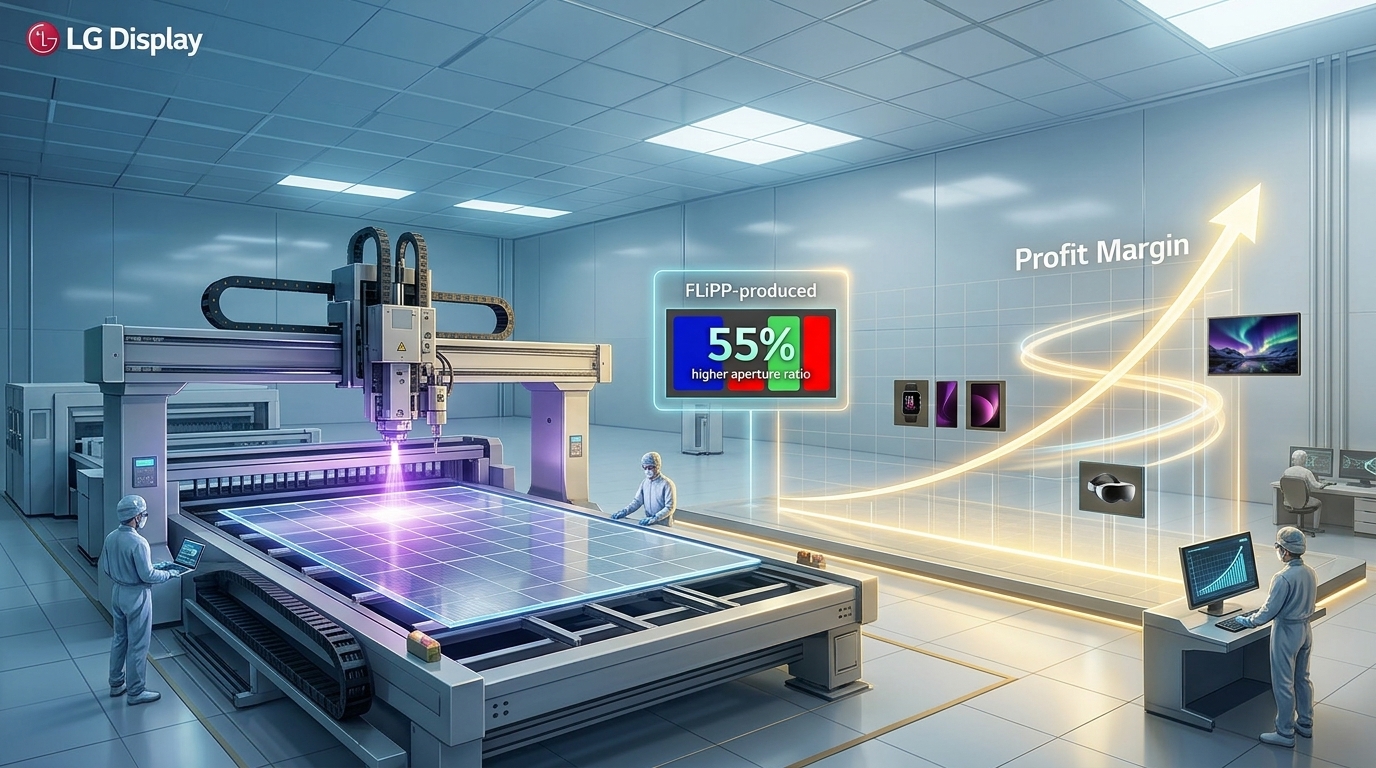
LG Display Co., Ltd. (NYSE: LPL) has recently unveiled FLiPP, a proprietary OLED pixel-patterning technology designed to eliminate the fine metal mask, or FMM, from the manufacturing process. The pitch is unusually attractive for a display business: brighter panels, longer product life, lower power consumption and potentially more efficient factory economic, all from a technology once treated as something of an OLED “dream.” For investors, this is more than another CES-style promise of prettier pixels. FLiPP could signal that LG Display (NYSE: LPL) is trying to change the industrial math behind OLED manufacturing, where yield, material use and production flexibility can matter as much as what the consumer sees on the screen.
The OLED Industry’s Mask Problem
For more than a decade, OLED manufacturers have generally used fine metal masks to form red, green and blue subpixels. In simplified terms, the FMM process works like a highly sophisticated stencil: organic emissive materials are deposited through microscopic openings in a metal sheet to create the pixel structure. It is precise, but it comes with real physical limitations. Fine masks are delicate, costly and difficult to scale for larger panels; they can sag or misalign, increasing the risk of color-mixing defects and manufacturing complexity. The need to customize mask configurations for differing panel specifications also limits production flexibility. The display industry has long had an uncomfortable relationship with this equipment. Fine metal masks are engineering marvels, but they are also a bit like conducting an orchestra with a lace handkerchief: beautiful in theory, temperamental in execution.
FLiPP Replaces the Stencil
FLiPP—FMM-Less innovative Pixel Patterning—takes a different route. Rather than depositing red, green and blue OLED materials through a metal mask, LG Display applies the RGB materials sequentially, secures them in defined locations and uses photolithography to pattern the pixels. Precision ultraviolet light helps remove unwanted material, leaving the desired pixel structure behind. The approach borrows a familiar concept from semiconductor fabrication: use light-driven patterning to make increasingly precise structures. In OLED manufacturing, that could replace a physical metal-mask constraint with a more flexible process architecture. LG Display says this was the result of roughly a year of concentrated research and development. The company has filed FLiPP trademark applications in Korea and key global markets, underscoring its intention to establish the platform as proprietary technology rather than a fleeting trade-show novelty.
Bigger Pixels, Better Economics
The central technical advantage is aperture ratio, the share of a display’s total surface area occupied by active RGB pixels. Conventional FMM-based production requires spacing between pixels, in part because of the physical limitations of mask-based deposition. LG Display says FLiPP removes much of that unused space, increasing aperture ratio by about 55% relative to conventional FMM-produced panels under comparable conditions. That opens several potential product-design choices: use the larger active area to produce a brighter display, extend longevity by operating at lower intensity, or reduce power use while maintaining performance.
| LG Display FLiPP claim | Reported improvement | Why investors may care |
|---|---|---|
| Brightness | Up to 1.6x higher | Enhances premium display performance, HDR impact and outdoor visibility |
| Lifespan | Up to 2.4x longer | Could improve product durability and address a key OLED value proposition |
| Power consumption | Up to 13% lower | Especially relevant for battery-sensitive tablets, notebooks, wearables and XR devices |
| Aperture ratio | Approximately 55% higher | Supports better use of display area and multiple performance trade-offs |
| Mother-glass utilization | Up to 64% higher for same-size OLED laptop panels | Could reduce material waste and strengthen panel-manufacturing economics |
These figures are LG Display’s reported comparisons under identical conditions, and real-world commercial performance will depend on panel design, yield and customer qualification. Still, it is rare for a new manufacturing approach to offer a plausible pathway toward higher visual performance and lower resource intensity at the same time.
The Factory-Floor Opportunity
The investment story gains credibility because FLiPP is not being positioned solely as an experimental process. LG Display says it has used its existing large-sized Tandem WOLED production infrastructure and technical expertise to manufacture FMM-less OLEDs on a full 8.5-generation mother-glass substrate—the first display company it says has done so as a single whole piece. That distinction matters. A mother-glass substrate is the large sheet from which multiple finished panels are cut. Conventional FMM constraints can require a substrate to be divided before processing, which may sacrifice usable area and increase manufacturing complexity. LG Display says processing whole 8.5-generation mother glass through FLiPP can improve utilization efficiency for same-sized OLED laptop panels by up to 64%. If commercially repeatable, better glass utilization could mean less material waste, lower cost per panel and a more competitive position in the fast-growing premium IT-display category. No investor should confuse a utilization claim with immediate gross-margin expansion. Commercial success will depend on production yield, throughput, depreciation, customer qualification and pricing. But the direction is compelling: OLED leaders that improve the economics of the factory can create advantages that are harder for competitors to erase with a glossy product launch.
Why Tablets and Monitors Come First
LG Display plans to initially deploy FLiPP in IT OLED applications, notably tablets and monitors, before widening its reach into formats that can theoretically span from one-inch wearables to 100-inch ultra-large displays. The initial focus is strategically sound.
Tablets, notebooks and premium monitors sit at an attractive intersection of buyer demand and manufacturing logic:
- Consumers and enterprise buyers value high brightness, thin designs, battery efficiency and color quality.
- Larger IT panels make mother-glass utilization particularly meaningful.
- PC makers are seeking differentiation as artificial-intelligence-capable devices encourage hardware upgrades.
- Longer panel life and reduced power use can strengthen OLED’s case against established LCD alternatives.
The eventual addressable market could be broader. Efficient, high-performance OLEDs would have clear relevance for automotive cockpit displays, extended-reality hardware, premium televisions, gaming monitors and wearables—categories where display quality is often part product feature and part brand identity.
Public-Company Read-Through
The most direct public-market exposure is LG Display (NYSE: LPL). Its FLiPP rollout should be evaluated as a multi-stage execution story: technology validation, commercial yields, customer adoption, capacity investment and ultimately financial conversion.
Other publicly traded companies with potential thematic exposure include:
- Apple Inc. (NASDAQ: AAPL): A major buyer and designer of premium displays across tablets, notebooks, smartphones and wearable devices.
- Dell Technologies Inc. (NYSE: DELL): A potential beneficiary if more capable and energy-efficient OLED panels broaden the premium monitor and notebook opportunity.
- HP Inc. (NYSE: HPQ): Another major PC vendor for which advanced displays can support higher-end product differentiation.
- Lenovo Group Ltd. (OTC: LNVGY): A global PC supplier positioned in the expanding premium laptop and tablet market.
- Sony Group Corporation (NYSE: SONY): A leader in premium entertainment hardware and television categories where OLED performance is commercially important.
- Samsung Electronics Co., Ltd. (OTC: SSNLF): Both a global display-industry competitor and a key consumer-electronics benchmark in the race for OLED innovation.
- Meta Platforms, Inc. (NASDAQ: META): A longer-term thematic read-through, as displays with improved brightness and energy efficiency could benefit virtual- and mixed-reality hardware economics.
None of these companies has been announced as a FLiPP customer, supplier or commercial partner. The relevance is strategic rather than contractual: the more successful LG Display becomes at scaling a flexible, efficient OLED platform, the more options device makers may have to differentiate premium hardware.
A Bullish Story With a Necessary Asterisk
The bullish case for LG Display (NYSE: LPL) is straightforward. FLiPP attacks three OLED manufacturing priorities at once: performance, durability and efficiency. It also seeks to remove a production constraint that has limited flexibility in the traditional FMM process.
The next questions are practical, and they are the ones the market should watch:
- Can LG Display maintain attractive yield and throughput at mass-production scale?
- How much of the reported glass-utilization advantage turns into lower per-panel cost?
- When will tablet, monitor and laptop customers qualify FLiPP-based panels?
- Can the platform expand into automotive, XR, wearable and television categories while preserving its technical edge?
- Will improved panel economics strengthen LG Display’s (NYSE: LPL) earnings power through the display cycle?
LG Display has not disclosed a consumer-product launch timetable or provided financial guidance directly tied to FLiPP. That makes the technology an emerging catalyst rather than a completed earnings event. Still, the company has put a credible new idea on the board. If FLiPP scales from technical achievement to high-yield production, LG Display (NYSE: LPL) may be doing more than eliminating a metal mask. It may be removing a recurring constraint on OLED economics, an outcome that can make the screen brighter and the investment narrative brighter still.
The Sources
- LG Display: “LG Display Unveils FLiPP, Achieving Dream Next-Generation OLED”
- LG Display: “An OLED Patterning Technology That Eliminates the Need for FMM Once Called a Dream Technology, FLiPP”
- LG Display: “IMID 2026 LG Display Unveils New Possibilities for the AI Era With OLED”
- PR Newswire: “LG Display Unveils FLiPP, Achieving Dream Next-Generation OLED”
- The Verge: “LG’s New OLED Breakthrough Can Boost Display Lifespans”
- Forbes: “LG Display Develops New OLED Panels With More Brightness and Longer Lifespans”
- Korea JoongAng Daily: “LG Display Unveils Its Maskless OLED Technology for the First Time”
- The Korea Herald: “LG Display Ditches Masks for Brighter, Longer-Lasting OLEDs”
- FlatpanelsHD: “LG’s New ‘FLiPP’ OLED Promises Brighter, Longer-Lasting Displays up to 100 Inches”
- Ubi Research: “LG Display Unveils 27-Inch FLiPP OLED, Reviews Use of Existing Facilities for IT Investment”
Stay Updated with Vista Partners
Subscribe to receive market insights, investing ideas, and the latest updates directly in your inbox.