Skip to content Skip to sidebar Skip to footer

Singapore’s S$1 Billion AI Bet: The Tiny Island Making a Big Tech Power Play

Singapore is writing a big‑tech future on a very small canvas, and it just sharpened the pen with more than S$1 billion (about US$779 million) in fresh AI and frontier‑tech funding over the next five years. This latest push cements the city‑state’s strategy: don’t try to outspend Washington or Beijing—out‑focus them,

The new capital falls under Singapore’s evolving National AI Strategy 2.0 and its broader Research, Innovation and Enterprise (RIE) framework, which already channels billions into advanced manufacturing, semiconductors, biotech, and quantum technologies. For investors, it is less an isolated budget line and more a signal flare that this jurisdiction intends to be a price‑setter, not a price‑taker, in the next computation cycle.

What the S$1 Billion AI Push Really Buys

At headline level, the new package is aimed at strengthening public sector AI capabilities, building local compute and talent, and aligning Singapore’s economy with an AI‑driven world. Beneath the official phrasing, the message is straightforward: the country wants to ensure its researchers and companies are renting fewer GPUs in someone else’s cloud and owning more of the value chain at home.

This funding sits on top of earlier commitments, including roughly US$554 million announced in 2024 to deepen national AI capabilities and support secure rollout of AI under NAIS 2.0. Add in targeted schemes such as “AI for Science,” backed by an additional S$120 million, and you get a policy mix that treats AI not as an app layer but as core scientific infrastructure. In Wall Street terms, Singapore isn’t just buying AI; it’s dollar‑cost‑averaging into the entire stack.

From AI Nation to Quantum Outpost

The new AI money arrives in a country that already behaves like a diversified technology ETF. Singapore has committed US$18.4 billion to public‑sector research under its RIE 2025 plan, with “Human Health and Potential” and deep‑tech domains such as quantum, advanced manufacturing, and biotechnology squarely in scope. That includes a dedicated National Quantum Strategy funded with about US$223.9 million to build a quantum ecosystem spanning research, talent, and commercialization.

On the ground, the strategy shows up as hard assets and real companies. Singapore accounts for roughly 10% of the global semiconductor chip market and about 20% of chip equipment production, anchoring its ambition to grow manufacturing output by 50% by 2030. At the same time, the government has launched focused quantum programs and co‑investment schemes that have helped the country capture about 58% of ASEAN venture funding and draw global investors into local quantum start‑ups. In a world where every major capital now talks about “chips, qubits, and talent,” Singapore has decided to specialize in being the place where all three actually ship.

Why Global Capital Should Care

For investors, Singapore’s AI and quantum push matters less for its absolute size and more for its signaling content. The United States, China, and the European Union are deploying vastly larger pools of money into advanced chips and quantum research, but Singapore’s approach is unusually targeted: it concentrates capital on commercialization pathways, industry partnerships, and talent programs rather than diffuse subsidies. That focus reduces policy noise and makes it easier for global funds to underwrite the risk.

The domestic response suggests the strategy is working. Early‑stage emerging‑tech start‑ups in Singapore raised about US$402 million in 2023, up 59% from the prior year, even as global venture funding cooled. In parallel, fintech and AI‑heavy firms continue to cluster in the city, supported by more than 1,300 local fintech companies and a pipeline of AI, blockchain, and quantum projects backed under MAS’s FSTI 3.0 scheme. When a small, open economy keeps attracting capital while everyone else complains about “higher for longer,” markets usually take notice.

The Smart‑Nation Trade: Data, Trust, and Scale

Singapore’s long‑running “Smart Nation” agenda is the backdrop that makes the new AI infusion more than a one‑off headline. The government has built out digital‑economy plumbing, from pervasive connectivity and 5G to AI governance frameworks like AI Verify and new model guidelines for generative AI. At the same time, regulators are tightening cyber‑ and data‑protection rules, responding to a surge in scams and cyber incidents and reinforcing the country’s pitch as a trusted data hub.

That combination—heavy digital usage, explicit AI ambition, and muscular regulation—creates an interesting trade for multinationals: ship your data‑intensive workloads and bleeding‑edge models to a jurisdiction that promises both scale and guardrails. Some of the world’s largest tech and life‑science companies have already responded, setting up AI innovation hubs and cloud, health, and fintech labs in Singapore. In effect, the country is offering investors a new asset class: jurisdictional premium on trust..

The Punchline for Markets

For public‑market investors, Singapore’s S$1‑billion‑plus AI push is unlikely to move a single mega‑cap chart on Monday morning—but it will increasingly shape where growth, listings, and strategic partnerships originate over the next decade. As AI, quantum, and advanced manufacturing converge, jurisdictions that provide stable rules, deep talent, and credible long‑term funding tend to become natural homes for premium multiples.

Singapore’s wager is that in a noisy world, discipline is alpha. While bigger economies debate how to fund the future, the city‑state is quietly doing what it usually does: sizing the position, managing the downside, and letting compounding do the rest. For investors watching the next wave of AI and quantum winners, ignoring that trade may turn out to be the most expensive risk‑free decision in the portfolio.


The Sources

  1. Singapore – Strategic Technologies, U.S. International Trade Administration
    https://www.trade.gov/country-commercial-guides/singapore-strategic-technologies
  2. “Singapore To Invest More Than S$1 Billion In AI Research And Development”
    https://www.businesstoday.com.my/2026/01/24/singapore-to-invest-more-than-s1-billion-in-ai-research-and-development/
  3. “Further S$120M investment in ‘AI for Science’”, Singapore NRF / MDDI
    https://www.mddi.gov.sg/newsroom/further-120m-investment-in-ai-for-science/
  4. National AI Strategy, Smart Nation Singapore
    https://www.smartnation.gov.sg/initiatives/national-ai-strategy/
  5. “Singapore’s AI Strategy 2.0: Pioneering a Future of Innovation”
    https://www.oreateai.com/blog/singapores-ai-strategy-20-pioneering-a-future-of-innovation/d2117b04a119b5243775800de2741dc5
  6. “Government Spending on Quantum Computing: Who’s Investing the Most?”
    https://patentpc.com/blog/government-spending-on-quantum-computing-whos-investing-the-most-latest-stats
  7. “Quantum in Singapore: Opportunities for collaboration to drive growth”
    https://www.gov.uk/government/publications/quantum-in-singapore-opportunities-for-collaboration/quantum-in-singapore-opportunities-for-collaboration-to-drive-growth
  8. “The History of AI – Part 2: Singapore’s AI Journey”
    https://www.tech.gov.sg/technews/the-history-of-ai-part-2-singapore-ai-journey/

Nvidia’s Jensen Huang Just Drew the Map for a Trillion‑Dollar AI Buildout – ( $JPM $NVDA $SPY )

At Davos, Nvidia (NVDA) CEO Jensen Huang didn’t just talk his book; he effectively redrew the global capex budget for the next decade, arguing that the world is only a “few hundred billion” dollars into what will be a trillions‑of‑dollars AI infrastructure buildout. He framed the surge as “the largest infrastructure buildout in history,” a supercycle that stretches from power grids to data centers and all the way up to application developers.

Huang’s point is simple but market‑moving: the AI trade isn’t about one chip upgrade cycle, it’s a long-haul re-tooling of the digital and physical economy. Investors fretting about an “AI bubble,” he suggested, may be confusing a long-duration capex cycle with a short-lived mania.

The Five‑Layer AI “Cake” Wall Street Has to Model

Huang likens AI to a five‑layer “cake”: at the base is energy, then chips, cloud infrastructure, AI models, and finally the application layer where profits are most visible. Each layer has to scale in sync, which means this is less a story about one hero stock and more a coordinated global buildout.

Consultants and banks are now putting numbers to that cake. McKinsey estimates that data centers alone will require nearly 7 trillion dollars of capex by 2030, with about 5.2 trillion targeted specifically at AI‑ready facilities. J.P. Morgan ( JPM) projects AI infrastructure spending could reach 1.4 trillion dollars per year by 2030, underscoring how quickly this line item could rival traditional industrial capital outlays.

From Capex Line Item to Global Construction Boom

For once, Wall Street’s favorite growth story is also a boon for people in hard hats. Analysts describe AI infrastructure as the largest infrastructure supercycle in modern history, with 2026 capex on AI data centers and associated power needs projected at roughly 602 billion dollars, up more than a third from 2025. Moody’s sees at least 3 trillion dollars in data center investment over the next five years, driven by hyperscalers racing to add capacity.

That spending doesn’t just buy GPUs; it hires electricians, engineers, and construction crews. Recent analysis suggests AI‑driven data center construction could create a wave of six‑figure technical and construction jobs as capacity scales, turning what used to be a niche real‑estate segment into a macro‑relevant employer. If the last tech boom minted software millionaires, this one may do the same for professionals who know their way around megawatts and chilled water.

GPUs as the New “Toll Booths” of the Data Economy

Underneath the cranes and concrete, Nvidia remains the dominant toll collector. GPUs now represent roughly 39% of total data center spending, making them the single biggest cost driver in AI infrastructure builds. Nvidia controls an estimated 92% of the AI data center GPU market, a position reinforced by a rapid product cadence that keeps each new architecture meaningfully ahead of rivals.

That dominance has prompted some bolder forecasts. One analysis pegs AI capex climbing from around 600 billion dollars in 2025 toward 3–4 trillion by 2030, arguing that Nvidia’s role as the indispensable compute layer could support a path toward a 10 trillion dollar market capitalization if the cycle runs its course. On that math, every incremental dollar of AI data center spend is less a headline and more a recurring toll payment.

Is This an AI Bubble or the New Baseline?

Talk of trillions tends to summon ghosts of the dot‑com era, and skeptics warn that outsized data center and chip budgets could eventually collide with more sober demand. Huang’s rebuttal leans on two realities: first, AI workloads are rapidly becoming foundational across sectors from healthcare and finance to manufacturing; second, we’re still early in building the “application layer” that ultimately monetizes that compute.

Forecasts back up that shift. McKinsey estimates AI‑related workloads could command the majority of data center capacity by 2030, with AI‑optimized servers driving most of the new power demand. J.P. Morgan’s view that AI infrastructure could triple to 1.4 trillion dollars annually by the end of the decade reframes the current spending spike less as a bubble and more as the new baseline for digital-era infrastructure. If Huang is right, the real risk for investors isn’t that the AI buildout is too big—it’s that their models still assume it’s temporary.


The Sources


[1] Nvidia CEO Jensen Huang: ‘Trillions of dollars of AI infrastructure … https://finance.yahoo.com/news/nvidia-ceo-jensen-huang-trillions-of-dollars-of-ai-infrastructure-needs-to-be-built-144212721.html
[2] What Bubble? Nvidia CEO Says AI Needs Trillions More in … https://finance.yahoo.com/news/bubble-nvidia-ceo-says-ai-225727598.html
[3] Nvidia CEO says AI boom is fueling the ‘largest’ infrastructure … https://finance.yahoo.com/news/nvidia-ceo-says-ai-boom-154207631.html
[4] The cost of compute: A $7 trillion race to scale data centers – McKinsey https://www.mckinsey.com/industries/technology-media-and-telecommunications/our-insights/the-cost-of-compute-a-7-trillion-dollar-race-to-scale-data-centers
[5] 13 Data Center Growth Projections That Will Shape 2026-2030 https://avidsolutionsinc.com/13-data-center-growth-projections-that-will-shape-2026-2030/
[6] AI Infrastructure Could Triple to $1.4 Trillion by 2030 – Nasdaq https://www.nasdaq.com/articles/ai-infrastructure-could-triple-14-trillion-2030-heres-best-stock-buy-2026
[7] Whether To Follow $602 Billion Flowing To AI Data Centers In 2026 https://www.forbes.com/sites/petercohan/2026/01/23/whether-to-follow-602-billion-flowing-to-ai-data-centers-in-2026/
[8] Moody’s sees $3T in data center spending by 2030 | Construction Dive https://www.constructiondive.com/news/moodys-data-center-spending-2031/810055/
[9] Nvidia CEO says AI boom will create ‘six-figure’ construction jobs https://finance.yahoo.com/news/nvidia-ceo-says-ai-boom-172142457.html
[10] Nvidia’s S-Curve: The Physical Buildout Driving Exponential Demand https://www.ainvest.com/news/nvidia-curve-physical-buildout-driving-exponential-demand-2601/
[11] Is Nvidia Still a Buy in 2026? Can NVDA Reach a $10 Trillion … https://www.tradingkey.com/analysis/stocks/us-stocks/261505954-nvda-nvidia-stock-price-2026-2030-tradingkey
[12] Nvidia CEO Jensen Huang: AI infrastructure buildout is ‘sensible’ https://finance.yahoo.com/video/nvidia-ceo-jensen-huang-ai-143500353.html
[13] Trillions of dollars of AI infrastructure needs to be built https://x.com/YahooFinance/status/2015184375772573974
[14] Nvidia CEO Jensen Huang says AI buildout still needs trillions of … https://www.youtube.com/watch?v=3Y8PvfUwaEw
[15] Nvidia CEO urges continued spending into AI: Top takeaways https://finance.yahoo.com/video/nvidia-ceo-urges-continued-spending-213600478.html

Vertical Aerospace’s Valo: The Air Taxi Aiming to Turn NYC Traffic into a Spectator Sport – ( $AAL $EVTL $JOBY $UBER )

Air Taxis Over Manhattan: Vertical Aerospace Bets the Jetsons Were Just Early

Vertical Aerospace (EVTL) is trying to turn New York’s infamous gridlock into a spectator sport — viewed from several hundred feet up in an electric air taxi that aims to cost about what you’d pay for an Uber Black to JFK, just without the traffic, the honking, or the existential questions at the Lincoln Tunnel entrance.


Meet Valo: The Six-Seat “Uber in the Sky”

This week in New York, the UK-based company rolled out Valo (pronounced “VAY-low”), its full-scale electric vertical take-off and landing aircraft, or eVTOL, with a wingspan close to 50 feet and room for six passengers plus a pilot and their bags. The aircraft is designed for trips up to roughly 100 miles, with the sweet spot being shorter hops flown back-to-back before a recharge.

Eight quiet electric rotors handle the vertical work, then four forward propellers rotate 90 degrees to push Valo into cruise, targeting speeds of around 150 miles per hour with zero operating emissions. The cabin, shown off in Manhattan with an upscale interior, is built around comfort and panoramic views, the kind of design that suggests the future of commuting might involve more Instagram stories and fewer subway delays.


Democratizing the Skies (Without the Helicopter Price Tag)

Vertical chairman Dómhnal Slattery insists this isn’t another toy for the helicopter set, which has long treated urban airspace like a private cul-de-sac. The company’s ambition is to “democratize” urban air mobility by targeting fares in the neighborhood of an Uber Black ride per seat on a six-passenger configuration — in New York, that’s roughly the $150 downtown–JFK run, before surge pricing and hurt feelings.

The economic bet is that fully electric aircraft — quieter, with lower operating and maintenance costs than conventional helicopters — can bring per-seat pricing down enough to widen the customer base beyond CEOs and hedge fund managers racing to beat the closing bell. If Vertical is right, the helicopter pad becomes less a status symbol and more a transit node, and the “last 15 miles to the airport” turns into a five- to ten-minute aerial shuttle.


The Route Map: From Downtown Pads to Stadium Lights

Valo’s New York coming-out party is not just a photo opportunity; it is the front end of a proposed network of electric routes linking Manhattan to the region’s key aviation and entertainment hubs. Vertical is working with Bristow Group, one of the world’s largest helicopter operators, and Skyports Infrastructure, which manages heliports around New York, to chart airport transfers between Manhattan and JFK, Newark, Teterboro, and even East Hampton.

Use cases under discussion range from airport shuttles to game-day hops to MetLife Stadium and sightseeing flights that lean on Valo’s spacious, quiet cabin and large windows. Existing operators like Blade, which currently rely on traditional helicopters for airport runs and charters, and Joby Aviation (JOBY), which plans to operate its own eVTOL aircraft, help underscore just how crowded this future airspace could become — more like a premium bus lane in the sky than a lonely luxury lane.


A Manufacturer, Not a Flying Taxi App

Unlike some rivals, Vertical does not plan to operate the taxi service itself; it wants to be the Boeing or Airbus of the eVTOL world, selling aircraft to airlines and operators that already know how to move people and manage complaints about carry-on luggage. The company’s order book spans roughly 1,500 pre-orders and options from carriers including American Airlines (AAL), Japan Airlines, AirAsia, GOL, Avolon, and Bristow, giving the Valo program a customer roster that looks more like a global alliance than a start-up pitch deck.

Vertical pitches itself as an “asset-light” original equipment manufacturer, leveraging partnerships with established aerospace suppliers like Honeywell, GKN, and others, while building out its own battery and propeller technology. The company says it has spent significantly less per aircraft than competitors while still aiming for a best-in-class safety and powertrain profile — an efficiency story public-market investors will parse as carefully as any performance metric.


The Regulatory Gauntlet and the 2028 Line in the Sky

None of this airborne optimism gets off the ground without regulators, and on that front Vertical is aiming high and playing the long game. Valo is slated to enter a rigorous certification process with European and UK aviation authorities, which Slattery argues are even more demanding than their U.S. counterparts, with the goal of achieving certification-standard approval around 2028.

To get there, Vertical plans to build seven Valo certification aircraft in the UK, doubling its flight-test capacity and moving into piloted transition testing — the critical moment when an eVTOL stops behaving like an elevator and starts behaving like an airplane. The company also plans a U.S. tour for Valo beginning in 2026, starting in New York, to showcase the aircraft to partners, regulators, and perhaps a few skeptical travelers who still remember the first time they trusted a rideshare app.


Beyond the Skyline: Industrial Ambition and Economic Upside

Behind the glossy renderings and Manhattan photo ops lies a straightforward industrial dream: rebuilding aircraft design and manufacturing in the UK and securing a leading position in the emerging advanced air mobility market. Founded in 2016 by entrepreneur Stephen Fitzpatrick, better known for OVO Group, Vertical is part aerospace start-up, part industrial policy experiment, projecting that its activities could add up to £3 billion annually to the UK economy by 2035 if the market develops as hoped.

Vertical describes its mission as pioneering electric aviation and reshaping urban transport to be quieter, faster, and cleaner, a pitch that aligns neatly with climate goals and city-level pushes to curb congestion and emissions. If the company can deliver on certification, operations, and costs, the morning commute in the 2030s may involve a familiar question — “car, subway, or ride-share?” — with a new, slightly more entertaining option tacked on at the end: “or should we just fly over it?


The Sources

  1. Vertical Aerospace wants to “democratize” urban air travel with its Valo air taxi – Yahoo Finance
    https://finance.yahoo.com/news/vertical-aerospace-wants-to-democratize-urban-air-travel-with-its-valo-air-taxi-160010939.html[finance.yahoo]​
  2. Vertical Aerospace awaiting approval for NYC air taxi service – Yahoo Finance Video
    https://finance.yahoo.com/video/vertical-aerospace-awaiting-approval-nyc-213108925.html[finance.yahoo]​
  3. Vertical Aerospace Brings Valo to New York, Outlining Plans for Electric Air Travel Routes – Press release
    https://finance.yahoo.com/news/vertical-aerospace-brings-valo-york-120000496.html[finance.yahoo]​
  4. Vertical Aerospace: Investor Relations
    https://investor.vertical-aerospace.com/overview/default.aspx[investor.vertical-aerospace]​
  5. Vertical Aerospace Doubles Flight Test Capacity With Final Prototype – Press release (PDF)
    https://vertical-aerospace.com/wp-content/uploads/2025/12/Vertical_Aerospace_Doubles_Flight_Test_Capacity_With_Final_Prototype.pdf[vertical-aerospace]​
  6. Vertical Aerospace Eyes 2028 Certification for New Valo eVTOL – Thomasnet
    https://www.thomasnet.com/insights/vertical-aerospace-valo-evtol/[thomasnet]​
  7. Vertical Aerospace – Company Profile (ADSG)
    https://www.adsgroup.org.uk/members/vertical-aerospace-2/[adsgroup.org]​
  8. Vertical Aerospace – Wikipedia
    https://en.wikipedia.org/wiki/Vertical_Aerospace[en.wikipedia]​
  9. Vertical Aerospace Ltd. – Company Profile and News – Bloomberg
    https://www.bloomberg.com/profile/company/EVTL:US[bloomberg]​
  10. Can electric air taxis really ease city gridlock? – Yahoo News
    https://ca.news.yahoo.com/electric-air-taxis-really-ease-060113326.html[ca.news.yahoo]​
  11. Joby Aviation, Inc. (JOBY) – Yahoo Finance
    https://finance.yahoo.com/quote/JOBY/[finance.yahoo]​
  12. Vertical Aerospace brings Valo eVTOL to New York, outlines plans for air taxi routes – Vertical
    https://verticalmag.com/press-releases/vertical-aerospace-brings-valo-evtol-to-new-york-outlines-plans-for-air-taxi-routes/amp/[verticalmag]​
  13. Vertical Aerospace Ltd. (EVTL) – Yahoo Finance
    https://finance.yahoo.com/quote/EVTL/[finance.yahoo]​

AI, Tariffs, Gold, Silver, and Trillion‑Dollar Pharma: Weekly Market Wrap – January 23, 2026 -( $DV $EPRX $GLD $GOVX $INTG $LLY $MCD $MU $NOK $NVDA $RIO $SLV $TSLA Rise!)

Indexes and overall tone

Wall Street limped into the weekend looking more like a tired marathoner than a sprinter, as major U.S. equity indexes closed a volatile, tariff‑tossed week with modest moves that felt heavier than the point changes implied. The S&P 500 ended the period with its second straight weekly decline, the Dow industrials slipped again under the weight of old‑economy bellwethers, and the Nasdaq managed to dip slightly too over the course of the week that said more about investors’ reluctance to abandon AI and chip darlings than any broad conviction. Small caps, represented by the Russell 2000, fared a little worse as risk appetite waned, leaving the index lower on the week and reminding traders that not all boats rise in a choppy tide.

Macro backdrop and Fed watch

The macro backdrop was busy for a holiday‑shortened stretch, even if the data did more to refine narratives than to rewrite them. Inflation remained the central preoccupation, with attention firmly trained on consumption and the Fed’s preferred gauges as investors weighed whether price pressures are easing enough to justify rate cuts this year or merely drifting toward a higher‑for‑longer plateau. Forecasts for the Personal Consumption Expenditures readings pointed to month‑over‑month gains around 0.2% and year‑over‑year inflation stuck near 2.8%, a level uncomfortably above the Federal Reserve’s 2% objective and therefore conveniently supportive of officials’ cautious rhetoric. Growth indicators remained mixed: a solid GDP backdrop, resilient labor markets, and expansionary but subdued purchasing managers’ indexes all painted the picture of an economy slowing from a sprint to a controlled jog rather than flirting with recession. Consumer sentiment was expected to hold in the mid‑50s on the University of Michigan index, a reading that suggests households are more resigned than exuberant but not yet in the mood for recessionary storytelling.

Rates, yield curve and FOMC expectations

Monetary policy, never far from the market’s mind, loomed large in the background as traders looked ahead to the next’s Jan. 27-28 Federal Open Market Committee (FOMC) gathering, widely expected to result in another “hold‑and‑watch” decision rather than a dramatic pivot. With inflation still running above target and growth not yet cracking, futures markets continued to price in a cautious path of eventual easing, while policymakers signaled that restrictive settings could persist longer than investors would prefer but shorter than the bond market’s more pessimistic scenarios once advertised. The yield curve stayed compressed, with shorter‑dated rates anchored by Fed expectations and longer‑term yields reflecting a blend of inflation uncertainty and term premium, a structure that still whispers late‑cycle rather than early‑recovery.

Tariffs and trade policy

Trade policy took another turn on the geopolitical stage, where tariffs once again auditioned for the role of main antagonist before being asked to stand down—for now. President Trump moved to pause a planned 10% levy on imports from eight NATO allies, offering markets a brief sigh of relief and a reprieve from what had threatened to be another front in the global trade skirmishes. Anxiety around tariffs on European goods faded somewhat as the week progressed, but not enough to restore full risk‑on cheer, particularly with tensions between Washington and European capitals still simmering over strategic assets and influence.

Greenland and geopolitics

The Greenland saga, which might have looked like geopolitical fan fiction a few years ago, continued to cast a peculiar shadow over asset markets. The administration touted a “framework” for a deal around Greenland‑related interests, keeping investors attentive to the intersection of Arctic resources, European relations, and U.S. strategic ambitions. Meanwhile, tensions over U.S.–European control and influence around Greenland and nearby strategic zones remained a recurring theme in foreign‑policy commentary, adding yet another non‑economic variable into models already juggling inflation, growth, and policy risk.

Commodities and bitcoin

In the commodities complex, gold decided subtlety was overrated. The metal surged to fresh record highs, briefly topping the 4,900‑dollar‑per‑ounce mark and logging its best week since 2020 as a weaker dollar, & actually hit $4,989.90 just under the 5k mark as geopolitical jitters, and doubts about the durability of disinflation stoked safe‑haven demand. Silver, not to be outdone, crossed the psychologically loud 100‑dollar threshold closing at $103.36/oz., underscoring just how far the precious‑metals trade has run in a world rediscovering hedges against both inflation and political uncertainty. Oil prices edged 1.56% higher this week to $61.28/bbl as traders weighed President Trump’s remarks about a Greenland‑related “framework” and broader cross‑Atlantic tensions, signaling that crude remains a convenient vessel for pricing geopolitical unease as much as physical supply and demand. Bitcoin trading around $89.5K, for its part, remained a lightning rod for speculation and macro narratives, trading as a high‑beta proxy on liquidity expectations and risk sentiment even as traditional safe havens stole the week’s spotlight.

Eli Lilly and big pharma

On the corporate front, Eli Lilly (LLY, $1,064.29, +3.03% over the last 5-days) continued to behave more like a marquee tech name than a staid pharmaceutical concern. Shares climbed this week, helped by the U.S. Food and Drug Administration granting Breakthrough Therapy designation to sofetabart mipitecan, an oncology candidate for a subset of ovarian cancer patients, reinforcing the company’s reputation as a central player in both obesity and cancer therapeutics. Analysts kept up a drumbeat of bullishness, with estimates and coverage reiterating the view that Lilly’s earnings trajectory and drug pipeline justify its lofty valuation and trillion‑dollar market capitalization, even if shorter‑term volatility occasionally reminds investors that gravity has not been formally repealed.

Chips, AI hardware and foundries

The semiconductor and AI hardware narrative remained dominated by a familiar cast of characters, with Taiwan Semiconductor Manufacturing Company, Nvidia, Apple, Micron, Broadcom, and Intel all central to the week’s conversations. TSMC’s role as the indispensable foundry to Nvidia (NVDA, $187.67, +.33% over the last 5-days), Apple, and other chip leaders was once again underscored, with the company’s ongoing multibillion‑dollar expansion in Arizona seen as both a hedge against geopolitical risk and a vote of confidence in the long‑term AI and high‑performance‑computing boom. Nvidia retained its status as the poster child of AI infrastructure, with fresh analyst commentary highlighting its dominant share of data center accelerators and raising price targets on the premise that trillions of dollars in AI‑related capex are still ahead. Micron (MU, $399.65, +18.72% over the last 5-days), riding the coattails of insatiable AI memory demand, enjoyed continued enthusiasm as rising DRAM prices and long‑term supply contracts reinforced the notion that the memory cycle has turned decisively in its favor. Broadcom, meanwhile, stayed in the frame as a critical enabler of AI networking and custom chips, benefiting from its position at the heart of data center plumbing even as investors debated just how long the current spending cycle can persist.

Intel and earnings disappointments

Intel (INTC, $45.07, -6.73% over the last 5-days) had a more complicated week, with the stock sliding after earnings disappointed investors who had come to expect a cleaner turnaround narrative from the once‑dominant chipmaker. The company’s soft results, coupled with cautious guidance, weighed on the broader Dow and tech complex, reminding markets that not every player in the AI ecosystem is benefiting equally from the current wave of spending. At the same time, some commentary pointed out that Intel’s recent rally had left it vulnerable to even modest underperformance, and the reaction may have reflected expectations as much as fundamentals.

Big Tech, EVs and software names

Big Tech and adjacent names continued to command attention. Apple remained a core holding in many AI‑and‑ecosystem portfolios, with its role as both a device maker and potential beneficiary of on‑device intelligence keeping it central to discussions about the next leg of tech hardware demand. Meta stayed in focus as investors weighed its heavy AI infrastructure spending against the durability of its advertising franchise and the potential upside of new monetization initiatives. Tesla remained a lightning rod, with attention on its progress in autonomous driving and new services—such as expanded robotaxi offerings—helping to sustain speculative interest despite ongoing questions about growth, competition, and margins. Palantir continued to be cast as a high‑growth software name at the intersection of AI and data analytics, with deals and long‑term contracts feeding expectations of continued revenue expansion and a maturing commercial business. Tesla (TSLA, $449.06, +2.39%) as Elon Musk spoke positively at Davos about robot axis and beyond.

Networks, cloud, nuclear and prop‑tech

Beyond the mega‑caps, the broader technology and digital‑economy cohort offered its own color. Nokia (NOK, $6.77., +2.42% over the last 5-days) stayed part of the conversation around network infrastructure and 5G‑and‑beyond deployments, a space that benefits from rising data consumption but has to wrestle with cyclical carrier spending. Oracle featured in discussions about cloud and enterprise software, as investors weighed its position in databases and infrastructure‑as‑a‑service against larger rivals in an increasingly AI‑centric IT spending landscape. Oklo, representative of the new generation of nuclear‑technology developers, continued to draw attention from investors looking for long‑duration plays on clean baseload power, even as regulatory and financing hurdles remained front and center. Opendoor, emblematic of prop‑tech’s attempt to algorithmically tame the housing market, sat at the intersection of real‑estate cycles, interest rates, and investor tolerance for business models that depend on liquidity and price stability in historically volatile assets.

Defensives and cyclicals: McDonald’s and Rio Tinto

Outside of tech and healthcare, stalwarts like McDonald’s (MCD, $309.25, +.20%) and Rio Tinto (RIO, $90.43, +4.73%) reminded markets that cash‑flow reliability still has an audience. McDonald’s remained a defensive favorite, with its global footprint and pricing power offering investors a way to participate in consumer spending without betting heavily on the most economically sensitive categories. Rio Tinto, by contrast, provided exposure to industrial metals I.e. copper that hit new highs, and global growth expectations, its fortunes closely tied to both Chinese demand and broader infrastructure‑and‑energy transitions.

Deals, M&A and IPO mood

In dealmaking, the week delivered at least one headline to remind investors that corporate strategists have not entirely gone into hibernation. Capital One announced an agreement to acquire corporate‑card and spend‑management platform Brex for roughly 5 billion dollars, a price that represents a sharp discount to the start‑up’s peak private‑market valuation and a telling snapshot of how the late‑cycle funding boom has deflated. The transaction highlighted how established financial institutions are still using acquisitions to buy technology and new customer relationships, while founders and early investors in high‑growth fintechs are being introduced to the concept of “downside scenarios” the hard way.

In the primary markets, the pipeline for initial public offerings on the New York Stock Exchange and Nasdaq remained active but selective, with investors showing renewed interest in companies tied to AI and chips while maintaining a more cautious stance toward businesses that lack clear profitability paths. Activity continued to be shaped by the same calculus that has dominated since the last cycle’s froth faded: firms with strong cash flows, defensible niches, or direct links to AI and data infrastructure can find a receptive audience, while others are encouraged—politely—to wait for better conditions.

Closing perspective

Taken together, the week ending January 23, 2026, offered a familiar but still engrossing script: equity indexes grinding lower even as certain themes—AI hardware, weight‑loss and oncology drugs, safe‑haven metals—enjoyed star billing. The market, it seems, remains perfectly capable of worrying about tariffs, Greenland, inflation, and earnings all at once, even as investors continue to pay up for growth stories that promise to turn today’s volatility into tomorrow’s compounded returns.

Vista Partners Watchlist Updates

Modular Medical, Inc. (Nasdaq: MODD., $.4667), a leader in innovative insulin delivery technology targeting the $3 billion adult “almost-pumpers” diabetes market with user-friendly, affordable patch pumps, announced (Dec. 10) that it had priced an underwritten public offering (the “offering”) of 12,173,000 shares of its common stock and accompanying warrants to purchase 6,086,500 shares of its common stock. Each two shares of common stock are being offered and sold together with one accompanying warrant at a combined offering at a price of $0.77, yielding an effective price of $0.38 per share and $0.01 per warrant. The warrants will have an exercise price of $0.45 per share, are exercisable immediately upon issuance and will expire five years following the date of issuance. In connection with the offering, Modular Medical has granted the underwriter a 30-day option to purchase up to an additional 15% of common shares and/or warrants at the public offering price, less underwriting discounts and commissions. The over-allotment option may be elected with respect to, at the underwriter’s sole discretion, shares and warrants together, solely shares, solely warrants, or any combination thereof. Newbridge Securities Corporation is acting as the sole bookrunner for the offering. Assuming no exercise of the over-allotment option, the gross proceeds to the Company from the offering are expected to be approximately $4.68 million, before deducting underwriting discounts, commissions, and estimated offering expenses payable by the Company. The Company intends to use the net proceeds from the offering to fund operations and for working capital and general corporate purposes, including capital expenditures.

On Nov. 17, Modular announced Institutional Review Board (“IRB”) approval to conduct an in-house study of its next-generation Pivot™ insulin delivery system using insulin on people with diabetes (the “Study”). Pursuant to U.S. Food and Drug Administration (“FDA”) regulations, an IRB is a group that has been formally designated to review and monitor biomedical research involving human subjects. The Study will simulate real-world conditions by delivering insulin to adult participants to gather critical data on device function and usability and obtain user feedback. Modular Medical’s Pivot tubeless patch pump aims to enhance accessibility for underserved patients with diabetes and drive market penetration and expansion.

On Nov. 14, Modular Medical announced the 510(k) premarket submission of its next generation Pivot™ tubeless patch pump to the U.S. Food and Drug Administration (the “FDA”). The Company expects to commence the commercial launch of its Pivot pump in Q1 2026. On Nov. 3, Modular Medical the successful validation of its Pivot controller line, a critical milestone in preparing for the commercial launch of its Pivot patch pump targeted for Q1 2026. The Pivot controller line validation further demonstrates manufacturing readiness for high-volume production, positioning Modular Medical to meet the growing demand in the diabetes treatment market for advanced technology.

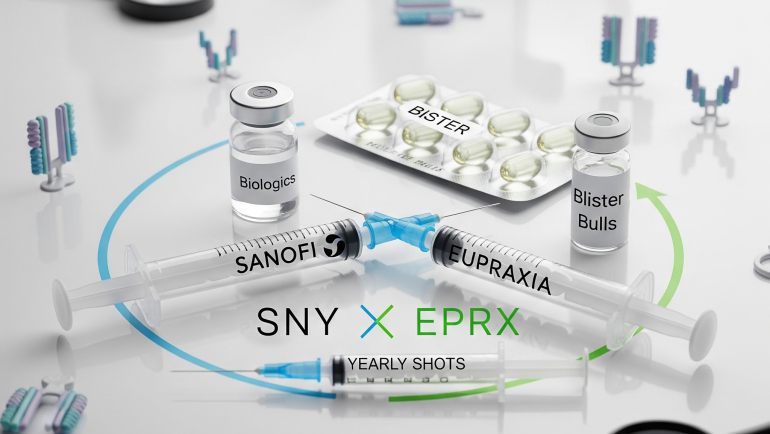
Eupraxia Pharmaceuticals Inc. (NASDAQ: EPRX, $9, up 2.62% over the last 5-days), a clinical-stage biotechnology company leveraging its proprietary Diffusphere™ technology to optimize local, controlled drug delivery for diseases with significant unmet need, announced (Nov. 13) the second set of 52-week follow up data from its ongoing Phase 1b/2a RESOLVE trial evaluating a single administration EP-104GI for the treatment of eosinophilic esophagitis (“EoE”). James A. Helliwell, Chief Executive Officer of Eupraxia stated,“These data further highlight the strong durability and tolerability profile of EP-104GI, reinforcing its potential to become a convenient, once-a-year treatment that fits seamlessly into routine disease management by aligning with annual patient endoscopies. The Cohorts 5 & 6 patients – the only groups to have reached 52 weeks in the trial – are demonstrating levels of symptom relief that is durable and clinically meaningful – we are very encouraged by this outcome. We’re also pleased that our previously announced 52-week data were presented as a late-breaking presentation at the American College of Gastroenterology Annual Scientific Meeting (ACG). These new results build on that momentum. Given that current EoE therapies often struggle with long-term adherence, we believe a durable, once-yearly treatment could meaningfully improve patient outcomes and establish EP-104GI as a preferred option for both physicians and their patients.”

GeoVax Labs, Inc. (Nasdaq: GOVX, $3.15, +10.53% over the last 5-days), a clinical-stage biotechnology company developing multi-antigen vaccines and immunotherapies for infectious diseases and cancer.

GeoVax is heading into the 44th Annual J.P. Morgan Healthcare Conference week (“JPM2026”) in San Francisco, CA Jan. 12-15 with the kind of narrative biotech investors typically like to hear: a differentiated platform, large funded trials lining up, and multiple shots on goal in both infectious disease and oncology. The company is leaning into its MVA platform as a potential franchise engine rather than a one‑product science experiment. Specifically, investors can meet David Dodd, Chairman & CEO of GeoVax, during his presentation at the Hilton Union Square, 333 O’Farrell Street, Yosemite A (Ballroom Level), San Francisco, CA on January 13, 2026, 2:30 pm PST.

GeoVax announced (Dec. 19) that it has entered into definitive securities purchase agreements with several institutional and individual investors for the purchase and sale of approximately 13.2 million units, each comprised of one share of the Company’s common stock and warrants, as described below, to purchase shares of the Company’s common stock, at a price of $0.245 per unit in a public offering. The Company will issue warrants to purchase up to approximately 26.5 million shares of common stock. The warrants will have an exercise price of $0.245 per share, will be exercisable immediately following the date of issuance and will have a term of five years following the date of issuance. Roth Capital Partners is acting as the exclusive placement agent for the offering. The gross proceeds to the Company from this offering are expected to be approximately $3.2 million, before deducting the placement agent’s fees and other offering expenses payable by the Company. The Company intends to use the net proceeds from this offering for working capital and general corporate purposes. The closing of the offering is expected to occur on or about December 22, 2025, subject to the satisfaction of customary closing conditions.

GeoVax announced (Dec. 18) the publication of a peer-reviewed article in Frontiers in Immunology titled: “Multi-antigen MVA-vectored SARS-CoV-2 vaccine, GEO-CM04S1, induces cross-protective immune responses to ancestral and Omicron variants.” The study provides definitive preclinical evidence that GeoVax’s multi-antigen COVID-19 vaccine candidate, GEO-CM04S1, delivers full cross-variant protection, driven predominantly by robust T-cell responses, even in the absence of neutralizing antibodies. The findings reinforce the design philosophy behind GeoVax’s MVA-based, multi-antigen platform and provide mechanistic insight that is increasingly relevant for immunocompromised individuals, who often fail to respond optimally to the first-generation COVID-19 vaccines.

GeoVax announced (Dec. 17) the successful completion of fill-finish for the initial clinical batch of GEO-MVA, its next-generation Mpox/smallpox vaccine. The product has now entered final release evaluation, the concluding quality-control and compliance process required before shipment for clinical use, positioning the Company for Phase 3 immunobridging trial start-up activities in Q1 2026. Fill-finish – the sterile, cGMP-regulated process of filling, sealing, and packaging vaccine vials – marks the last manufacturing step before a vaccine may enter clinical study supply channels. With fill-finish complete and GEO-MVA now undergoing final release evaluation, GeoVax has moved into the final pre-clinical-deployment phase of its EMA-aligned clinical program. In June 2025, the European Medicines Agency (EMA) Scientific Advice confirmed that a single Phase 3 immunobridging study demonstrating immune comparability to the approved MVA vaccine, Imvanex(R), would be sufficient to evaluate GEO-MVA’s efficacy. This provides a clear, accelerated regulatory path to licensure. This milestone coincides with increasing Mpox activity globally – including expanding Clade I outbreaks in Africa and emerging cases in the United States – exposing vulnerabilities associated with global dependence on a sole foreign MVA vaccine supplier. GEO-MVA is designed to expand supply, diversify sources, and strengthen biodefense infrastructure.

Volato Group, Inc. (NYSE American: SOAR, $.49) and M2i Global, Inc. (MTWO, $.0485), a company specializing in the development and execution of a complete global value supply chain for critical minerals, reaffirmed, on Tuesday, Jan. 20, their expectation to complete their targeted first-quarter 2026 closing timeline for the previously announced business combination, citing steady advancement through the SEC review process alongside continued progress in operational planning and integration readiness. Subject to the effectiveness of the registration statement on Form S-4, stockholder approvals, and other customary closing conditions, the companies continue to expect the merger to close in the first quarter of 2026. To align the transaction timeline with the current stage of the SEC review process, the companies have mutually agreed to extend the end date of the merger agreement through March 31, 2026. This extension reflects disciplined execution and provides additional runway to complete the remaining regulatory steps in an orderly manner, while maintaining transaction commitment and protecting stockholder interests. Amendment No. 1 to the Form S-4 was filed on Monday, January 12, 2026, to respond to SEC comments and advance the registration statement through the review process. The review timeline was affected in part by a temporary slowdown in SEC operations following the recent federal government shutdown. With the amendment now on file, the companies are focused on completing the remaining steps of the SEC review process.

On Jan. 9, M2i Global and Volato Group announced that they have entered into a strategic collaboration agreement with Australian company Titanium X to advance critical mineral development in the US. This partnership represents a significant move towards enhancing domestic refining capacity and strengthening the critical materials supply chain that underpins US industry and national security. Titanium X and M2i Global will work together on the financing, development and commercialisation of the former’s critical mineral assets. M2i Global will apply its global experience in delivering mineral projects to support these initiatives. The companies are also in talks to conclude an exclusive titanium concentrate supply agreement.

On Jan. 7, M2i Global, Inc. (MTWO , $,05) along with Volato Group, Inc. (NYSE American: SOAR, $.45), a technology-driven company, announced a strategic collaboration agreement with Titanium X, marking a major step forward in advancing domestic refining capabilities and securing the critical materials supply chain essential to U.S. industry and national security.

Volato Group, Inc. today (Dec. 29) announced the appointment of Alan D. Gaines to its Board of Directors, effective immediately. Mr. Gaines will also serve as Chairman of the Audit Committee.

On Dec. 23, Volato Group, Inc. announced preliminary financial guidance for the fourth quarter and full year ending December 31, 2025, reflecting continued execution against its strategic and balance sheet objectives. For the fourth quarter of 2025, Volato expects to report revenue between $27 million and $28 million. For the full year 2025, the Company anticipates total revenue between $78 million and $79 million, with net income of $6 million to $8 million. These results reflect a year of meaningful progression aligning operational performance with Volato’s long-term growth initiatives and advancing its pending merger with M2i Global, Inc. (OTC: MTWO). During 2025, Volato also made substantial progress strengthening its balance sheet. As of September 30, 2025, the Company reduced total liabilities to $9.5 million, satisfying the debt reduction condition required under its pending merger agreement with M2i Global, Inc. (OTC: MTWO). Volato expects continued improvement in its capital structure as it advances toward a targeted first-quarter 2026 closing of the transaction. “Our 2025 results reflect a year of transformation and disciplined balance sheet execution,” said Mark Heinen, Chief Financial Officer of Volato. “We made significant progress reducing liabilities while sharpening our focus on scalable, technology-driven businesses that are designed to complement and strengthen the M2i Global platform over the long term.”

Serina Therapeutics (NYSE American: SER, $2.87), Alabama-based biotech is betting its proprietary POZ platform and reimagined approach to apomorphine delivery may redefine the treatment paradigm for patients who have exhausted standard oral therapies. On Dec. 11, Serina announced the appointment of Joshua Thomas, Ph.D., as Vice President and Head of Chemistry. He will oversee internal and external chemistry efforts to optimize POZ-based candidates, supporting efficient translation from discovery through development.

On Dec. 10, Serina announced that it has submitted a complete response to the U.S. Food and Drug Administration’s (“FDA”) clinical hold letter for SER-252, the Company’s lead program for advanced Parkinson’s disease. As previously disclosed, the FDA placed the Company’s Investigational New Drug (“IND”) application for SER-252 on clinical hold pending additional information related to a commonly used formulation excipient. On November 25, 2025, the FDA issued a formal full clinical hold letter specifying the information required to permit initiation of the planned Phase 1b registrational study, SER-252-1b. The issues identified by the FDA do not relate to the apomorphine active drug substance, its mechanism of action, the use of the enFuse device (Enable Injections) or the broader 505(b)(2) NDA development pathway previously discussed with the Agency.

The InterGroup Corporation (NASDAQ: INTG, $29.87, +1.67%) announced (Jan. 6) that on December 29, 2025, it completed the sale of a non-core 12-unit apartment complex in Los Angeles County for a gross sales price of approximately $4,850,000. InterGroup expects to report a GAAP net gain on sale of approximately $3,509,000, which will be reflected in the Company’s Form 10‑Q for the quarter ended December 31, 2025. The transaction is expected to result in federal and state income tax liability, the amount of which will be determined based on the Company’s final tax position and applicable tax rules.

DoubleVerify Holdings Inc. (DV) closed at $10.99, +4.07% over the last 5-days. DoubleVerify, which built its franchise on media verification and ad performance analytics, is now the first badged TikTok Marketing Partner focused specifically on attention measurement, tapping impression-level signals from the platform. Brands gain a granular view of how exposure and user interaction come together across TikTok formats, ad sets, creatives, and objectives, effectively treating every swipe as a tiny A/B test.

flyExclusive, Inc. (NYSE American: FLYX, $3.28), one of the nation’s largest private jet operators and a certified Part 145 Repair Station, today announced it has signed an authorized dealership agreement with Starlink, becoming a certified dealer and installer for Starlink’s high-speed, low-latency aviation connectivity system.

The Sources

  1. Wall Street Journal – “Stock Market Today: Dow Drops; Intel Stock Slides; Gold Hits Record”
    https://www.wsj.com/livecoverage/stock-market-today-dow-sp-500-nasdaq-01-23-2026[wsj]​
  2. Bloomberg – “S&P 500 Steady at End of Turbulent Week; Intel Sinks on Earnings”
    https://www.bloomberg.com/news/articles/2026-01-23/us-stocks-slip-at-end-of-turbulent-week-intel-sinks-on-earnings[bloomberg]​
  3. Bloomberg – “S&P 500 Posts Its First Two-Week Losses Since June: Markets Wrap”
    https://www.bloomberg.com/news/articles/2026-01-22/stock-market-today-dow-s-p-live-updates[bloomberg]​
  4. Yahoo Finance – “Stock market today: Dow, S&P 500, Nasdaq rise after Trump backpedals on tariffs”
    https://finance.yahoo.com/news/stock-market-today-dow-sp-500-nasdaq-futures-rise-after-trump-backpedals-on-tariffs-234947394.html[uk.finance.yahoo]​
  5. Reuters – “Wall Street finishes up as investors buoyed by tariff relief, upbeat data”
    https://www.reuters.com/world/europe/futures-rise-further-greenland-relief-2026-01-22/[reuters]​
  6. New York Times – “Stocks Rebound After Trump Backs Off European Tariffs”
    https://www.nytimes.com/2026/01/21/business/greenland-stocks-bonds-dollar-gold.html[nytimes]​
  7. U.S. News & World Report – “US Stocks Recover Half of the Prior Day’s Plunge After Trump Calls off Greenland-Related Tariffs”
    https://www.usnews.com/news/business/articles/2026-01-20/us-stocks-recover-half-of-the-prior-days-plunge-after-trump-calls-off-greenland-related-tariffs[usnews]​
  8. Investopedia – “Markets News, Jan. 22, 2026: Stocks Finish Higher for 2nd Straight Day”
    https://www.investopedia.com/dow-jones-today-01222026-11890213[investopedia]​
  9. Investors.com – “Dow Falls While Nasdaq Is The Day’s Bright Spot (Live Coverage)”
    https://www.investors.com/market-trend/stock-market-today/dow-jones-sp500-nasdaq-greenland-deal-intel-stock-intc/[investors]​
  10. Investors.com – “Stock Market Falls, Recovers On Trump Greenland Shift” (Weekly Review)
    https://www.investors.com/news/stock-market-falls-recovers-on-trumps-greenland-shifts-intel-netflix-tesla-key-movers-weekly-review/[investors]​
  11. CNBC – “5 things to know before the stock market opens Friday” (Jan. 23, 2026)
    https://www.cnbc.com/2026/01/23/5-things-to-know-before-the-stock-market-opens.html[cnbc]​
  12. CNBC – “Stock market news for Jan. 23, 2026 – live updates”
    https://www.cnbc.com/2026/01/22/stock-market-today-live-updates.html[cnbc]​
  13. Trading Economics – “United States Economic Calendar”
    https://tradingeconomics.com/united-states/calendar[tradingeconomics]​
  14. Investing.com – “7 Critical Signals From This Week’s U.S. Economic Calendar (January 19–23, 2026)”
    https://in.investing.com/analysis/7-critical-signals-from-this-weeks-us-economic-calendar-january-1923-2026-200633925[in.investing]​
  15. Yahoo Finance – Eli Lilly and Company (LLY) quote page
    https://finance.yahoo.com/quote/LLY/[finance.yahoo]​
  16. Yahoo Finance – “Why Eli Lilly (LLY) Stock Is Up Today”
    https://finance.yahoo.com/news/why-eli-lilly-lly-stock-203040864.html[finance.yahoo]​
  17. Motley Fool via AOL – “Eli Lilly Soared by 39% in 2025, but Here’s Another Healthcare Stock to Consider”
    https://www.aol.com/articles/eli-lilly-soared-39-2025-103000224.html[aol]​
  18. MarketBeat – “Strs Ohio Sells 46,646 Shares of Eli Lilly and Company (LLY)”
    https://www.marketbeat.com/instant-alerts/filing-strs-ohio-sells-46646-shares-of-eli-lilly-and-company-lly-2026-01-23/[marketbeat]​
  19. Investor’s Business Daily – “Eli Lilly Stock Rebounds As Weight-Loss Drug Battle Continues”
    https://www.investors.com/stock-lists/sector-leaders/eli-lilly-stock-lly-orforglipron-weight-loss-drugs/[investors]​
  20. Globe and Mail – “4 Leading Tech Stocks to Buy in 2026”
    https://www.theglobeandmail.com/investing/markets/markets-news/Motley%20Fool/36954814/4-leading-tech-stocks-to-buy-in-2026/[theglobeandmail]​
  21. MarketBeat – “Best Technology Stocks To Consider – January 5th”
    https://www.marketbeat.com/instant-alerts/best-technology-stocks-to-consider-january-5th-2026-01-05/[marketbeat]​
  22. Global X ETFs – “The Next Big Theme: January 2026”
    https://www.globalxetfs.com/articles/the-next-big-theme-january-2026[globalxetfs]​
  23. Nasdaq.com – “Pre-Markets Lower Ahead of Massive Polar Vortex”
    https://www.nasdaq.com/articles/pre-markets-lower-ahead-massive-polar-vortex[nasdaq]​
  24. CNBC – “Biggest Wall Street analyst calls Thursday like Nvidia”
    https://www.cnbc.com/2026/01/15/biggest-wall-street-analyst-calls-thursday-like-nvidia.html[cnbc]​
  25. Yahoo Finance – “High Growth US Tech Stocks To Watch In January 2026”
    https://finance.yahoo.com/news/high-growth-us-tech-stocks-113827833.html[finance.yahoo]​
  26. Yahoo Finance – “Oil Ticks Up as Trump Cites ‘Framework’ for Greenland Deal”
    https://finance.yahoo.com/news/oil-drops-traders-gear-trump-060219587.html[finance.yahoo]​

Why Family Offices & Institutions See a ‘Once‑in‑a‑Decade’ Window in Biotech & Healthcare at JPM 2026 -( $JPM $IBB $NVDA $XBI)

Valuations may be flat, but the mood in healthcare is anything but. At the 44th Annual J.P. Morgan Healthcare Conference in San Francisco, the industry arrived with compressed multiples and an innovation gap—and left talking about disciplined optimism, AI leverage and a surprisingly serious courtship between family offices and biotech.

From Innovation Gap To Deal Pipeline

Large pharmaceutical companies are increasingly conceding that the next decade of growth will not be manufactured solely in-house. External innovation—via licensing, M&A, and structured partnerships—has become the default setting rather than the exception.

  • Analyses of pharma strategy to 2035 show big drugmakers “externalizing” discovery risk to leaner biotechs while reserving their internal firepower for late-stage development and commercialization.
  • Academic work on pharma innovation labs highlights a shift toward open, collaborative models that rely on external partners to refresh pipelines and expand into adjacent therapeutic and digital domains.

In other words, pipelines are not shrinking; they are being syndicated.

AI Meets 30 Years Of Data

If there was a single phrase that captured the JPM hallway chatter, it was AI—though this year, the buzz sounded less like science fiction and more like a capital budget line item.

  • Conference coverage pointed to AI moving “from excitement to infrastructure,” backed by large-scale initiatives such as a 1 billion dollar joint innovation lab between Nvidia (NVDA) and Eli Lilly (LLY) and broader deployment of AI agents across discovery, clinical trials, and operations.
  • New models, such as Claude for Healthcare, arrived with HIPAA-ready infrastructure and integrations into medical and scientific databases, underscoring that the real exponential leverage comes when modern models are pointed at deep, validated clinical datasets.

The emerging playbook: pair generative models with decades of curated trial and real-world evidence, then let the statisticians sleep occasionally.

Autism And Other “Frontier” Diseases Grow Up

Some of the most animated side conversations centered on areas that, not long ago, lived in the speculative fringe of investor decks. Autism spectrum disorders in particular are attracting more serious scientific and commercial attention as tools for genetics, neuroimaging, and digital phenotyping mature.

  • Broader analyses of the pharma pipeline show growth in neuroscience and genetically informed indications, with companies using more precise biomarkers and AI-driven patient stratification to design trials in historically challenging conditions.
  • Investors who once treated autism as a “nice to have” slide near the back of the deck now see it as a legitimate arena for platform technologies, from novel mechanisms to AI-assisted diagnostics and digital therapeutics.

The result is a subtle but important shift: less hand-waving, more IND-enabling data.

Capital Follows The Clinical Curve

If 2021 was the year of preclinical PowerPoint funding, 2026 is shaping up as the era when investors insist on clinically relevant inflection points.

  • Dealmaking analyses indicate that big pharma increasingly prefers assets with clearer line-of-sight to value—structured options, milestone-heavy partnerships, and acquisitions timed around proof‑of‑concept data.
  • Conference commentary described a market of “disciplined optimism,” where capital is available but more tightly targeted around programs with credible paths to differentiation and reimbursement.

In practical terms, that means the velvet rope is now located somewhere between first‑in‑human and robust Phase 2, not at the seed-stage idea on a café napkin.

Family Offices: Patient Capital At The Inflection Point

Perhaps the most intriguing subplot in San Francisco was who, exactly, is stepping into the gap left by more cautious generalist funds. Family offices, with their long time horizons and appetite for thematic exposure, are quietly becoming central actors in early- and mid-stage healthcare.

  • Recent overviews of family office activity in biotech highlight a tilt toward direct and co‑investments, often alongside specialist funds or operator-led platforms that shepherd companies to key clinical milestones.
  • Even as overall deal counts have slowed, surveys show family offices continuing to emphasize healthcare and AI as core areas of focus—viewing them less as momentum trades and more as multi-decade compounding opportunities with real-world impact.

For these investors, the current setup does not resemble a hype cycle so much as a rare, valuation‑compressed entry window—one that rewards scientific diligence, regulatory literacy, and the ability to sit through more than one market cycle without needing a liquidity event as a personality trait.


The Sources:

  1. Opala – “3 Key Takeaways from the 2026 J.P. Morgan Healthcare Conference” – https://opala.com/news/3-key-takeaways-from-the-2026-jpmorgan-healthcare-conference/[opala]​
  2. Freshfields – “2026 J.P. Morgan Healthcare Conference Highlights – A Fresh Take” – https://blog.freshfields.us/post/102m2h7/2026-j-p-morgan-healthcare-conference-highlights[blog.freshfields]​
  3. Advisory Board – “The top 5 takeaways from J.P. Morgan’s 2026 healthcare conference” – https://www.advisory.com/daily-briefing/2026/01/20/jpm-health[advisory]​
  4. Gilmartin Group – “Key Sector Takeaways Out of J.P. Morgan 2026” – https://gilmartinir.com/key-sector-takeaways-out-of-jpm-2026/[gilmartinir]​
  5. BMC Health Services Research – “Driving health transformation: big pharma’s innovation labs revolution” – https://pmc.ncbi.nlm.nih.gov/articles/PMC12551358/[pmc.ncbi.nlm.nih]​
  6. LinkedIn – “How Family Offices Are Revolutionizing Biotech Investing” – https://www.linkedin.com/posts/mikeloftusclinicaltrials_biotech-familyoffice-investing-activity-7363188834869649410-899l[linkedin]​
  7. Multiple Myeloma Research Foundation – “J.P. Morgan Healthcare Conference 2026 Takeaways” – https://themmrf.org/mmrf-blogs/jp-morgan-healthcare-conference-2026-takeaways/[themmrf]​
  8. Drug Discovery & Development – “The Pharma Playbook to 2035” – https://www.drugdiscoverytrends.com/pharma-2035-playbook-speed-focus-and-conviction-in-an-uncertain-world/[drugdiscoverytrends]​
  9. Life Science Nation – “How Family Offices Are Cracking the Code on Biotech Investing” – https://blog.lifesciencenation.com/2025/04/15/how-family-offices-are-cracking-the-code-on-biotech-investing/[blog.lifesciencenation]​
  10. Bloomberg – “JPMorgan Healthcare Conference Deals, M&A Could Include AI …” – https://www.bloomberg.com/news/newsletters/2026-01-12/jpmorgan-healthcare-conference-deals-m-a-could-include-ai-life-sciences[bloomberg]​
  11. Intuition Labs – “Global Pharmaceutical Market: 2025 Analysis & Key Trends” – https://intuitionlabs.ai/articles/pharmaceutical-market-analysis-trends[intuitionlabs]​
  12. CNBC – “Family offices still bet on AI and health care even as deals slow down” – https://www.cnbc.com/2025/10/09/family-offices-still-bet-on-ai-and-health-care-even-as-deals-slow-down.html[cnbc]​
  13. MM+M – “Live from JPM Healthcare Conference: Highlights from San Francisco” – https://www.mmm-online.com/news/live-from-jpm-healthcare-conference-highlights-from-san-francisco-2026/[mmm-online]​
  14. McKinsey – “Pulse check: Key trends shaping biopharma dealmaking in 2025” – https://www.mckinsey.com/industries/life-sciences/our-insights/the-synthesis/pulse-check-key-trends-shaping-biopharma-dealmaking[mckinsey]​

Gold’s Best Week in Years and Silver’s Dash Toward $100: Is This the Start of a New Metals Supercycle? -( $GLD $SLV )

Gold just logged its best week since 2020 while silver flirted with triple digits, turning the once-sleepy precious‑metals aisle into the buzziest corner of Wall Street’s supermarket. In a market year already thick with plot twists, the yellow and white metals have quietly stolen the lead role.

A Shimmering Flight to Safety

Investors have been rushing into gold as anxiety over U.S. assets, central bank independence, and swelling government debt reaches a new pitch. For many, bullion has become the ultimate referee in a contest between politics, policy, and market credibility.

  • Gold futures recently pushed near 5,000 dollars an ounce, extending a record‑setting rally that already delivered roughly 70% gains last year.
  • Central banks have kept stacking bars, while ETF inflows suggest retail and institutional investors are finally agreeing on something: they would rather argue over which vault than which bond.

Silver’s Star‑Turn: From Sidekick to Headliner

If gold is the store of value, silver has become the store of bravado. The metal has sprinted toward 100 dollars an ounce after a year in which it already outpaced gold by a wide margin.

  • Silver rallied more than 150% last year, aided by an October short squeeze and persistent tightness in key trading hubs like London.
  • The gold‑to‑silver ratio has collapsed from over 100 to around the low‑50s, signaling silver’s dramatic catch‑up and giving traders a new favorite cocktail‑party statistic.

Macro Drama, Monetary Theater

Behind the fireworks in the metals pits lies a crowded macro stage featuring a weaker dollar, rate‑cut bets, and noisy politics. Lower yields have made non‑yielding assets like gold and silver look less like eccentric collectibles and more like rational portfolio anchors.

  • Market pricing points to multiple Federal Reserve rate cuts in the back half of 2026, bolstering the case for holding hard assets over cash.
  • Federal Reserve officials have openly warned that political pressure and threats to the bank’s independence could undermine confidence in paper assets, nudging more capital toward metals that do not tweet, testify, or campaign.

Industrial Demand Meets AI Hype

Silver is not just riding monetary angst; it is riding the wiring. The metal’s role in electronics, energy, and health‑care applications has intersected neatly with an AI‑fueled build‑out of data centers and advanced manufacturing.

  • Analysts highlight a growing structural deficit as industrial demand outstrips mine supply, particularly after China tightened exports, adding a geopolitical premium to every ounce.
  • Platinum and other sister metals have joined the rally on similar themes, with platinum climbing more than 40% in a single month as auto and jewelry demand collide with supply disruptions.

Can This Rally Keep Glittering?

Veteran traders warn that parabolic charts often end with algebra, not poetry. After such a powerful move, the risk of air pockets and sharp corrections is rising, even as long‑term narratives for scarcity, de‑dollarization, and political risk remain firmly in place.

  • Some strategists see further upside, with prior forecasts for gold at 4,000 dollars by mid‑2026 already surpassed, forcing models—and risk managers—to update their wardrobes.
  • Others caution that when retail investors start discussing the gold‑to‑silver ratio at family dinners, positioning may be closer to peak exuberance than to ground floor opportunity.

Still, in a world where balance sheets expand faster than patience, the latest surge in gold and silver suggests investors have rediscovered an old idea: sometimes the most modern hedge is the one dug out of the ground.


Sources

  1. Gold set for best week since 2020, silver approaches 100 dollars in stunning rally – Yahoo Finance.[uk.finance.yahoo]​
  2. Gold, silver and platinum extend record‑setting rally – Yahoo Finance.[finance.yahoo]​
  3. Silver is surging, here’s how this trader is playing the rally – Yahoo Finance Video.[finance.yahoo]​
  4. Silver hits record above 90 dollars as precious‑metals rally powers on – Yahoo Finance.[finance.yahoo]​
  5. Gold and silver smash records again as rally gathers momentum – Yahoo Finance.[finance.yahoo]​
  6. Gold notches biggest gain since 2020 as precious metal goes parabolic – Yahoo Finance.[finance.yahoo]​
  7. Gold’s record rally continues above 3.8K dollars: What to know – Yahoo Finance Video.[finance.yahoo]​
  8. Silver nears record in hockey‑stick rally, gold approaches 4,000 dollars an ounce – Yahoo Finance.[finance.yahoo]​
  9. Gold, silver surge as “assault on Fed” sparks rush to precious metals – Yahoo Finance.[finance.yahoo]​
  10. Gold extends record run while silver joins rally to new high – Yahoo Finance.[finance.yahoo]​

Wall Street, Gold, Silver Surges as Tariff Fears Ease – January 22, 2026 -( $COF $DV $INTC $LLY $META $MCD $MU $NVDA $NOK $OKLO $ORCL $PLTR $TSLA Rise!)

Wall Street ended Thursday with a relieved shrug and a raised eyebrow, as President Trump’s tariff U‑turn kept risk appetites intact and sent major indexes modestly higher while safe‑haven trades stayed stubbornly in vogue. On balance, Thursday’s tape also suggested a market willing to forgive colorful tariff diplomacy as long as the actual tariffs stay mostly hypothetical, central banks remain predictable, and AI stocks keep justifying their starring roles—proof that in 2026, Wall Street still prefers drama in earnings calls, not customs forms.

Major indexes

  • S&P 500: The S&P 500 added about 0.55%, extending Wednesday’s rebound after the White House formally backed away from sweeping tariffs on eight European nations tied to the Greenland saga, leaving the benchmark within sight of record territory.
  • Dow 30: The Dow Jones Industrial Average also climbed roughly 0.63%, with cyclicals and big tech sharing the load as investors treated the tariff reprieve as an excuse to rotate back into economically sensitive names rather than hide in cash.
  • Nasdaq: The Nasdaq Composite led with a gain of about 0.91%, powered by AI‑heavyweights and chipmakers as traders re‑embraced the “everything AI, all at once” trade that had briefly gone out of fashion when tariff headlines flared.
  • Russell 2000: Small caps continued their early‑year resurgence rising .76%, with the Russell 2000 building on a string of record closes and extending a stretch of outperformance versus the Nasdaq and S&P 500 that strategists note is rare this late in a cycle.

Macro and policy

  • Tariffs and trade: The administration formally paused plans for 10% across‑the‑board tariffs on imports from Denmark, Norway, Sweden, France, Germany, the UK, the Netherlands and Finland after a “framework” understanding on Greenland, removing an imminent shock to transatlantic trade even as broader tariff policy remains the market’s favorite recurring nightmare. Separately, new 25% Section 232 tariffs on certain advanced semiconductor imports underscore that while the Greenland front has cooled, chip geopolitics remain very much a live fire exercise.
  • FOMC and rates: The Federal Reserve’s next policy gathering is scheduled for Jan. 27–28, with markets pricing a steady hand next week and hoping mostly for clarity on the timing and pace of eventual rate cuts rather than any surprise hawkish flourish. The 10‑year Treasury yield has recently hovered in the mid‑4% range while the 30‑year sits just under 4.9%, leaving the curve still relatively flat by historical standards rather than deeply inverted.
  • Shutdown watch: On Capitol Hill, lawmakers are racing a Jan. 30 funding deadline, with a 1,000‑plus‑page bipartisan spending package on the table designed to avert a repeat of last year’s record‑long shutdown; markets are treating brinkmanship as background noise but would likely notice quickly if talks stall.
  • Reuters reported that the gross domestic product increased at an upwardly revised ‌4.4% annualized rate, the fastest pace since the third quarter of 2023, the Commerce Department’s Bureau of Economic Analysis said in its updated estimate of third-quarter GDP on Thursday.

Commodities and crypto

  • Gold and silver: Gold prices pushed to fresh record highs above roughly $4,938.40 per troy ounce at one point, reflecting lingering anxiety about tariffs, fiscal politics and long‑term currency credibility even on a day when equities were in a decent mood. Silver continued to ride a powerful structural bull story rising to $96.21/oz. tied to industrial demand and tightening supply, with recent gains far outpacing gold on a percentage basis.
  • Oil: Crude oil futures slipped around 1.57% to $59.67, with prices consolidating as traders weighed resilient demand against concerns that policy and tariff uncertainty could eventually sap global growth; technically, crude remains in a choppy range rather than a clean trend.
  • Bitcoin: Bitcoin hovered near the psychologically loaded $90,000 level after a sharp pullback from its prior peak near $126,000, behaving less like “digital gold” and more like a levered expression of risk sentiment that is currently catching its breath.

Corporate news and key stocks

  • Eli Lilly (LLY): Eli Lilly extended its climb as investors continued to chase the obesity‑drug leader; shares traded around the low‑$1,080s intraday, up modestly and hovering near 52‑week highs, helped by strong GLP‑1 demand, upbeat clinical updates and expectations for an oral obesity therapy launch later this year. In a market increasingly obsessed with weight‑loss injections, Lilly remains the stock that rarely goes on a valuation diet.
  • Semiconductors – TSM, NVIDIA ($184.84, +.91%, Micron (MU, $397.58, +2.18%), Intel (INTC, $54.3), Broadcom: Semiconductor names were again central to the AI trade narrative. Micron rallied on the back of a strong earnings print and bullish commentary around high‑bandwidth memory demand, underscoring how memory chips have migrated from commodity backwater to AI royalty. NVIDIA remained a core beneficiary of AI infrastructure spending, staying in investors’ good graces as one of the market’s most recommended large‑cap tech names. Intel, despite warnings that its AI enthusiasm may be outrunning fundamentals, participated in the broader chip bid rose to $54.32, however has dropped significantly in the aftermarket as their Q1 failed to impress. Taiwan Semiconductor and Broadcom traded as essential plumbing for the same AI and cloud cycle, with tariff headlines particularly relevant given Washington’s new semiconductor‑focused trade restrictions.
  • Megacap platforms – Apple, Tesla, Meta: Apple shares stayed supported, with the stock still broadly rated in “buy” territory as investors look past smartphone cyclicality toward services and AI‑enhanced devices. Tesla (TSLA, $449.36. +4.15%)remained a volatility magnet at the intersection of EV adoption and Musk‑driven narrative swings, participating in the tech rally as traders leaned back into higher‑beta AI and EV names. Meta Platforms (META, $647.63, +5.66%) added to 2025’s recovery as markets rewarded its cash‑gushing ad engine and AI ambitions, even as regulators continue to lurk in the wings.
  • Nokia: Nokia (NOK) stayed a more subdued story rising +.93% to $6.50, with the once‑iconic handset leader now trading as a network and infrastructure play that tends to move more on capex cycles and 5G spending than on the day‑to‑day theatrics of AI headlines.
  • McDonald’s: McDonald’s shares edged higher to $306.03 as the chain benefited from its role as a defensive, cash‑flow machine in a world where diners may trade down from white‑tablecloth to drive‑through but rarely skip lunch entirely.
  • Rio Tinto: Rio Tinto traded in step with industrial metals sentiment, with investors parsing how tariff uncertainty and global growth forecasts might influence demand for iron ore and other key inputs; the stock today functioned as something of a barometer for how seriously markets take the risk of a renewed trade slowdown.
  • Oracle: Oracle (ORCL, $178.18, +2.47%) continued to ride enthusiasm around cloud infrastructure and database demand, offering investors a lower‑drama, high‑cash‑conversion way to play the same digital transformation themes driving the AI darlings.
  • OKLO: OKLO, a small‑scale nuclear and advanced reactor story, remained a speculative vehicle tethered to the broader decarbonization theme, with sentiment sensitive to news on regulatory milestones and funding rather than near‑term earnings closed at $90.93, +.17%.
  • Palantir Technologies: Palantir closed up modestly after a blistering 2025 that saw the stock gain roughly 145%, as some on the Street warned that expectations for its AI platforms and government contracts have become rich enough to require immaculate execution. The company remains at the center of the AI‑plus‑national‑security narrative, but buyers are becoming more discerning on price.

Deals, listings and other market color

  • M&A and SPACs: In energy and climate tech, General Fusion announced a definitive agreement to go public via a merger with Spring Valley Acquisition Corp. III, in a deal valuing the fusion company at roughly $1 billion and positioning it to list on Nasdaq under the ticker GFUZ once the transaction closes. The market’s appetite for fusion‑powered dreams appears to remain intact, at least on the term‑sheet level. Capital One Financial Corporation (NYSE: COF, $235.07, +1.76%) today announced that it has entered into a definitive agreement to acquire Brex, in a combination of stock and cash transaction valued at $5.15 billion. Brex is a modern, AI-native software platform offering intelligent finance solutions that make it easy for businesses to issue corporate cards, automate expense management and make secure, real-time payments. The company also leverages AI agents to help customers automate complex workflows to reduce manual review and control spend.
  • IPOs: In the traditional IPO lane, Praetorian Acquisition Corp. priced a $220 million SPAC offering of 22 million units at $10 each, with trading on Nasdaq as PTORU expected to begin tomorrow, Jan. 23, another reminder that blank‑check vehicles, while no longer the life of the party, still find occasional invitations. A separate $200 million SPAC, X3 Acquisition Corp. Ltd., also recently closed its initial public offering, adding more dry powder to the market’s deal‑making arsenal.

Vista Partners Watchlist Updates

Modular Medical, Inc. (Nasdaq: MODD., $.4705), a leader in innovative insulin delivery technology targeting the $3 billion adult “almost-pumpers” diabetes market with user-friendly, affordable patch pumps, announced (Dec. 10) that it had priced an underwritten public offering (the “offering”) of 12,173,000 shares of its common stock and accompanying warrants to purchase 6,086,500 shares of its common stock. Each two shares of common stock are being offered and sold together with one accompanying warrant at a combined offering at a price of $0.77, yielding an effective price of $0.38 per share and $0.01 per warrant. The warrants will have an exercise price of $0.45 per share, are exercisable immediately upon issuance and will expire five years following the date of issuance. In connection with the offering, Modular Medical has granted the underwriter a 30-day option to purchase up to an additional 15% of common shares and/or warrants at the public offering price, less underwriting discounts and commissions. The over-allotment option may be elected with respect to, at the underwriter’s sole discretion, shares and warrants together, solely shares, solely warrants, or any combination thereof. Newbridge Securities Corporation is acting as the sole bookrunner for the offering. Assuming no exercise of the over-allotment option, the gross proceeds to the Company from the offering are expected to be approximately $4.68 million, before deducting underwriting discounts, commissions, and estimated offering expenses payable by the Company. The Company intends to use the net proceeds from the offering to fund operations and for working capital and general corporate purposes, including capital expenditures.

On Nov. 17, Modular announced Institutional Review Board (“IRB”) approval to conduct an in-house study of its next-generation Pivot™ insulin delivery system using insulin on people with diabetes (the “Study”). Pursuant to U.S. Food and Drug Administration (“FDA”) regulations, an IRB is a group that has been formally designated to review and monitor biomedical research involving human subjects. The Study will simulate real-world conditions by delivering insulin to adult participants to gather critical data on device function and usability and obtain user feedback. Modular Medical’s Pivot tubeless patch pump aims to enhance accessibility for underserved patients with diabetes and drive market penetration and expansion.

On Nov. 14, Modular Medical announced the 510(k) premarket submission of its next generation Pivot™ tubeless patch pump to the U.S. Food and Drug Administration (the “FDA”). The Company expects to commence the commercial launch of its Pivot pump in Q1 2026. On Nov. 3, Modular Medical the successful validation of its Pivot controller line, a critical milestone in preparing for the commercial launch of its Pivot patch pump targeted for Q1 2026. The Pivot controller line validation further demonstrates manufacturing readiness for high-volume production, positioning Modular Medical to meet the growing demand in the diabetes treatment market for advanced technology.

Eupraxia Pharmaceuticals Inc. (NASDAQ: EPRX, $9.01), a clinical-stage biotechnology company leveraging its proprietary Diffusphere™ technology to optimize local, controlled drug delivery for diseases with significant unmet need, announced (Nov. 13) the second set of 52-week follow up data from its ongoing Phase 1b/2a RESOLVE trial evaluating a single administration EP-104GI for the treatment of eosinophilic esophagitis (“EoE”). James A. Helliwell, Chief Executive Officer of Eupraxia stated,“These data further highlight the strong durability and tolerability profile of EP-104GI, reinforcing its potential to become a convenient, once-a-year treatment that fits seamlessly into routine disease management by aligning with annual patient endoscopies. The Cohorts 5 & 6 patients – the only groups to have reached 52 weeks in the trial – are demonstrating levels of symptom relief that is durable and clinically meaningful – we are very encouraged by this outcome. We’re also pleased that our previously announced 52-week data were presented as a late-breaking presentation at the American College of Gastroenterology Annual Scientific Meeting (ACG). These new results build on that momentum. Given that current EoE therapies often struggle with long-term adherence, we believe a durable, once-yearly treatment could meaningfully improve patient outcomes and establish EP-104GI as a preferred option for both physicians and their patients.”

GeoVax Labs, Inc. (Nasdaq: GOVX, $2.88), a clinical-stage biotechnology company developing multi-antigen vaccines and immunotherapies for infectious diseases and cancer.

GeoVax is heading into the 44th Annual J.P. Morgan Healthcare Conference week (“JPM2026”) in San Francisco, CA Jan. 12-15 with the kind of narrative biotech investors typically like to hear: a differentiated platform, large funded trials lining up, and multiple shots on goal in both infectious disease and oncology. The company is leaning into its MVA platform as a potential franchise engine rather than a one‑product science experiment. Specifically, investors can meet David Dodd, Chairman & CEO of GeoVax, during his presentation at the Hilton Union Square, 333 O’Farrell Street, Yosemite A (Ballroom Level), San Francisco, CA on January 13, 2026, 2:30 pm PST.

GeoVax announced (Dec. 19) that it has entered into definitive securities purchase agreements with several institutional and individual investors for the purchase and sale of approximately 13.2 million units, each comprised of one share of the Company’s common stock and warrants, as described below, to purchase shares of the Company’s common stock, at a price of $0.245 per unit in a public offering. The Company will issue warrants to purchase up to approximately 26.5 million shares of common stock. The warrants will have an exercise price of $0.245 per share, will be exercisable immediately following the date of issuance and will have a term of five years following the date of issuance. Roth Capital Partners is acting as the exclusive placement agent for the offering. The gross proceeds to the Company from this offering are expected to be approximately $3.2 million, before deducting the placement agent’s fees and other offering expenses payable by the Company. The Company intends to use the net proceeds from this offering for working capital and general corporate purposes. The closing of the offering is expected to occur on or about December 22, 2025, subject to the satisfaction of customary closing conditions.

GeoVax announced (Dec. 18) the publication of a peer-reviewed article in Frontiers in Immunology titled: “Multi-antigen MVA-vectored SARS-CoV-2 vaccine, GEO-CM04S1, induces cross-protective immune responses to ancestral and Omicron variants.” The study provides definitive preclinical evidence that GeoVax’s multi-antigen COVID-19 vaccine candidate, GEO-CM04S1, delivers full cross-variant protection, driven predominantly by robust T-cell responses, even in the absence of neutralizing antibodies. The findings reinforce the design philosophy behind GeoVax’s MVA-based, multi-antigen platform and provide mechanistic insight that is increasingly relevant for immunocompromised individuals, who often fail to respond optimally to the first-generation COVID-19 vaccines.

GeoVax announced (Dec. 17) the successful completion of fill-finish for the initial clinical batch of GEO-MVA, its next-generation Mpox/smallpox vaccine. The product has now entered final release evaluation, the concluding quality-control and compliance process required before shipment for clinical use, positioning the Company for Phase 3 immunobridging trial start-up activities in Q1 2026. Fill-finish – the sterile, cGMP-regulated process of filling, sealing, and packaging vaccine vials – marks the last manufacturing step before a vaccine may enter clinical study supply channels. With fill-finish complete and GEO-MVA now undergoing final release evaluation, GeoVax has moved into the final pre-clinical-deployment phase of its EMA-aligned clinical program. In June 2025, the European Medicines Agency (EMA) Scientific Advice confirmed that a single Phase 3 immunobridging study demonstrating immune comparability to the approved MVA vaccine, Imvanex(R), would be sufficient to evaluate GEO-MVA’s efficacy. This provides a clear, accelerated regulatory path to licensure. This milestone coincides with increasing Mpox activity globally – including expanding Clade I outbreaks in Africa and emerging cases in the United States – exposing vulnerabilities associated with global dependence on a sole foreign MVA vaccine supplier. GEO-MVA is designed to expand supply, diversify sources, and strengthen biodefense infrastructure.

Volato Group, Inc. (NYSE American: SOAR, $.49) and M2i Global, Inc. (MTWO, $.0485), a company specializing in the development and execution of a complete global value supply chain for critical minerals, reaffirmed, on Tuesday, Jan. 20, their expectation to complete their targeted first-quarter 2026 closing timeline for the previously announced business combination, citing steady advancement through the SEC review process alongside continued progress in operational planning and integration readiness. Subject to the effectiveness of the registration statement on Form S-4, stockholder approvals, and other customary closing conditions, the companies continue to expect the merger to close in the first quarter of 2026. To align the transaction timeline with the current stage of the SEC review process, the companies have mutually agreed to extend the end date of the merger agreement through March 31, 2026. This extension reflects disciplined execution and provides additional runway to complete the remaining regulatory steps in an orderly manner, while maintaining transaction commitment and protecting stockholder interests. Amendment No. 1 to the Form S-4 was filed on Monday, January 12, 2026, to respond to SEC comments and advance the registration statement through the review process. The review timeline was affected in part by a temporary slowdown in SEC operations following the recent federal government shutdown. With the amendment now on file, the companies are focused on completing the remaining steps of the SEC review process.

On Jan. 9, M2i Global and Volato Group announced that they have entered into a strategic collaboration agreement with Australian company Titanium X to advance critical mineral development in the US. This partnership represents a significant move towards enhancing domestic refining capacity and strengthening the critical materials supply chain that underpins US industry and national security. Titanium X and M2i Global will work together on the financing, development and commercialisation of the former’s critical mineral assets. M2i Global will apply its global experience in delivering mineral projects to support these initiatives. The companies are also in talks to conclude an exclusive titanium concentrate supply agreement.

On Jan. 7, M2i Global, Inc. along with Volato Group, Inc. (“Volato”) (NYSE American: SOAR), a technology-driven company, announced a strategic collaboration agreement with Titanium X, marking a major step forward in advancing domestic refining capabilities and securing the critical materials supply chain essential to U.S. industry and national security.

Volato Group, Inc. today (Dec. 29) announced the appointment of Alan D. Gaines to its Board of Directors, effective immediately. Mr. Gaines will also serve as Chairman of the Audit Committee.

On Dec. 23, Volato Group, Inc. announced preliminary financial guidance for the fourth quarter and full year ending December 31, 2025, reflecting continued execution against its strategic and balance sheet objectives. For the fourth quarter of 2025, Volato expects to report revenue between $27 million and $28 million. For the full year 2025, the Company anticipates total revenue between $78 million and $79 million, with net income of $6 million to $8 million. These results reflect a year of meaningful progression aligning operational performance with Volato’s long-term growth initiatives and advancing its pending merger with M2i Global, Inc. (OTC: MTWO). During 2025, Volato also made substantial progress strengthening its balance sheet. As of September 30, 2025, the Company reduced total liabilities to $9.5 million, satisfying the debt reduction condition required under its pending merger agreement with M2i Global, Inc. (OTC: MTWO). Volato expects continued improvement in its capital structure as it advances toward a targeted first-quarter 2026 closing of the transaction. “Our 2025 results reflect a year of transformation and disciplined balance sheet execution,” said Mark Heinen, Chief Financial Officer of Volato. “We made significant progress reducing liabilities while sharpening our focus on scalable, technology-driven businesses that are designed to complement and strengthen the M2i Global platform over the long term.”

Serina Therapeutics (NYSE American: SER, $2.96, +3.86%), Alabama-based biotech is betting its proprietary POZ platform and reimagined approach to apomorphine delivery may redefine the treatment paradigm for patients who have exhausted standard oral therapies. On Dec. 11, Serina announced the appointment of Joshua Thomas, Ph.D., as Vice President and Head of Chemistry. He will oversee internal and external chemistry efforts to optimize POZ-based candidates, supporting efficient translation from discovery through development.

On Dec. 10, Serina announced that it has submitted a complete response to the U.S. Food and Drug Administration’s (“FDA”) clinical hold letter for SER-252, the Company’s lead program for advanced Parkinson’s disease. As previously disclosed, the FDA placed the Company’s Investigational New Drug (“IND”) application for SER-252 on clinical hold pending additional information related to a commonly used formulation excipient. On November 25, 2025, the FDA issued a formal full clinical hold letter specifying the information required to permit initiation of the planned Phase 1b registrational study, SER-252-1b. The issues identified by the FDA do not relate to the apomorphine active drug substance, its mechanism of action, the use of the enFuse device (Enable Injections) or the broader 505(b)(2) NDA development pathway previously discussed with the Agency.

The InterGroup Corporation (NASDAQ: INTG, $27.21) announced (Jan. 6) that on December 29, 2025, it completed the sale of a non-core 12-unit apartment complex in Los Angeles County for a gross sales price of approximately $4,850,000. InterGroup expects to report a GAAP net gain on sale of approximately $3,509,000, which will be reflected in the Company’s Form 10‑Q for the quarter ended December 31, 2025. The transaction is expected to result in federal and state income tax liability, the amount of which will be determined based on the Company’s final tax position and applicable tax rules.

DoubleVerify Holdings Inc. (DV) closed at $10.91, +3.71%. DoubleVerify, which built its franchise on media verification and ad performance analytics, is now the first badged TikTok Marketing Partner focused specifically on attention measurement, tapping impression-level signals from the platform. Brands gain a granular view of how exposure and user interaction come together across TikTok formats, ad sets, creatives, and objectives, effectively treating every swipe as a tiny A/B test.

flyExclusive, Inc. (NYSE American: FLYX, $3.26), one of the nation’s largest private jet operators and a certified Part 145 Repair Station, today announced it has signed an authorized dealership agreement with Starlink, becoming a certified dealer and installer for Starlink’s high-speed, low-latency aviation connectivity system.

The Sources

  1. Wall Street overview and index moves
    https://www.wsj.com/livecoverage/stock-market-today-dow-sp-500-nasdaq-01-22-2026[wsj]​
  2. U.S. stocks up on tariff relief and data
    https://www.reuters.com/world/europe/futures-rise-further-greenland-relief-2026-01-22/[reuters]​
  3. U.S. and global markets after tariff U‑turn
    https://www.straitstimes.com/business/companies-markets/wall-street-ends-up-as-investors-buoyed-by-tariff-relief-upbeat-data[straitstimes]​
  4. LA Times recap of tariff reversal and market reaction
    https://www.latimes.com/business/story/2026-01-22/stocks-climb-some-more-after-trump-calls-off-his-tariffs-for-greenland[latimes]​
  5. Davos and the evolving trade map under Trump tariffs
    https://www.reuters.com/world/americas/new-trade-map-takes-shape-davos-world-adjusts-trump-tariffs-2026-01-22/[reuters]​
  6. Davos tariffs discussion (alternative text version)
    https://amp.rte.ie/amp/1554506/[amp.rte]​
  7. Tariff framework and Greenland context (background)
    https://www.asiaone.com/world/new-trade-map-takes-shape-davos-world-adjusts-trump-tariffs[asiaone]​
  8. Trump tariff tracker and semiconductor‑related measures
    https://www.tradecomplianceresourcehub.com/2026/01/21/trump-2-0-tariff-tracker/tradecomplianceresourcehub+1
  9. U.S. pauses proposed Greenland tariffs
    https://globalsanctions.com/2026/01/us-pauses-proposed-greenland-tariffs/[globalsanctions]​
  10. Tech/AI rally – MU, NVDA, TSLA, etc.
    https://nai500.com/blog/2026/01/tech-rally-runs-hot-mu-nvda-googl-amzn-tsla-lead/[nai500]​
  11. Small‑cap and Russell 2000 performance context
    https://www.morningstar.com/news/marketwatch/20260122169/small-cap-stocks-are-off-to-a-rare-bullish-start-history-says-tech-is-the-key[morningstar]​
  12. Pre‑market macro and Fed expectations
    https://www.investopedia.com/5-things-to-know-before-the-stock-market-opens-january-22-2026-11890216[investopedia]​
  13. Fed meeting calendar and policy schedule
    https://www.federalreserve.gov/monetarypolicy/fomccalendars.htm[federalreserve]​
  14. U.S. 10‑year Treasury yield data
    https://fred.stlouisfed.org/series/DGS10[fred.stlouisfed]​
  15. U.S. long‑bond yield levels
    https://tradingeconomics.com/united-states/30-year-bond-yield[tradingeconomics]​
  16. Government funding bill and shutdown risk
    https://www.nbcnews.com/politics/congress/congress-releases-massive-funding-bill-ahead-shutdown-deadline-ice-cla-rcna254968[nbcnews]​
  17. Shutdown backdrop and deadline overview
    https://ctmirror.org/2026/01/05/congress-federal-shutdown-january-2026/[ctmirror]​
  18. Gold, silver and macro backdrop for 2026
    https://www.forbes.com/sites/digital-assets/2025/12/27/us-dollar-collapse-crisis-warning-2026-gold-and-silver-surge-predicted-to-continue/[forbes]​
  19. Bitcoin evening technical and price update (22 Jan 2026)
    https://www.economies.com/crypto/analysis/evening-update-for-bitcoin–22-01-2026-124306[economies]​
  20. Eli Lilly stock move and drivers
    https://finance.yahoo.com/news/why-eli-lilly-lly-stock-203040864.html[finance.yahoo]​
  21. Eli Lilly pipeline and strategy context
    https://www.ainvest.com/news/eli-lilly-shares-rise-3-58-strategic-direction-pipeline-advancements-2601/[ainvest]​
  22. Eli Lilly quote and intraday trading
    https://robinhood.com/us/en/stocks/LLY/[robinhood]​
  23. Longer‑term Eli Lilly outlook
    https://247wallst.com/forecasts/2026/01/12/eli-lilly-lly-stock-price-prediction-and-forecast-2025-2030/[247wallst]​
  24. Mega‑cap and AI/tech sentiment including NVDA, META, AAPL
    https://finance.yahoo.com/news/4-top-tech-stocks-buy-222000338.html[finance.yahoo]​
  25. Recent trading in AAPL, NVDA, INTC and peers
    https://www.nasdaq.com/articles/after-hours-most-active-jan-20-2026-nflx-aapl-nvda-t-cccc-f-pfe-wmt-intc-gpn-path-nuvb[nasdaq]​
  26. Caution on popular AI stocks including Palantir and Intel
    https://finance.yahoo.com/news/2-popular-ai-stocks-sell-024700655.html[finance.yahoo]​
  27. Options activity around NVDA, INTC, TSLA and others
    https://theoptionsinsider.com/news/most-active-options/hotoptions-report-for-mid-day-january-21-2026-nvda-nflx-intc-tsla-amd-aapl-msft-mara-intu-pdd/[theoptionsinsider]​
  28. Market‑wide news hub for Jan. 22, 2026 (sector and single‑stock notes)
    https://www.marketwatch.com/archive/2026/01/22[marketwatch]​
  29. Trump Greenland tariff walk‑back and market color
    https://www.latimes.com/business/story/2026-01-22/stocks-climb-some-more-after-trump-calls-off-his-tariffs-for-greenland[latimes]​
  30. General Fusion–Spring Valley Acquisition Corp. III SPAC merger
    https://finance.yahoo.com/news/general-fusion-become-first-publicly-130000859.html[finance.yahoo]​
  31. Praetorian Acquisition Corp. $220M SPAC IPO (Nasdaq: PTORU)
    https://www.stocktitan.net/news/PTORU/praetorian-acquisition-corp-announces-the-pricing-of-220-000-000-hd4s2y4ipms9.html[stocktitan]​
  32. X3 Acquisition Corp. $200M SPAC IPO
    https://www.stocktitan.net/news/XCBEU/x3-acquisition-corp-ltd-announces-closing-of-200-000-000-initial-sglx6durwxrc.html[stocktitan]​

The Next Trillion‑Dollar Grid Trade: Automakers Supplying Batteries to AI Clouds -( $F $GM $TSLA )

U.S. automakers are repositioning their EV battery bets into a new growth story: supplying grid and on‑site energy storage, with AI data centers emerging as one of the most coveted customers.

Core narrative

As EV demand cools and sales forecasts reset, automakers that spent tens of billions building battery plants suddenly face excess capacity and pressured margins. Rather than abandon those assets, companies like Ford, GM and Tesla are reframing themselves as energy companies, chasing a young but fast‑growing market for large battery packs that can soak up cheap electricity and discharge it when power is scarce and expensive.

Ford’s $2 billion pivot

Ford becomes the central character in this story when it quietly turns a flagship EV battery project in Kentucky into the backbone of a brand‑new energy storage division. The company commits about $2 billion over two years to retrofit its Kentucky and Michigan plants, shifting from batteries destined for big electric trucks to lithium iron phosphate (LFP) systems designed for utilities, commercial customers and data centers, while also carving out smaller packs for homes. By 2027, Ford aims to ship roughly 20 GWh of storage systems a year, effectively transforming a symbol of its EV ambitions into a factory for containerized battery blocks that can sit behind warehouses, substations and server farms.

Tesla’s playbook as proof

In the background of this pivot is Tesla, which has already shown how lucrative energy storage can be when EV growth slows. As Tesla’s vehicle sales stumbled for a second straight year in 2025, its energy segment—bundling large‑scale storage like Megapacks with solar—became its fastest‑growing business, delivering roughly 44% year‑over‑year sales growth in the third quarter and contributing about a quarter of company revenue, with margins around 30%, roughly twice those of its cars. That financial profile becomes the template the traditional Detroit automakers now want to copy: take EV‑grade batteries, repackage them into stationary blocks, and sell them into a market less sensitive to consumer whims and discount wars.

AI data centers as power‑hungry client

The story’s tension comes from AI itself, whose rapid spread is quietly reshaping the U.S. power grid. General Motors and battery recycler‑builder Redwood Materials sign a deal to deploy both new and second‑life EV batteries into modular storage systems, explicitly targeting the surging electricity demand of AI data centers, which are projected to triple their share of U.S. power use from about 4.4% in 2023 to roughly 12% by 2028. These systems charge when power is cheap or when renewables are plentiful, then discharge when the grid strains under the weight of GPU‑packed server halls, turning a former car battery into a buffer that keeps the lights—and the algorithms—on.

Opportunities and risks

Industry insiders frame the move as both logical and fraught. On one hand, regulators in states like California are already nudging utilities toward storage, federal incentives now favor U.S.‑made systems over Chinese imports, and the need to balance a grid saturated with renewables and AI demand is only growing. On the other hand, selling containerized batteries to utilities, cloud providers and industrial customers is nothing like selling pickups and SUVs: the buyers are different, sales cycles are longer, the field is quickly crowding with newcomers, and the EV battery market is still roughly three times larger than storage, meaning a sharp rebound in EV demand could yank these same factories back in the opposite direction.

Where the story lands

By the end, the narrative casts automakers as reluctant yet opportunistic power companies, racing to turn a perceived EV miscalculation into a bet on the infrastructure behind the AI boom. Whether these repurposed plants become the backbone of America’s next‑generation grid or another detour on the road to electrification depends on two uncertainties that hang over the story: how fast AI data centers really grow, and whether drivers eventually fall back in love with electric cars.

The Sources

  1. CNBC – “Why Automakers Want To Power AI Data Centers” (video)
    https://www.youtube.com/watch?v=YdySswIbgyE[youtube]​
  2. CNBC – “Automakers Ford and GM jump into energy storage as EV demand slows”
    https://www.cnbc.com/2026/01/15/ford-gm-tesla-energy-storage.html[cnbc]​
  3. LinkedIn News – “Major US automakers pivot from EVs to batteries”
    https://www.linkedin.com/news/story/major-us-automakers-pivot-from-evs-to-batteries-6892508/[linkedin]​
  4. Mexico Business News – “US Automakers Expand Into Energy Storage as EV Demand Slows”
    https://mexicobusiness.news/automotive/news/us-automakers-expand-energy-storage-ev-demand-slows[mexicobusiness]​
  5. TechCrunch – “Ford is starting a battery storage business to power data centers and the grid”
    https://techcrunch.com/2025/12/15/ford-is-starting-a-battery-storage-business-to-power-data-centers-and-the-grid[techcrunch]​
  6. Yahoo Finance (rehost of TechCrunch) – “Ford is starting a battery storage business to power data centers and the grid”
    https://finance.yahoo.com/news/ford-starting-battery-storage-business-211745514.html[finance.yahoo]​
  7. Ford – “Reinvests in Trucks, Hybrids, Affordable EVs, Battery Storage”
    https://www.fromtheroad.ford.com/us/en/articles/2025/ford-reinvests-trucks-hybrids-affordable-electric-vehicles[fromtheroad.ford]​
  8. Planet Detroit – “Ford takes $19.5 billion hit in shift from EVs to battery storage”
    https://planetdetroit.org/2025/12/ford-shifts-ev-battery-plans/[planetdetroit]​
  9. Data Centre Magazine – “GM and Redwood Target Battery Storage for Data Centres”
    https://datacentremagazine.com/news/gm-and-redwood-target-battery-storage-for-data-centres[datacentremagazine]​
  10. GM Newsroom – “GM and Redwood Materials to pursue use of U.S.-built batteries for energy storage”
    https://news.gm.com/home.detail.html/Pages/news/us/en/2025/jul/0716-GM-Redwood-Materials-pursue-use-US-built-batteries-energy-storage.html[news.gm]​

S&P 500 Snaps Back After Tariff Scare: Greenland Drama, Fed Signals and the Next AI Trade – January 21, 2026 -( $AAPL $EPRX $FLYX $GOVX $INTC $MCD $MTWO $MU $NOK $NVDA $OPEN $RIO $TSLA Rise!)

U.S. stocks staged a confident rebound on Wednesday, January 21, 2026, as investors cheered President Donald Trump’s decision to shelve threatened tariffs tied to his Greenland ambitions, turning a geopolitical soap opera into a tradable relief rally that lifted risk assets across the board. The market treated the newly unveiled “framework” with NATO over Greenland’s future as sufficiently vague to be ignored on the spreadsheet but clear enough to justify buying the dip.

Major Indexes

The S&P 500 climbed roughly 1.16%, recouping a sizable chunk of Tuesday’s sharp losses as traders reversed defensive positioning and rotated back into large‑cap growth and AI bellwethers. The benchmark’s bounce followed one of its steepest single‑day drops in months, underscoring how quickly sentiment can swing when tariff threats morph into handshake agreements in Davos.

The Dow Jones Industrial Average advanced about 1.21%, helped by multinational industrials and financials that had been in the direct line of fire from prospective European tariffs. With the 10% levies on eight EU countries now on ice, investors resumed the familiar exercise of paying up for earnings visibility while hoping the next presidential post does not rewrite their models overnight.

The tech‑heavy Nasdaq Composite gained around 1.18%, rising alongside the day’s rebound as AI‑linked and semiconductor names snapped back from Tuesday’s rout. Volatility, however, remained elevated, a reminder that richly valued growth stocks are trading inside a policy laboratory where a single comment about minerals under Greenland’s ice sheet can move trillions in market cap.

Small‑caps, represented by the Russell 2000, also finished 2% higher, extending a year‑to‑date stretch in which smaller domestically focused companies have outpaced their mega‑cap peers. Enthusiasm for mid‑ and small‑cap names trading at a historic discount to large caps has persisted, suggesting investors are still willing to venture down the cap spectrum when macro headlines break their way.

Macroeconomic Reports

The U.S. economic calendar was relatively light, featuring housing and construction figures that painted a mixed picture. Data showed pending home sales sliding sharply in December even as construction spending and related activity in prior months held up, underscoring how quickly rate‑sensitive demand can cool once borrowing costs reset higher.

More broadly, major inflation and labor indicators for January had already been released earlier in the month, leaving Wednesday’s session to trade mostly on politics and positioning rather than fresh macro surprises. With no new shocks from growth or prices, markets used the lull to reprice risk around the evolving tariff narrative and upcoming Fed communication.

Company Highlights

Coverage and flows continued to circle around the AI and semiconductor complex that includes Nvidia (NVDA, $183.32, +2.95%), Apple (AAPL, $247.65, +.39%), Tesla (TSLA, $431.44, +2.91%), Micron (MU, $389.11, +6.61%), Intel (INTC, %54.25, +11.72%) Broadcom, Meta and Palantir, even when individual company headlines were sparse. Recent research spotlighted Nvidia and select mega‑cap tech platforms such as Apple and Meta as candidates to join or extend their stay in the two‑trillion‑dollar valuation club on the strength of AI infrastructure spending.

Eli Lilly (LLY, $1,078.52, +3.58%), TSMC, Micron, Tesla, Broadcom, Nokia (NOK, $6.44, +.47%), McDonald’s (MCD, $305.69, +.94%), Rio Tinto (RIO, $88.84, +3.69%), Oracle, Oklo, Opendoor (OPEN, $6.48, +1.41%) and others largely traded as part of broader sector moves rather than on company‑specific catalysts in Wednesday’s session. The AI and chip cohort remained central to options and momentum screens, while more defensive stalwarts such as McDonald’s and Oracle served as ballast for portfolios still wary of sudden shifts in tariff and rate expectations.

Deals, IPOs and Corporate Actions

In primary markets, the IPO spigot stayed open, with Nasdaq calendars showing fresh listings such as Santacruz Silver Mining and X3 Acquisition Corp. units in and around the January 21 window, keeping deal activity alive despite recent turbulence. Looking forward, larger aspirants including BitGo Holdings and Riku Dining Group remain in the queue for NYSE and Nasdaq debuts, signaling that bankers and issuers still see investor appetite for new paper in 2026.

Merger and buyout headlines were relatively muted, with no blockbuster deals announced to rival the day’s geopolitical drama. Corporate acquirers appear content to let valuations and borrowing costs settle around the Fed’s next move before pushing sizeable transactions into a tape that only yesterday was reminding everyone what a genuine risk‑off day feels like.

Tariffs, Greenland and Washington

The tone shift began in Davos, where President Trump announced that he had reached a “framework of a future deal” on Greenland and the Arctic region with NATO Secretary General Mark Rutte. As part of that framework, the White House said it will suspend previously announced 10% tariffs on eight European countries that had opposed U.S. ambitions over the Danish territory, defusing a trade confrontation that had rattled markets and Europe’s political class.

Reports indicated the framework contemplates U.S. participation in Greenland’s mineral rights and a proposed “Golden Dome” missile defense initiative, though details remain sparse and Denmark maintains that Greenland is not for sale. European officials, who had warned about military escalation and frozen trade negotiations in response to Washington’s earlier rhetoric, greeted the tariff reprieve cautiously, noting that NATO does not control Greenland and that sovereignty questions remain squarely in Copenhagen’s hands.

The tariff pause also eased pressure in Washington, where lawmakers had begun to weigh responses to the proposed levies amid lingering scars from the 43‑day government shutdown in 2025. While no near‑term shutdown threat dominated Wednesday’s tape, the episode reinforced that fiscal brinkmanship and trade policy can intersect quickly, especially when global investors are a captive audience in Davos.

Rates, Yield Curve and the Fed

Treasury yields drifted lower as the Greenland‑tariff de‑escalation reduced immediate safe‑haven demand without fully unwinding it. Benchmark 10‑year yields traded in the low‑4% to mid‑4% area, down from recent peaks, while shorter‑dated paper such as the 1‑year hovered around the mid‑3% range, leaving the curve modestly positive across key maturities.

Attention now turns to the Federal Open Market Committee, which is scheduled to meet January 27–28, with markets overwhelmingly expecting policymakers to hold the federal‑funds rate steady near the 3.50%–3.75% band. After three cuts in late 2025 and softer inflation readings, futures imply a gradual easing path rather than aggressive action, meaning any surprise in Chair Jerome Powell’s messaging on growth, tariffs or financial conditions could matter more than the rate decision itself.

Commodities and Crypto

Gold remained in the spotlight, hovering near record territory after a surge that took the metal above roughly 4,837.30 dollars an ounce as investors sought insurance against both policy volatility and longer‑term inflation risk. Silver pulled back to $93.12/oz.

Oil prices inched higher to $60.66/bbl, supported by a mix of supply concerns and steady demand that kept benchmark crude grinding toward recent resistance levels. Bitcoin also moved above the $90k range again.

Vista Partners Watchlist Updates

Modular Medical, Inc. (Nasdaq: MODD., $.47595), a leader in innovative insulin delivery technology targeting the $3 billion adult “almost-pumpers” diabetes market with user-friendly, affordable patch pumps, announced (Dec. 10) that it had priced an underwritten public offering (the “offering”) of 12,173,000 shares of its common stock and accompanying warrants to purchase 6,086,500 shares of its common stock. Each two shares of common stock are being offered and sold together with one accompanying warrant at a combined offering at a price of $0.77, yielding an effective price of $0.38 per share and $0.01 per warrant. The warrants will have an exercise price of $0.45 per share, are exercisable immediately upon issuance and will expire five years following the date of issuance. In connection with the offering, Modular Medical has granted the underwriter a 30-day option to purchase up to an additional 15% of common shares and/or warrants at the public offering price, less underwriting discounts and commissions. The over-allotment option may be elected with respect to, at the underwriter’s sole discretion, shares and warrants together, solely shares, solely warrants, or any combination thereof. Newbridge Securities Corporation is acting as the sole bookrunner for the offering. Assuming no exercise of the over-allotment option, the gross proceeds to the Company from the offering are expected to be approximately $4.68 million, before deducting underwriting discounts, commissions, and estimated offering expenses payable by the Company. The Company intends to use the net proceeds from the offering to fund operations and for working capital and general corporate purposes, including capital expenditures.

On Nov. 17, Modular announced Institutional Review Board (“IRB”) approval to conduct an in-house study of its next-generation Pivot™ insulin delivery system using insulin on people with diabetes (the “Study”). Pursuant to U.S. Food and Drug Administration (“FDA”) regulations, an IRB is a group that has been formally designated to review and monitor biomedical research involving human subjects. The Study will simulate real-world conditions by delivering insulin to adult participants to gather critical data on device function and usability and obtain user feedback. Modular Medical’s Pivot tubeless patch pump aims to enhance accessibility for underserved patients with diabetes and drive market penetration and expansion.

On Nov. 14, Modular Medical announced the 510(k) premarket submission of its next generation Pivot™ tubeless patch pump to the U.S. Food and Drug Administration (the “FDA”). The Company expects to commence the commercial launch of its Pivot pump in Q1 2026. On Nov. 3, Modular Medical the successful validation of its Pivot controller line, a critical milestone in preparing for the commercial launch of its Pivot patch pump targeted for Q1 2026. The Pivot controller line validation further demonstrates manufacturing readiness for high-volume production, positioning Modular Medical to meet the growing demand in the diabetes treatment market for advanced technology.

Eupraxia Pharmaceuticals Inc. (NASDAQ: EPRX, $9.03, +.11%), a clinical-stage biotechnology company leveraging its proprietary Diffusphere™ technology to optimize local, controlled drug delivery for diseases with significant unmet need, announced (Nov. 13) the second set of 52-week follow up data from its ongoing Phase 1b/2a RESOLVE trial evaluating a single administration EP-104GI for the treatment of eosinophilic esophagitis (“EoE”). James A. Helliwell, Chief Executive Officer of Eupraxia stated,“These data further highlight the strong durability and tolerability profile of EP-104GI, reinforcing its potential to become a convenient, once-a-year treatment that fits seamlessly into routine disease management by aligning with annual patient endoscopies. The Cohorts 5 & 6 patients – the only groups to have reached 52 weeks in the trial – are demonstrating levels of symptom relief that is durable and clinically meaningful – we are very encouraged by this outcome. We’re also pleased that our previously announced 52-week data were presented as a late-breaking presentation at the American College of Gastroenterology Annual Scientific Meeting (ACG). These new results build on that momentum. Given that current EoE therapies often struggle with long-term adherence, we believe a durable, once-yearly treatment could meaningfully improve patient outcomes and establish EP-104GI as a preferred option for both physicians and their patients.”

GeoVax Labs, Inc. (Nasdaq: GOVX, $2.98, +6.81%), a clinical-stage biotechnology company developing multi-antigen vaccines and immunotherapies for infectious diseases and cancer.

GeoVax is heading into the 44th Annual J.P. Morgan Healthcare Conference week (“JPM2026”) in San Francisco, CA Jan. 12-15 with the kind of narrative biotech investors typically like to hear: a differentiated platform, large funded trials lining up, and multiple shots on goal in both infectious disease and oncology. The company is leaning into its MVA platform as a potential franchise engine rather than a one‑product science experiment. Specifically, investors can meet David Dodd, Chairman & CEO of GeoVax, during his presentation at the Hilton Union Square, 333 O’Farrell Street, Yosemite A (Ballroom Level), San Francisco, CA on January 13, 2026, 2:30 pm PST.

GeoVax announced (Dec. 19) that it has entered into definitive securities purchase agreements with several institutional and individual investors for the purchase and sale of approximately 13.2 million units, each comprised of one share of the Company’s common stock and warrants, as described below, to purchase shares of the Company’s common stock, at a price of $0.245 per unit in a public offering. The Company will issue warrants to purchase up to approximately 26.5 million shares of common stock. The warrants will have an exercise price of $0.245 per share, will be exercisable immediately following the date of issuance and will have a term of five years following the date of issuance. Roth Capital Partners is acting as the exclusive placement agent for the offering. The gross proceeds to the Company from this offering are expected to be approximately $3.2 million, before deducting the placement agent’s fees and other offering expenses payable by the Company. The Company intends to use the net proceeds from this offering for working capital and general corporate purposes. The closing of the offering is expected to occur on or about December 22, 2025, subject to the satisfaction of customary closing conditions.

GeoVax announced (Dec. 18) the publication of a peer-reviewed article in Frontiers in Immunology titled: “Multi-antigen MVA-vectored SARS-CoV-2 vaccine, GEO-CM04S1, induces cross-protective immune responses to ancestral and Omicron variants.” The study provides definitive preclinical evidence that GeoVax’s multi-antigen COVID-19 vaccine candidate, GEO-CM04S1, delivers full cross-variant protection, driven predominantly by robust T-cell responses, even in the absence of neutralizing antibodies. The findings reinforce the design philosophy behind GeoVax’s MVA-based, multi-antigen platform and provide mechanistic insight that is increasingly relevant for immunocompromised individuals, who often fail to respond optimally to the first-generation COVID-19 vaccines.

GeoVax announced (Dec. 17) the successful completion of fill-finish for the initial clinical batch of GEO-MVA, its next-generation Mpox/smallpox vaccine. The product has now entered final release evaluation, the concluding quality-control and compliance process required before shipment for clinical use, positioning the Company for Phase 3 immunobridging trial start-up activities in Q1 2026. Fill-finish – the sterile, cGMP-regulated process of filling, sealing, and packaging vaccine vials – marks the last manufacturing step before a vaccine may enter clinical study supply channels. With fill-finish complete and GEO-MVA now undergoing final release evaluation, GeoVax has moved into the final pre-clinical-deployment phase of its EMA-aligned clinical program. In June 2025, the European Medicines Agency (EMA) Scientific Advice confirmed that a single Phase 3 immunobridging study demonstrating immune comparability to the approved MVA vaccine, Imvanex(R), would be sufficient to evaluate GEO-MVA’s efficacy. This provides a clear, accelerated regulatory path to licensure. This milestone coincides with increasing Mpox activity globally – including expanding Clade I outbreaks in Africa and emerging cases in the United States – exposing vulnerabilities associated with global dependence on a sole foreign MVA vaccine supplier. GEO-MVA is designed to expand supply, diversify sources, and strengthen biodefense infrastructure.

Volato Group, Inc. (NYSE American: SOAR, $.49) and M2i Global, Inc. (MTWO, $.05, +3.95%), a company specializing in the development and execution of a complete global value supply chain for critical minerals, reaffirmed, on Tuesday, Jan. 20, their expectation to complete their targeted first-quarter 2026 closing timeline for the previously announced business combination, citing steady advancement through the SEC review process alongside continued progress in operational planning and integration readiness. Subject to the effectiveness of the registration statement on Form S-4, stockholder approvals, and other customary closing conditions, the companies continue to expect the merger to close in the first quarter of 2026. To align the transaction timeline with the current stage of the SEC review process, the companies have mutually agreed to extend the end date of the merger agreement through March 31, 2026. This extension reflects disciplined execution and provides additional runway to complete the remaining regulatory steps in an orderly manner, while maintaining transaction commitment and protecting stockholder interests. Amendment No. 1 to the Form S-4 was filed on Monday, January 12, 2026, to respond to SEC comments and advance the registration statement through the review process. The review timeline was affected in part by a temporary slowdown in SEC operations following the recent federal government shutdown. With the amendment now on file, the companies are focused on completing the remaining steps of the SEC review process.

On Jan. 9, M2i Global and Volato Group announced that they have entered into a strategic collaboration agreement with Australian company Titanium X to advance critical mineral development in the US. This partnership represents a significant move towards enhancing domestic refining capacity and strengthening the critical materials supply chain that underpins US industry and national security. Titanium X and M2i Global will work together on the financing, development and commercialisation of the former’s critical mineral assets. M2i Global will apply its global experience in delivering mineral projects to support these initiatives. The companies are also in talks to conclude an exclusive titanium concentrate supply agreement.

On Jan. 7, M2i Global, Inc. along with Volato Group, Inc. (“Volato”) (NYSE American: SOAR), a technology-driven company, announced a strategic collaboration agreement with Titanium X, marking a major step forward in advancing domestic refining capabilities and securing the critical materials supply chain essential to U.S. industry and national security.

Volato Group, Inc. today (Dec. 29) announced the appointment of Alan D. Gaines to its Board of Directors, effective immediately. Mr. Gaines will also serve as Chairman of the Audit Committee.

On Dec. 23, Volato Group, Inc. announced preliminary financial guidance for the fourth quarter and full year ending December 31, 2025, reflecting continued execution against its strategic and balance sheet objectives. For the fourth quarter of 2025, Volato expects to report revenue between $27 million and $28 million. For the full year 2025, the Company anticipates total revenue between $78 million and $79 million, with net income of $6 million to $8 million. These results reflect a year of meaningful progression aligning operational performance with Volato’s long-term growth initiatives and advancing its pending merger with M2i Global, Inc. (OTC: MTWO). During 2025, Volato also made substantial progress strengthening its balance sheet. As of September 30, 2025, the Company reduced total liabilities to $9.5 million, satisfying the debt reduction condition required under its pending merger agreement with M2i Global, Inc. (OTC: MTWO). Volato expects continued improvement in its capital structure as it advances toward a targeted first-quarter 2026 closing of the transaction. “Our 2025 results reflect a year of transformation and disciplined balance sheet execution,” said Mark Heinen, Chief Financial Officer of Volato. “We made significant progress reducing liabilities while sharpening our focus on scalable, technology-driven businesses that are designed to complement and strengthen the M2i Global platform over the long term.”

Serina Therapeutics (NYSE American: SER, $2.85), Alabama-based biotech is betting its proprietary POZ platform and reimagined approach to apomorphine delivery may redefine the treatment paradigm for patients who have exhausted standard oral therapies. On Dec. 11, Serina announced the appointment of Joshua Thomas, Ph.D., as Vice President and Head of Chemistry. He will oversee internal and external chemistry efforts to optimize POZ-based candidates, supporting efficient translation from discovery through development.

On Dec. 10, Serina announced that it has submitted a complete response to the U.S. Food and Drug Administration’s (“FDA”) clinical hold letter for SER-252, the Company’s lead program for advanced Parkinson’s disease. As previously disclosed, the FDA placed the Company’s Investigational New Drug (“IND”) application for SER-252 on clinical hold pending additional information related to a commonly used formulation excipient. On November 25, 2025, the FDA issued a formal full clinical hold letter specifying the information required to permit initiation of the planned Phase 1b registrational study, SER-252-1b. The issues identified by the FDA do not relate to the apomorphine active drug substance, its mechanism of action, the use of the enFuse device (Enable Injections) or the broader 505(b)(2) NDA development pathway previously discussed with the Agency.

The InterGroup Corporation (NASDAQ: INTG, $29.36) announced (Jan. 6) that on December 29, 2025, it completed the sale of a non-core 12-unit apartment complex in Los Angeles County for a gross sales price of approximately $4,850,000. InterGroup expects to report a GAAP net gain on sale of approximately $3,509,000, which will be reflected in the Company’s Form 10‑Q for the quarter ended December 31, 2025. The transaction is expected to result in federal and state income tax liability, the amount of which will be determined based on the Company’s final tax position and applicable tax rules.

DoubleVerify Holdings Inc. (DV) closed at $10.52. DoubleVerify, which built its franchise on media verification and ad performance analytics, is now the first badged TikTok Marketing Partner focused specifically on attention measurement, tapping impression-level signals from the platform. Brands gain a granular view of how exposure and user interaction come together across TikTok formats, ad sets, creatives, and objectives, effectively treating every swipe as a tiny A/B test.

flyExclusive, Inc. (NYSE American: FLYX, $3.28, +1.55%), one of the nation’s largest private jet operators and a certified Part 145 Repair Station, today announced it has signed an authorized dealership agreement with Starlink, becoming a certified dealer and installer for Starlink’s high-speed, low-latency aviation connectivity system.

The Sources

  1. Reuters – “Wall Street jumps on Greenland framework deal”
    https://www.reuters.com/business/us-stock-futures-steady-after-wall-street-rout-eyes-trump-davos-2026-01-21/[reuters]​
  2. CNBC – “Trump says he reached Greenland deal ‘framework’ with NATO, will not impose tariffs”
    https://www.cnbc.com/2026/01/21/trump-tariffs-nato-greenland-davos.html[cnbc]​
  3. Yahoo Finance – “Stock market today: Dow surges 550 points, S&P 500, Nasdaq jump as Trump backs off Greenland tariff threats”
    https://finance.yahoo.com/news/live/stock-market-today-dow-surges-550-points-sp-500-nasdaq-jump-as-trump-backs-off-greenland-tariffs-[finance.yahoo]​
  4. ABC News – “Trump stands down on NATO tariff threat, citing ‘framework’ for a Greenland deal”
    https://abcnews.go.com/Politics/trump-stands-nato-tariff-threat-citing-framework-deal/story?id=129430043[abcnews.go]​
  5. The Hill – “Trump agrees to ‘framework’ deal on Greenland, retreats on European tariffs”
    https://thehill.com/homenews/administration/5699533-trump-greenland-nato-tariffs-deal/[thehill]​
  6. Al Jazeera – “Trump nixes European tariff threats over Greenland after NATO chief talks”
    https://www.aljazeera.com/news/2026/1/21/trump-nixes-european-tariff-threats-over-greenland-after-nato-chief-talks[aljazeera]​
  7. Reuters (analysis) – “Investor reaction as U.S. President Trump withdraws tariff threat, says Greenland deal framework reached”
    https://www.reuters.com/business/finance/view-investor-reaction-us-president-trump-withdraws-tariff-threat-says-greenland-2026-01-21/[reuters]​
  8. Yahoo Finance – “Wall Street rebounds after Trump announces the framework for a deal on Greenland, calls off tariffs”
    https://ca.finance.yahoo.com/news/us-futures-edge-higher-gold-045640262.html[ca.finance.yahoo]​
  9. New York Post (via Reuters) – “Dow surges 700 points amid Trump–Greenland framework, tariff threat called off”
    https://nypost.com/2026/01/21/business/dow-surges-700-points-amid-trump-greenland-framework-tariff-threat-called-off/[nypost]​
  10. Wall Street Journal – “Stock Market Today: Dow Gains 200 Points After Trump Speech” (live coverage)
    https://www.wsj.com/livecoverage/stock-market-today-fed-lisa-cook-trump-nvidia-01-21-2026[wsj]​

The Traceability Equation: How Transparency Became the New Gold Standard in Critical Minerals -( $MTWO )

There was a time when a shiny rock was simply a shiny rock. Today, it’s a data point — and possibly a diplomatic tool. The global critical minerals race, once defined by tonnage and tariffs, has entered a new phase in which traceability is as valuable as the ore itself.

Ellen Carey, a veteran of policy corridors and boardrooms alike, describes it as “seeing upstream with clarity.” In her conversation with Alberto Rosende, CEO of M2i Global (MTWO), on The Minerals Metals Initiative, Carey makes a persuasive case that visibility — not just supply — is the modern currency of resource security. With nickel and lithium markets as volatile as a caffeine-fueled trader, her argument carries both economic and geopolitical weight.


Mining for Truth in a Cloud of Uncertainty

For years, nation-states have fretted over where materials like cobalt and graphite actually come from — and more importantly, under whose influence. Traceability, Carey notes, offers a simple answer to a complex dilemma: a mechanism to distinguish allied production from less transparent sources. Think of it as a moral metal detector buried deep in the global supply chain.

Through digital ledgers, blockchain tagging, and a growing network of certification frameworks, traceability is evolving from a feel-good initiative into a strategic advantage. The ability to prove provenance isn’t just about ESG bragging rights — it’s about unlocking procurement deals, tax credits, and investment capital that increasingly favor clean, verifiable sourcing.


Policy Meets Pragmatism

Under Alberto Rosende’s leadership at Mi Global, the conversation around minerals has migrated from abstract strategy sessions to the machinery of real-world implementation. Rosende, a man who seems equally comfortable in a mine shaft or a minister’s office, sees traceability as a way to fuse sustainability with sovereignty.

“We’re not just mapping rocks,” he quipped in the episode. “We’re mapping resilience.” That blend of humor and foresight reflects a growing consensus: that economic durability depends on understanding — and proving — the origins of the materials that power modern industry.


Following the Digital Breadcrumbs

Carey’s prior work at Circulor exemplifies how traceability tools are now hardwired into trade and finance systems. From the Inflation Reduction Act’s mineral origin requirements to corporate disclosures demanded by automakers and electronics firms, traceability has turned into a compliance art form.

And while it may sound like a bureaucratic exercise, the rewards are tangible. Manufacturers paying premiums for transparent sourcing can now justify those costs to regulators, investors, and consumers with a clear conscience — and cleaner data. In today’s market, visibility is not just virtuous; it’s bankable.


The New Alchemy of Accountability

If the old industrial economy was fueled by extraction, the new one thrives on illumination. Traceability transforms an opaque global marketplace into a map of trust — a delicate alloy of governance, innovation, and commercial logic.

Carey and Rosende’s dialogue suggests a rare optimism in a sector often defined by scarcity. With the right mix of transparency and technology, the critical minerals industry may finally prove that accountability is more than just a line item — it’s a competitive edge.


Watch The Entire Interview Now

Your Guide To Staying Informed In The Markets

Subscribe For Free Email Updates Access To Exclusive Research

Vista Partners — © 2026 — Vista Partners LLC (“Vista”) is a Registered Investment Advisor in the State of California. Vista is not licensed as a broker, broker-dealer, market maker, investment banker, or underwriter in any jurisdiction. By viewing this website and all of its pages, you agree to our terms. Read the full disclaimer here