Skip to content Skip to sidebar Skip to footer

Griffin, Gold Tip, and AllCornhole: Escalade Levels Up -( $ESCA )

Evansville, Indiana’s Escalade, Incorporated (NASDAQ: ESCA) is quietly assembling the kind of small‑cap playbook Wall Street tends to notice late: a focused portfolio of enthusiast brands, earnings power trending up, a CEO with real skin in the game, and a steady drip of targeted acquisitions over the last three years.

A New Quarter, A New Quarterback

Escalade, Incorporated (NASDAQ: ESCA) has formally installed Patrick J. Griffin as Chief Executive Officer and President, effective March 5, 2026, elevating him from interim status after a multi‑month audition. Griffin has been in the Escalade orbit for over a decade, serving in board and senior corporate development roles since 2012, with responsibility for investor relations and strategic initiatives. The board’s move converts a successful trial into a long‑term mandate and signals a preference for continuity and insider expertise over a flashy external hire.

In a market where some companies treat the corner office like a revolving door, Escalade (NASDAQ: ESCA) is betting that deep institutional memory and a steady hand will compound more reliably than a headline‑grabbing outsider. Investors now have a CEO who has already spent years explaining the story to Wall Street and must now keep improving the script quarter after quarter.

What Escalade Actually Does

Escalade, Incorporated (NASDAQ: ESCA) is not selling luxury SUVs; it is building a portfolio of sporting goods and indoor/outdoor recreation brands that live in garages, basements, and backyards across America. The company’s banners read like a roll call of enthusiast niches: Goalrilla in‑ground basketball hoops, STIGA table tennis, Bear Archery, Brunswick Billiards, Accudart darting, ONIX pickleball, Lifeline fitness products, and RAVE Sports water recreation. Products are sold online and through leading national retailers, giving Escalade a hybrid distribution footprint that taps both e‑commerce and big‑box shelf space.

The strategy is deceptively simple: own category‑leading brands in durable leisure segments where passionate consumers are willing to pay for performance, quality, and a recognizable name. Rather than chase fads, Escalade (NASDAQ: ESCA) leans into sports and activities that have proven staying power, from archery and billiards to pickleball and competitive outdoor games.

A Quietly Strong First Quarter

For the first quarter of 2026, Escalade, Incorporated (NASDAQ: ESCA) reported net sales of approximately 55.8 million dollars, essentially flat with the prior‑year period, but turned that steady top line into meaningfully higher profitability. Gross margin expanded to about 30.7 percent from 26.7 percent a year earlier, supporting an increase in operating income to roughly 5.8 million dollars from around 3.7 million dollars. Net income climbed to about 4.4 million dollars, with diluted earnings per share rising to roughly 0.32 dollars from 0.19 dollars, reflecting lower product costs, improved mix, and tight expense control.

It is the kind of quarter that rarely dominates financial television but tends to improve long‑term models: not a revenue rocket, but a margin story built on pricing discipline, sourcing gains, and operational efficiency. Escalade (NASDAQ: ESCA) also continued to strengthen its balance sheet, trimming debt and sharpening cash generation while outlining plans for higher capital spending to support capacity, efficiency, and product innovation.

An Acquisition Engine in Recreation

Escalade, Incorporated (NASDAQ: ESCA) has long used acquisitions as a core growth lever, completing more than thirty deals historically and ten in the last seven years, with a focus on bolt‑on and platform opportunities that extend its brand portfolio and geographic reach. The company emphasizes speed of closure and certainty of financing, positioning itself as a buyer of choice for owners looking to plug into a larger recreation platform without losing the identity of their brands.

Over the last three years, Escalade (NASDAQ: ESCA) has continued to lean into this playbook in categories where it already has scale and credibility. Rather than chase sprawling conglomerate status, the company tends to pick its spots: archery, outdoor games, and tournament‑level products where performance matters and the Escalade platform can accelerate distribution.

Cornhole, But Make It Strategic

In December 2025, Escalade, Incorporated (NASDAQ: ESCA) acquired the assets of AllCornhole, a leading supplier of tournament‑quality cornhole bags and equipment founded in 2013. AllCornhole brings a strong brand reputation among competitive cornhole players and complements Escalade’s existing Victory Tailgate business and its partnership with the American Cornhole League. The deal gives Escalade coverage across the full cornhole spectrum, from backyard beginners to top‑tier professionals, effectively turning what might look like a casual lawn game into a structured, scalable product platform.

AllCornhole is being integrated into Escalade’s Rec Sports portfolio under the leadership of a dedicated general manager, with a mandate to leverage brand heritage and advanced product technologies to grow the sport and deepen engagement. For investors, the acquisition underscores Escalade’s (NASDAQ: ESCA) knack for spotting niche but rapidly professionalizing categories and then owning the equipment that serious players insist on using.

Sharpening the Archery Portfolio

In 2025, Escalade, Incorporated (NASDAQ: ESCA) also announced the acquisition of Gold Tip and its Bee Stinger brand from Revelyst Inc., adding a leading manufacturer of carbon arrows and premium bow stabilizers to its archery portfolio. Gold Tip, founded in 1989, has an established reputation among target archers and bow hunters, while Bee Stinger is known for high‑performance stabilizers used by competitive shooters.

These brands join a nearly century‑long Escalade presence in archery through Bear Archery, Trophy Ridge, and Cajun Bowfishing, giving the company an even deeper bench across arrows, bows, accessories, and performance gear. By integrating Gold Tip and Bee Stinger into its archery division under experienced leadership, Escalade (NASDAQ: ESCA) is effectively turning an already strong category position into a more comprehensive ecosystem for both hunters and competitive archers.

Leadership With Skin in the Game

Patrick J. Griffin’s elevation at Escalade, Incorporated (NASDAQ: ESCA) is not just a title change; recent disclosures show that he holds a significant equity stake in the company, aligning his upside directly with that of other shareholders. That ownership sits on top of a background steeped in corporate development and investor relations, giving him a dual perspective on both how capital should be allocated and how results will be judged.

For Escalade (NASDAQ: ESCA), that mix of operator, dealmaker, and shareholder creates a feedback loop where acquisitions, margin initiatives, and balance‑sheet moves are all evaluated through the lens of long‑term value creation rather than quarter‑to‑quarter optics. When the person presenting the earnings slide deck is also heavily exposed to the share price, “disciplined capital allocation” tends to become more than a slogan.

Margin Discipline as a Strategy

The 400‑basis‑point gross margin expansion Escalade, Incorporated (NASDAQ: ESCA) reported in the first quarter of 2026 reflects more than a one‑off benefit; it is part of a broader focus on pricing, product mix, and cost structure across its recreation brands. Trailing twelve‑month results into the end of 2025 showed roughly 240.2 million dollars in revenue and just under 1.00 dollar in earnings per share, with net profit margins around the mid‑single‑digit range and earnings growth outpacing a softer five‑year record.

Against that backdrop, Escalade (NASDAQ: ESCA) has outlined plans for higher capital spending aimed at improving capacity, efficiency, and product innovation, while targeting better inventory turns to unlock working capital. The aim is to turn margin resilience into a defining characteristic of the model, not a pleasant surprise that appears only in select quarters.

From Interim Story to Long‑Term Thesis

With Patrick J. Griffin now permanent CEO and President, Escalade, Incorporated (NASDAQ: ESCA) has effectively graduated from a leadership transition story to a longer‑term thesis built on brand depth, acquisition synergies, and operational discipline. The company’s acquisition activity in archery and cornhole, margin expansion in Q1 2026, and focus on inventory and capital efficiency all point toward a model that is being tuned rather than reinvented.

For shareholders, the appeal is increasingly clear: a portfolio of enthusiast brands, a history of accretive bolt‑on deals, improving earnings power, and a CEO whose incentives are firmly tied to the same ticker they see on their screens — ESCA. In a market crowded with grand narratives, Escalade offers something subtler but often more durable: a company quietly getting better at making money from games, sports, and pastimes people are not likely to give up anytime soon.

The Sources

  1. Escalade Appoints Patrick J. Griffin as Chief Executive Officer and President – Yahoo Finance
    https://finance.yahoo.com/news/escalade-appoints-patrick-j-griffin-120000009.htmlfinance.yahoo
  2. Escalade Announces Executive Management Change – Yahoo Finance
    https://finance.yahoo.com/news/escalade-announces-executive-management-change-100000032.htmlfinance.yahoo
  3. Escalade Appoints Patrick J. Griffin as Chief Executive Officer and President – LinkedIn post
    https://www.linkedin.com/posts/escalade-sports_escalade-appoints-patrick-j-griffin-as-chief-activity-7439683459935248385-PPWvlinkedin
  4. Escalade names Patrick J. Griffin as CEO and President – TradingView
    https://www.tradingview.com/news/tradingview:c3edfc8244c8d:0-escalade-names-patrick-j-griffin-as-ceo-and-presidenttradingview
  5. Escalade Makes Executive Leadership Change – NSGA
    https://nsga.org/news/escalade-makes-executive-leadership-changensga
  6. Escalade (NASDAQ: ESCA) boosts Q1 profit and trims debt – StockTitan (Q1 2026 details)
    https://www.stocktitan.net/sec-filings/ESCA/10-q-escalade-inc-quarterly-earnings-report-e46663cd1165.htmlstocktitan
  7. Escalade, Incorporated appoints Patrick J. Griffin as CEO and President – MarketScreener
    https://www.marketscreener.com/news/escalade-incorporated-appoints-patrick-j-griffin-as-ceo-and-president-on-march-5-2026-sec-filing-ce7emarketscreener
  8. Escalade company overview – ZoomInfo
    https://www.zoominfo.com/c/escalade-inc/13287587zoominfo
  9. Escalade, Incorporated (ESCA) Q1 FY2026 earnings call transcript – Yahoo Finance
    https://finance.yahoo.com/quote/ESCA/earnings/ESCA-Q1-2026-earnings_call-575085.htmlfinance.yahoo
  10. Escalade Appoints Patrick Griffin as CEO and President – Intellectia.ai
    https://intellectia.ai/news/etf/escalade-appoints-patrick-griffinhas-ceo-and-presidentintellectia
  11. Escalade Names Patrick Griffin Permanent CEO and President – The Globe and Mail
    https://www.theglobeandmail.com/investing/markets/stocks/ESCA/pressreleases/623695/escalade-names-patrick-griffin-permanent-ceotheglobeandmail
  12. Escalade, Incorporated (ESCA) stock price, news, quote and history – Yahoo Finance
    https://finance.yahoo.com/quote/ESCAfinance.yahoo
  13. Escalade, Incorporated (ESCA) Q1 2026 Earnings Call Transcript – Seeking Alpha
    https://seekingalpha.com/article/4896866-escalade-incorporated-esca-q1-2026-earnings-call-transcriptseekingalpha
  14. Escalade (ESCA) CEO Patrick Griffin reports 2.83M‑share, 20.6% stake – StockTitan
    https://www.stocktitan.net/sec-filings/ESCA/schedule-13d-escalade-inc-major-shareholder-acquisition-5-328ac55b99ce.htmlstocktitan
  15. Earnings call transcript: Escalade’s Q1 2026 shows growth amid challenges – Investing.com
    https://www.investing.com/news/transcripts/earnings-call-transcript-escalades-q1-2026-shows-growth-amid-challenges-93CH-4650646investing
  16. Escalade – Acquisitions overview – Escalade Inc.
    https://escaladeinc.com/acquisitionsescaladeinc
  17. Escalade (ESCA) Margin Resilience Challenges Long Term Headwinds – Simply Wall St
    https://simplywall.st/stocks/us/consumer-durables/nasdaq-esca/escalade/news/escalade-esca-margin-resilience-challenges-long-termsimplywall
  18. Escalade Announces Acquisition of AllCornhole – PR Newswire
    https://www.prnewswire.com/news-releases/escalade-announces-acquisition-of-allcornhole-a-leading-brand-in-the-fast-growing-cornhole-category-302340247.htmlprnewswire
  19. Escalade Acquires Gold Tip Archery Brand from Revelyst – StockTitan
    https://www.stocktitan.net/news/ESCA/escalade-announces-acquisition-of-gold-tip-a-leading-archery-brand-fdvy5pfj55sa.htmlstocktitan
  20. Escalade, Incorporated acquired AllCornhole – MarketScreener
    https://www.marketscreener.com/news/escalade-incorporated-acquired-allcornhole-4770-45695987marketscreener
  21. Escalade (NASDAQ:ESCA) Ticks All The Boxes When It Comes To… – Yahoo Finance / Simply Wall St analysis
    https://finance.yahoo.com/markets/stocks/articles/escalade-nasdaq-esca-ticks-boxes-125940443.htmlfinance.yahoo
  22. Escalade outlines path to ~3x inventory turns while planning higher 2026 capex – Seeking Alpha news
    https://seekingalpha.com/news/4583103-escalade-outlines-path-to-3x-inventory-turns-while-planning-higher-2026-capexseekingalpha

From Molecules to Millions: How Eupraxia, Eli Lilly and Merck Navigate the FDA Maze -( $EPRX $LLY $MRK )

The modern FDA approval maze is becoming less a straight corridor and more a high-speed roundabout—and investors riding with Eupraxia Pharmaceuticals (EPRX), Eli Lilly (LLY) and Merck (MRK) may find that’s exactly where outsized opportunity lives.

From Wall Poster to Wall Street

The classic FDA flowchart—discovery, clinical proof of concept, pivotal trials, approval, and post‑market monitoring—looks tidy enough pinned to a clinic wall. In practice, it now resembles air‑traffic control for an industry trying to land first-in-class obesity pills, precision-delivery platforms, and next‑generation cancer drugs on the same runway. For investors, the key isn’t memorizing every acronym on the graphic; it’s understanding how select companies are learning to bend the timeline without breaking the rules.

Eupraxia Pharmaceuticals, Eli Lilly, and Merck each offer a different angle on this new regulatory reality: one rewiring drug delivery, one redefining metabolic disease, and one defending oncology’s high ground. Together, they illustrate how the FDA’s evolving playbook is rewriting the risk‑reward calculus across the sector.

Eupraxia: Turning Old Drugs into New Stories

Eupraxia Pharmaceuticals (NASDAQ: EPRX) is not trying to out‑GLP‑1 Eli Lilly or out‑oncology Merck; instead, it is treating the FDA process itself as a design constraint—and a competitive weapon. The company’s core Diffusphere platform is built to deliver existing or well‑known drugs in a more precise, extended‑release manner, targeting local tissue over long durations while limiting systemic exposure. In a world where regulators increasingly like innovation but love safety databases, “better delivery of familiar agents” is more than a scientific nuance—it can be a regulatory shortcut.

Eupraxia has already seen the FDA nod in that direction: its EP‑104IAR candidate for knee osteoarthritis received Fast Track designation, opening the door to more frequent FDA interactions and potentially accelerated review if the data line up. Fast Track doesn’t lower the bar for approval, but it can shorten the distance between promising data and commercial reality—an important distinction for small caps whose most expensive line item is time. More recently, Eupraxia has been generating encouraging Phase 1b/2 data in eosinophilic esophagitis (EoE) with EP‑104GI, including 36‑week tissue health and symptom improvements that it is taking to the Digestive Disease Week (DDW) stage in Chicago.

For investors, the appeal is that Eupraxia is not betting the farm on exotic biology; it is using known pharmacology and aiming to let formulation engineering do the heavy lifting. If regulators continue to favor programs that pair innovation with risk containment, platforms like Diffusphere could become valuable partners or acquisition targets for larger players that prefer their pipeline upgrades with a side of de‑risking.

Eli Lilly: Fast Track to the Waistline and the Bottom Line

If Eupraxia is playing the long game with controlled delivery, Eli Lilly is running a full‑court press on cardiometabolic disease. The company’s GLP‑1 franchise has already reshaped revenue expectations across Big Pharma, and the pipeline suggests Lilly is nowhere near done. Orforglipron, its once‑daily oral GLP‑1, has now secured an FDA approval for obesity and weight-related conditions—part of a new expedited review initiative that cut the review to roughly 50 days.

This is not just another pill; it’s the regulatory equivalent of express checkout in a market projected to reach roughly 150 billion dollars in obesity drug sales by 2035, driven largely by GLP‑1 receptor agonists. Late‑stage trials showed double‑digit percentage weight loss at higher doses compared to low single‑digit declines with placebo, giving payers and physicians reason to take the drug seriously, even before the ink dried on the label. Lilly has also flagged its next‑wave candidate retatrutide as a defining GLP‑1–based therapy, further entrenching its position in cardiometabolic disease.

Behind the scenes, Lilly is underwriting this future with heavy capital commitments, including a multi‑billion‑dollar manufacturing build‑out to support next‑generation injectable weight‑loss products. That kind of spend only makes sense if management believes the FDA is not just permitting, but structurally encouraging, rapid development of high‑impact metabolic drugs under accelerated frameworks. To investors used to thinking of the FDA as a speed bump, the GLP‑1 era is showing it can also act as a green light—at least for therapies that can move the needle on public‑health priorities like obesity, diabetes, and cardiovascular risk.

Merck: Oncology’s Master Class in Regulatory Endurance

Merck, meanwhile, is proving that while obesity may dominate headlines, oncology still sets the tempo for regulatory innovation. The company’s flagship checkpoint inhibitor, KEYTRUDA (pembrolizumab), continues to collect new indications and survival data, a trend reinforced by recent results in bladder and ovarian cancers showcased at a major European oncology congress. Positive survival data from KEYNOTE‑905 and KEYNOTE‑B96 are being highlighted in high‑profile sessions, underscoring how Merck uses pivotal trials not as a single swing at the plate but as a multi‑year indication expansion strategy.

At the same time, Merck is investing in next‑generation oncology assets, including antibody‑drug conjugates such as raludotatug deruxtecan (R‑DXd) for platinum‑resistant ovarian cancer. This kind of program is tailored for the FDA’s evolving stance on oncology approvals, where single pivotal trials, strong response data, and compelling survival curves can translate into meaningful, and sometimes expedited, regulatory decisions. In 2025 alone, the FDA cleared dozens of new drugs, with cancer therapies claiming a large share of the field, reflecting both scientific momentum and regulators’ willingness to move quickly when the clinical signal is compelling.

For Merck shareholders, the takeaway is that the company has become a case study in regulatory compounding: each successful trial, each label expansion, and each new mechanism doesn’t just add revenue; it builds a diversified reservoir of regulatory experience that can be redeployed across future oncology launches. In a sector where timelines and endpoints are as critical as molecules, that institutional memory is a competitive asset in its own right.

The New FDA Playbook: Speed for Those Who Earn It

On paper, the FDA approval process still begins with discovery and early research, winds through Phase 1 safety and Phase 2 proof‑of‑concept, and culminates in pivotal Phase 3 trials before regulators cast their vote. In reality, what’s changing is how that path is paved—through Fast Track and similar designations, pilot programs designed to compress review times, and a growing willingness to accept a single high‑quality pivotal study in certain diseases instead of the traditional two‑trial standard. For companies that can consistently deliver strong data against serious, high‑priority conditions, the regulator is increasingly acting more like a demanding partner than a distant referee.

Eupraxia is navigating that environment by focusing on precision delivery and leveraging designations like Fast Track to punch above its market‑cap weight. Eli Lilly is exploiting it at scale, turning its GLP‑1 engine into a platform for rapid launches and line extensions backed by expedited reviews and extraordinary demand. Merck, for its part, continues to demonstrate that rigorous oncology trials, thoughtfully sequenced and globally executed, can turn the traditional stepwise FDA diagram into a flywheel of recurring approvals.

For investors, the message is straightforward but not simple: the FDA is no longer a monolithic gatekeeper; it’s a dynamic system that rewards the right mix of innovation, safety, and execution. Companies that understand that—and build platforms, pipelines, and trial strategies accordingly—may find that the most valuable asset on their balance sheet is not any single drug, but their ability to navigate the increasingly intricate map hanging on that clinic wall.

The Sources


[1] 2025 FDA approvals – Nature https://www.nature.com/articles/d41573-026-00001-z
[2] Novel Drug Approvals for 2025 | FDA https://www.fda.gov/drugs/novel-drug-approvals-fda/novel-drug-approvals-2025
[3] Eupraxia Pharmaceuticals Reports Positive Nine-Month Tissue … https://www.biospace.com/press-releases/eupraxia-pharmaceuticals-reports-positive-nine-month-tissue-health-and-symptom-data-from-the-highest-dose-cohort-in-its-ongoing-phase-1b-2a-resolve-trial-in-eosinophilic-esophagitis
[4] Eupraxia Pharmaceuticals https://eupraxiapharmaceuticals.com
[5] GLP-1 Pipeline Update: February 2026 – Prime Therapeutics – Portal https://www.primetherapeutics.com/glp-1-pipeline-update-february-2026
[6] Lilly’s Orforglipron, Retatrutide Named as Defining GLP-1 Drugs of … https://www.pharmexec.com/view/eli-lilly-orforglipron-retatrutide-glp-clarivate
[7] FDA Grants Speedy Approval to Eli Lilly’s Oral GLP-1 RA Drug for … https://carolinefifemd.com/2026/04/06/eli-lilly-oral-glp-1-ra-drug-for-obesity/
[8] Merck Advances Oncology Innovation, Highlighting Progress in New … https://www.merck.com/news/merck-advances-oncology-innovation-highlighting-progress-in-new-tumor-types-and-earlier-stages-of-disease-at-esmo-2025/
[9] Eli Lilly Uses GLP 1 Strength To Build Broader Drug Pipeline https://finance.yahoo.com/news/eli-lilly-uses-glp-1-210630652.html
[10] Eupraxia Pharmaceuticals to Present at Digestive Disease https://www.globenewswire.com/news-release/2026/04/22/3278788/0/en/eupraxia-pharmaceuticals-to-present-at-digestive-disease-week-annual-meeting.html
[11] Eupraxia Pharmaceuticals Receives U.S. FDA Fast Track … https://www.linkedin.com/pulse/eupraxia-pharmaceuticals-receives-us-fda
[12] Eupraxia to Present EP-104GI Data at DDW 2026 | EPRX SEC Filing https://www.stocktitan.net/sec-filings/EPRX/6-k-eupraxia-pharmaceuticals-inc-current-report-foreign-issuer-c59848386b1a.html
[13] Eupraxia Pharmaceuticals Receives U.S. FDA Fast Track … https://firstwordpharma.com/story/5750964
[14] The @fda approved 10 cancer drugs in 2025, based on clinical trials … https://www.facebook.com/memorialsloankettering/posts/the-fda-approved-10-cancer-drugs-in-2025-based-on-clinical-trials-in-which-msk-p/1283723167135231/
[15] IMG_9808.jpeg https://ppl-ai-file-upload.s3.amazonaws.com/web/direct-files/attachments/images/24996935/cb0c8d0f-ac5f-478b-86fc-f50961b36e2d/IMG_9808.jpeg?AWSAccessKeyId=ASIA2F3EMEYETJDLPFLC&Signature=rFhUy4Sb5m0bPaJJQlZZxcQqhKs%3D&x-amz-security-token=IQoJb3JpZ2luX2VjEJ3%2F%2F%2F%2F%2F%2F%2F%2F%2F%2FwEaCXVzLWVhc3QtMSJHMEUCIQDxoJG%2BCWewoD61vYlMwRdOUeW2eleqQznLispbOojWXgIgPQH4GaQJXHwbjjDWKCj5K8B%2FjGxHXI6iFdU1VJHlJmEq8wQIZhABGgw2OTk3NTMzMDk3MDUiDA%2Bo0bKMAqcu0CeDcSrQBKWx9JQ5Je8pEXdUTglNz4exZA1aUmft4VdElYabB%2BCGPl%2FB1XzDePDMe0KQrsJvyRJ%2BGroml8aiFSlJTFwaHu073hdCJx9G3j9TAUrMcnezLZv2RO4PgCbPIw1DSBTzgZtaRadIbWoe3STRFWdyOLmfVVdxjdUkOey3omGWvS7V6QqX2OFOFm2SpaQyTFHXYDZSw7fbiyV9Qqib9KCq4E6e03LeBqMBs2ZZ0utThgu6Uxmsey9h%2FD4Syoexb1v3waGz%2BY9pIGOXuSEDUM0Fa9qBJZSac%2B1V2oCREV%2BSvXpqH56LXj4jSGKXrXgKpZSejnG3mKM3aonmFUacYCCQuwYs3na3ouDoOrzQzjWMO1iFLS7%2BhCZ%2FsuRVEGczH5JfZBE7r9YIG8JP%2BpXa%2BVM8M9nAobYTFEGuGsFbZ%2BFhnxwbZIi9I2XXC%2Bq8ck01O%2BbJZSSZcNvpomtxNApPQcOrqszQFkHPBwOIGc6jDUo4vspviz6RY5cv%2FiEV060su%2BpZSS8VoCnFjoDd%2BJTPhHi7eVHIUOdEtQzkso4pYfdklgj%2F7DsIAr8m1Bk8vnTC2GGFZl9nbqWsEvevUb41uqDXy3wtcrkElMwVDlvotjEe0Avo61MXEFgAhVGmkmLJsOJ9Y8dvnSzB4%2FMrmjDjGR%2Fr6OAWbR7OM6ky3UMA%2BVwgT8EvAC1dO%2BcgC6DF69k9kbAO6V%2BMEaAe4SR6TkMBGlxaQCWmIyaMeo5w%2FHrhsG8SaWg3ZO%2BOxD1yMzGl5rDv5Qh5Rn0PNWN2hMlGEn00JlWNS7Ewrs7gzwY6mAHFv1hTVl0d0WaOo838PaBL4n5FdTOjrWX4H5s36r1PxueY1rj244l4uowCp4M6EboAoQ%2BzNnceq%2B26xpxKHJkD2IMJlv2eFw5Cs0hCDaQcnCKOpfbJGIhY%2BO4Fl3xVEQnqc2dj80QL0AfECtJ41DfoFKngLkHZScAVOgxBdSxk9fYlMSRs%2FouF7QKNy3uPAYVfqa183327Wg%3D%3D&Expires=1777872924
[16] Eli Lilly says new GLP-1 weight loss pill could reach market in 2026 https://www.youtube.com/watch?v=T_iLAFHEb9M

GLP-1s, Hairlines, and the Almost-Pumpers: Why Modular Medical May Be Ready for Its Close-Up -( $LLY $MODD )

At this point, glucagon-like peptide-1 drugs, or GLP-1s, have become the market’s favorite lifestyle macro-theme, credited with trimming waistlines, lowering A1Cs, and supposedly reshaping everything from snack aisles to airplane seat designs. Yet in 2026, a new subplot is stealing some headlines: hair. Specifically, the notion that rapid weight loss from GLP-1s may be accompanied by unexpected hair shedding for a subset of patients.

Dermatologists and researchers increasingly frame GLP-1–associated hair loss as a byproduct of fast weight reduction and nutritional stress rather than a direct follicle vendetta, and reports indicate the effect is generally temporary and manageable. Still, nothing sharpens consumer awareness like the possibility that a “miracle drug” could cost you more than your co-pay at the salon. For Wall Street, this tension between life-changing efficacy and cosmetic side effects underscores a broader truth: metabolic innovation rarely travels in a straight line.

A New FDA Era Favors the De-Riskers

While GLP-1 narratives dominate the front page, a quieter shift is playing out inside the U.S. Food and Drug Administration’s evolving posture toward devices and digital-enabled therapies. The agency has leaned into risk-based frameworks and iterative innovation, particularly via the 510(k) pathway, creating a more navigable environment for companies that can credibly de-risk technology and execution early.

That backdrop matters for emerging players like Modular Medical, Inc. (NASDAQ:MODD), a development-stage medical device company focused on insulin delivery technology for people with diabetes. As obesity and type 2 diabetes markets swell in the GLP-1 era, the addressable population for user-friendly insulin solutions has never looked larger — but regulators, payers, and patients are increasingly rewarding simplicity, reliability, and cost transparency over gadgetry for gadgetry’s sake.

Modular Medical’s Pitch: From Almost-Pumpers to True Believers

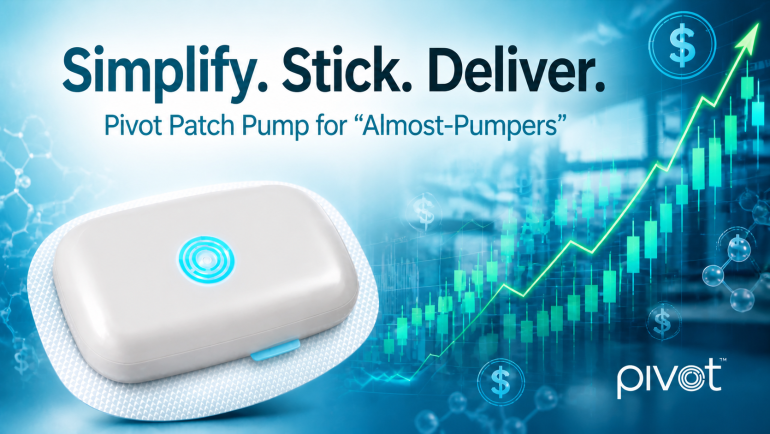
Modular Medical (MODD) has positioned itself squarely in that pragmatic sweet spot, aiming at what management and commentators have described as the large pool of “almost-pumpers” — patients who would like the benefits of insulin pumps but have historically balked at complexity, bulk, and price.

Pivot, Modular Medical’s next-generation tubeless insulin patch pump designed as a removable, two-part system with a three milliliter reservoir. Modular Medical (MODD) recently (April 9) announced FDA 510(k) clearance for Pivot, clearing the path for commercial availability and initial shipments targeted by the end of the second quarter of 2026. With smartphone connectivity for bolus delivery and monitoring, electronic dosing accuracy, and an emphasis on straightforward use, Pivot is tailored for adults who have hesitated to embrace traditional pumps but are equally tired of syringes and regimented injection routines.

When GLP-1s Don’t Finish the Job

The market perception of GLP-1s can sometimes sound like the medication equivalent of a universal remote — one shot to solve every metabolic problem. Yet clinical and real-world data continue to remind investors that many patients will still progress to insulin, will require combination regimens, or will churn off GLP-1 therapy due to cost, tolerability, or personal preference. Hair loss concerns, even if typically reversible, simply add nuance to a landscape where personalization, adherence, and quality-of-life tradeoffs loom large.

That nuance is precisely where a company like Modular Medical (MODD) could thrive. By targeting simplicity over maximal feature sets, the Pivot system as described aims to convert millions of injection-only users into pump therapy by lowering adoption barriers and addressing the everyday friction points that keep patients in “almost-pumper” limbo. In practical terms, that positions Modular Medical (MODD) not as a rival to GLP-1 giants such as Eli Lilly and Company (NYSE:LLY) and its obesity pill Foundayo, but as a complementary player in a world where injectable and oral therapies coexist with increasingly intelligent delivery devices.

A Retail Investor’s Metabolic Checklist

For investors scanning the crosscurrents of GLP-1 enthusiasm and diabetes-tech innovation, a few themes stand out. First, the GLP-1 market is expanding rapidly, but hair loss headlines underscore that even blockbuster mechanisms carry real-world tradeoffs, and adherence remains a long-term question mark. Second, the FDA’s receptiveness to incremental device innovation via the 510(k) route can sharply de-risk timelines for companies that show disciplined engineering and a clear value proposition, as seen in Modular Medical’s (MODD) clearance for Pivot.[

Third, as metabolic care fragments into injections, pills, wearables, and pumps, the “boring” virtues of usability, affordability, and reliability may end up driving more shareholder value than any single buzzword. In that regard, Modular Medical (MODD) offers a case study in how a relatively small device company can surf the same secular tailwinds that power GLP-1 leaders like Eli Lilly (LLY), without needing to win the arms race on efficacy alone. For investors who have watched the GLP-1 wave reshape waistlines, wardrobes, and now, perhaps, hairlines, the emerging device ecosystem may be where the “almost-believers” finally decide to put some capital — and some trust — to work.

The Sources


[1] Bay Area doctor finds link between Ozempic and hair loss – SFGATE https://www.sfgate.com/bayarea/article/ozempic-hair-loss-research-22235173.php
[2] Weight loss pills and GLP-1s: Stitch Fix, apparel retailers may benefit https://www.cnbc.com/2026/04/09/weight-loss-pills-glp-1s-stitch-fix-apparel-retailers.html
[3] Hair Loss Associated With Glucagon-Like Peptide-1 (GLP-1 … – PMC https://pmc.ncbi.nlm.nih.gov/articles/PMC12530271/
[4] How to Treat Hair Loss From GLP-1 Drugs Like Ozempic – Healthline https://www.healthline.com/health-news/glp-1-drugs-may-cause-hair-loss-treatment
[5] Millions of Americans are losing weight with GLP-1s. Here’s … – CNBC https://www.cnbc.com/video/2026/04/09/millions-of-americans-are-losing-weight-with-glp-1s-heres-how-thats-changing-retail.html
[6] Modular Medical Receives FDA 510(k) Clearance for Pivot Tubeless … https://www.biospace.com/press-releases/modular-medical-receives-fda-510k-clearance-for-pivot-tubeless-insulin-patch-pump
[7] Modular Medical wins FDA nod for tubeless insulin patch pump https://www.drugdeliverybusiness.com/modular-medical-fda-clearance-pivot-pump/
[8] MODD Stock Price, News & Analysis | Modular Med https://www.stocktitan.net/overview/MODD/
[9] MODD Stock Price Quote | Morningstar https://www.morningstar.com/stocks/xnas/modd/quote
[10] Modular Medical: MODD Stock Price Quote & News – Robinhood https://robinhood.com/us/en/stocks/MODD/
[11] Modular Medical wins FDA clearance for Pivot pump – Stock Titan https://www.stocktitan.net/news/MODD/modular-medical-receives-fda-510-k-clearance-for-pivot-tubeless-h2yibgu7uc0k.html
[12] How GLP-1s are changing people’s lives in unexpected ways – CNBC https://www.cnbc.com/2026/02/23/how-glp-1s-are-changing-peoples-lives-in-unexpected-ways.html
[13] Eli Lilly GLP-1 pill Foundayo approved for obesity – CNBC https://www.cnbc.com/2026/04/01/eli-lilly-glp-1-pill-foundayo-approved-for-obesity.html
[14] Modular Medical Submits Pivot Tubeless Insulin Patch Pump for … https://finance.yahoo.com/news/modular-medical-submits-pivot-tubeless-140000932.html
[15] The booming GLP-1 space was built on weekly injections. In 2026 … https://www.facebook.com/cnbc/posts/the-booming-glp-1-space-was-built-on-weekly-injections-in-2026-new-obesity-pills/1276129951055062/

May 1, 2026 – AI, Oil, and the Fed Walk Into a Bar: Markets Close the Week Laughing -( $AAPL $CVX $EPRX $INSG $INTC $INTG $NOK $SNDK $SOAR $TSLA $WMT $XOM Rise!)

U.S. equities finished the week ending Friday, May 1, 2026 on a strong note, with the S&P 500 and Nasdaq punching out fresh record highs as mega-cap tech, AI beneficiaries, and a better‑behaved oil tape helped investors look through geopolitical and inflation worries.

Index performance and market tone

  • The S&P 500 closed at a record high around 7,230.12, up a little over .29% on Friday, extending April’s powerful rally and marking the best month for the index since 2020.
  • The Dow Jones Industrial Average pulled back .31% on the day to about 49,499.27, recently helped by cyclicals and strength in select industrial and energy names.
  • The Nasdaq Composite added close to 0.89% to finish at 25,114.44, also at or near a record, powered by ongoing enthusiasm around AI‑linked earnings and a rebound in one of its largest components, Apple (AAPL, $280.14) and up 3.24% after beating earnings expectation on Thursday. SanDisk’s (SNDK, $1,187, +8.25% Friday) latest quarter didn’t just beat expectations; it crashed through them with enough force to make even seasoned chip analysts wonder if they’d accidentally opened a slide deck for Nvidia (NVDA) by mistake. The AI infrastructure party now has more than one headliner, and SanDisk is quickly proving it belongs on the same marquee as the GPU king itself.
  • Volatility stayed contained as futures pointed higher into Friday following Thursday’s broad‑based advance, signaling growing investor comfort with both the macro backdrop and the earnings season narrative.
  • The Small Caps on the Russell 200 added +.46% on Friday and added .93% over the last 5-days pushing it up +13.22% YTD.

Earnings: Apple, energy majors, and the AI complex

  • Apple delivered a key psychological boost: the company reported fiscal Q2 earnings of about 2.01 per share on revenue near 111 billion, topping expectations and sending the stock up roughly 3% in after‑hours and into the next session.
  • The broader “Mag 7”/AI cohort continued to frame the story; strong cloud and AI momentum at mega‑cap platforms helped push the S&P and Nasdaq to new highs as investors leaned back into high‑quality growth.
  • In energy, Exxon Mobil (XOM, $152.75, +2.58% over the last 5-days) and Chevron (CVX, $190.63, +2.93% over the last 5-days) both beat headline earnings expectations despite sizable year‑on‑year profit declines (roughly 45% for Exxon and 36% for Chevron) as last year’s elevated comparison base and conflict‑related disruptions weighed on results. Nevertheless, Chevron traded higher and Exxon modestly firmer as the market looked through the drop in absolute profits and focused on capital discipline, cash returns, and resilience amid shipping delays tied to the U.S.–Iran conflict.

Macro: Fed week, data deluge, and inflation narrative

  • The macro centerpiece was the Federal Open Market Committee meeting on Wednesday, where the Fed held the policy rate steady in the 3.50–3.75% range and maintained guidance for only one potential cut in 2026, even as a growing minority on the Committee is open to no cuts at all.
  • Chair Powell’s messaging stayed focused on sticky but gradually cooling inflation and the need to see more data before easing, with explicit nods to geopolitical risks from the Middle East conflict.
  • A heavy data slate framed that stance: the week featured Consumer Confidence and regional manufacturing gauges early on, followed Thursday by initial jobless claims, the Employment Cost Index, the first Q1 GDP print, and the PCE deflator (the Fed’s preferred inflation gauge).
  • The broad takeaway for markets: growth remains positive, labor conditions are still tight but not overheating, and inflation progress is incremental rather than dramatic—enough to keep hopes alive for a later‑in‑the‑year cut but not enough to force the Fed’s hand in the near term.

Rates, dollar, oil, and geopolitics

  • The 10‑year Treasury yield ended the week around 4.38%, little changed on the day, reflecting a balance between strong risk appetite in equities and a Fed that is still some distance from a full‑fledged easing cycle.
  • The U.S. dollar index drifted modestly lower toward the high‑90s (around 97.9), as risk‑on flows and steady policy expectations sapped some of the safe‑haven bid.
  • Oil prices cooled but reminds unnaturally elevated at $102.50/bbl after a “hot April,” with reports of Iran floating a proposal to help resolve the conflict contributing to a pullback in crude and a modest easing of energy‑driven inflation fears.
  • That geopolitical backdrop—U.S.–Iran tensions that had disrupted some energy shipments and fed into oil volatility—remained on investors’ radar, but the equity market chose to emphasize the prospect of de‑escalation and resilient earnings instead.

Cross‑asset and global context

  • U.S. equities’ strong April capped with the S&P 500 and Nasdaq registering their best monthly performance since 2020, even as markets absorbed an oil shock and persistent geopolitical uncertainty.
  • In Europe, trading was fragmented by the May Day holiday, with the U.K.’s FTSE 100 one of the few major markets open, giving back a fraction of Thursday’s 1.6% gain but still finishing April up about 2%.
  • Euro area focus stayed on the European Central Bank’s path: with inflation having bounced from about 1.9% in February to 2.6% in March, investors eyed the June meeting for potential hawkish surprises, even as the deposit rate remained at 2.0% this week.
  • Across global equities, roughly a quarter to a third of S&P 500 companies had reported Q1 results by this point, with a very high share beating earnings and revenue expectations, reinforcing the “better‑than‑feared” narrative that underpins the current risk rally.

Big‑picture investor takeaway

  • For now, the market is rewarding quality growth and visible cash‑flow stories, treating the combination of steady Fed policy, easing oil prices, and strong earnings as a workable “goldilocks” mix, even if inflation remains above target.
  • The key near‑term risks investors are still discounting include a potential re‑flare in Middle East tensions, any upside surprise in upcoming inflation prints (especially core PCE), and the possibility that the Fed’s “one‑and‑done” 2026 cut guidance slips further toward “none‑and‑done” if the data stay firm..
  • Against that backdrop, dips in cyclicals and selected rate‑sensitive growth remain attractive spots for incremental risk, but the tape continues to favor staying aligned with the leaders of this AI‑driven, earnings‑led advance rather than trying to call a top.

VP Watchlist Updates

Below is an update‑style snapshot on the VP Watchlist names for the week, focused on recent catalysts, positioning, and narrative rather than precise price moves.

FMC Corporation (NYSE: FMC, $14.82)

FMC Corporation (NYSE:FMC) reported (April 29) first quarter 2026 results above guidance with Adjusted EBITDA above high end of range, reaffirms full-year outlook. Their first quarter 2026 revenue of $759 million, down 4 percent versus first quarter 2025. First quarter 2026 revenue, excluding India, was $762 million, down 4 percent versus first quarter 2025, which included India. On a GAAP basis, the company reported a loss of $2.25 per diluted share in the first quarter, a decrease of $2.13 versus first quarter 2025. First quarter adjusted loss per diluted share of $0.23 was down 41 cents versus first quarter 2025. FMC Corporation also announced today that its board of directors declared a regular quarterly dividend of 8 cents per share, payable on July 16, 2026, to shareholders of record as of the close of business on June 30, 2026.

Eupraxia Pharmaceuticals (EPRX, $7.89, +10.20% over the last 5-days)

Eupraxia Pharmaceuticals Inc. (EPRX), a clinical-stage biotechnology company leveraging its proprietary Diffusphere™ technology designed to optimize local, controlled drug delivery for applications with significant unmet need, announced on Friday, May 1, the appointment of Dr. Jeymi Tambiah as Chief Medical Officer (CMO) as well as the retirement of Dr. Mark Kowalski, Eupraxia’s current CMO. Dr. Jeymi Tambiah (MB ChB, FRCS, MS, FAPCR, FFPM), is a Board Certified Cardiothoracic Surgeon physician scientist who practiced at Guys and St Thomas’ Hospitals prior to entering the biopharmaceutical industry in 2008. Dr. Tambiah brings over 18 years of experience in clinical development, medical and regulatory strategy, and product commercialization across pharmaceutical and biotechnology organizations.

Eupraxia announced (April 21) 36-week tissue health and symptom data from patients in the highest dose cohort from its ongoing Phase 1b/2a part of the RESOLVE trial evaluating EP-104GI for the treatment of eosinophilic esophagitis (“EoE”). Dr. James A. Helliwell, Chief Executive Officer of Eupraxia stated, “We are very pleased with the robust and sustained response in both tissue health and symptom data in the highest dose cohort at 36 weeks. This data is consistent with the compelling results we observed at earlier timepoints at this dose level, highlighting the potential to achieve both strong and durable responses after a single administration of EP-104GI. We are also reassured by the excellent safety outcomes across all doses in the trial as we continue to observe no indication of drug related SAEs or spikes in glucose or cortisol. We look forward to the results of the placebo-controlled Phase 2b portion of the study where the same dose is being further evaluated”.

Eupraxia recently co-hosted a Tribe Public www.TribePublic.com, CEO Presentation & Q&A Webinar event, Wednesday, April 1 titled “Turning EOE Into a Once-a-Year Appointment.” The event featured James A. Helliwell, M.D., Co‑founder and CEO of Eupraxia Pharmaceuticals (NASDAQ: EPRX), who discusses the company’s precision drug‑delivery platform, its approach to Eosinophilic Esophagitis (EoE), and broader pipeline priorities, followed by a focused 5–10 minute Q&A. You may watch it now at this Youtube link.

Modular Medical (MODD, $4.14)

  • Modular Medical, Inc. (NASDAQ:MODD), a leader in innovative, patient-centric insulin delivery, today (May 1) saw CEO Jeb Besser join Tribe Public’s members to unpack a simple question with big implications: what happens when an “almost‑pumper” market finally meets an FDA‑cleared device built for the rest of us, not just the superusers? Tribe Public hosted its CEO Presentation and Q&A Webinar, “From FDA Wins to Scaling Manufacturing – What Investors Should Watch,” on Friday, May 1, 2026, at 8:00 a.m. PT / 11:00 a.m. ET. In keeping with Tribe’s reputation for efficient programming, the session ran approximately 30 minutes, pairing a focused prepared talk with a 5–10 minute live Q&A segment that allowed investors to drill into timelines, capital needs, and commercial strategy. Besser’s formal remarks were framed under the title “From FDA Wins to Scaling Manufacturing – What Investors Should Watch,” setting the tone for a discussion that sat at the intersection of regulation, innovation, and recurring‑revenue hardware. By registering, attendees also joined Tribe Public’s membership base, ensuring they will receive future invitations to CEO briefings, sector spotlights, and investor wish‑list events.
  • Modular Medical announced (APRIL 19) the pricing of a registered direct offering consisting of 750,000 shares of the Company’s common stock at an offering price of $4.50 per share. The gross proceeds to the Company from the Offering are estimated to be approximately $3.4 million before deducting placement agent fees and other offering expenses. The Offering is expected to close on or about April 21, 2026, subject to the satisfaction of customary closing conditions.
  • Modular Medical’s latest regulatory milestone upgrades the narrative: the company has now (April 9) secured FDA 510(k) clearance for its Pivot tubeless insulin patch pump, moving from “launch‑ready” to “launch‑approved” in the heart of the fast‑growing diabesity market. The FDA has cleared Modular Medical’s Pivot patch pump as a tubeless, removable insulin delivery system, formally validating the device’s design and performance for commercial use in U.S. adults living with diabetes. The clearance converts what had been a Q1 2026 launch “subject to FDA response” into a tangible commercial pathway, giving the company permission to sell into an insulin pump market that has been estimated at roughly 8 billion dollars globally. Pivot is engineered as a simplified, two‑part patch pump with a 3‑milliliter removable reservoir, no need for battery recharging, and the ability to bolus without a dedicated controller, aiming squarely at patients who have stayed on multiple daily injections because traditional pumps felt too complex, cumbersome, or costly. By clearing Pivot, the FDA is effectively endorsing Modular Medical’s attempt to make advanced insulin delivery feel less like adopting a gadget and more like upgrading a daily habit.

The InterGroup Corporation (INTG, $39.46, +7.87% over the last 5-days)

  • InterGroup Corporation delivered (Feb. 17) a notably stronger quarter, highlighted by a 20% jump in total revenue to $17.3 million and a 27% surge in hotel revenue as renovated rooms returned to service and travel demand improved. The company swung from a prior-year net loss to $1.0 million in net income, with operating income more than doubling to $2.0 million, underscoring better cost control and improved operating efficiency. Management further enhanced liquidity and sharpened strategic focus by selling a non-core 12‑unit Los Angeles multifamily property, generating a meaningful gain and additional working capital while maintaining stable performance across its real estate portfolio.

Volato Group, Inc. (SOAR, +10.59%) & M2i Global, Inc. (MTWO)

  • M2i Global, Inc., a company specializing in the development and execution of a complete global value supply chain for critical minerals, announced (April 28), in connection with the the Agreement and Plan of Merger and Reorganization, dated as of July 28, 2025, by and among M2i Volato Group, Inc. (“Volato”) (NYSE American: SOAR), and Volato Merger Subsidiary, Inc., , that the sole holder of M2i’s Series A Super Voting Preferred Stock, entitled to 10,000 votes per share of voting stock, voted by written consent in favor of the Company’s merger with Volato whereby M2i will become a wholly-owned subsidiary of Volato. At the closing of the merger, the name of Volato will change to M2i Global.
  • Volato Group, Inc. (April 16) announced that it will hold a special meeting of shareholders on May 7, 2026 to vote on the previously announced proposed merger with M2i Global, Inc. (“M2i Global”). Shareholders of record as of the close of business on April 17, 2026 will be entitled to vote at the special meeting. The Company expects the merger to close shortly after the meeting, subject to shareholder approval and the satisfaction of customary closing conditions. Under the terms of the merger agreement, M2i Global will merge with a wholly owned subsidiary of Volato, with M2i Global continuing as the surviving entity and a wholly owned subsidiary of Volato. Upon completion of the transaction, existing M2i Global shareholders are expected to own approximately 85% of the combined company, while Volato shareholders are expected to own approximately 15%, on a fully diluted basis (excluding warrants). The combined company is expected to leverage M2i Global’s capabilities across mining, refining, and recycling of critical minerals alongside Volato’s expertise in software, data systems, and operational execution, creating a scalable, technology-enabled platform focused on strengthening domestic supply chains.
  • Volato Group, Inc. (NYSE American: SOAR) (the “Company” or “Volato”) and M2i Global, Inc. (OTCQB: MTWO) (“M2i Global”) (April 13) announced that the U.S. Securities and Exchange Commission has declared effective the Registration Statement on Form S-4 (File No. 333-292132) relating to Volato’s proposed merger with M2i Global, formally advancing the transaction into its shareholder approval and closing phases. Volato is proceeding with distribution of the definitive proxy statement/prospectus and a special meeting of shareholders is expected to be held on May 7, 2026. Shareholders of record as of April 17, 2026 will be entitled to vote on the proposed transaction.
  • flyExclusive (NYSE American: FLYX), the vertically integrated private aviation company, announced (March 25) two milestones in its proprietary technology development: the filing of a utility patent application for a novel aircraft schedule optimization architecture, and the availability of Contrails, its Flight Management System, to other Part 135 operators beginning in Q2 2026. Both announcements coincide with the company’s presence at the NBAA Schedulers & Dispatchers Conference 2026 in Cleveland. “We have spent years building flyExclusive into one of the most operationally capable private aviation companies in the country. Contrails is how we make that expertise available to the broader industry—and the intellectual property behind it reflects the depth of investment we have made in solving problems that matter to every serious operator. We believe the right technology, built by people who actually run flights, changes what is possible in this industry. Today we are unable to source lift for nearly 300 trip requests per day. We believe Contrails will allow us to address that demand far more efficiently—both within our own operation and through coordination with other operators—and that represents a material revenue opportunity for flyExclusive and for all participating operators.”
  • Volato Group, Inc. announced (March 10) that it has entered into an amendment to its Aircraft Management Services Agreement with flyExclusive, Inc. (“FLYX”) providing for the sale of certain legacy intellectual property assets. The agreement provides for consideration valued at approximately $1.3 million, payable in FLYX Class A common stock, subject to customary conditions. The assets relate to legacy intellectual property developed during earlier stages of the Company’s technology initiatives and are not part of Volato’s current operating platforms. Volato continues to evaluate opportunities to streamline its asset base and focus resources on strategic priorities, including the continued development of its core software platforms and the pending business combination with M2i Global, Inc.
  • On Feb. 4, M2i Global,Inc.along with Volato Group, Inc. announced that Titanium X has initiated its first shipment of titanium ore from Western Australia to the U.S. under its collaboration agreement.

Nokia (NOK, $13.30, +27.15% over the last 5-days)

NVIDIA (NVDA, $198.45)

NVIDIA will host a conference call on Wednesday, May 20, at 2 p.m. PT (5 p.m. ET) to discuss its financial results for the first quarter of fiscal year 2027, which ended April 26, 2026. The call will be webcast live (in listen-only mode) on investor.nvidia.com.

McDonald’s (MCD, $286.64)

  • Morgan Stanley (April 21) has adjusted its price target on McDonald’s (MCD) to $334, maintaining an Equal Weight stance on the stock . The firm’s analyst highlighted consumer strength heading into first-quarter results, noting that earnings quality will likely vary across the restaurant and food distribution landscape . While some operators may face headwinds, the underlying consumer backdrop remains robust, which could support McDonald’s performance as one of the industry’s quality players positioned to navigate the current environment .

Tesla (TSLA, $390.82, +3.86% over the last 5-days)

Reportedly, Tesla recently and unexpectedly swung to positive free cash flow in the first quarter, a neat trick for a company many on Wall Street still expected to be busily torching cash. The electric-vehicle maker has yet to fully open the spending spigots on artificial intelligence and added manufacturing capacity, suggesting the real splurge is still to come.

Reportedly, Ross Gerber of Gerber Kawasaki believes that combining Tesla and SpaceX could create a Berkshire Hathaway–style powerhouse focused on artificial intelligence.

Serina Therapeutics (NYSE: SER, $1.817)

Serina Therapeutics (NYSE: SER) (www.serinatx.com) seems to have have just traded itself into Wall Street’s good graces, pairing fresh capital with a late-session pop that suggests investors are finally starting to connect the dots between polymer chemistry and portfolio returns. In Huntsville, Alabama, Serina Therapeutics announced definitive agreements for a private placement of common stock and pre-funded warrants that could bring in up to 30 million dollars in gross proceeds. The first 15 million dollar tranche is expected to close on March 20, 2026, with a second tranche of up to 15 million dollars anticipated by April 30, 2026, subject to customary closing conditions.

What makes the deal stand out in a biotech tape crowded with discounts is the pricing: the securities are being sold at about 2.25 dollars per share, a roughly 68 percent premium to Serina’s March 17 closing price, signaling that insiders are willing to pay up for exposure to the company’s clinical agenda. The financing also adds board-level heft, with director Greg Bailey, M.D., stepping into a Co-Chairman role as he leads the investment, a move that effectively puts the capital and the governance on the same optimistic page. Learn more here.

Intel (INTC, $99.62, +20.69% over the last 5-days)

FPT and Intel, a global leader in semiconductor and AI technologies, recently announced a strategic relationship to deliver an end-to-end AI-driven factory optimization solution. Powered by AI, simulation, and digital manufacturing technologies, the collaboration aims to reduce bottlenecks, accelerate decision-making and improve downtime recovery, facilitating the sector’s transition towards AI-driven, autonomous operations.

Walmart (WMT, $131.60, +1.29% over the last 5-days)

Walmart’s (WMT) latest move into digital health reads less like a retail side-hustle and more like an opening bell in the next leg of the GLP‑1 trade, with syringes, smartphones, and stock tickers all lining up on aisle 7. 

The Sources

  1. Yahoo Finance – “S&P 500, Nasdaq jump to fresh records as AI trade fuels rally, oil cools” (Stock Market Today, Friday May 1)
    https://finance.yahoo.com/markets/stocks/live/stock-market-today-friday-may-1-records-apple-iran-231056146.htmlfinance.yahoo
  2. CNBC – “S&P 500 closes at a new record to usher in May as oil cools” (Stock Market Today, April 30, 2026)
    https://www.cnbc.com/2026/04/30/stock-market-today-live-updates.htmlcnbc
  3. The Wall Street Journal – “Stock Market Today: S&P 500, Nasdaq Rise to New Highs” (Live coverage, May 1, 2026)
    https://www.wsj.com/livecoverage/stock-market-today-dow-sp-500-nasdaq-05-01-2026wsj
  4. Reuters – “Wall Street ends higher, S&P 500, Nasdaq notch biggest monthly gains since 2020”
    https://www.reuters.com/business/wall-street-futures-mixed-oil-spike-overshadows-tech-earnings-strength-2026-04-30/reuters
  5. Yahoo Finance – “S&P 500 Inches to New Record on Further AI Optimism” (April 27, 2026) – context for AI/mega‑cap strength
    https://finance.yahoo.com/markets/stocks/articles/stock-market-today-april-27-211608019.htmlfinance.yahoo
  6. CNBC – “Stock market news for April 28, 2026” – intra‑week context and global markets color
    https://www.cnbc.com/2026/04/27/stock-market-today-live-updates.htmlcnbc
  7. CNBC – “Stock market news for April 29, 2026” – mid‑week pullback and rate‑sensitive action
    https://www.cnbc.com/2026/04/28/stock-market-today-live-updates.htmlcnbc
  8. Yahoo Finance – “Stock market today: Dow, S&P 500, Nasdaq climb as ‘Magnificent Seven’ earnings buoy hopes for AI boom” (April 30 color)
    https://finance.yahoo.com/markets/stocks/live/stock-market-today-thursday-april-30-dow-nasdaq-sp-mixed-earnings-fed-233115208.htmlfinance.yahoo
  9. Yahoo Finance – Live Markets / U.S. stocks hub (for intraday quotes and background)
    https://finance.yahoo.comfinance.yahoo
  10. WSJ – Live Coverage Archive (for supplemental intraday updates around May 1, 2026)
    https://www.wsj.com/livecoveragewsj

Apollo’s Big Pickleball Bet: When Private Equity Meets America’s Fastest-Growing Sport

In a sign that the “backyard craze” has officially made varsity, Apollo Sports Capital and billionaire investor Tom Dundon are putting a combined $225 million behind Pickleball Inc., the newly formed parent of Major League Pickleball and the PPA Tour. The deal values the integrated pickleball platform at roughly $750 million and lifts total capital raised for the company to about $315 million, giving the sport a balance sheet that now looks less like a hobby and more like a mid-cap growth story.

Pickleball Inc. says its constellation of tours, technology, retail and infrastructure businesses generated more than $140 million in revenue in 2025, suggesting that America’s favorite paddle pastime now throws off real cash, not just social-media likes. For Apollo, this is an early, high-visibility swing for its new sports investment platform; for Dundon, it is the latest chapter in a playbook that already includes ownership of the NHL’s Carolina Hurricanes and the NBA’s Portland Trail Blazers.

Apollo Sports Capital Steps Onto the Court

Apollo Sports Capital is not a vanity side fund; it is the permanent capital sports arm of Apollo Global Management, part of a broader strategy to deploy roughly $6 billion into franchises, leagues, venues, media and events. The platform is designed to favor credit and hybrid structures, pairing flexibility with long-dated capital in a segment where traditional lenders have been more cautious.

Executives at Apollo have described Sports Capital as a vehicle meant to be a “preeminent” investor in global sports, providing patient funding and strategic support to properties that want more than a quick flip. In that context, Pickleball Inc. functions as both a growth asset and a showcase: a rapidly scaling sport where Apollo can help professionalize operations, expand media, and test structures that could later be exported to other leagues and emerging properties.

Building the Largest Pickleball Ecosystem

The investment is paired with a consolidation move that rolls a wide range of pickleball assets under the Pickleball Inc. umbrella, which the company now describes as the largest single pickleball ecosystem in existence. Alongside Major League Pickleball and the PPA Tour, the portfolio includes Pickleball Central, a leading specialty retailer founded in 2006; PickleballTournaments.com, a tournament software platform; and Just Courts, a business focused on court installation and infrastructure.

Management says the goal is nothing less than a fully integrated system that spans professional competition, amateur play, consumer products, technology and media in one platform. In practical terms, pickleball fans can buy gear from the ecosystem, sign up for events on its software, compete on its courts, and watch its stars on its tours—while investors enjoy a vertically stacked revenue model that would make even a seasoned media conglomerate nod in approval.

Tom Dundon’s “Own the Sport” Strategy

For Tom Dundon, this latest capital infusion extends a multi-year campaign to do in pickleball what many owners wish they could do in traditional leagues: effectively own the entire value chain. Dundon previously acquired the PPA Tour, Pickleball Central and PickleballTournaments.com, giving him a head start in knitting together the sport’s pro and amateur sides well before private equity fully woke up to the opportunity.

Dundon’s resume already includes majority control of the Carolina Hurricanes and an ownership stake in the Portland Trail Blazers, experience that brings a Rolodex of national sponsors, media contacts and operational know-how into the pickleball tent. Where other investors see a fun sport with good demographics, Dundon appears to see something more ambitious: a scalable sports entertainment platform built around low-cost participation, high engagement and data-rich digital infrastructure.

From Backyard Fad to Asset Class

The numbers help explain the enthusiasm. The newly merged Pickleball Inc. generated more than $140 million in 2025 revenue, and the latest funding marks the largest single investment ever into the sport. With a post-money valuation of about $750 million, pickleball is now valued like a serious sports-and-media growth asset rather than a quirky side hustle that escaped from the local rec center.

Major League Pickleball leadership has framed the funding as a catalyst to expand content, media rights and infrastructure, signaling that the next phase of growth will likely center on broadcast deals, digital streaming and new event formats. For Apollo and Dundon, that opens the door to the full sports-finance toolkit: sponsorships, data partnerships, naming rights, and possibly new league or team-level capital structures over time.

Why This Deal Matters for Sports Finance

The Apollo–Pickleball Inc. transaction illustrates how emerging sports have become a distinct asset class, attractive for their growth curves and relatively modest entry valuations compared with legacy leagues. Rather than trying to pry small equity slivers out of multibillion‑dollar franchises, investors can shape an entire ecosystem at the sub‑$1 billion level and still enjoy the upside of media, technology and live events.

Apollo’s sports platform, with permanent capital and a mandate to invest across credit and hybrid structures, is particularly suited to this environment. Deals like Pickleball Inc. allow the firm to establish early influence in a fast-growing sport while building a broader origination pipeline that management believes could reach tens of billions of dollars in future sports-related opportunities.

The Next Set: Scaling the Pickleball Platform

With capital in hand and assets under one roof, Pickleball Inc. now faces a different type of test: executing like a scaled sports-and-media company while preserving the accessibility that helped fuel its rise. Management has signaled that new investment will support expanded events, enhanced content and further infrastructure development, ideas that should resonate with both core players and casual fans looking for more ways to engage.

If Apollo and Dundon succeed, pickleball’s story may evolve from “fastest-growing sport in America” to “template for how private capital builds an entire sport from the ground up.” For now, investors appear comfortable with the risk‑reward profile: in a world where valuations for traditional teams have soared into the stratosphere, pickleball offers something rare—a growth sport where the multiples are still catching up to the momentum.

The Sources

  1. CNBC – Apollo Sports Capital, Tom Dundon make $225M pickleball investment
    https://www.cnbc.com/2026/05/01/apollo-sports-capital-tom-dundon-pickleball-investment.htmlcnbc+1
  2. Yahoo/Sports business coverage – Pickleball Inc. gets $225M investment from Apollo Sports Capital, Tom Dundon
    (Use this or a similar syndication/recap article you prefer for diversification.)sports.yahoo
  3. MarketWatch / Morningstar – Pickleball gets its largest-ever investment: $225 million
    https://www.marketwatch.com/story/pickleball-gets-its-largest-ever-investment-225-million-its-still-a-growth-sport-its-not-just-a-fadmorningstar+1
  4. SportsPro – Apollo ready to deploy US$6bn for new sports investment platform
    https://www.sportspro.com/news/finance-investment/apollo-sports-capital-investment-capital-february-2026/sportspro
  5. Apollo Global Management – Apollo Announces Launch of Apollo Sports Capital (official press release)
    https://www.apollo.com/insights-news/pressreleases/2025/09/apollo-announces-launch-of-apollo-sports-capital-3157634apollo+1
  6. Paul, Weiss – Apollo Launches Apollo Sports Capital
    https://www.paulweiss.com/insights/client-news/apollo-launches-apollo-sports-capitalpaulweiss
  7. Front Office Sports – Private Equity Loves Pickleball / How Pickleball Became One Massive Private-Equity Rollup
    https://frontofficesports.com/how-pickleball-became-one-massive-private-equity-rollup/frontofficesports+1
  8. Endurance Sportswire – Pickleball Central Announces a Majority Investment from Dundon Capital Partners
    https://www.endurancesportswire.com/pickleball-central-announces-a-majority-investment-from-dundon-capital-partners-llc/endurancesportswire
  9. Major League Pickleball – team valuation / league growth releases
    Example: Los Angeles Mad Drops Sell Majority Stake at a $13 Million Franchise Valuation
    https://majorleaguepickleball.co/news/major-league-pickleballs-los-angeles-mad-drops-sell-majority-stake-at-a-13-million-franchise-valuationmajorleaguepickleball+1
  10. CNBC – Major League Pickleball looks to add teams, reach profitability
    https://www.cnbc.com/2025/01/28/major-league-pickleball-teams-profitability.htmlcnbc
  11. Wikipedia – Thomas Dundon (background on Dundon, Hurricanes, Trail Blazers, Dundon Capital)
    https://en.wikipedia.org/wiki/Thomas_Dundonwikipedia
  12. TrackItHub Blog – Tom Dundon’s Drop Shot into Pickleball
    https://blog.trackithub.com/tom-dundons-drop-shot-into-pickleball-ppa-and-pickleball-central-purchases-could-lead-to-big-wins/trackithub

Winning in the New FDA Era: Why Modular Medical’s Pivot Could Turn “Almost‑Pumpers” into Believers -( $MODD $PODD )

Tribe Public’s (www.TribePublic.com) latest CEO spotlight managed to condense a multi‑year medtech inflection point into a crisp half hour—and still leave investors wanting a few more slides. On May 1, 2026, Modular Medical (NASDAQ: MODD) CEO Jeb Besser joined Tribe Public’s members to unpack a simple question with big implications: what happens when an “almost‑pumper” market finally meets an FDA‑cleared device built for the rest of us, not just the superusers?

A 30‑Minute Tour Through the New FDA Era

Tribe Public hosted its CEO Presentation and Q&A Webinar, “From FDA Wins to Scaling Manufacturing – What Investors Should Watch,” on Friday, May 1, 2026, at 8:00 a.m. PT / 11:00 a.m. ET. In keeping with Tribe’s reputation for efficient programming, the session ran approximately 30 minutes, pairing a focused prepared talk with a 5–10 minute live Q&A segment that allowed investors to drill into timelines, capital needs, and commercial strategy.

Besser’s formal remarks were framed under the title “From FDA Wins to Scaling Manufacturing – What Investors Should Watch,” setting the tone for a discussion that sat at the intersection of regulation, innovation, and recurring‑revenue hardware. By registering, attendees also joined Tribe Public’s membership base, ensuring they will receive future invitations to CEO briefings, sector spotlights, and investor wish‑list events.

FDA Clearance: From Risk Factor to Revenue Roadmap

The central catalyst for this webinar was Modular Medical’s April 9, 2026 announcement that the U.S. Food and Drug Administration had granted 510(k) clearance for its Pivot tubeless insulin patch pump. Clearance formally opens the door to U.S. commercial sales and, more importantly in Wall Street shorthand, converts a binary regulatory overhang into an execution story centered on manufacturing, adoption, and margin.

For investors who spend their days swimming in risk factors, the Pivot clearance is notable on several fronts. It de‑risks the core product platform, validates the company’s regulatory strategy, and starts the clock on a commercial timeline that targets initial customer shipments by the end of the second quarter of 2026, with European CE Mark ambitions in the late‑2026 to early‑2027 window. In other words, the market has shifted from asking “if” to asking “how fast” and “how profitably” this platform can scale.

Pivot: A Patch Pump Designed for “Almost‑Pumpers”

At the heart of the story is Pivot, billed as the first two‑part tubeless patch pump to pair a removable 3 mL insulin reservoir with a disposable battery and smartphone connectivity for bolus dosing and monitoring. Unlike traditional, tube‑dependent pumps that can leave patients feeling tethered, Pivot’s architecture is deliberately minimalist: no tubing, no recharging regimen, and the ability to detach for showers, sports, or moments when discretion is the better part of glycemic control.biospace+1

Where Pivot really differentiates itself is in its target audience. Modular Medical estimates that roughly 70% of insulin‑dependent adults remain on multiple daily injections—despite 4.8 million individuals in the U.S. requiring daily insulin and only about 20% using pumps—largely because existing devices are viewed as complex, cumbersome, or costly. This “almost‑pumper” cohort is precisely where Pivot is aimed, with a design philosophy that seeks to simplify onboarding, reduce hardware burden, and position the system as an affordable step‑up from syringes, not a lifestyle overhaul reserved for early adopters .

Manufacturing at Scale: From Validation Lots to Real‑World Users

For a company transitioning from development to commercialization, the conversation naturally shifts from lab bench to assembly line. Modular Medical reports that manufacturing validation lots for Pivot are already underway, with initial capacity designed to support approximately 6,000 users and a platform architecture that can scale production while keeping unit costs competitive.

Investors listening to the webinar were particularly attuned to the interplay between capacity, capital, and cadence. Recent corporate actions—ranging from financings and a 1‑for‑30 reverse split to the establishment of a sizeable shelf registration—underscore that management is building both the physical and financial infrastructure to support a commercial ramp, even as the stock has experienced volatility around dilution events. In that context, the Q&A on manufacturing scale‑up was less about whether Modular Medical can make pumps and more about how quickly it can convert factory throughput into recurring revenue.

Software, AID, and the Longer‑Term Technology Stack

While the immediate story is about getting the first wave of Pivot users on therapy, Besser’s narrative also pointed to a layered roadmap on the software side. Ongoing development efforts include features such as variable bolus options, enhanced alarms, and future compatibility with ACE and automated insulin delivery (AID) ecosystems—capabilities that would move Pivot from a novel patch pump into a connected, data‑rich platform.

For healthcare sector oriented investors, this is where the story begins to compound. As software functionality expands, each hardware sale becomes a gateway to deeper integration with clinical workflows, payer expectations, and potential algorithmic partners, reinforcing the subscription‑like dynamics that have made diabetes technology a durable growth theme in healthcare portfolios. In short, Pivot’s first act is hardware, but the franchise value increasingly resides in the code.

Tribe Public’s Role: Curating the “Next” Conversations

The Modular Medical webinar also served as a real‑time illustration of Tribe Public’s model: connecting company management teams with an audience that ranges from family offices and portfolio managers to accredited investors, analysts, and media. Headquartered in San Francisco, Tribe Public curates both virtual and in‑person events across dozens of venues, with agendas frequently shaped by member wish lists that surface the next round of CEOs, sectors, and catalysts the community wants to hear from directly.

By design, these webinar-based sessions are compact: roughly 30 minutes of prepared remarks followed by targeted Q&A, enough to move beyond the press release but not so sprawling that investors need a second cup of coffee to reach the outlook slide. And in the case of Modular Medical (NASDAQ: MODD), the format offered a timely forum to translate a fresh FDA clearance into a more nuanced investor dialogue about manufacturing, market penetration, and the practical realities of serving millions of insulin‑dependent patients who are ready for something better than needles, but not interested in wearing a spaceship on their waistband.

Watch The Tribe Event Video Now

From Sidekick to Co‑Star: SanDisk Quietly Joins Nvidia at the Center of the AI Trade -( $NVDA $SNDK )

SanDisk’s (SNDK) latest quarter didn’t just beat expectations; it crashed through them with enough force to make even seasoned chip analysts wonder if they’d accidentally opened a slide deck for Nvidia (NVDA) by mistake. The AI infrastructure party now has more than one headliner, and SanDisk is quickly proving it belongs on the same marquee as the GPU king itself.

SanDisk and Nvidia: The AI Power Couple

SanDisk has shifted from a “nice-to-have” storage vendor into a central pillar of the AI infrastructure trade, with results that read like a growth investor’s wish list. Revenue has been surging at a breakneck pace, driven by hyperscale data centers racing to build out AI clusters that live and die by access to fast, scalable storage. Net income has expanded even faster than sales, as higher prices for NAND and SSDs finally flow straight through to margins rather than evaporating in the usual pricing wars.

Nvidia, meanwhile, continues to supply the brains of these AI systems—its GPUs remain the must-have silicon for training and running large models—but those GPUs are only as useful as the data you can shovel in and out of them. That’s where SanDisk comes in: its high‑performance SSDs and flash solutions sit directly in the data path, turning Nvidia’s GPUs from impressive hardware into fully utilized revenue engines. In practical terms, every time a hyperscaler commits billions in capex for Nvidia-powered AI clusters, a meaningful slice of that spend eventually flows into the storage stack that SanDisk is now dominating.

From Commodity Storage To AI Royalty

For years, NAND and SSDs were treated as the commodity carbohydrates of the semiconductor world: cheap, plentiful, and almost never the star of the plate. The AI boom has overturned that narrative. AI training clusters and inference farms demand massive, low-latency data pipelines—think petabytes of vector data and training corpora—which are far beyond the scope of traditional enterprise storage footprints. Suddenly, the “just storage” line item has become a strategic bottleneck.

SanDisk sits right at this inflection point. Hyperscalers building Nvidia‑centric clusters need enormous volumes of flash storage pushed ever closer to the GPU layer, not just in bulk capacity but in blistering performance and endurance. The result: tighter supply, firmer pricing, and longer-term agreements as customers prioritize guaranteed delivery over bargain hunting. What used to be a brutally cyclical business now looks, for the moment, like a structurally constrained one, with SanDisk ascending from background player to AI royalty alongside Nvidia at the compute tier.

When The Market Crowns New AI Royalty

The stock market, never shy about falling in love with a good AI story, has responded accordingly. SanDisk’s share price has exploded higher over the past year, posting gains that would look right at home on a chart of early-stage Nvidia’s ascent during the first wave of the AI trade. It has notched outsized returns as investors increasingly view it as a core way to own the storage backbone of AI data centers rather than just another memory cyclical.

That performance has already earned SanDisk a new level of index prominence, with benchmark inclusion pulling in additional passive capital and cementing its status as a go‑to AI infrastructure name. For portfolio managers, the pairing is becoming familiar: Nvidia for compute, SanDisk for storage—two different layers of the same secular story. If Nvidia is the pick-and-shovel leader for AI math, SanDisk is fast becoming the preferred supplier of AI memory and data plumbing.

The AI Storage Chain Reaction

SanDisk’s breakout is also a signal flare for the broader AI storage ecosystem. Peers in hard drives and flash have been enjoying their own renaissance as long‑term contracts, rising utilization, and near‑sold‑out capacity ripple across the sector. With capacity disciplined and AI demand climbing, storage vendors are operating in a far friendlier environment than the old boom-and-bust cycles investors learned to fear.

From a systems perspective, every incremental Nvidia GPU rack introduces a storage multiplier effect. You don’t simply add accelerators; you add entire tiers of flash, object storage, and backup capacity to keep those accelerators fully fed. That’s why research houses increasingly frame NAND and high‑performance SSDs as structural beneficiaries of the AI build-out. In this sense, SanDisk isn’t just riding Nvidia’s coattails; it’s lashed to the same growth engine, with its own operating leverage and pricing dynamics.

Nvidia, SanDisk, And The Investor’s High‑Class Problem

For investors, the dilemma now is less about whether Nvidia and SanDisk are central to the AI story and more about how much future success is already reflected in their valuations. On one side, you have Nvidia, whose GPUs remain the de facto standard for AI workloads, backed by deep software moats and relentless product cycles. On the other, SanDisk is delivering venture-like growth with expanding margins in a segment that used to be dismissed as “commodity memory.”

The high‑class problem is that both stocks have already delivered extraordinary returns. Yet the fundamental backdrop—a multi‑year AI build‑out with rising storage intensity and ever-larger models—argues that this may be less a late-stage blow‑off and more an extended capital-spending regime. If AI is the new industrial revolution, Nvidia is supplying the engines and SanDisk is supplying the fuel tanks, pipelines, and storage yards. For long‑term investors, that pairing may prove less a speculative fling and more a durable core of any serious AI infrastructure allocation.

The Sources

Here’s a clean, SEO‑friendly numbered source list you can use with the story:

  1. Sandisk surges as robust AI demand powers blowout forecast[1]
  2. Is Sandisk Stock the Biggest AI Winner in 2026?[2]
  3. Sandisk Joins Nasdaq 100 As AI NAND Boom Reshapes Investor Landscape[3]
  4. SanDisk Stock’s Breakout Looks Overdone—Unless the AI Boom Lasts[4]
  5. SanDisk and Western Digital are the Real AI Kings of 2026[5]
  6. NAND Flash Memory Market Outlook 2026–2031: AI Training Demand[6]
  7. AI Memory Giant Hits All-Time High Amid Soaring Demand[7]
  8. SanDisk (SNDK), Western Digital (WDC) AI Stocks Get Upgrades[8]
  9. 2026 NAND Flash: AI & HDD Shortage Ignite Price Surge – TrendForce[9]
  10. 3 AI Stocks That Can Beat Nvidia Over the Next Five Years[10]
  11. Western Digital says 2026 HDD capacity 100% sold out, hyperscaler demand soaring[11]
  12. NAND Flash Prices Are Surging in 2026 — What It Means for Your Supply Chain[12]
  13. Sandisk Corporation (SNDK) News Page[13]
  14. A Deep-Dive Research Report on Western Digital (WDC)[14]

Nokia Hands Inseego the Keys to 5G: Why Jim Cramer Thinks This Legacy Giant Is Back Online -( $INSG $NOK ) 

Inseego’s (INSG) planned acquisition of Nokia’s fixed wireless access business is shaping up as one of those rare telecom deals where both sides can plausibly claim they got the better end of the bargain—and the market, at least for now, seems inclined to agree. Layer in Jim Cramer’s very public embrace of Nokia as a “winner” that’s “back,” and you get a story that reads less like a turnaround pitch deck and more like a quietly confident comeback chapter in global connectivity.

Inseego Buys the On‑Ramp to Global Wireless

Inseego is set to acquire Nokia’s Fixed Wireless Access (FWA) customer premises equipment (CPE) business, in a transaction expected to close in the fourth quarter of 2026, pending customary approvals. The deal pulls Nokia’s FWA CPE product lines into Inseego’s portfolio, effectively handing the San Diego‑based company a turnkey on‑ramp to carriers and customers across multiple continents.

Management estimates the acquisition will approximately double Inseego’s revenue and significantly broaden its total addressable market, turning what was once a niche wireless specialist into a global broadband contender almost overnight. In practical terms, that means Inseego is no longer simply selling boxes; it is positioning itself as an end‑to‑end wireless broadband platform spanning fixed wireless, mobile broadband, and cloud‑managed connectivity for both enterprises and consumers.

Nokia Trades Hardware for High‑Margin Optionality

For Nokia, the move is less about surrendering territory and more about trading hardware heft for strategic leverage. Rather than walking away from FWA entirely, Nokia is taking roughly a 7% equity stake in Inseego at closing, plus an additional $10 million investment, bringing its expected ownership to about 11% once the transaction is complete.

The company has already told investors that the agreement is not financially material to its near‑term results, underlining that this is about portfolio focus rather than plugging an income‑statement hole. As Nokia pivots harder toward AI‑driven networking, cloud infrastructure, and high‑performance IP and optical gear, handing the FWA CPE reins to a partner that lives and breathes this niche lets it keep a hand in the upside without the day‑to‑day operational drag.

A Quietly Ambitious 6G and AI Alliance

The most intriguing piece of the announcement is not the asset transfer; it is the forward‑looking partnership roadmap buried in the fine print. Inseego and Nokia plan joint go‑to‑market campaigns and innovation initiatives around 6G and the wireless edge, with an explicit eye toward capitalizing on AI workloads.

In practice, that means the pair will explore carrier 5G and future 6G monetization opportunities, from enterprise edge compute to AI‑enabled customer premises gear, while working to ensure what they call “seamless continuity” for existing customers through the transition. The ambition is straightforward: build a broader global wireless broadband platform, deepen Tier‑1 carrier relationships, and turn the FWA edge into a profit center for data‑hungry AI and cloud applications.

Markets Vote With Their Feet

Investors did not wait for the last footnote to be parsed before making a judgment. Inseego shares rallied after the deal was announced, as traders digested the prospect of a revenue base that could double and a product portfolio suddenly validated by a blue‑chip partner willing to take equity risk. The message from the tape: this is not just another incremental product extension; it is a credible scale‑up event.

On Nokia’s side, the equity stake in Inseego is additive to a broader narrative that has quietly shifted from “former handset champion” to “AI‑age network utility.” The company recently reported a 49% year‑over‑year jump in AI and cloud infrastructure revenue in its first‑quarter 2026 results, with those businesses now representing roughly 8% of sales and more than €1 billion in new AI and cloud orders booked in the quarter. Offloading FWA CPE while retaining exposure through ownership looks less like retreat and more like portfolio optimization.

Jim Cramer’s “Winner” Call Adds Prime‑Time Tailwind

Into this evolving backdrop stepped Jim Cramer, who has put Nokia back in the living rooms—and watchlists—of mainstream investors. On Mad Money, Cramer described Nokia as a “winner” that is “back,” praising investors who stuck with the stock and arguing that the company now has “a lot of good technology.”

In a lightning‑round exchange, he went further, telling one viewer to hold onto their Nokia position because he sees another 30% upside potential from here. For a name that has spent years as shorthand for legacy telecom, hearing a high‑profile growth‑stock cheerleader lean in with that kind of language is no small sentiment shift. It does not change the fundamentals, but it certainly oils the gears of momentum at a moment when the company is leaning hard into AI networking and cloud‑centric infrastructure.

Why This Deal Matters for the Future of Connectivity

Stepping back from the ticker, the Inseego‑Nokia arrangement is a microcosm of where connectivity is headed. As data traffic surges and AI workloads proliferate, the bottleneck is no longer just core data centers; it is the last‑mile and last‑hundred‑feet connectivity that has to deliver low‑latency, high‑reliability bandwidth to homes, offices, factories, and remote sites.

By consolidating Nokia’s FWA CPE under a specialist like Inseego, the ecosystem gets a focused operator incentivized to squeeze every bit of growth out of the installed base and pipeline, while Nokia frees capital and management attention for its higher‑margin AI and cloud network bets. The joint 6G and wireless‑edge roadmap effectively stitches these priorities together, turning today’s asset swap into a potential launchpad for tomorrow’s AI‑ready access infrastructure.

The Sources

  1. Nokia – “Inseego to acquire Nokia’s Fixed Wireless Access business to create a global wireless broadband leader”
    https://www.nokia.com/newsroom/inseego-to-acquire-nokias-fixed-wireless-access-business-to-create-a-global-wireless-broadband-leadernokia
  2. GuruFocus – “Nokia (NOK) Partners with Inseego for Strategic Acquisition”
    https://www.gurufocus.com/news/8831547/nokia-nok-partners-with-inseego-for-strategic-acquisitiongurufocus
  3. ISPreview – “Inseego to Acquire Nokia’s Fixed Wireless Access CPE Broadband Business”
    https://www.ispreview.co.uk/index.php/2026/04/inseego-to-acquire-nokias-fixed-wireless-access-cpe-broadband-business.htmlispreview
  4. Telecompaper – “Inseego to purchase Nokia FWA CPE business as Nokia takes 11% stake in the company”
    https://www.telecompaper.com/news/inseego-to-purchase-nokia-fwa-cpe-business-as-nokia-takes-11-stake-in-the-company–1569701telecompaper
  5. MarketWatch – “Inseego Rallies After Nokia Deal”
    https://www.marketwatch.com/story/inseego-rallies-after-nokia-deal-82c6f846marketwatch
  6. AInvest – “Inseego to acquire Nokia’s FWA business, doubling revenue”
    https://www.ainvest.com/news/inseego-acquire-nokia-fwa-business-doubling-revenue-2604ainvest
  7. QuiverQuant – “Inseego Corp. Announces Acquisition of Nokia’s Fixed Wireless Access Business and Strategic Partnership”
    https://www.quiverquant.com/news/Inseego+Corp.+Announces+Acquisition+of+Nokia’s+Fixed+Wireless+Access+Business+and+Strategic+Partnershipquiverquant
  8. Yahoo Finance – “Jim Cramer on Nokia: ‘I Think It’s a Winner, It’s Back’”
    https://finance.yahoo.com/markets/stocks/articles/jim-cramer-nokia-think-winner-191804313.htmlfinance.yahoo
  9. Benzinga – “This Tech Stock Is A ‘Winner’, Snap Does Not Have Growth” (Cramer on Nokia)
    https://www.benzinga.com/trading-ideas/long-ideas/26/04/52125410/jim-cramer-this-tech-stock-is-a-winner-snap-does-not-have-growthbenzinga
  10. TheStreet – “Cramer turns bullish after surprise comeback in legacy tech stock”
    https://www.thestreet.com/investing/stocks/cramer-turns-bullish-after-surprise-comeback-in-legacy-tech-stockthestreet

Apple’s iPhone Revival: China Calls, Wall Street Answers -( $AAPL $DIA $SPY $QQQ )

Apple’s (AAPL) latest quarter read like a reminder that gravity is optional when your flagship product is still defying the smartphone cycle—powered, this time, by a resurgent China and an iPhone franchise that refuses to act its age. Wall Street got the beat it wanted, and Apple gave just enough upside and forward-looking commentary to keep the “too big to grow” narrative on the back foot—for now.

iPhone: Still the Hero of a Very Long Running Show

The core of the story is familiar, but the numbers remain anything but boring: iPhone once again did the heavy lifting, sitting near 60% of Apple’s total net sales as robust demand for the iPhone 17 lineup ran through the quarter. Estimates heading into the print already called for iPhone revenue to jump more than 20% year over year, and Apple managed to clear that bar, leaning on strong upgrade activity and stable pricing power.

China was the surprise co‑star in this episode, not the risk factor in the fine print. In a market where overall smartphone shipments declined, Apple’s iPhone volumes surged about 20% in China, pushing the company into the No. 2 spot behind Huawei and signaling that premium buyers are still willing to pay up for the ecosystem badge. Promotional activity, online discounts, and local incentives helped, but the end result is the same: more iPhones in more hands—and more services revenue waiting down the road.

For investors who have spent the past two years stress‑testing “peak iPhone” models in spreadsheets, a quarter like this one is the corporate equivalent of a polite eye roll. When a single product can still drive double‑digit revenue growth off a massive base, it starts to look less like a maturing gadget and more like an annuity with a camera upgrade schedule.

China: From Question Mark to Growth Engine (Again)

For several quarters, the China slide in earnings decks looked like the scene where the music slows and everyone checks the exits; this time, it read more like a comeback montage. Greater China revenue is tracking close to 18% year‑over‑year growth, turning a region many had written off as structurally challenged into a meaningful driver of Apple’s top line again.

Under the surface, the dynamics are even more interesting: iPhone sales in China have been described as Apple’s “best iPhone quarter ever” in the region, helped by an 8–20% surge in shipments against a shrinking broader market. That divergence—gaining share while the pie gets smaller—has a way of forcing even the more skeptical analysts to revisit their market‑share models.

Policy tailwinds and consumer subsidies helped put premium smartphones back on shopping lists, and Apple met the moment by pairing aggressive channel promotions with disciplined cost management. Long‑term supply deals—particularly on components like displays and memory—have helped Apple lock in lower input costs than many rivals, keeping margins intact even as it leans more heavily on promotions in price‑sensitive markets.

If there’s a cautionary note, it is that China’s macro backdrop still looks more like a balance‑beam routine than a victory parade, which means Apple will need to keep executing almost flawlessly to maintain this momentum. But for now, the company has taken the “China problem” and turned it into a “China upside surprise,” which tends to trade at a very different multiple.

Wall Street: Bullish, but Still Checking Under the Hood

Heading into the print, expectations were already elevated: consensus called for roughly 14–15% revenue growth in the quarter and EPS in the neighborhood of 1.92–1.95, with more bullish shops penciling in a 2‑handle on earnings per share. Apple’s performance landed in that “better than good enough” zone that Wall Street loves—beating the headline numbers while leaving just enough debate around AI, product cadence, and long‑term growth to keep the research notes flowing.

Price targets have drifted steadily higher into the mid‑ to high‑$200s and low‑$300s, with major banks reiterating overweight and buy ratings on the back of iPhone strength, resilient services growth, and industry‑leading profitability metrics. At the same time, more cautious firms continue to warn of “limited long‑term upside” from here, arguing that even a company with Apple’s track record has to work harder to justify a premium multiple once smartphone and services growth normalize.

In other words, the Street is largely bullish—but not blindly so. Investors will be watching forward commentary on AI initiatives, new hardware categories, and management transition closely, with incoming CEO John Ternus now part of every serious long‑term model. Apple doesn’t need to reinvent itself overnight, but it does need to keep convincing the market that the iPhone era is a launchpad, not a finish line.

Beyond the Quarter: Services, AI, and the Next Narrative

If iPhone is the headline, Services remains the quietly compounding sub‑plot that could steal the show over the next several years. Services revenue is expected to clear $30 billion for the quarter, up from about $26–27 billion a year ago, as the installed base of active devices continues to expand and users spend more across subscriptions, cloud, payments, and media. That kind of high‑margin, recurring revenue tends to make equity analysts reach for words like “resilient” and “durable,” often right before they raise their price targets.

AI, meanwhile, sits in the “show us” bucket rather than the “price it in” column. Apple has telegraphed plans to showcase next‑generation Siri and broader on‑device intelligence features at upcoming developer events, and investors are increasingly framing this as a catalyst for both device upgrades and new services layers. The Street doesn’t need Apple to win the AI arms race on press releases; it just needs the company to demonstrate that its privacy‑centric, hardware‑plus‑software approach can translate into new monetizable experiences at scale.

Layer on top the pending transition from Tim Cook to John Ternus—Apple’s first CEO handoff of the AI era—and you have a narrative mix that is rich enough to keep both the bulls and the skeptics busy for several more quarters. If Cook spent the past decade perfecting the operational symphony behind Apple’s numbers, Ternus will be judged on whether he can orchestrate the next big product crescendos without missing a beat on execution.

What This Quarter Really Signals for Investors

Stepping back, this Q2 does not radically rewrite the Apple story so much as it underlines the parts the market tends to forget between earnings calls. A single product line still commands extraordinary global demand, the company is gaining share in a crucial and volatile market, and high‑margin services are quietly scaling into a business that, on its own, would be the envy of most stand‑alone tech giants.

For long‑term investors, the message is disarmingly straightforward: as long as Apple keeps turning iPhone strength into ecosystem depth—and ecosystem depth into recurring revenue—it remains more compounding machine than mature hardware vendor. The questions that remain around AI, China sustainability, and leadership transition are real, but they are being asked against a backdrop of double‑digit growth, robust cash generation, and a balance sheet that gives management the luxury of time.

If Wall Street does have a complaint this quarter, it is perhaps that Apple continues to make “better than expected” look a bit too routine—and routine, in this corner of the market, is usually the most profitable surprise of all.

The Sources

Here’s a clean, numbered list of useful sources with links you can reference around Apple’s Q2 earnings, iPhone strength, and China performance:cnbc+8

  1. Apple tops Q2 earnings estimates on strong iPhone, China sales – Yahoo Finance
    https://finance.yahoo.com/news/apple-tops-q2-earnings-estimates-on-strong-iphone-china-sales-174442565.htmlfinance.yahoo
  2. Apple beats on Q2 earnings, thanks to China & iPhone sales – Yahoo Finance (video and recap)
    https://finance.yahoo.com/video/apple-beats-on-q2-earnings-thanks-to-china–iphone-sales-204052273.htmlfinance.yahoo
  3. Apple’s Q2 Earnings: Strong iPhone 17 Shipment to Aid Top-Line Growth – Yahoo Finance/Zacks
    https://finance.yahoo.com/markets/stocks/articles/apples-q2-earnings-strong-iphone-170900237.htmlfinance.yahoo
  4. Apple eyes iPhone growth in first earnings report since Tim Cook’s announced exit – CNBC
    https://www.cnbc.com/2026/04/30/apple-aapl-q2-2026-earnings-report.htmlcnbc
  5. Earnings Flash (AAPL): Apple Posts Fiscal Q2 EPS $2.01 vs. FactSet Est. $1.95 – MarketScreener
    https://www.marketscreener.com/news/earnings-flash-aapl-apple-posts-fiscal-q2-eps-2-01-vs-factset-est-of-1-95-ce7f58d8df8ff420marketscreener
  6. Apple’s iPhone revenue jumps to $57 billion despite chip shortages – The Verge
    https://www.theverge.com/tech/921527/apple-iphone-revenue-q2-2026-earningstheverge
  7. Apple gets a stunning boost as smartphone rivals stumble – AOL
    https://www.aol.com/finance/apple-gets-stunning-boost-smartphone-154631339.htmlaol
  8. Apple’s iPhone shipments in China surge 20% in first quarter, data shows – CNBC
    https://www.cnbc.com/2026/04/17/apples-iphone-shipments-in-china-surge-20percent-in-first-quarter-data-shows.htmlcnbc
  9. Record quarter leads to new $100B share buyback, increased dividend – AppleInsider
    https://appleinsider.com/articles/26/04/30/record-quarter-leads-to-new-100b-share-buyback-increased-dividendappleinsider

April 30, 2026 – Stocks Throw a 2020 Reunion Party—And the Dow Brings ~800 New Friends -( $CAT $EPRX $FMC $GOOG $MCD $MODD $MTWO $NOK $SOAR $TSLA Rise!)

US stocks ripped higher on Thursday, capping April with a powerful relief rally that delivered the strongest monthly performance for equities since 2020, as investors cheered resilient growth data, a calmer Treasury market, and Big Tech earnings that were good enough to keep the bull narrative intact. The move came against a backdrop of moderating but still solid GDP growth, sticky services inflation, and a Federal Reserve that has paused further hikes but remains highly data‑dependent, keeping every major macro release market‑moving.

Indexes and sector moves

  • The Dow Jones Industrial Average surged roughly 790 points to close at 49,652.14, putting the blue‑chip gauge on pace for one of its best single sessions of the year and sealing a blockbuster month for cyclicals tied to the US growth story. Today’s move was powered in part by Caterpillar’s (CAT, $890.11, +9.88%) Q1 earnings beat.
  • The S&P 500 notched fresh intraday and closing record highs at 7,209.01, extending this week’s rebound and marking its strongest month since the early post‑pandemic recovery phase in 2020.
  • The Nasdaq Composite also closed at a record at 24,892.31, even as some of the “Magnificent Seven” traded mixed, underscoring how broadening participation beyond mega‑cap tech has been crucial to April’s upside follow‑through.
  • Under the surface, cyclical sectors such as industrials and financials outperformed, while some mega‑cap growth names lagged after a volatile earnings stretch for Alphabet (GOOG, $381.94, +9.97%), Amazon, Microsoft, and Meta.
  • The small caps on the Russell 2000 closed at 2,799.91, +2.21% and is now up +12.81% YTD.

A simple way to frame today: the tape looked less like a narrow AI melt‑up and more like an old‑fashioned “growth is fine, rates are stable, risk back on” session, which is exactly what you want to see if this bull is going to persist.

Macroeconomic backdrop

  • GDP data this week showed the US economy continuing to expand at a solid clip, supporting the soft‑landing narrative and helping investors look through recent volatility in oil and geopolitics.
  • The Federal Reserve held its policy rate in a 3.5%–3.75% range at its latest meeting, in a surprisingly divided 8‑4 decision, reinforcing the idea that the bar for further hikes is high even as officials resist declaring victory on inflation.
  • Fed officials have signaled that future moves will depend heavily on the trajectory of inflation and labor data, leaving the timing of the first cut uncertain and keeping macro prints like PCE, CPI, and payrolls squarely in focus for May.
  • Earlier in the week, markets had to digest rising crude oil prices ($105.55/bbl) and heightened Middle East tensions, but today’s rally suggested investors are increasingly confident that earnings and domestic demand can offset those external shocks—for now.

Put together, the macro mix remains imperfect but investable: growth is slowing from peak levels but not rolling over, inflation is frustrating but no longer accelerating, and monetary policy has shifted from blunt‑force hikes to a more surgical, meeting‑by‑meeting stance.

Earnings and the ‘Mag 7’

  • This week’s flurry of Big Tech earnings has been a key driver of intraday swings, with Microsoft and Alphabet posting strong cloud results, while Meta and Amazon sparked more nuanced reactions around spending, margins, and AI capex.
  • Microsoft beat expectations on the back of ~40% Azure growth, reinforcing the market’s conviction that enterprise AI and cloud remain secular tailwinds even as overall IT budgets normalize.
  • Alphabet’s quarter featured roughly 60%+ growth in cloud revenue, pushing that business above a $20 billion quarterly run‑rate and helping offset investor nerves about ad cyclicality.
  • Meta sold off after guiding 2026 capex sharply higher into the $125–145 billion range, feeding the debate over whether AI infrastructure build‑out is an investment opportunity or an over‑build risk at this stage of the cycle.

For now, the scoreboard favors the bulls: earnings breadth across the S&P 500 remains better than feared, with more than 80% of early reporters beating estimates and aggregate profit growth tracking in the mid‑teens. That backdrop makes it easier for equities to digest a Fed on hold and yields that are no longer collapsing.

Positioning into May

  • With April on track to be the best month for US stocks since 2020, positioning has shifted from underweight to closer to neutral, and the buy‑the‑dip impulse is clearly back in play for many discretionary managers.investopedia+2
  • Key risk catalysts into May include the next wave of macro data (jobs, inflation, and consumer spending), any incremental guidance revisions from AI and cloud leaders, and ongoing geopolitical developments that could spill into energy and FX.team.monetagroup+2
  • From a top‑down lens, investors are watching whether breadth can continue to improve and whether small caps and international equities can finally join US large caps in a sustained way, or if leadership quickly snaps back to a narrow AI‑mega‑cap cohort.heygotrade+1

VP Watchlist Updates

Below is an update‑style snapshot on the VP Watchlist names for the week, focused on recent catalysts, positioning, and narrative rather than precise price moves.

FMC Corporation (NYSE:FMC, $15.38, +4.98%)

FMC Corporation (NYSE:FMC) reported (April 29) first quarter 2026 results above guidance with Adjusted EBITDA above high end of range, reaffirms full-year outlook. Their first quarter 2026 revenue of $759 million, down 4 percent versus first quarter 2025. First quarter 2026 revenue, excluding India, was $762 million, down 4 percent versus first quarter 2025, which included India. On a GAAP basis, the company reported a loss of $2.25 per diluted share in the first quarter, a decrease of $2.13 versus first quarter 2025. First quarter adjusted loss per diluted share of $0.23 was down 41 cents versus first quarter 2025. FMC Corporation also announced today that its board of directors declared a regular quarterly dividend of 8 cents per share, payable on July 16, 2026, to shareholders of record as of the close of business on June 30, 2026.

Eupraxia Pharmaceuticals (EPRX, $7.80, +6.27%)

Eupraxia Pharmaceuticals Inc. (EPRX), a clinical-stage biotechnology company leveraging its proprietary Diffusphere™ technology designed to optimize local, controlled drug delivery for applications with significant unmet need, announced (April 21) 36-week tissue health and symptom data from patients in the highest dose cohort from its ongoing Phase 1b/2a part of the RESOLVE trial evaluating EP-104GI for the treatment of eosinophilic esophagitis (“EoE”). Dr. James A. Helliwell, Chief Executive Officer of Eupraxia stated, “We are very pleased with the robust and sustained response in both tissue health and symptom data in the highest dose cohort at 36 weeks. This data is consistent with the compelling results we observed at earlier timepoints at this dose level, highlighting the potential to achieve both strong and durable responses after a single administration of EP-104GI. We are also reassured by the excellent safety outcomes across all doses in the trial as we continue to observe no indication of drug related SAEs or spikes in glucose or cortisol. We look forward to the results of the placebo-controlled Phase 2b portion of the study where the same dose is being further evaluated”.

Eupraxia recently co-hosted a Tribe Public www.TribePublic.com, CEO Presentation & Q&A Webinar event, Wednesday, April 1 titled “Turning EOE Into a Once-a-Year Appointment.” The event featured James A. Helliwell, M.D., Co‑founder and CEO of Eupraxia Pharmaceuticals (NASDAQ: EPRX), who discusses the company’s precision drug‑delivery platform, its approach to Eosinophilic Esophagitis (EoE), and broader pipeline priorities, followed by a focused 5–10 minute Q&A. You may watch it now at this Youtube link.

Modular Medical (MODD, $4.34., +4.08%)

  • Modular Medical, Inc. (NASDAQ:MODD), a leader in innovative, patient-centric insulin delivery, today announced that Jeb Besser, CEO of Modular Medical, will present at Tribe Public’s Webinar Presentation and Q&A Event titled “From FDA Wins to Scaling Manufacturing – What Investors Should Watch.” The event is scheduled to begin at 8 a.m. pacific / 11 a.m. eastern on Friday, May 1, 2026. To register to join the complimentary event, please visit the Tribe Public LLC at MODD-May-Watch.TribePublic.com.
  • Modular Medical announced (APRIL 19) the pricing of a registered direct offering consisting of 750,000 shares of the Company’s common stock at an offering price of $4.50 per share. The gross proceeds to the Company from the Offering are estimated to be approximately $3.4 million before deducting placement agent fees and other offering expenses. The Offering is expected to close on or about April 21, 2026, subject to the satisfaction of customary closing conditions.
  • Modular Medical’s latest regulatory milestone upgrades the narrative: the company has now secured FDA 510(k) clearance for its Pivot tubeless insulin patch pump, moving from “launch‑ready” to “launch‑approved” in the heart of the fast‑growing diabesity market. The FDA has cleared Modular Medical’s Pivot patch pump as a tubeless, removable insulin delivery system, formally validating the device’s design and performance for commercial use in U.S. adults living with diabetes. The clearance converts what had been a Q1 2026 launch “subject to FDA response” into a tangible commercial pathway, giving the company permission to sell into an insulin pump market that has been estimated at roughly 8 billion dollars globally. Pivot is engineered as a simplified, two‑part patch pump with a 3‑milliliter removable reservoir, no need for battery recharging, and the ability to bolus without a dedicated controller, aiming squarely at patients who have stayed on multiple daily injections because traditional pumps felt too complex, cumbersome, or costly. By clearing Pivot, the FDA is effectively endorsing Modular Medical’s attempt to make advanced insulin delivery feel less like adopting a gadget and more like upgrading a daily habit.

The InterGroup Corporation (INTG, $41.69)

  • InterGroup Corporation delivered (Feb. 17) a notably stronger quarter, highlighted by a 20% jump in total revenue to $17.3 million and a 27% surge in hotel revenue as renovated rooms returned to service and travel demand improved. The company swung from a prior-year net loss to $1.0 million in net income, with operating income more than doubling to $2.0 million, underscoring better cost control and improved operating efficiency. Management further enhanced liquidity and sharpened strategic focus by selling a non-core 12‑unit Los Angeles multifamily property, generating a meaningful gain and additional working capital while maintaining stable performance across its real estate portfolio.

Volato Group, Inc. (SOAR, +4.98%) & M2i Global, Inc. (MTWO, +11.94%)

  • M2i Global, Inc., a company specializing in the development and execution of a complete global value supply chain for critical minerals, announced (April 28), in connection with the the Agreement and Plan of Merger and Reorganization, dated as of July 28, 2025, by and among M2i Volato Group, Inc. (“Volato”) (NYSE American: SOAR), and Volato Merger Subsidiary, Inc., , that the sole holder of M2i’s Series A Super Voting Preferred Stock, entitled to 10,000 votes per share of voting stock, voted by written consent in favor of the Company’s merger with Volato whereby M2i will become a wholly-owned subsidiary of Volato. At the closing of the merger, the name of Volato will change to M2i Global.
  • Volato Group, Inc. (April 16) announced that it will hold a special meeting of shareholders on May 7, 2026 to vote on the previously announced proposed merger with M2i Global, Inc. (“M2i Global”). Shareholders of record as of the close of business on April 17, 2026 will be entitled to vote at the special meeting. The Company expects the merger to close shortly after the meeting, subject to shareholder approval and the satisfaction of customary closing conditions. Under the terms of the merger agreement, M2i Global will merge with a wholly owned subsidiary of Volato, with M2i Global continuing as the surviving entity and a wholly owned subsidiary of Volato. Upon completion of the transaction, existing M2i Global shareholders are expected to own approximately 85% of the combined company, while Volato shareholders are expected to own approximately 15%, on a fully diluted basis (excluding warrants). The combined company is expected to leverage M2i Global’s capabilities across mining, refining, and recycling of critical minerals alongside Volato’s expertise in software, data systems, and operational execution, creating a scalable, technology-enabled platform focused on strengthening domestic supply chains.
  • Volato Group, Inc. (NYSE American: SOAR) (the “Company” or “Volato”) and M2i Global, Inc. (OTCQB: MTWO) (“M2i Global”) (April 13) announced that the U.S. Securities and Exchange Commission has declared effective the Registration Statement on Form S-4 (File No. 333-292132) relating to Volato’s proposed merger with M2i Global, formally advancing the transaction into its shareholder approval and closing phases. Volato is proceeding with distribution of the definitive proxy statement/prospectus and a special meeting of shareholders is expected to be held on May 7, 2026. Shareholders of record as of April 17, 2026 will be entitled to vote on the proposed transaction.
  • flyExclusive (NYSE American: FLYX), the vertically integrated private aviation company, announced (March 25) two milestones in its proprietary technology development: the filing of a utility patent application for a novel aircraft schedule optimization architecture, and the availability of Contrails, its Flight Management System, to other Part 135 operators beginning in Q2 2026. Both announcements coincide with the company’s presence at the NBAA Schedulers & Dispatchers Conference 2026 in Cleveland. “We have spent years building flyExclusive into one of the most operationally capable private aviation companies in the country. Contrails is how we make that expertise available to the broader industry—and the intellectual property behind it reflects the depth of investment we have made in solving problems that matter to every serious operator. We believe the right technology, built by people who actually run flights, changes what is possible in this industry. Today we are unable to source lift for nearly 300 trip requests per day. We believe Contrails will allow us to address that demand far more efficiently—both within our own operation and through coordination with other operators—and that represents a material revenue opportunity for flyExclusive and for all participating operators.”
  • Volato Group, Inc. announced (March 10) that it has entered into an amendment to its Aircraft Management Services Agreement with flyExclusive, Inc. (“FLYX”) providing for the sale of certain legacy intellectual property assets. The agreement provides for consideration valued at approximately $1.3 million, payable in FLYX Class A common stock, subject to customary conditions. The assets relate to legacy intellectual property developed during earlier stages of the Company’s technology initiatives and are not part of Volato’s current operating platforms. Volato continues to evaluate opportunities to streamline its asset base and focus resources on strategic priorities, including the continued development of its core software platforms and the pending business combination with M2i Global, Inc.
  • On Feb. 4, M2i Global,Inc.along with Volato Group, Inc. announced that Titanium X has initiated its first shipment of titanium ore from Western Australia to the U.S. under its collaboration agreement.

NVIDIA (NVDA, $199.57) & Nokia (NOK, $12.91, +3.61%)

  • Nokia just served Wall Street a quietly confident Q1, the kind of quarter that doesn’t light up the meme feeds but does make long-only portfolio managers reach for their notebooks instead of the antacids.
  • In an AI market obsessed with GPUs and stardust, Nokia (NOK) is quietly reminding investors that none of this magic moves without serious plumbing. While Nvidia (NVDA) prepares to headline its GTC 2026 “Woodstock of AI” showcase, the chip giant has already written a very real check to Nokia, committing a $1 billion investment to help rewire the world’s networks for 5G‑Advanced, 6G, and AI‑native workloads. The message is simple enough: GPUs may be the new rock stars, but networking is the stadium.
  • Nvidia delivered strong fourth-quarter results recently, posting revenue of $68.1 billion, well above analyst expectations. Looking ahead, the company projects $7.8 billion in revenue for the first quarter of 2026, reflecting continued robust demand for its AI chips even amid broader market headwinds.
  • NVIDIA and Nebius Group N.V. (NASDAQ: NBIS) (March 11) announced a strategic partnership to develop and deploy the next generation of hyperscale cloud for the AI market, from AI natives to enterprises. NVIDIA will invest $2 billion in Nebius.

McDonald’s (MCD, $293.59, +1.21%)

  • Morgan Stanley (April 21) has adjusted its price target on McDonald’s (MCD) to $334, maintaining an Equal Weight stance on the stock . The firm’s analyst highlighted consumer strength heading into first-quarter results, noting that earnings quality will likely vary across the restaurant and food distribution landscape . While some operators may face headwinds, the underlying consumer backdrop remains robust, which could support McDonald’s performance as one of the industry’s quality players positioned to navigate the current environment .

Tesla (TSLA, $381.63, +2.37%)

Reportedly, Tesla recently and unexpectedly swung to positive free cash flow in the first quarter, a neat trick for a company many on Wall Street still expected to be busily torching cash. The electric-vehicle maker has yet to fully open the spending spigots on artificial intelligence and added manufacturing capacity, suggesting the real splurge is still to come.

Reportedly, Ross Gerber of Gerber Kawasaki believes that combining Tesla and SpaceX could create a Berkshire Hathaway–style powerhouse focused on artificial intelligence.

Serina Therapeutics (NYSE: SER, $1.82)

Serina Therapeutics (NYSE: SER) (www.serinatx.com) seems to have have just traded itself into Wall Street’s good graces, pairing fresh capital with a late-session pop that suggests investors are finally starting to connect the dots between polymer chemistry and portfolio returns. In Huntsville, Alabama, Serina Therapeutics announced definitive agreements for a private placement of common stock and pre-funded warrants that could bring in up to 30 million dollars in gross proceeds. The first 15 million dollar tranche is expected to close on March 20, 2026, with a second tranche of up to 15 million dollars anticipated by April 30, 2026, subject to customary closing conditions.

What makes the deal stand out in a biotech tape crowded with discounts is the pricing: the securities are being sold at about 2.25 dollars per share, a roughly 68 percent premium to Serina’s March 17 closing price, signaling that insiders are willing to pay up for exposure to the company’s clinical agenda. The financing also adds board-level heft, with director Greg Bailey, M.D., stepping into a Co-Chairman role as he leads the investment, a move that effectively puts the capital and the governance on the same optimistic page. Learn more here.

Intel (INTC, $94.48)

FPT and Intel, a global leader in semiconductor and AI technologies, recently announced a strategic relationship to deliver an end-to-end AI-driven factory optimization solution. Powered by AI, simulation, and digital manufacturing technologies, the collaboration aims to reduce bottlenecks, accelerate decision-making and improve downtime recovery, facilitating the sector’s transition towards AI-driven, autonomous operations.

Walmart (WMT, $131.93, +3.06%)

Walmart’s (WMT) latest move into digital health reads less like a retail side-hustle and more like an opening bell in the next leg of the GLP‑1 trade, with syringes, smartphones, and stock tickers all lining up on aisle 7. 

The Sources

Your Guide To Staying Informed In The Markets

Subscribe For Free Email Updates Access To Exclusive Research

Vista Partners — © 2026 — Vista Partners LLC (“Vista”) is a Registered Investment Advisor in the State of California. Vista is not licensed as a broker, broker-dealer, market maker, investment banker, or underwriter in any jurisdiction. By viewing this website and all of its pages, you agree to our terms. Read the full disclaimer here