
The modern FDA approval maze is becoming less a straight corridor and more a high-speed roundabout—and investors riding with Eupraxia Pharmaceuticals (EPRX), Eli Lilly (LLY) and Merck (MRK) may find that’s exactly where outsized opportunity lives.
From Wall Poster to Wall Street
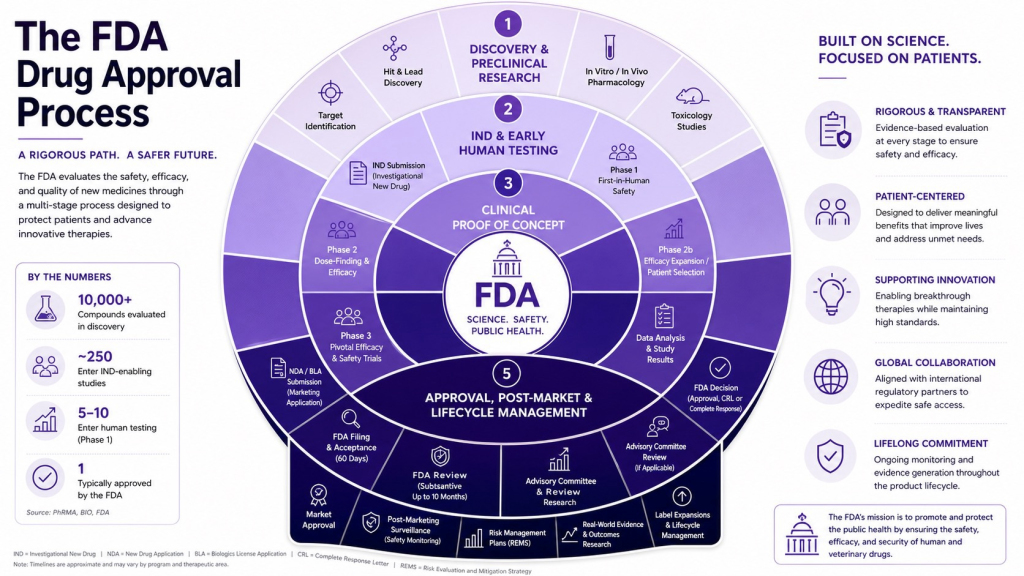
The classic FDA flowchart—discovery, clinical proof of concept, pivotal trials, approval, and post‑market monitoring—looks tidy enough pinned to a clinic wall. In practice, it now resembles air‑traffic control for an industry trying to land first-in-class obesity pills, precision-delivery platforms, and next‑generation cancer drugs on the same runway. For investors, the key isn’t memorizing every acronym on the graphic; it’s understanding how select companies are learning to bend the timeline without breaking the rules.
Eupraxia Pharmaceuticals, Eli Lilly, and Merck each offer a different angle on this new regulatory reality: one rewiring drug delivery, one redefining metabolic disease, and one defending oncology’s high ground. Together, they illustrate how the FDA’s evolving playbook is rewriting the risk‑reward calculus across the sector.
Eupraxia: Turning Old Drugs into New Stories
Eupraxia Pharmaceuticals (NASDAQ: EPRX) follows a different strategy from Eli Lilly and Merck. Rather than competing directly in GLP-1 drugs or oncology, it focuses on improving drug delivery. The company also treats FDA requirements as part of its development strategy.
Its core Diffusphere platform aims to improve how existing drugs reach targeted tissues. It uses controlled, extended-release delivery over longer periods. This approach also aims to limit exposure throughout the body.
The strategy combines familiar medicines with improved delivery methods. This could offer scientific and regulatory advantages. However, each candidate must still meet the FDA’s safety and effectiveness requirements.
FDA Support and Clinical Progress
Eupraxia has already received encouraging regulatory support. Its EP-104IAR candidate targets knee osteoarthritis. The FDA granted it Fast Track designation. This allows more frequent communication with regulators during development.
However, Fast Track does not reduce the approval requirements. Instead, it may help speed up the development and review process. This distinction is particularly important for smaller biotechnology companies. For them, time and development costs can significantly affect their financial outlook.
Meanwhile, Eupraxia is also advancing EP-104GI for eosinophilic esophagitis (EoE). Its Phase 1b/2 results have shown encouraging improvements. These include changes in tissue health and symptoms at 36 weeks. The company has also presented this research at Digestive Disease Week (DDW) in Chicago.
Why Eupraxia Matters to Investors
Eupraxia’s approach offers a different investment opportunity. The company is not relying entirely on developing new or unfamiliar drug compounds. Instead, it combines established pharmacology with formulation engineering.
As a result, its platform could attract interest from larger pharmaceutical companies. These companies may seek ways to improve existing drug pipelines while managing development risks.
However, commercial success will depend on clinical results and regulatory decisions. If Diffusphere demonstrates consistent benefits, it could become an important asset. It may also create partnership or acquisition opportunities for Eupraxia.
Eli Lilly: Fast Track to the Waistline and the Bottom Line
While Eupraxia is taking a long-term approach with controlled drug delivery, Eli Lilly is moving quickly in cardiometabolic disease. Its GLP-1 portfolio has already changed revenue expectations across the pharmaceutical industry. Moreover, its development pipeline suggests further growth opportunities.
One key candidate is orforglipron, Lilly’s once-daily oral GLP-1 drug. The FDA has approved it for obesity and weight-related conditions. This approval followed an expedited review process. The review took roughly 50 days under a new initiative.
A Growing Opportunity in the Obesity Drug Market
Orforglipron represents more than another weight-loss pill. It gives Lilly an opportunity to compete in a market expected to reach approximately $150 billion by 2035. GLP-1 receptor agonists are expected to drive much of this growth.
Clinical trials also showed promising results. At higher doses, participants achieved double-digit percentage weight loss. By comparison, the placebo group recorded only low single-digit declines. These findings could strengthen the drug’s appeal among physicians and healthcare payers.
Meanwhile, Lilly is developing retatrutide as another important candidate. The company sees it as a potential next-generation GLP-1-based therapy. Consequently, Lilly continues to strengthen its position in cardiometabolic disease.
Manufacturing Investment Supports Future Growth
Lilly is also investing heavily to support future demand. Its plans include a multi-billion-dollar manufacturing expansion. This investment will help increase production capacity for next-generation injectable weight-loss treatments.
Such commitments reflect management’s confidence in the market’s long-term potential. They also highlight the importance of regulatory support. However, faster FDA reviews do not guarantee approval for every drug.
For investors, the GLP-1 market signals a changing regulatory environment. The FDA can still present challenges for drug developers. Nevertheless, expedited pathways may help promising treatments reach patients sooner. This is particularly important for public-health priorities such as obesity, diabetes and cardiovascular risk.
Merck: Oncology’s Master Class in Regulatory Endurance
Meanwhile, Merck continues to demonstrate the importance of oncology in pharmaceutical innovation. Although obesity drugs dominate headlines, cancer treatments remain a major focus for regulatory progress.
Merck’s flagship checkpoint inhibitor, KEYTRUDA (pembrolizumab), continues to gain new indications. The company is also reporting important survival data from clinical trials. Recent findings in bladder and ovarian cancers have attracted attention at a major European oncology congress.
Two trials are particularly important: KEYNOTE-905 and KEYNOTE-B96. Their positive survival results have featured in high-profile conference sessions. These developments highlight Merck’s long-term strategy. Rather than relying on a single clinical trial, the company continues to expand KEYTRUDA’s approved uses.
Investing in Next-Generation Cancer Treatments
Alongside KEYTRUDA, Merck is developing new oncology treatments. These include antibody-drug conjugates (ADCs). One notable candidate is raludotatug deruxtecan (R-DXd). It is being investigated for platinum-resistant ovarian cancer.
These programs reflect the changing landscape of FDA oncology approvals. Strong clinical evidence can support important regulatory decisions. In some cases, it may also help accelerate the review process.
The FDA approved dozens of new drugs in 2025. Cancer treatments accounted for a significant share of these approvals. This reflects continued progress in oncology research. It also highlights the importance of compelling clinical results in regulatory decisions.
What This Means for Merck Investors
For Merck shareholders, the company’s regulatory experience offers a potential competitive advantage. Each successful trial can support future development programs. New indications can also create additional revenue opportunities.
Furthermore, every successful launch strengthens Merck’s understanding of regulatory requirements. This experience can help the company navigate future oncology approvals.
In a competitive pharmaceutical market, drug development is only part of the challenge. Clinical timelines, trial endpoints and regulatory decisions also matter. Merck’s accumulated experience could therefore support its future growth in oncology.
The New FDA Playbook: Speed for Those Who Earn It
On paper, the FDA approval process still begins with discovery and early research, winds through Phase 1 safety and Phase 2 proof‑of‑concept, and culminates in pivotal Phase 3 trials before regulators cast their vote. In reality, what’s changing is how that path is paved—through Fast Track and similar designations, pilot programs designed to compress review times, and a growing willingness to accept a single high‑quality pivotal study in certain diseases instead of the traditional two‑trial standard. For companies that can consistently deliver strong data against serious, high‑priority conditions, the regulator is increasingly acting more like a demanding partner than a distant referee.
Eupraxia is navigating that environment by focusing on precision delivery and leveraging designations like Fast Track to punch above its market‑cap weight. Eli Lilly is exploiting it at scale, turning its GLP‑1 engine into a platform for rapid launches and line extensions backed by expedited reviews and extraordinary demand. Merck, for its part, continues to demonstrate that rigorous oncology trials, thoughtfully sequenced and globally executed, can turn the traditional stepwise FDA diagram into a flywheel of recurring approvals.
For investors, the message is straightforward but not simple: the FDA is no longer a monolithic gatekeeper; it’s a dynamic system that rewards the right mix of innovation, safety, and execution. Companies that understand that—and build platforms, pipelines, and trial strategies accordingly—may find that the most valuable asset on their balance sheet is not any single drug, but their ability to navigate the increasingly intricate map hanging on that clinic wall.
The Sources
[1] 2025 FDA approvals – Nature https://www.nature.com/articles/d41573-026-00001-z
[2] Novel Drug Approvals for 2025 | FDA https://www.fda.gov/drugs/novel-drug-approvals-fda/novel-drug-approvals-2025
[3] Eupraxia Pharmaceuticals Reports Positive Nine-Month Tissue … https://www.biospace.com/press-releases/eupraxia-pharmaceuticals-reports-positive-nine-month-tissue-health-and-symptom-data-from-the-highest-dose-cohort-in-its-ongoing-phase-1b-2a-resolve-trial-in-eosinophilic-esophagitis
[4] Eupraxia Pharmaceuticals https://eupraxiapharmaceuticals.com
[5] GLP-1 Pipeline Update: February 2026 – Prime Therapeutics – Portal https://www.primetherapeutics.com/glp-1-pipeline-update-february-2026
[6] Lilly’s Orforglipron, Retatrutide Named as Defining GLP-1 Drugs of … https://www.pharmexec.com/view/eli-lilly-orforglipron-retatrutide-glp-clarivate
[7] FDA Grants Speedy Approval to Eli Lilly’s Oral GLP-1 RA Drug for … https://carolinefifemd.com/2026/04/06/eli-lilly-oral-glp-1-ra-drug-for-obesity/
[8] Merck Advances Oncology Innovation, Highlighting Progress in New … https://www.merck.com/news/merck-advances-oncology-innovation-highlighting-progress-in-new-tumor-types-and-earlier-stages-of-disease-at-esmo-2025/
[9] Eli Lilly Uses GLP 1 Strength To Build Broader Drug Pipeline https://finance.yahoo.com/news/eli-lilly-uses-glp-1-210630652.html
[10] Eupraxia Pharmaceuticals to Present at Digestive Disease https://www.globenewswire.com/news-release/2026/04/22/3278788/0/en/eupraxia-pharmaceuticals-to-present-at-digestive-disease-week-annual-meeting.html
[11] Eupraxia Pharmaceuticals Receives U.S. FDA Fast Track … https://www.linkedin.com/pulse/eupraxia-pharmaceuticals-receives-us-fda
[12] Eupraxia to Present EP-104GI Data at DDW 2026 | EPRX SEC Filing https://www.stocktitan.net/sec-filings/EPRX/6-k-eupraxia-pharmaceuticals-inc-current-report-foreign-issuer-c59848386b1a.html
[13] Eupraxia Pharmaceuticals Receives U.S. FDA Fast Track … https://firstwordpharma.com/story/5750964
[14] The @fda approved 10 cancer drugs in 2025, based on clinical trials … https://www.facebook.com/memorialsloankettering/posts/the-fda-approved-10-cancer-drugs-in-2025-based-on-clinical-trials-in-which-msk-p/1283723167135231/
[15] IMG_9808.jpeg https://ppl-ai-file-upload.s3.amazonaws.com/web/direct-files/attachments/images/24996935/cb0c8d0f-ac5f-478b-86fc-f50961b36e2d/IMG_9808.jpeg?AWSAccessKeyId=ASIA2F3EMEYETJDLPFLC&Signature=rFhUy4Sb5m0bPaJJQlZZxcQqhKs%3D&x-amz-security-token=IQoJb3JpZ2luX2VjEJ3%2F%2F%2F%2F%2F%2F%2F%2F%2F%2FwEaCXVzLWVhc3QtMSJHMEUCIQDxoJG%2BCWewoD61vYlMwRdOUeW2eleqQznLispbOojWXgIgPQH4GaQJXHwbjjDWKCj5K8B%2FjGxHXI6iFdU1VJHlJmEq8wQIZhABGgw2OTk3NTMzMDk3MDUiDA%2Bo0bKMAqcu0CeDcSrQBKWx9JQ5Je8pEXdUTglNz4exZA1aUmft4VdElYabB%2BCGPl%2FB1XzDePDMe0KQrsJvyRJ%2BGroml8aiFSlJTFwaHu073hdCJx9G3j9TAUrMcnezLZv2RO4PgCbPIw1DSBTzgZtaRadIbWoe3STRFWdyOLmfVVdxjdUkOey3omGWvS7V6QqX2OFOFm2SpaQyTFHXYDZSw7fbiyV9Qqib9KCq4E6e03LeBqMBs2ZZ0utThgu6Uxmsey9h%2FD4Syoexb1v3waGz%2BY9pIGOXuSEDUM0Fa9qBJZSac%2B1V2oCREV%2BSvXpqH56LXj4jSGKXrXgKpZSejnG3mKM3aonmFUacYCCQuwYs3na3ouDoOrzQzjWMO1iFLS7%2BhCZ%2FsuRVEGczH5JfZBE7r9YIG8JP%2BpXa%2BVM8M9nAobYTFEGuGsFbZ%2BFhnxwbZIi9I2XXC%2Bq8ck01O%2BbJZSSZcNvpomtxNApPQcOrqszQFkHPBwOIGc6jDUo4vspviz6RY5cv%2FiEV060su%2BpZSS8VoCnFjoDd%2BJTPhHi7eVHIUOdEtQzkso4pYfdklgj%2F7DsIAr8m1Bk8vnTC2GGFZl9nbqWsEvevUb41uqDXy3wtcrkElMwVDlvotjEe0Avo61MXEFgAhVGmkmLJsOJ9Y8dvnSzB4%2FMrmjDjGR%2Fr6OAWbR7OM6ky3UMA%2BVwgT8EvAC1dO%2BcgC6DF69k9kbAO6V%2BMEaAe4SR6TkMBGlxaQCWmIyaMeo5w%2FHrhsG8SaWg3ZO%2BOxD1yMzGl5rDv5Qh5Rn0PNWN2hMlGEn00JlWNS7Ewrs7gzwY6mAHFv1hTVl0d0WaOo838PaBL4n5FdTOjrWX4H5s36r1PxueY1rj244l4uowCp4M6EboAoQ%2BzNnceq%2B26xpxKHJkD2IMJlv2eFw5Cs0hCDaQcnCKOpfbJGIhY%2BO4Fl3xVEQnqc2dj80QL0AfECtJ41DfoFKngLkHZScAVOgxBdSxk9fYlMSRs%2FouF7QKNy3uPAYVfqa183327Wg%3D%3D&Expires=1777872924
[16] Eli Lilly says new GLP-1 weight loss pill could reach market in 2026 https://www.youtube.com/watch?v=T_iLAFHEb9M
Stay Updated with Vista Partners
Subscribe to receive market insights, investing ideas, and the latest updates directly in your inbox.