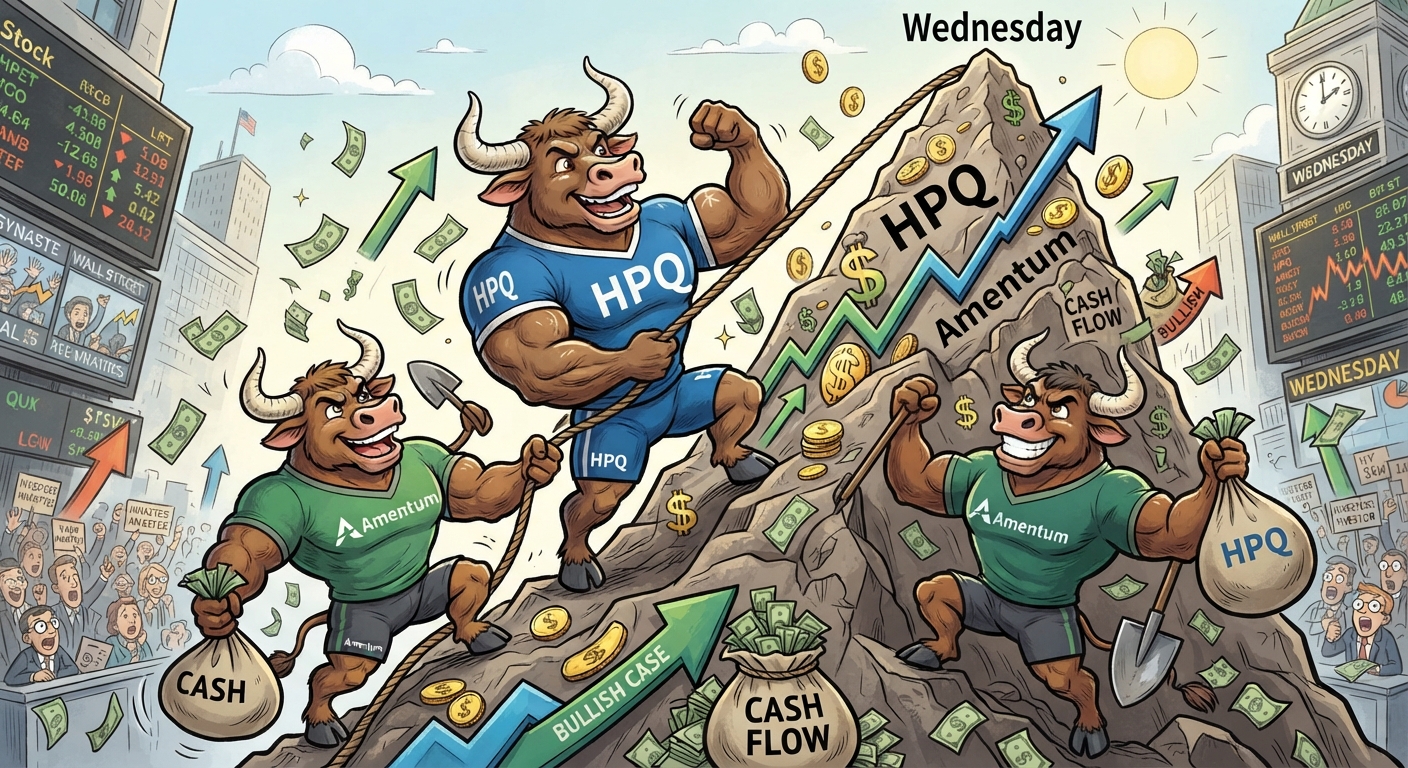
HP’s AI-PC momentum and Amentum’s first $500 million buyback highlight two different routes to a familiar destination: stronger shareholder returns.
Wednesday’s market has offered a useful reminder that companies need not sell the same products to tell a compelling financial story. Sometimes, the common denominator is cash. HP Inc. (NYSE: HPQ) traded at $30.97, up $3.03, or 10.84%, at approximately 11:12 a.m. Eastern on Wednesday, November 25, 2026. Amentum Holdings Inc. (NYSE: AMTM) rose to $25.49, gaining $0.69, or 2.78%, at approximately 11:11 a.m. Eastern. Those are intraday moves, not closing results and on a day the broad market indices are currently and simultaneously sell off. Behind those gains sit two distinct operating stories. HP is pairing renewed revenue growth and rising AI-PC adoption with a higher dividend. Amentum is combining better profitability, debt reduction and a substantial contract backlog with its first share-repurchase authorization. Neither story requires a suspension of financial gravity, a refreshing distinction in any market.
HP Earnings: A $60.5 Billion Business Finds Fresh Momentum
HP’s fiscal 2026 results supply the foundation for a constructive outlook. Annual revenue reached $60.5 billion, increasing 9.5%, while fourth-quarter revenue rose 9.3% to $16.0 billion. Full-year adjusted diluted earnings climbed 6.7% to $3.33 a share. GAAP diluted earnings, however, slipped 1.1% to $2.62, an important distinction when assessing the quality of the improvement.[investor.hp]
The more persuasive evidence comes from cash generation. HP produced approximately $4.0 billion in operating cash flow and $3.3 billion in free cash flow during the year. It returned $2.3 billion through dividends and repurchases, including approximately $1.2 billion spent buying back 46.7 million shares. For many, that combination is the attraction: a large technology franchise generating enough cash to support both business investment and meaningful capital returns. HP also raised its quarterly dividend to $0.31 a share, payable January 6, 2027, to holders of record on December 9, 2026. That represents an increase of approximately 3.3% from $0.30 and an annualized payment of $1.24, assuming the quarterly rate remains unchanged. It is not the sort of announcement that requires theatrical lighting. The cash clears just as well without it.
AI PCs Move From Presentation Slides to Shipment Mix
HP’s most consequential growth opportunity may be the changing composition of the personal-computer market. Interim Chief Executive Bruce Broussard said AI PCs accounted for nearly 60% of shipments in the fourth quarter. Management sees advances in processing and engineering supporting additional device-refresh cycles as more AI functionality moves onto local hardware. That is an opportunity, not a guarantee, but the shipment mix shows that AI-capable machines have become a substantial part of HP’s business rather than a distant product ambition. Commercial demand provides another encouraging signal. Fourth-quarter Personal Systems revenue increased 14% to $11.8 billion, with commercial revenue rising 23%. Consumer revenue declined 7%, underscoring that the business-customer opportunity currently looks stronger than the household upgrade story. The bullish interpretation is straightforward: HP has a large installed customer base, global distribution and an increasingly AI-oriented product mix. If it can translate that position into better profitability, revenue growth could become more valuable to shareholders. The qualification matters. Personal Systems posted a 3.0% operating margin, and total segment unit shipments declined sharply. Rising revenue should therefore not be confused with a broad acceleration in PC volumes.
HP’s Next Test Is Turning Growth Into Better Margins
HP’s results were encouraging, but not immaculate. Fourth-quarter adjusted earnings declined 10.8% to $0.83 a share. Tariff refunds contributed $0.15 a share to the quarter, while full-year adjusted earnings benefited by $0.26 a share. Fourth-quarter free cash flow also fell from the prior-year period. These are material components of the earnings picture, not footnotes to be escorted quietly out of the room. For fiscal 2027, HP projects adjusted diluted earnings of $3.15 to $3.45 a share and free cash flow of $2.9 billion to $3.1 billion. Management’s outlook reflects continuing cost and demand pressures. Comparisons will also require care: beginning in fiscal 2027, HP will exclude stock-based compensation from its non-GAAP results. The company says that change would have increased fiscal 2026 adjusted earnings by a net $0.38 a share. Consequently, the new guidance should not be compared mechanically with the previously reported $3.33 figure. The constructive case rests less on declaring victory today than on HP’s ability to improve margins while sustaining substantial cash generation.
Amentum’s $500 Million Buyback Opens a New Chapter
Amentum’s catalyst is more directly tied to capital allocation. On November 23, its board authorized the company’s first share-repurchase program, allowing purchases of up to $500 million. Chief Executive John Heller said management views the company’s valuation as an attractive opportunity while retaining flexibility for organic growth, acquisitions and balance-sheet management. That authorization is meaningful because it follows measurable financial progress. Amentum finished fiscal 2026 with $583 million in free cash flow, up 13%, and $627 million in operating cash flow. Net debt declined to approximately $3.1 billion, while net leverage fell to 2.7 times. The company made a $287 million voluntary principal payment on its Term Loan B during the fourth quarter. The sequence strengthens the argument. Debt reduction came alongside improving cash generation, and repurchases now give management another option for deploying capital. Still, authorization is not execution. Amentum is not obligated to purchase a particular number of shares, and the program can be suspended, modified or discontinued. Its ultimate value will depend on purchase prices, actual spending and the balance between repurchases and other financial priorities.
Amentum’s Profitability Improves Even as Revenue Faces Friction
Amentum’s annual revenue declined 4% to $13.8 billion, but adjusted diluted earnings increased 13% to $2.51 a share. Adjusted EBITDA rose 3% to approximately $1.13 billion, and the adjusted EBITDA margin expanded to 8.2% from 7.7%. GAAP net income reached $338 million. That divergence is central to the bullish thesis: the company earned more from a smaller reported revenue base. Management attributed the revenue decline to several factors, including the prior year’s extra week, changes in joint-venture consolidation, divestitures and government-shutdown effects. Those explanations provide context, but they do not eliminate the need for renewed growth. Earlier results show the progression. Amentum reported $263 million in adjusted EBITDA in its first fiscal quarter and $275 million in its second. Its third-quarter release reported $135 million in free cash flow and approximately $500 million in bookings associated with NASA’s COSMOS award. These updates help place the year-end cash generation and buyback decision within a broader operating record.
A $48.3 Billion Backlog Gives the Growth Case Substance
Amentum ended fiscal 2026 with $48.3 billion in backlog, up 2.4%, and $6.0 billion in funded backlog, up 8%. Full-year book-to-bill was 1.1 times, meaning net bookings exceeded recognized revenue over the period. The distinction between total and funded backlog is important. The larger figure represents estimated future revenue under negotiated contracts, not cash already collected or a promise that all work will proceed unchanged. The opportunity set nevertheless extends across substantial programs. Recent awards include an $800 million, ten-year National Geospatial-Intelligence Agency contract and a $700 million, five-year Navy training-environment contract. A separate $77 million logistics contract calls for AI-powered supply-chain support in Japan, illustrating how Amentum applies digital capabilities to operational work rather than simply attaching “AI” to the corporate stationery. For fiscal 2027, management projects revenue of $13.8 billion to $14.05 billion, adjusted diluted earnings of $2.50 to $2.70 a share and free cash flow of at least $600 million. That is a measured outlook, but one that supports the possibility of additional financial flexibility.
Why the Cash-Flow Story Deserves Attention
These are not interchangeable businesses, and their risks differ. Amentum’s SEC filings detail exposure to government contracting, funding decisions, contract execution and indebtedness. Its annual and quarterly reports remain essential reading alongside the more upbeat earnings announcements. Its SEC-filed fiscal 2025 release also supplies the historical baseline against which the latest earnings and cash-flow gains should be judged. HP, meanwhile, must demonstrate that AI-PC adoption can deliver better economics despite component-cost pressure and uneven demand. Yet the common attraction is clear. HP offers a substantial cash-generating technology franchise with rising revenue and a higher dividend. Amentum offers improving margins, lower leverage and a newly available repurchase mechanism backed by cash generation. Wednesday’s share-price gains put both names in the spotlight. The more durable bullish argument is what happens after the applause: whether HP converts its product transition into stronger margins, and whether Amentum converts its backlog and financial flexibility into sustained per-share growth. For many, that is a more useful proposition than another promise that profitability will arrive shortly after the next presentation.
The Sources
- HP Inc.: Fiscal 2026 Full-Year and Fourth-Quarter Results and Dividend Increase
- HP Newsroom: Fiscal 2026 Results, Segment Performance and Fiscal 2027 Outlook
- Amentum: First-Ever Share-Repurchase Program Authorizing Up to $500 Million
- Amentum: Fourth-Quarter and Fiscal-Year 2026 Results
- Amentum: Third-Quarter Fiscal 2026 Results
- Amentum: Second-Quarter Fiscal 2026 Results
- Amentum: First-Quarter Fiscal 2026 Results
- Amentum: $77 Million AI-Powered Defense Supply-Chain Logistics Contract
- SEC.gov: Amentum Fiscal 2025 Form 10-K
- SEC.gov: Amentum Form 10-Q for the Quarter Ended April 3, 2026
- SEC.gov: Amentum Fiscal 2025 Results, Exhibit 99.1
Wednesday’s intraday prices and percentage changes were obtained from the connected real-time market-data feed at approximately 11:12 a.m. Eastern.
Stay Updated with Vista Partners
Subscribe to receive market insights, investing ideas, and the latest updates directly in your inbox.