The Fed Debate Is About More Than Interest Rates
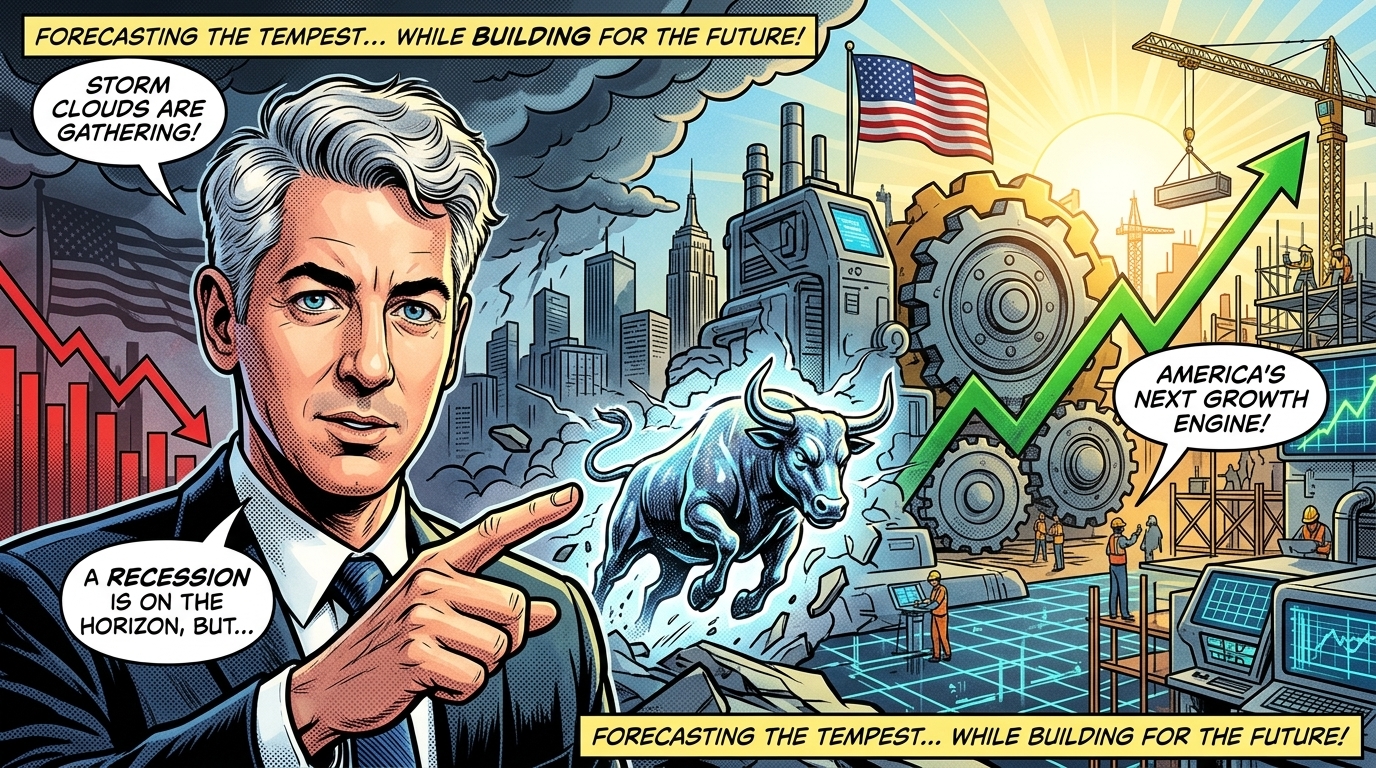
Bill Ackman’s recession warning carries an unexpectedly constructive message for Wall Street: the American economy’s problem may not be a shortage of ambition, but the cost of financing it. The Pershing Square chief argues that the Federal Reserve risks pushing the economy into recession by pursuing its 2% inflation objective too aggressively. His alternative is a more accommodating 3% ambition, reflecting a world of heavier infrastructure spending, geopolitical friction and enormous artificial intelligence investment. That is a policy argument, not an announced change in the Fed’s framework. But it places an important question before many watching the market: how much economic strength should monetary policy restrain while the country builds its next generation of productive capacity?. The bullish answer does not require the Fed to abandon its target. It requires something less dramatic and potentially more durable: inflation easing while business investment, productivity and corporate earnings continue advancing. There is evidence supporting that possibility. The Fed’s October meeting minutes described economic activity as expanding at a strong pace, domestic spending as resilient and unemployment as largely unchanged. That is not a recession declaration. It is an economy presenting central bankers with the professionally inconvenient problem of remaining energetic.
A Recession Warning Is Not a Recession Forecast Written in Stone
The Federal Open Market Committee held its benchmark interest-rate range at 3.75% to 4% in October, with two members preferring a quarter-point increase. Its statement acknowledged elevated inflation while emphasizing the need for additional information. The decision left room for adjustment rather than committing policy to an automatic sequence of increases. There is genuine disagreement beneath that measured language. In a November 10 speech, Governor Christopher Waller said economic activity was strong and the labor market stable, but inflation remained too high. He indicated that he was leaning toward supporting a quarter-point increase in December. In a separate speech that day, Michelle Bowman emphasized the absence of emerging labor-market inflation pressures and projected that core inflation would move closer to 2% next year as shocks faded. For many, that distinction matters more than the daily choreography of rate speculation. A central bank debating the appropriate response to a resilient economy presents a different backdrop from one confronting collapsing demand. The constructive interpretation is conditional but straightforward: if inflation pressures moderate without a substantial deterioration in employment, the economy can keep expanding without needing an emergency monetary rescue.
AI Spending Has Graduated From Presentation Slides to Economic Activity
The strongest foundation for that argument is the scale of actual business investment. Federal Reserve research published in April found that combined capital expenditures at Amazon (NASDAQ: AMZN), Alphabet (NASDAQ: GOOGL, GOOG), Meta Platforms (NASDAQ: META), Microsoft (NASDAQ: MSFT) and Oracle (NYSE: ORCL) reached approximately $412 billion in 2025. The research put that spending at roughly 1.31% of U.S. gross domestic product and noted that the capital-expenditure figures excluded leases. Those figures are not a pure measure of AI spending. The companies also finance other business requirements. Nevertheless, they establish the size of the corporate infrastructure commitment behind the AI expansion. A separate Federal Reserve study published in July found that AI-related investment components contributed meaningfully to quarterly GDP growth from 2025 through the first quarter of 2026, with software and computer equipment among the largest positive contributors. This is where the market story becomes more substantial than another debate about whether a chatbot can write a respectable wedding toast. Companies are purchasing equipment, developing infrastructure and expanding computing capacity. That activity creates current demand while offering the possibility of greater productive capacity later. The bullish thesis rests on that transition from expenditure to economic usefulness, not simply on the expenditure itself.
The SEC Filings Give the Bull Case Some Accounting
Corporate filings provide another reason to distinguish the AI investment cycle from enthusiasm unsupported by commercial results. NVIDIA (NASDAQ: NVDA) reported second-quarter fiscal 2027 revenue of $96.2 billion, an increase of 106% from a year earlier. The quarter ended July 26, 2026. Those results do not settle questions about future growth or valuation, but they demonstrate that spending elsewhere in the technology ecosystem is producing substantial realized revenue for a major supplier. The company’s fiscal 2026 Form 10-K likewise attributed revenue growth to data-center computing and networking platforms for accelerated computing and AI. NVIDIA also reported $6.1 billion in capital expenditures for that fiscal year, compared with $3.4 billion the year before. The spending commitment extends to the buyers of that infrastructure. In a June SEC-filed announcement, Alphabet reiterated that it expected 2026 capital expenditures of $180 billion to $190 billion and anticipated a significant increase in 2027. Those were forward-looking expectations, not completed expenditures, but they illustrated the scale of management’s intended commitment. The distinction is essential. Capital spending is evidence of demand for infrastructure. Revenue is evidence that suppliers are monetizing that demand. Neither, by itself, establishes that every project will earn an attractive return. Still, a growth cycle supported by purchase commitments, financial statements and recognized sales deserves a more serious hearing than one supported principally by adjectives.
Productivity Is the Bullish Bridge Between Spending and Lower Inflation
The most compelling upside scenario is not permanently higher inflation. It is that today’s investment helps businesses produce more efficiently tomorrow. Federal Reserve research published November 20 examined productivity booms and interest rates. The authors described a mechanism in which output expands without a corresponding increase in inflation, while reduced uncertainty about monetary policy supports demand for longer-term bonds. That research is not a promise about AI’s eventual effects, but it provides an economic framework for understanding why stronger growth need not automatically require persistently higher rates. The opportunity is therefore broader than selling more computing hardware. It is whether businesses can convert computing capacity into more output, better service and lower costs per unit. Adoption has room to deepen. An April Federal Reserve study, drawing on Census Bureau survey data, found that approximately 18% of firms had adopted AI by the end of 2025. The figure describes adoption, not proven financial returns, but it suggests that the technology’s business penetration remained far from universal. For many assessing the next phase of the market, that creates a useful distinction: the infrastructure buildout can drive spending before widespread adoption produces measurable productivity benefits. The attractive possibility is that the second phase eventually helps justify the first.
The Bull Case Does Not Need a New Inflation Target
Ackman’s proposed 3% ambition attracts attention because it challenges a central pillar of modern monetary policy. Yet the more practical bullish scenario can operate within the existing framework. The Fed’s September projections placed median PCE inflation at 3.7% in 2026, declining to 2.3% in 2027 and 2.1% in 2028. These were policymakers’ conditional projections, not guarantees, but they showed a contemplated path toward lower inflation over several years rather than an immediate return to target. October’s meeting minutes offered a related explanation. Most participants expected inflation to decline over time as tariff-related effects waned, energy’s contribution diminished and pressures associated with the AI buildout moderated. That is a potentially favorable combination for equities: demand remains sufficiently resilient to support earnings while inflation becomes less troublesome. It also avoids making the investment case dependent on the Fed publicly rewriting its rule book. Central bankers are rarely enthusiastic about announcing that the destination has moved because the journey became uncomfortable.
What Could Interrupt the Expansion?
A credible bullish argument must account for the possibility that inflation stays stubborn. Vice Chair Philip Jefferson warned in November that a stronger policy response would be warranted if inflation expectations risked becoming unanchored. That is the limitation on any argument that the Fed should simply tolerate more inflation: allowing expectations to drift could make price stability harder to restore. The corporate side has its own test. NVIDIA’s annual filing identifies higher interest rates, tighter credit, weaker economic growth and lower business capital expenditures among the risks to its operations. The AI buildout does not suspend the business cycle, and rapid revenue growth does not eliminate financing or execution risk.. For many, the useful scoreboard is therefore not whether every policy speech sounds reassuring. It is whether inflation moderates, employment remains resilient and spending increasingly converts into sustainable earnings.
America’s Growth Story Is Bigger Than the Next Fed Meeting
Ackman’s warning highlights a real danger: monetary policy can become too restrictive for the economy it is trying to stabilize. But the underlying evidence also supports a constructive reading. The Fed has described strong activity and resilient spending. Its researchers have documented meaningful economic contributions from AI-related investment. SEC filings show that major technology companies are committing capital and that important suppliers are recording substantial sales. None of that guarantees rising share prices. It does, however, support a bullish thesis grounded in something more durable than hopes for the next rate cut. America is financing a major expansion in computing capacity while working through an inflation problem. If that investment produces stronger productivity and commercially useful applications, the economy could gain room to grow without generating an equivalent increase in price pressure. For many, that is the opportunity worth watching: not an economy rescued from having nothing to do, but one learning how to profit from everything it is building.
The Sources
- Bill Ackman’s recession warning and inflation-target argument, supplied article
- Federal Reserve: October 2026 FOMC meeting minutes
- Federal Reserve: October 28, 2026, monetary-policy statement
- Federal Reserve: Christopher Waller’s November 10, 2026, economic-outlook speech
- Federal Reserve: Michelle Bowman’s November 10, 2026, economic and monetary-policy speech
- Federal Reserve: Monitoring AI Adoption in the U.S. Economy
- Federal Reserve: Monitoring AI Adoption, accessible capital-expenditure data
- Federal Reserve: The AI Buildout and the Economy
- SEC.gov: NVIDIA second-quarter fiscal 2027 earnings release
- SEC.gov: NVIDIA fiscal 2026 Form 10-K
- SEC.gov: Alphabet June 1, 2026, financing announcement and capital-expenditure expectations
- Federal Reserve: When Productivity Booms, Do Interest Rates Rise?
- Federal Reserve: September 2026 Summary of Economic Projections
- Federal Reserve: Philip Jefferson’s November 19, 2026, speech on economic shocks
Stay Updated with Vista Partners
Subscribe to receive market insights, investing ideas, and the latest updates directly in your inbox.