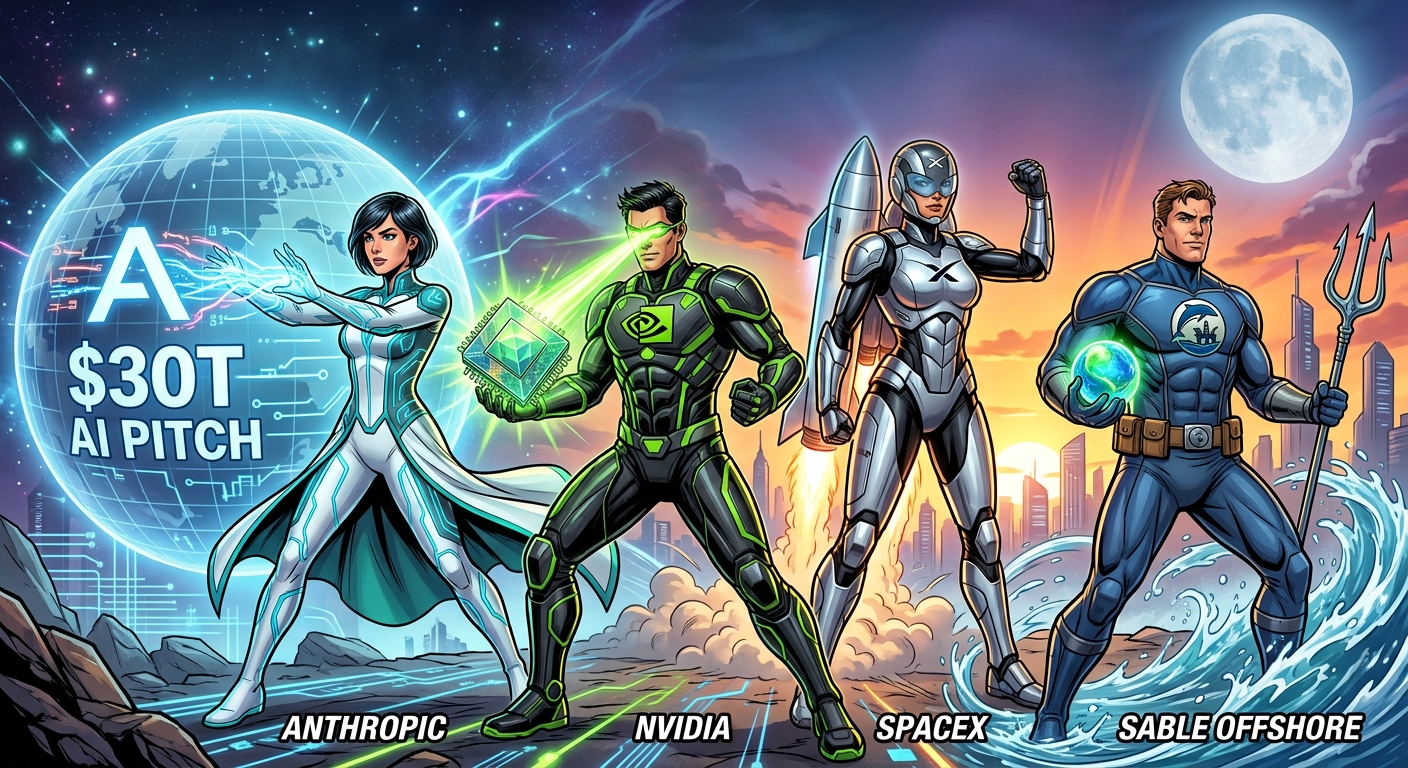
Wall Street’s current mood is not quite euphoric, “sticky” inflation has a way of removing the champagne from the conference room, but it is becoming notably more constructive. The most compelling development is not simply another rally in technology; it is the emergence of several investable growth lanes at once: artificial intelligence, a reopening IPO market, enterprise infrastructure, and a domestic-energy production story with tangible operating leverage. The result is a market that may be learning an old but useful lesson: innovation does not need to arrive in a straight line to create value. It merely needs customers, capital and a sufficiently impatient competitor set.
Anthropic’s Ambition Signals AI’s Economic Scale
Anthropic (ANTH.PVT) , the creator of Claude, has reportedly filed confidentially for a potential IPO and may present investors with a revenue-opportunity estimate exceeding $30 trillion. That number is deliberately enormous and, on first hearing, has the subtlety of arriving at a dinner party in a rocket ship. Yet the strategic logic is more grounded than the headline suggests. The addressable market is not merely chatbot subscriptions. AI is increasingly aimed at enterprise productivity, software development, research, customer support, cybersecurity, workflow automation and the creation of new digital products. The important question for investors is not whether a single company can collect $30 trillion in revenue. It plainly cannot. The question is whether AI can reshape a meaningful portion of the world’s labor, software and information-services spending. That possibility is now difficult to dismiss. Anthropic’s reported revenue trajectory illustrates why public-market interest could be intense: its annualized revenue run rate was cited at roughly $65 billion, compared with $9 billion in the prior year. If sustained, that growth would put the company among the rare businesses entering public markets with both narrative power and visible commercial adoption. The company remains private, so investors should treat any prospective valuation and IPO timetable as uncertain, but the broader takeaway is bullish: AI demand is moving from laboratory spectacle toward recurring enterprise budgets. For listed companies, the read-through extends across the AI stack:
- NVIDIA Corp. (NASDAQ: NVDA) remains central to accelerated computing demand, even as investors scrutinize whether customers are converting major AI capital expenditures into adequate returns.
- Meta Platforms Inc. (NASDAQ: META) represents the consumer and advertising side of AI monetization, pairing enormous distribution with substantial infrastructure investment.
- Synopsys Inc. (NASDAQ: SNPS), CrowdStrike Holdings Inc. (NASDAQ: CRWD), Veeva Systems Inc. (NYSE: VEEV), Okta Inc. (NASDAQ: OKTA) and Nutanix Inc. (NASDAQ: NTNX) illustrate the broader software, security and enterprise-infrastructure ecosystem where AI adoption can become embedded in day-to-day operations.
The IPO Window Is Becoming a Capital-Market Tailwind
A healthy IPO market matters far beyond the companies ringing the bell. It provides late-stage private businesses a path to liquidity, gives venture investors a reason to fund the next crop of innovators, and encourages public-market investors to think beyond the same familiar mega-cap roster. The U.S. IPO market has already shown a sharp revival. Traditional IPOs raised approximately $114.1 billion in the second quarter, compared with $14.8 billion in the same period a year earlier, according to PwC figures cited by Yahoo Finance. In the first half, 65 traditional IPOs raised about $114.2 billion, versus 34 offerings raising $14.8 billion in the first half of 2025. The debut of SpaceX (NASDAQ: SPCX) has become a reference point for how a major frontier-technology listing can rearrange investor attention. Destiny Family Office founder Tom Ruggie argues that a successful offering of that size may influence portfolio allocations across ETFs, mutual funds, pensions and sovereign wealth funds, while also making the public route more appealing for large private technology companies. He specifically identified companies such as Stripe and Databricks, both private, as businesses investors may watch as the IPO environment develops. That is constructive for listed investors because a stronger issuance market does two things simultaneously:
- It expands the opportunity set in artificial intelligence, aerospace, biotechnology and infrastructure.
- It forces investors to become more discerning about valuation, fundamentals and post-IPO execution—an underrated virtue in any bull market.
SpaceX (SPCX) may be the marquee attraction, but the larger point is that capital markets are again willing to finance scale. That is a favorable backdrop for companies capable of turning technological ambition into revenues, cash flow and, eventually, earnings that require no interpretive dance.
NVIDIA Remains the AI Economy’s Quarterly Report Card
NVIDIA (NVDA) continues to function as the market’s de facto AI barometer. Its earnings report has become a referendum not just on graphics processors, but on the durability of hyperscaler and enterprise AI spending. The more interesting underappreciated element is networking. NVIDIA’s networking operation generated nearly $15 billion in the prior quarter, up from approximately $3 billion per quarter two years earlier, with Wall Street expecting the figure to approach $17 billion. Compute remains the larger data-center business, but networking has been growing faster, a reminder that AI infrastructure is a system build, not just a chip purchase. This would seem to suggest a more resilient AI thesis than the narrow “GPU-only” framing. Data centers need processors, networks, power, cooling, security, software and increasingly complex orchestration. Even when one segment pauses, the buildout can shift toward adjacent bottlenecks. The central risk, of course, is that valuation expectations are already elevated. But elevated expectations are not the same as exhausted opportunity. If spending remains tied to rising workloads, recurring software demand and measurable productivity gains, the AI cycle has room to mature into a multiyear capital-investment phase rather than a one-season market fashion.
Sable Offshore Offers a Different Kind of Growth Engine
Not every bullish story requires a data center. Sable Offshore Corp. (NYSE: SOC) offers an operational turnaround and production-ramp narrative tied to the Santa Ynez Unit offshore California. In its second-quarter 2026 report, Sable said it generated $137.1 million of revenue and $9.4 million of positive operating cash flow—its first full quarter of revenue generation and positive operating cash flow since inception. The company reported average daily net sales volumes of roughly 21,000 barrels of oil per day during the quarter and exited it at approximately 40,000 net barrels per day, a 149% entry-to-exit growth rate.
The bullish case for SOC rests on execution rather than mystery:
- Production ramped as more wells returned online, with the company expecting to bring all 77 production wells on the Harmony and Heritage platforms online during the third quarter.
- Platform Hondo was expected to restart in September, alongside planned well-optimization activity.
- Management reduced the midpoint of second-half capital-expenditure guidance by 41% to $85 million, aiming to optimize cash flow and accelerate debt amortization.
- A commodity hedging program includes Brent price floors of $65 per barrel, providing some downside protection while preserving exposure to higher oil prices within the collar structure.
- Sable’s recent Form 8-K describes a significant federal-court ruling involving the Santa Ynez Pipeline System, or SYPS. The U.S. District Court for the Central District of California modified a 2020 consent decree, replacing California’s Office of the State Fire Marshal with the federal Pipeline and Hazardous Materials Safety Administration, or PHMSA, as the regulator overseeing pipeline operations under that decree. The court found that Sable had restarted segments of the system without prior OSFM authorization and imposed a $1.449 million penalty. Crucially, it declined California’s request to shut down the onshore pipeline segments, finding that Sable was no longer in violation because PHMSA had approved the company’s Restart Plan. That is the legal distinction investors should focus on. A penalty can be modeled. A court-ordered operational shutdown could have threatened the entire recovery thesis. In a special-situations stock, the difference between those two outcomes is roughly the difference between a speed bump and a drawbridge.
The caveat is substantial: Sable faces midstream constraints, California regulatory complexity, a high-cost debt structure and exposure to commodity-price volatility. Still, the company’s pathway from restart to rising sales volumes, improved infrastructure utilization and potential cash-flow expansion is plainly visible. In a market captivated by algorithms, barrels remain refreshingly legible.
A Bull Market With More Than One Engine
The day’s market action shows why selectivity remains necessary. Core PCE inflation rose 3.3% year over year in July, matching expectations but keeping the Federal Reserve and bond market very much in the conversation. Major indexes slipped modestly as investors awaited NVIDIA’s results, while Abercrombie & Fitch Co. (NYSE: ANF) surged after reporting stronger-than-expected second-quarter results and raising full-year guidance. That combination is constructive, not contradictory. It shows that many are still rewarding execution, whether it comes from AI infrastructure, consumer demand, new public offerings or a returning oil field.
The investor-magnetic setup is therefore broader than a single trade:
- AI leaders such as NVIDIA (NVDA) can benefit from accelerating compute and networking demand.
- Platform companies such as Meta Platforms (META) may find new ways to monetize AI across enormous installed user bases.
- The return of landmark offerings, including SpaceX (SPCX) and a potential Anthropic IPO, could re-energize public-market participation in frontier technology.
- Operational growth stories such as Sable Offshore (SOC) offer differentiated exposure to domestic energy production and cash-flow inflection.
A market does not need perfect inflation, frictionless regulation or universally cheap valuations to advance. It needs earnings growth, investable innovation and enough evidence that capital is finding productive homes. On those measures, the bull case is acquiring more texture—and perhaps even a little better posture.
The Sources
- Yahoo Finance Why Anthropic’s $30 trillion sales pitch ahead of its IPO could make sense
- Yahoo Finance Destiny Family Office Founder Tom Ruggie Examines What the SpaceX IPO Means for Investors
- Yahoo Finance Stock market today: Dow, S&P 500, Nasdaq slip as PCE inflation stays sticky, Nvidia earnings loom
- Yahoo Finance Sable Offshore Corp. Reports Second Quarter 2026 Financial and Operational Results
- Reuters Anthropic expected to tell investors it sees over $30 trillion in potential revenue, Wall Street Journal reports
- Reuters Anthropic IPO valuation hinges on $190 billion to $200 billion 2028 revenue forecast, sources say
- Reuters Nvidia faces growth test as Rubin debut meets AI financing scrutiny
- Reuters Nvidia shares set for $280 billion price swing after earnings, options show
- Reuters AMD’s AI-powered revenue forecast fails to wow investors
- Sable Offshore Corp. Second Quarter 2026 Financial and Operational Results
- Sable Offshore Corp. Second Quarter 2026 Earnings Conference Call Announcement
- Investing.com Earnings Call Transcript: Sable Offshore posts Q2 2026 miss as shares fall
Stay Updated with Vista Partners
Subscribe to receive market insights, investing ideas, and the latest updates directly in your inbox.